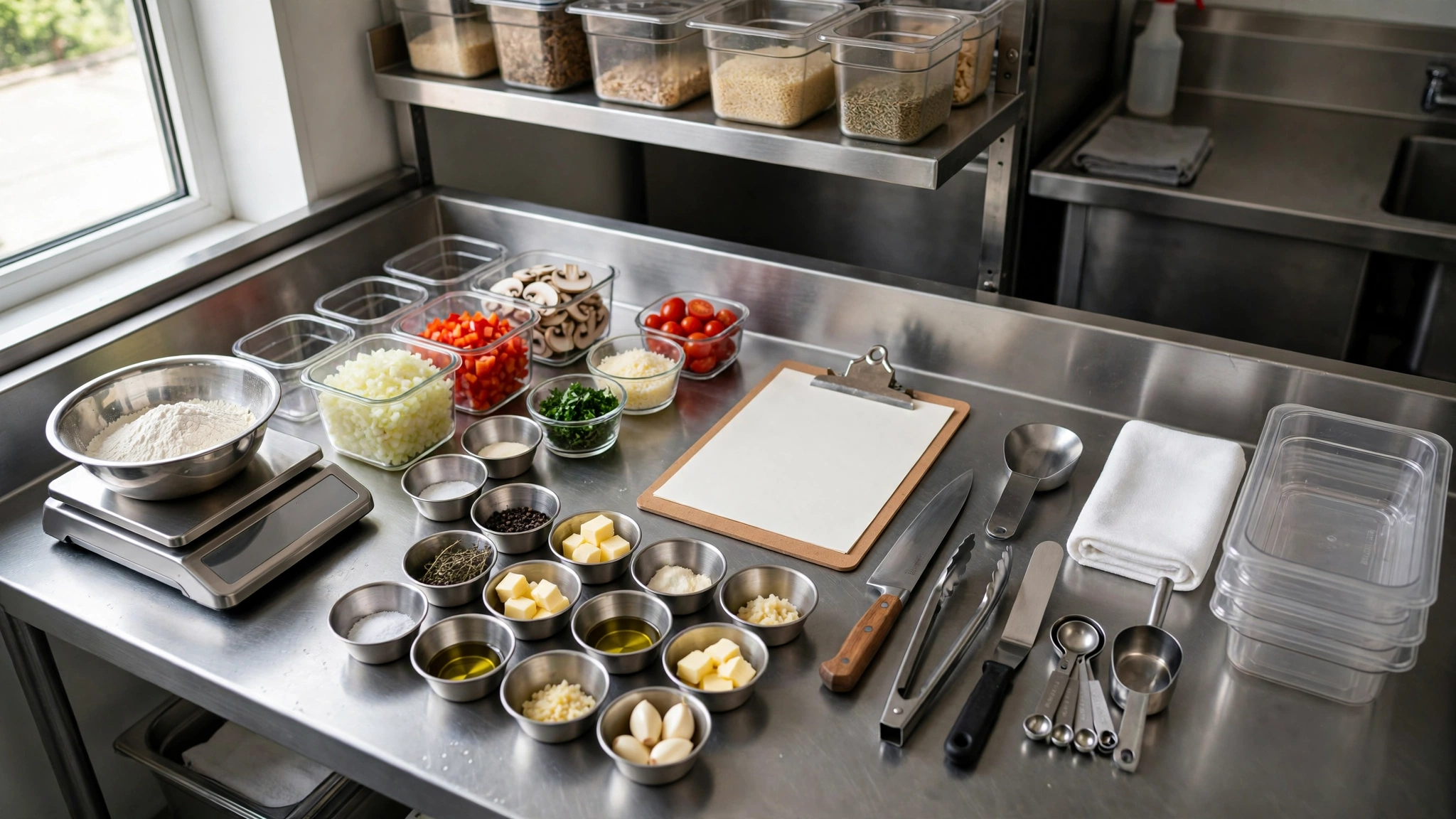
A bakery can sell out and still underprice its best-looking products. The problem is usually not the selling price itself; it is the costing underneath it. Flour, butter and chocolate are easy to remember. Small ingredients, decoration time, packaging, failed batches and labor are much easier to miss.
The most useful way to price bakery products is to cost the whole batch first, then divide that cost by the number of saleable units the batch actually produces. From there, you can decide what selling price makes sense for your operation and market.
Why bakery costing is different from simple ingredient math
A bakery product often carries costs that do not show up on the recipe card. A cake may need a board, box, piping bag, label and decoration time. A pastry batch may lose some units during proofing or baking. A tray of brownies may produce 24 theoretical portions but only 20 portions that meet your selling standard.
That is why a strong bakery costing sheet should answer three questions:
- What does the full batch cost to produce?
- How many saleable units does the batch really produce?
- What contribution does each unit need to make after direct cost?
Start with a standardized batch recipe
Before calculating cost, make sure the recipe itself is stable. If one baker uses 1.8 kg of flour and another uses 2.1 kg for the same batch, your cost per unit will move every time.
Your batch sheet should show:
- ingredient name,
- quantity used,
- purchase unit,
- purchase cost,
- recipe unit cost,
- expected batch yield.
If your recipes are not standardized yet, fix that first. Our guide on standardizing recipes for cost and consistency explains the operating side of that process.
A practical bakery costing example
Take a simple example: a bakery makes one batch of 10-inch chocolate cakes. The numbers below are illustrative only, but the method is the important part.
| Ingredient or item | Batch cost |
|---|---|
| Flour | $4.20 |
| Sugar | $3.10 |
| Eggs | $6.40 |
| Butter / oil | $7.80 |
| Cocoa / chocolate | $10.50 |
| Dairy and flavoring | $4.60 |
| Frosting ingredients | $8.40 |
| Decoration | $3.50 |
| Boards and boxes | $5.00 |
Total direct ingredient and packaging cost for the batch is $53.50.
If the batch produces five saleable cakes, the direct material cost per cake is:
$53.50 ÷ 5 = $10.70 per cake
That number is useful, but it is not yet the full product cost.
Add production labor where it matters
Bakery items can be deceptively labor-heavy. A product may use inexpensive ingredients but require significant mixing, shaping, decorating or finishing time.
For costing purposes, separate:
- active production time,
- decoration / finishing time,
- packing time where meaningful.
Do not automatically cost every minute of proofing, chilling or baking as active labor if the employee is working on other products during that time. What matters is the labor that the product actually consumes.
Suppose the five-cake batch needs:
- 1.5 hours of preparation and baking work,
- 1.25 hours of finishing and decoration,
- 0.25 hours of packing.
That is 3.0 active labor hours. If the relevant labor cost is $18 per hour, direct labor for the batch is:
3 × $18 = $54
Now the direct batch cost becomes:
$53.50 materials + $54 labor = $107.50
At five saleable cakes, the direct cost is:
$107.50 ÷ 5 = $21.50 per cake
Use saleable yield, not theoretical yield
This is one of the most important bakery costing habits.
If a dough formula theoretically gives 30 pastries but your team normally sells only 27 because three are misshapen, overbaked or damaged, then pricing from 30 units understates the real cost.
Use the yield you can reliably sell.
For example:
$81 batch cost ÷ 30 theoretical units = $2.70
But if only 27 units are normally saleable:
$81 ÷ 27 = $3.00
That 30-cent difference looks small until the product sells hundreds or thousands of units.
Account for bakery waste separately
Not every loss should be hidden inside recipe cost. If the recipe is correct but the bakery is regularly losing finished products because of overproduction, damaged display items or stale stock, track that as operational waste.
This distinction matters:
- recipe yield loss belongs in product costing,
- avoidable operational waste should be measured and managed.
Otherwise poor production planning can quietly become part of the “normal” product cost. Our guide on reducing restaurant waste applies equally well to bakery production.
What about overhead?
Rent, utilities, software, cleaning, administration and equipment depreciation are real costs, but they should not be forced into every recipe using arbitrary guesses.
For day-to-day product decisions, many operators find it more practical to calculate:
- direct materials,
- direct labor,
- product-specific packaging,
- product-specific external costs.
Then they set prices that leave enough contribution to cover the business’s overhead and profit target.
This is similar to the logic behind prime cost: you want visibility into the costs most directly controlled by operations without pretending every overhead item can be allocated perfectly to one cake or pastry.
Set a selling price from the cost—not from instinct alone
Once direct cost per unit is known, you can test possible selling prices.
Using the cake example, direct cost is $21.50 per cake.
| Selling price | Direct contribution | Direct-cost percentage |
|---|---|---|
| $32 | $10.50 | 67.2% |
| $38 | $16.50 | 56.6% |
| $45 | $23.50 | 47.8% |
This table does not tell you which price is “correct.” It shows what each price leaves behind to pay overhead and generate profit.
Your final price still has to make sense for:
- your customer segment,
- portion size and quality,
- local competition,
- brand position,
- customization level,
- order size and production complexity.
For a broader pricing framework, see Restaurant Menu Pricing Strategies.
Do not use one markup for every bakery product
A common shortcut is to multiply ingredient cost by the same number for everything. That can work as a rough check, but it is weak as a pricing system.
Consider two products:
- A simple loaf has low finishing labor and simple packaging.
- A custom decorated cake may require hours of skilled labor and customer communication.
Even if both contain $8 of ingredients, they should not necessarily carry the same selling price logic.
Bakery pricing works better when products are grouped by how they consume labor and complexity.
Separate standard products from custom work
Custom products should usually be costed differently from standard shelf items.
A custom cake may include:
- design discussion,
- special colors or decorations,
- nonstandard packaging,
- extra finishing time,
- delivery or setup,
- higher failure risk.
If those costs are absorbed into a standard cake price, the bakery can become busy with custom orders without becoming more profitable.
Review packaging more often than you think
Bakery packaging can change cost quickly because boxes, inserts, cake boards, labels and branded bags are frequently purchased separately from food ingredients.
If packaging suppliers change price, your recipe may still look unchanged while product cost has increased.
For premium cakes and gift products, packaging is part of the product—not just an overhead item.
Re-cost when any major input changes
You do not need to recalculate every product every day. But you should have a trigger for re-costing when:
- butter, chocolate, eggs or other major ingredients change materially in price,
- portion size changes,
- packaging changes,
- labor process changes,
- yield changes,
- supplier changes,
- the product is redesigned.
A product that was profitable six months ago may not still be profitable if the cost structure moved and the selling price did not.
Watch products that are popular but operationally expensive
Some bakery items sell well because customers love them, but they create bottlenecks in finishing, refrigeration or oven capacity.
Do not evaluate those products using margin alone. Also ask:
- Does it consume scarce oven time?
- Does it slow down the decorating team?
- Does it require one highly skilled employee?
- Does it create excessive leftovers?
- Does it prevent production of higher-value items?
This is where costing and menu engineering meet. Popularity is valuable, but only if the product fits the operating capacity of the bakery.
A simple bakery costing routine
A small bakery does not need complicated software to improve costing. A disciplined routine is enough:
- Standardize the batch recipe.
- Record current ingredient purchase costs.
- Add packaging and product-specific supplies.
- Estimate active labor.
- Use actual saleable yield.
- Calculate direct cost per unit.
- Test selling prices against contribution.
- Compare the result with the market.
- Re-cost when major inputs change.
The number to watch
The most useful number is not simply ingredient cost. It is the direct cost per saleable unit.
That number forces the bakery to recognize labor, packaging and yield loss instead of hiding them. Once you know it, pricing decisions become much easier to defend.
Good bakery costing does not guarantee that every product will have the same margin. It gives the operator enough visibility to decide which products deserve more volume, which need a price change, and which may not be worth the production effort at all.
Use contribution per production hour for bottleneck products
When two products compete for the same oven, mixer or decorating time, contribution per unit is not enough. A product that earns $12 contribution but consumes twice the constrained production time of another product earning $9 may be the weaker use of capacity during peak production.
A practical comparison is:
Contribution per constrained hour = Total contribution from the batch ÷ Hours of the bottleneck resource used
This does not replace ordinary product costing. It adds a capacity lens for items that compete for scarce bakery resources.
Model custom-order deposits and failure risk
Custom cakes and special-event products can require purchases, design time and reserved production capacity days before delivery. Your commercial terms should reflect that commitment. Define when the order becomes confirmed, when design changes close, how final quantities are handled and what happens if the customer cancels.
The exact deposit and cancellation rules depend on local law and your market, but the operating principle is simple: do not leave expensive production commitments commercially ambiguous.
Create a bakery product-cost worksheet
| Field | What to record |
|---|---|
| Batch recipe | Every material ingredient and quantity |
| Ingredient cost | Current usable-unit cost |
| Packaging | Box, board, label, bag and inserts |
| Active labor | Mixing, shaping, finishing and packing time |
| Saleable yield | Units that meet the selling standard |
| Direct cost per unit | Total direct batch cost ÷ saleable units |
| Selling price | Current or proposed price |
| Contribution | Selling price − modeled direct cost |
The worksheet should be simple enough to update when supplier prices or yields change.
Review bakery profitability by product family
Individual product costing is useful, but product-family analysis can reveal bigger decisions. Group breads, pastries, cakes, cookies, beverages and custom work. Compare revenue, contribution, waste and production burden by family. A category that looks small in revenue may still be attractive if it creates strong contribution with little labor, while a large category may be consuming disproportionate capacity.
Frequently asked questions
Should bakery pricing include labor?
For products with meaningful active production or decoration time, labor should be visible in the economic model. Otherwise a labor-heavy product can appear profitable simply because only ingredients were counted.
Should every bakery item use the same target margin?
No. Demand, labor, customization, waste risk, competitive context and production capacity differ by item. Use a consistent costing method, then make pricing decisions with product-specific economics.
How often should bakery products be re-costed?
Re-cost when major ingredients, packaging, labor process, yield or product design changes materially. High-volume and volatile-cost products deserve the most frequent review.
Operational note: The examples in this article are illustrative. Actual ingredient prices, wages, taxes, packaging, utilities and commercial requirements vary by business and location. Use your own current costs when making pricing decisions.