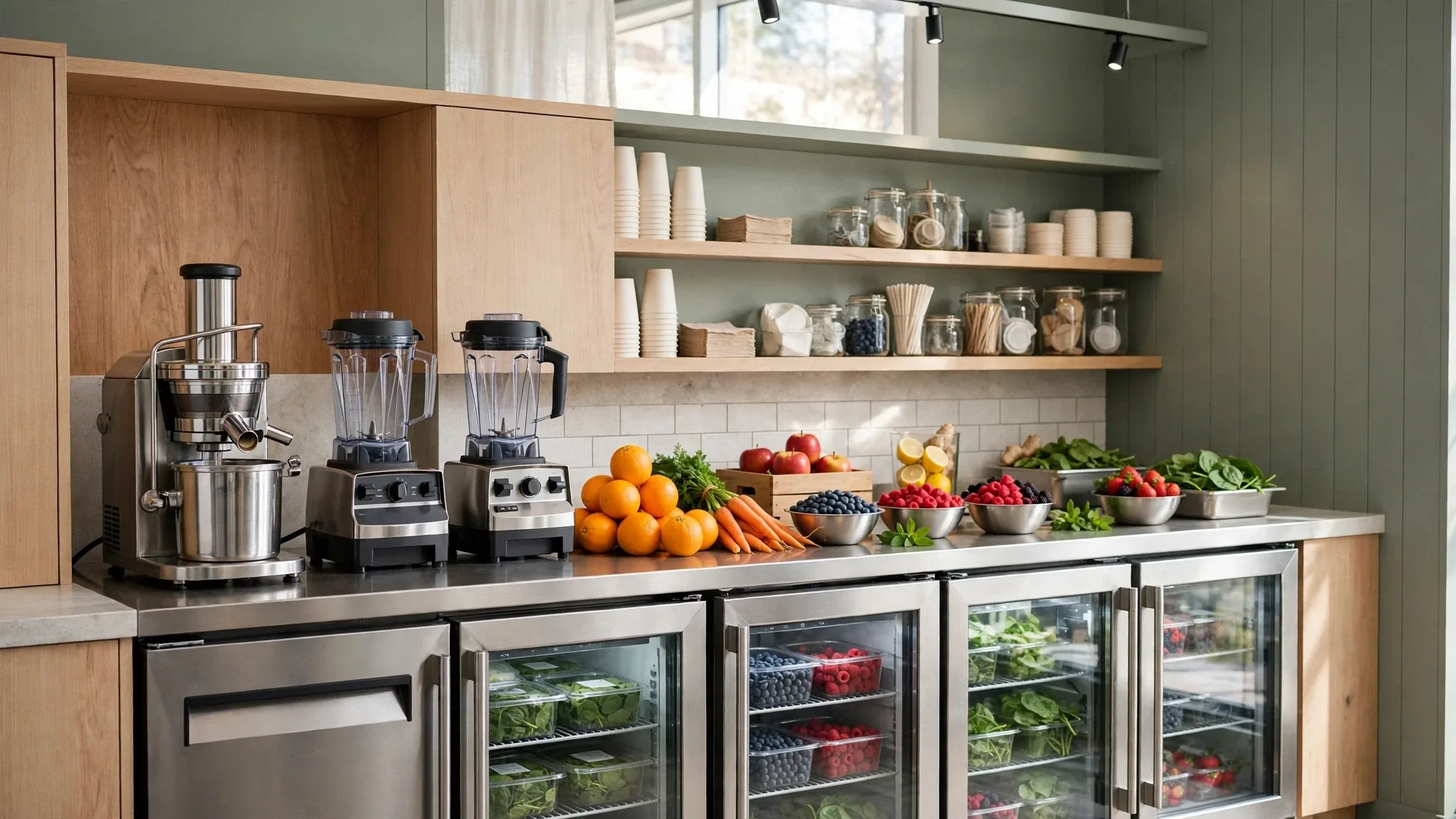
A juice bar often appears inexpensive to start because the menu may not include a grill or complicated hot kitchen. Yet a licensed food premises, cold storage, produce preparation, sanitation infrastructure, commercial appliances and enough capital to survive a slow launch can make the opening investment significant.
Quick answer: The cost to open a U.S. juice bar depends on whether it is a counter inside an existing facility, a kiosk, an independent storefront or a larger production-and-retail operation. This guide uses a hypothetical $145,000 startup budget for a small independent storefront, including $30,000 of opening cash reserve. It is a worked planning example, not a verified U.S. average or supplier quotation.
Free planning tool: Build your own restaurant startup budget, separate opening expenses from cash reserves, and download the estimate. No signup; replace all example values with local quotes.
First choose the business model, because the equipment follows it
A made-to-order smoothie shop, a fresh-squeezed juice bar, a cold-pressed bottled-juice counter and a blended beverage-plus-bowl café are different operating systems. Their appliances, required labor, preparation time, food-safety controls and inventory loss rates are not interchangeable.
A made-to-order counter may rely heavily on commercial blenders, ready-to-use prepared ingredients and a compact line. A cold-pressed concept may need more elaborate extraction, refrigerated holding, bottling, labeling and potentially additional regulatory controls depending on how and where products are sold. Açaí bowls or other prepared foods require their own recipe, holding and packaging standards.
Choose a concise opening menu first. List ingredient quantities and expected portions for every drink. Then match the commercial juicer, refrigeration, ice capacity, wash facilities and prep space to anticipated peak transactions. Buying machinery just because it looks impressive is an expensive way to discover that you cannot sell enough drinks to justify it.
Sample itemized budget for one independent shop
Assume an existing leased commercial space with some usable services but meaningful counter and plumbing improvements. The amounts below are planning assumptions selected to demonstrate a complete cash requirement.
| Startup item | Illustrative amount |
|---|---|
| Upfront lease and occupancy payments | $10,000 |
| Plumbing, sinks, electrical and counter build-out | $48,000 |
| Commercial juicers, blenders and refrigeration | $22,000 |
| POS, furniture, signage and smallwares | $9,000 |
| Permits, insurance and professional setup | $4,000 |
| Initial produce, ingredients and disposables | $5,000 |
| Pre-opening training and launch marketing | $7,000 |
| Installation or construction contingency | $10,000 |
| Cash reserve for initial operating losses and timing gaps | $30,000 |
| Total initial cash required | $145,000 |
Do not confuse the $30,000 reserve with an expense already spent. Its purpose is to cover cash outflows after opening. A financing agreement may reduce cash paid for certain appliances at launch, but it introduces payments and financing cost. It may also demand a personal guarantee.
The strongest cost estimate comes from written contractor bids and exact equipment quotes, not the average of online articles. Do not mix a kiosk budget with a store requiring a new ventilation, drainage or accessibility system.
Prepare a cold-chain and sanitation layout before signing a lease
Juice operators handle high volumes of raw produce and moisture. The work area needs safe receiving, storage, washing, preparation and cleanup zones. Confirm handwashing and other sinks, food-safe surfaces, floor drains where required, waste handling, pest controls and adequate refrigeration with the local authority and qualified designers.
Power capacity matters. If several high-demand blenders, commercial juicers, refrigerators and ice machines run simultaneously, electrical load must be verified by professionals. The price of an appliance is only one line: delivery, installation, permits, support and future repairs can change the real investment.
A low-cost unit in a high-traffic retail corridor may be a bad deal if the landlord will not allow required foodservice improvements. Ask about permitted uses, water supply, grease or wastewater conditions where applicable, restroom obligations, signage restrictions and which party pays for alterations.
Price produce by usable yield, not purchase weight
Raw produce loses weight and value through peeling, trimming, sorting, spoilage and extraction. A case purchased at an attractive price may have weak usable yield if quality is poor or the recipe extracts little juice.
For every signature drink, record supplier purchase price, raw quantity, cleaned quantity, extracted usable volume, portion size, packaging and realistic waste. If a recipe requires 500 grams of mixed produce for a finished drink, it is not enough to divide the case price by its gross weight and call the result ingredient cost.
Batch testing is critical. Record input produce weight and output juice volume, then calculate cost per actual served unit. Repeat when produce origin, season or supplier changes. The menu must tolerate price and yield fluctuation without silently erasing contribution.
Illustrative beverage calculation: suppose a drink sells for $11, uses $2.80 of fruit and vegetables and $0.90 of packaging and other direct supplies. Direct cost is $3.70, leaving $7.30 before card fees, paid labor, occupancy and overhead. This is contribution before several expenses, not profit. A $0.40 increase in direct cost on 3,000 drinks consumes $1,200 monthly unless offset by price, yield, purchase or menu-mix improvements.
Food safety and packaged juice are not minor details
The U.S. Food and Drug Administration warns that untreated fruit and vegetable juice can carry pathogens. Packaged untreated juice may be subject to a specified warning statement. The precise rules depend on processing method, distribution channel and whether the business operates solely as a retail establishment or supplies other businesses. FDA’s Juice HACCP regulation has a retail exemption under defined conditions, but that does not excuse sanitation, local requirements or applicable labeling obligations.
Read the FDA’s guidance on juice safety and its retail-versus-processing discussion. Confirm the legal classification of your specific operation with regulators and qualified advisers. Do not assume that making a bottle in-house and selling it through another retailer is identical to pouring a fresh drink directly for a walk-in customer.
Budget for employee training, documented sanitation, temperature checks, labeling where applicable and the operating time required to follow safe procedures. Safety compliance is part of the business model, not an optional marketing extra.
Inventory and waste can consume a promising margin
Fresh produce has limited usable life and variable quality. Too much inventory increases spoilage; too little means sold-out ingredients and lost customer trust. Set initial ordering quantities from your actual recipes and a cautious traffic forecast, then adjust after observing demand.
Track receiving date, supplier, case quantity, produce condition, usable yield, temperature where necessary, portion usage and discarded quantity. Separate legitimate peel or extraction yield loss from preventable storage spoilage. A weekly waste total without reason codes will not identify which control failed.
Think through substitutions in advance. If a specific fruit is unavailable or expensive, an approved alternate recipe must have its own yield, allergen and nutrition claims checked. Staff should never substitute ingredients in ways that undermine accurate customer communication.
Calculate how many orders pay the monthly bills
Break-even analysis should separate genuinely per-order costs from rent, planned payroll, subscriptions, insurance and other costs that continue even when orders disappear.
Consider a hypothetical juice bar with $18,000 per month of fixed/semi-fixed costs and an average $11 net order. Assume variable ingredients, packaging, payment costs and other transaction-variable items together cost $4 per order. Contribution per order is $7.
Break-even transactions per month = $18,000 ÷ $7 ≈ 2,572. At 26 operating days, that means approximately 99 transactions per open day. If the business needs additional owner wages or debt service not already included, raise the required monthly contribution accordingly.
This is not a claim that juice shops usually need 99 orders a day. It is a formula driven by deliberately stated assumptions. Use the break-even calculator with local figures to find your actual threshold. Once the shop is open, the juice bar owner earnings guide compares sold-business SDE with an illustrated sales model and owner cash flow.
Labor planning starts with peak demand, not average daily orders
A location might process 100 orders in a day yet receive half of them in a tight breakfast or lunch window. Calculate transactions per fifteen-minute interval and estimate how many staff members can fulfill orders while maintaining washing, sanitation, payment and guest communication standards.
Commercial equipment throughput is not the same as service-line throughput. A juicer that can mechanically process a large quantity does not eliminate produce preparation, cleaning, payment, cup labeling or finishing time. Likewise, a bowl with several toppings may sell for more but take longer to assemble.
Test opening and closing labor as separate fixed requirements. A weak schedule can appear efficient on revenue per paid hour while hiding unfinished prep or cleaning work. Link planned labor hours to a realistic order forecast and monitor service quality alongside productivity.
See labor productivity by sales per labor hour for a practical method.
Create a three-case cash forecast
Construct a 13-week cash view before opening and a monthly forecast for at least one year. Model a conservative traffic case, an achievable base case and a better-than-expected case. Each must include lease deposits, startup invoices, supplier payment timing, wages, tax obligations, credit-card settlement delays if material and financing payments.
Do not fund the opening on the assumption that demand immediately reaches the base case. A new shop needs time to build awareness and repeat purchases. A particularly attractive concept can still fail if it exhausts operating cash while customers are discovering it.
Run sensitivity tests for increases in produce costs, lower yields, a slower morning rush and a failed blender. The point is to identify which assumptions determine whether the concept is financially robust—not to predict the future with false precision.
Final launch review
Before the first customer arrives, ensure the menu costs were calculated using real extraction tests; the space has appropriate approvals; staff can follow safe food-handling steps; peak order flow is tested; and the store can reconcile daily sales, inventory and cash. Review repeat purchases and product returns after opening, not merely social-media attention.
Budget discipline should continue after launch. Each month, compare actual cases consumed, prepared servings, labor hours, promotional spending and net sales against the forecast used to authorize the project. Look for root causes, not only percentage differences.
Frequently asked questions
Is a juice bar cheap to open because there is no cooking line?
Not necessarily. Plumbing, wash facilities, refrigeration, appliances, food-safety controls, labor and lease improvements can be substantial. A kiosk in a suitable existing facility and a newly built standalone retail shop should have different budgets.
Should I start with bottled cold-pressed juice?
Only after testing product demand, extraction yield, refrigerated distribution, packaging economics and the regulatory status of the processing model. Bottled distribution can add shelf-life, labeling and compliance requirements not present in every made-to-order concept.
How do I calculate true juice ingredient cost?
Use the purchase price divided by usable finished beverage output, including trimming and extraction yield. Add packaging and relevant consumables before comparing against net selling price.
What is the biggest opening risk?
It varies. Common high-impact risks are unsuitable premises, underfunded working capital, poor product yield, inadequate peak-hour throughput, spoilage and misunderstanding packaged-product obligations. Build safeguards for the risks that apply to your format.
Sources and editorial notes
- SBA: break-even point — financial method.
- FDA: What You Need to Know About Juice Safety — untreated juice safety and labeling context.
- FDA: Juice HACCP Hazards and Controls Guidance — regulator guidance, consult current local rules.
- TRUiC Juice Bar Equipment Purchasing Guide — examples of equipment categories, not binding vendor quotes.
Methodology: The $145,000 budget, $11 average order and $18,000 monthly fixed-cost illustration are author-created scenarios, not national averages, supplier quotations or guaranteed outcomes.