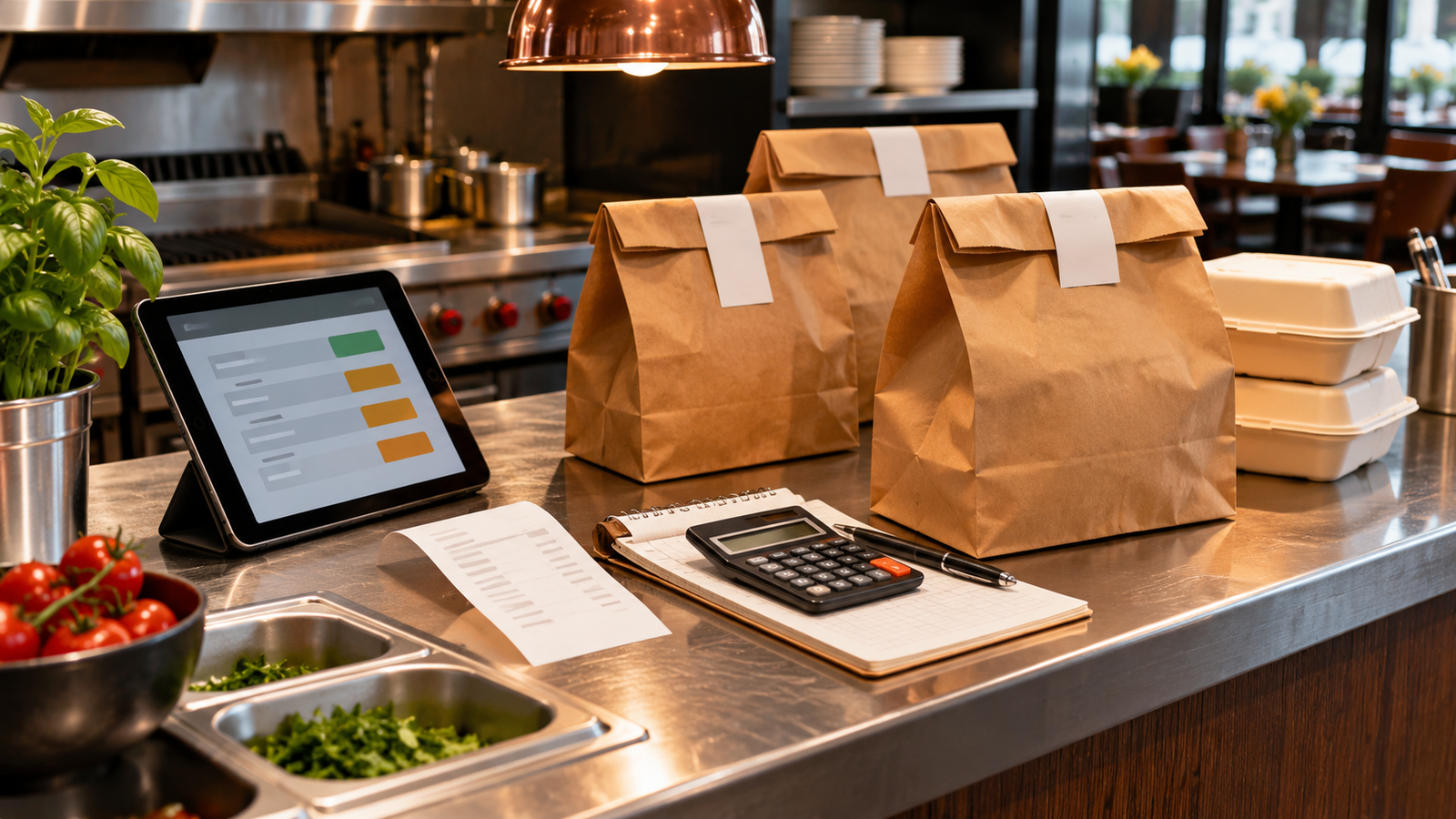
A $40 delivery order can generate only $4 of contribution before rent and other fixed expenses. The danger is comparing the customer’s menu subtotal with the marketplace payout rather than with the real cost of producing the order. This guide builds an order-level profit model for U.S. independent restaurants using current publicly advertised delivery-app pricing and clearly labeled example costs.
Updated November 2026. All sample food, labor, packaging and promotion costs are hypothetical operating assumptions, not market averages. Actual commissions depend on merchant terms and local laws.
How much do delivery apps charge restaurants?
DoorDash’s U.S. merchant pricing advertises delivery commission rates of 15% for Basic, 25% for Plus and 30% for Premier, and qualifying pickup pricing of 6%. Uber Eats U.S. pricing lists marketplace fees of 20% for Lite, 25% for Plus and 30% for Premium, with local variations, other conditions and different pickup or self-delivery structures. Promotional periods and membership orders may carry different effective fees. Your signed agreement and settlement report control, not a general website example.
Confirm whether card processing is included before adding it as an extra expense. Do not treat consumer delivery fees, taxes collected for a government, or courier tips as restaurant menu revenue unless your settlement and accounting facts actually support that treatment.
The formula: contribution, not revenue
Order contribution = restaurant menu revenue − ingredients − packaging − incremental labor − marketplace commission − restaurant-funded discounts − other variable costs.
Contribution is what remains to pay rent, salaried management, insurance, utilities, debt service and owner compensation. It is not the same as the business’s net profit. If a commission is levied on a different fee base than your pre-tax menu subtotal, use the actual base from the agreement.
Worked example: a $40 delivery order
| Component | Illustrative amount | Explanation |
|---|---|---|
| Menu subtotal | $40.00 | Before tax and tips |
| Food ingredients | −$12.00 | Recipes costing 30% of subtotal |
| Incremental kitchen and packing labor | −$8.00 | Measured minutes at burdened labor cost |
| Packaging | −$1.50 | Container, bag, seals and supplies |
| Restaurant-funded promotion | −$2.00 | Average allocated discount |
| Order-variable refunds/remakes | −$0.50 | Sample loss allowance |
| Before marketplace commission | $16.00 | Money available to cover commission and overhead |
| Commission assumption | Fee on $40 | Remaining contribution |
|---|---|---|
| 15% | $6 | $10 |
| 20% | $8 | $8 |
| 25% | $10 | $6 |
| 30% | $12 | $4 |
At 25%, this order retains $6 in contribution, equal to a 15% contribution rate. At 30%, it retains $4, equal to 10%. Every assumption matters: a $1 packaging overrun or additional remake reduces contribution by exactly $1.
Do bigger delivery plans create more profit?
Not necessarily. A plan with a higher fee might increase reach and introduce new customers. To evaluate it, compare the additional orders attributable to the plan with the additional commission, advertising and service costs. At a $40 subtotal, increasing the commission from 15% to 25% adds $4 of commission per order. If the more expensive plan produces only orders that would have arrived anyway, it is a cost increase without incremental benefit.
Orders during an otherwise idle afternoon may use available labor capacity. Orders during a Saturday rush might require another line cook, cause late tickets or displace higher-margin dining-room sales. Track order contribution separately for peak and quiet dayparts.
Displacement example
Suppose 100 marketplace orders in a week each contribute $6, producing $600. But 40 direct orders, each otherwise contributing $12, were displaced: the opportunity cost is $480. That leaves only $120 of incremental contribution before additional fixed costs. More gross sales do not automatically mean better economics.
Reconcile every payout before judging profitability
A marketplace’s deposit to the bank may reflect several days of orders and deduct commissions, promotions, refunds or other adjustments. Do not book a $1,850 bank deposit as $1,850 of gross restaurant revenue by default. Trace the order subtotal through fee deductions and cash settlement to the bank. For the workflow, use our delivery aggregator reconciliation guide.
Build a weekly delivery profit scorecard
| Measure | Calculation | Decision supported |
|---|---|---|
| Average menu subtotal | Recognized menu revenue ÷ completed orders | Pricing and mix |
| Effective marketplace fee | Actual marketplace fees ÷ contractual fee base | Verify contract |
| Food cost per order | Standard recipe cost adjusted for loss | Menu engineering |
| Packaging per order | Supplies consumed ÷ completed orders | Packaging standards |
| Incremental labor per order | Minutes × burdened cost per minute | Peak staffing |
| Adjustment rate | Refunds and replacements ÷ orders | Quality control |
| Contribution per order | Menu revenue less variable costs | Channel profitability |
A practical 14-day test
- Export every order, promotion, fee and net payout from each channel; keep sales tax and tips separate.
- Fully cost at least your ten most popular delivery items, including packaging and sauces.
- Measure prep and packing labor minutes in peak and off-peak periods.
- Allocate restaurant-funded marketing by order rather than assuming a platform funded it.
- Compare actual contribution against direct order economics and the number of displaced transactions.
- Change one variable at a time: assortment, pricing, staffing or promotional spend.
How to improve delivery profit without an automatic price increase
Start with the delivery-only menu. Remove items that travel poorly and cause refunds. Standardize portioning, sauce cups and container sizes. Set a practical order minimum when the platform allows it, reduce paid promotions that attract single-use discount shoppers, and improve order accuracy at the expo station. Our delivery menu engineering guide explains the food-quality side of the decision.
Frequently asked questions
Is a 30% fee always unprofitable?
No. Profit depends on the menu and whether orders are incremental. The $40 example retains $4 before fixed overhead at 30%, which may be insufficient for some operations but is not a universal verdict.
Should I include packaging in food cost?
Track packaging separately in this decision model. Your formal accounting classification can differ, but avoid counting it twice.
Is a higher marketplace payout always better?
No. Payouts reflect timing and deductions. Review contribution and reconcile gross sales to cash. Also compare against our small takeout restaurant earnings model to understand fixed overhead.
Reference notes
Pricing reviewed November 2026: DoorDash merchant plans and Uber Eats U.S. merchant plans. All operating expense examples are hypothetical. Confirm current fees with your provider and applicable local rules.