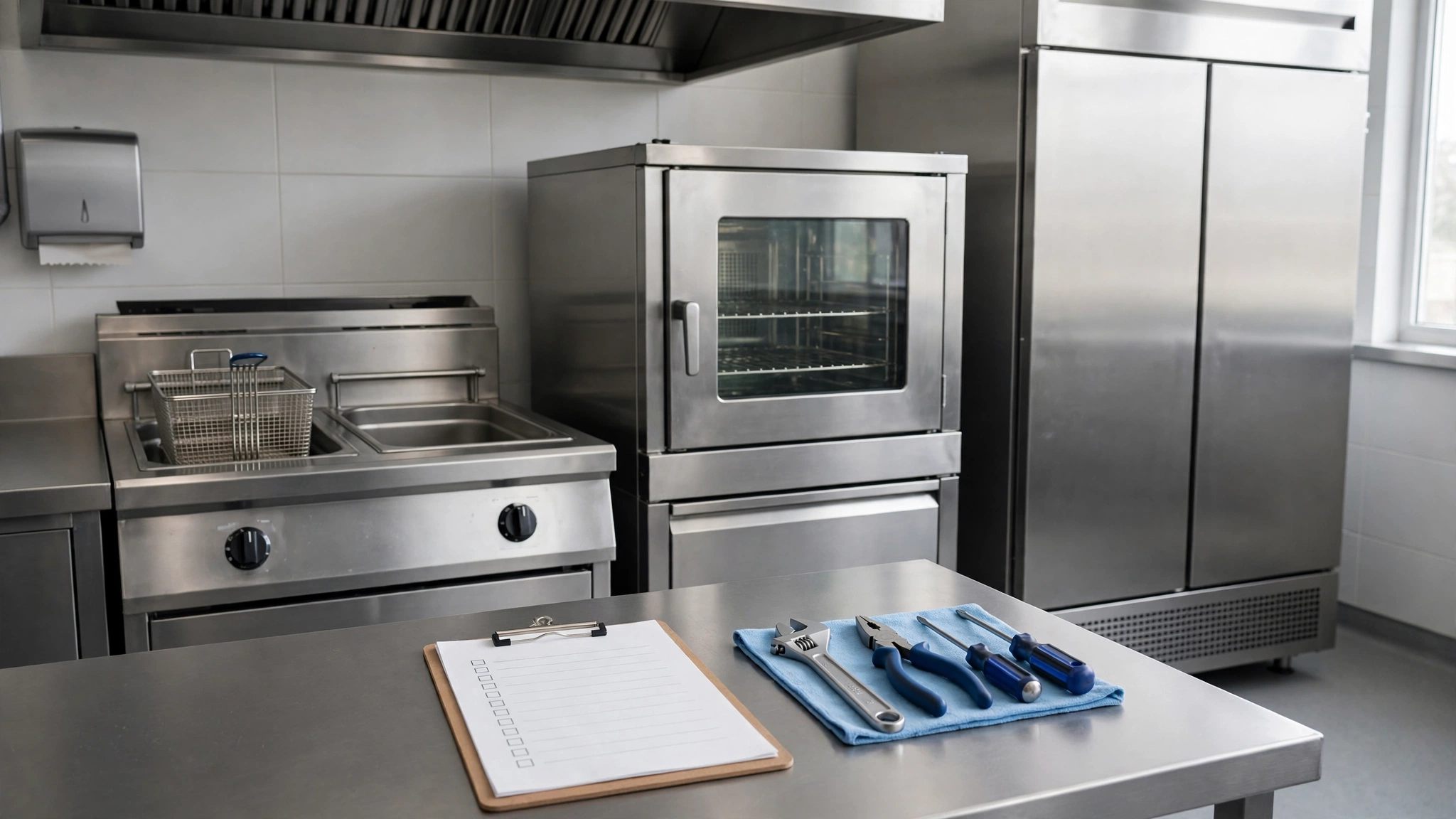
Restaurant equipment usually fails at the worst possible time: during a busy service, on a fully booked weekend, or just after a large delivery has been put away.
Some breakdowns are unpredictable. Many are not.
A neglected condenser, a loose door gasket, a clogged filter, a fryer that is never inspected properly, or a refrigerator that has been running warm for days can often show warning signs before the equipment stops working.
A practical maintenance system does not require the kitchen team to become technicians. It requires the restaurant to separate simple operating checks from professional repair work, record recurring problems and act before a small issue becomes an expensive interruption.
What preventive maintenance should accomplish
A good equipment maintenance routine should help the restaurant do four things:
- spot abnormal conditions early,
- keep equipment clean enough to operate correctly,
- reduce avoidable emergency repairs,
- create a clear record of recurring faults.
The objective is not to make every machine last forever. The objective is to reduce preventable downtime and make repair decisions based on evidence rather than memory.
Start with an equipment register
Before building a checklist, make a simple list of the equipment that matters most to daily operations.
For each item, record:
- equipment name,
- brand and model,
- serial number where available,
- location,
- purchase or installation date if known,
- service company or technician contact,
- warranty status,
- last professional service date.
This does not need to be complicated. A spreadsheet is enough for many independent restaurants.
The value becomes obvious when something fails and the manager does not have to search through old invoices just to identify the model or service history.
Separate operator checks from technician work
This is one of the most important rules in restaurant maintenance.
Kitchen staff can usually perform routine operational checks such as cleaning accessible surfaces, checking visible damage, confirming normal temperatures, listening for unusual noise and reporting leaks.
Electrical repair, gas work, sealed refrigeration work, internal component replacement and other technical service should be left to qualified personnel.
A useful checklist should therefore tell the team what to observe and report, not encourage unsafe repairs.
Use three maintenance levels
For most restaurants, it is easier to organize maintenance into three rhythms.
Daily checks
These are quick operating observations that can be built into opening, closing or cleaning routines.
Weekly or monthly checks
These look for developing problems that are easy to miss during service.
Scheduled professional service
These are inspections or maintenance tasks carried out according to equipment needs, manufacturer guidance, service history and local requirements.
The exact interval will differ by equipment. A heavily used fryer may need more attention than an ice machine in a low-volume operation.
Daily restaurant equipment checklist
Daily checks should be short enough that they actually happen.
A practical daily list can include:
- equipment powers on normally,
- no unusual noise or vibration,
- no visible leaks,
- doors and lids close properly,
- temperature displays appear normal where applicable,
- no damaged cords, plugs or visible fittings,
- vents and air paths are not obviously blocked,
- grease and food debris are removed from accessible surfaces,
- warning lights or error messages are recorded,
- any fault is reported before the next service period.
The point is not to inspect every screw. It is to make “something looks wrong” visible before it turns into “the machine stopped.”
Refrigeration: watch the trend, not just one reading
Refrigerators and freezers are among the most critical pieces of equipment in a restaurant.
For daily operation, the team should watch:
- temperature readings,
- door closure,
- gasket condition,
- ice buildup,
- water around the unit,
- unusual fan or compressor noise,
- blocked internal airflow,
- overloading that prevents circulation.
One abnormal temperature reading may have an operational explanation, such as a door left open during loading. Repeated high readings are different.
That is why a temperature log is more useful than memory. The trend shows whether the unit is becoming unstable.
Check door gaskets before blaming the compressor
A damaged or dirty door gasket can allow cold air to escape continuously.
That can make the refrigeration system run longer than necessary and may contribute to unstable cabinet temperatures.
Staff can check whether:
- the gasket is torn,
- it is pulling away from the door,
- food debris prevents a clean seal,
- the door appears misaligned.
If the seal is damaged, record it and arrange the appropriate repair rather than simply increasing the thermostat setting.
Keep condenser and ventilation areas on the maintenance calendar
Refrigeration and other equipment often depend on clear airflow.
Dust, grease and debris around accessible ventilation areas can reduce performance.
The exact cleaning method and safe access procedure depend on the equipment, so the restaurant should follow manufacturer instructions and use qualified service where required.
The management point is simple: if an area needs periodic cleaning, put it on the calendar. Do not rely on someone remembering it after performance has already deteriorated.
Fryers: look for operating changes
Fryers work under demanding conditions, so small changes can matter.
Operators should report:
- slow heating,
- temperature instability,
- unusual ignition behavior,
- oil leaks,
- damaged baskets or handles,
- warning lights or error codes,
- unusual smell or sound.
Cleaning routines should prevent heavy buildup around accessible areas without turning normal cleaning into technical disassembly.
If ignition, gas, electrical or internal heating components are involved, the restaurant should use qualified service personnel.
Ovens and ranges: combine cleaning with inspection
Daily cleaning can also act as a visual inspection.
While cleaning accessible surfaces, staff can notice:
- damaged knobs,
- loose handles,
- door alignment problems,
- broken seals,
- uneven heating complaints,
- burner or flame behavior that appears abnormal,
- error messages on digital equipment.
The important step is to record the observation. A complaint such as “the oven has been slow for two weeks” is much more useful when the maintenance log shows when the issue started and whether it is getting worse.
Dishwashing equipment: prevent small flow problems from becoming service problems
Dishwashers can create immediate operational pressure when they fail.
Routine observations can include:
- spray arms move and appear unobstructed,
- filters or screens are cleaned as required,
- doors or curtains close correctly,
- there are no visible leaks,
- chemical containers are connected and not empty where applicable,
- unusual noise is reported,
- drainage appears normal.
Technical calibration, heating faults and internal repair should be handled according to the equipment’s service requirements.
Ice machines need their own maintenance line
Ice machines are easy to ignore because they often sit away from the main cooking line.
They should not disappear from the maintenance system.
The restaurant should have a defined routine for cleaning and inspection based on the manufacturer’s instructions and its food-safety program.
Operators should also report:
- reduced ice production,
- unusual ice shape,
- water leakage,
- unusual noise,
- visible buildup in accessible areas.
Do not ignore small equipment
Blenders, food processors, mixers, slicers, scales and other smaller equipment can create just as much disruption when they fail during prep.
A useful check includes:
- visible damage,
- loose or damaged guards,
- frayed cords,
- unusual noise,
- worn seals or lids,
- inconsistent performance.
If a safety component is damaged, remove the equipment from use until it is properly assessed.
Build the maintenance log around symptoms
A maintenance log should not require a technician’s vocabulary.
The team can record what they actually observed.
| Date | Equipment | Observation | Priority | Action |
|---|---|---|---|---|
| Sep 10 | Walk-in cooler | Temperature rising above normal after lunch delivery | High | Manager monitoring; service call requested |
| Sep 12 | Convection oven | Door not closing evenly | Medium | Added to technician visit |
| Sep 13 | Prep mixer | New vibration at high speed | Medium | Removed from heavy use pending inspection |
The examples above are illustrative.
This kind of log is much more useful than a vague note saying “equipment problem.”
Use priority levels
Not every maintenance issue has the same urgency.
A simple system can use three levels:
Urgent: equipment is unsafe, not maintaining required conditions, leaking significantly, producing abnormal electrical or gas symptoms, or has stopped operating.
High: performance is deteriorating and failure could disrupt service soon.
Routine: the issue does not currently affect safe operation but should be repaired during planned service.
The purpose is to prevent minor cosmetic problems from competing with operationally critical faults.
Track repeat repairs
A machine that is repaired four times in six months may have a different problem than a machine with one isolated failure.
For each major asset, record:
- service date,
- problem reported,
- repair performed,
- parts replaced,
- cost,
- downtime.
This history helps the owner decide whether repeated repair is still economical.
Maintenance cost should be compared with disruption cost
The cheapest repair invoice is not always the cheapest business decision.
Consider a freezer that fails repeatedly.
The cost is not only the technician fee. It may also include:
- lost product,
- emergency product transfers,
- staff time,
- menu items being unavailable,
- expedited delivery costs,
- service disruption.
A better maintenance decision looks at the full operating impact.
Do not let cleaning and maintenance become separate worlds
The team doing daily cleaning is often the first to notice wear, leaks, damage or unusual buildup.
That is why your Commercial Kitchen Cleaning Checklist and equipment maintenance process should support each other.
Cleaning finds problems. Maintenance records them. Management decides what happens next.
Connect opening and closing checks to equipment condition
The restaurant does not need a completely separate form for every operating control.
Some equipment checks can sit naturally inside the daily Opening and Closing Checklist.
For example, opening staff can confirm that critical equipment is operating normally before prep begins.
Closing staff can report leaks, damaged seals, unusual noises or warning messages discovered during cleaning.
This reduces the chance that a problem is noticed at night and then forgotten before the next shift.
Create a weekly manager walk-through
Once a week, a manager should walk through the equipment list rather than waiting for complaints.
The walk-through can include:
- critical refrigeration,
- cooking equipment,
- dishwashing,
- ice equipment,
- ventilation-related observations,
- small prep equipment,
- storage equipment and shelving condition.
This is not a technical inspection. It is a management review of visible condition and known issues.
A practical monthly review
At least once a month, management can review the maintenance log and ask:
- Which equipment had repeated faults?
- Which repairs are still open?
- Which assets caused downtime?
- Which items are approaching scheduled service?
- Which repair costs are increasing?
- Which issues were reported but never closed?
This turns maintenance from emergency response into a controlled operating process.
Keep spare parts only where it makes sense
Some restaurants overreact to downtime by buying a large stock of spare parts they may never use.
Others keep nothing and lose hours waiting for simple replacement items.
A sensible middle ground is to identify inexpensive, frequently needed consumables or approved replacement items that can be stored safely and legally for your equipment.
The decision should be based on service history, lead time and manufacturer guidance.
Know when replacement deserves serious consideration
Maintenance records can help identify when an asset is becoming operationally expensive.
Warning signs include:
- repairs becoming more frequent,
- parts becoming hard to obtain,
- downtime increasing,
- performance no longer matching operational needs,
- energy or operating cost becoming materially worse,
- the equipment repeatedly threatening service continuity.
Replacement is a financial decision, not just a maintenance decision. The log gives the owner better evidence for making it.
A simple restaurant equipment maintenance routine
For an independent restaurant, the system can be summarized like this:
- Keep an equipment register.
- Add simple daily observations to opening and closing routines.
- Record every abnormal symptom.
- Prioritize critical faults.
- Use qualified service for technical work.
- Schedule recurring maintenance instead of relying on memory.
- Review repair history monthly.
- Replace equipment when repeated failure makes continued repair uneconomical.
The goal is fewer surprises
Preventive maintenance does not eliminate breakdowns.
What it does is make deterioration more visible, create accountability for unresolved faults and give the restaurant a better chance to schedule service before equipment fails during a busy shift.
The most useful maintenance system is not the longest checklist. It is the one the team actually follows, the manager reviews and the restaurant uses to make decisions.
Track downtime as well as repair cost
A repair invoice does not show the full business impact of a failure. Add downtime to the equipment history so management can see which assets are most disruptive.
A useful downtime record can include:
- time the fault started,
- time normal operation returned,
- menu items or stations affected,
- product loss,
- emergency labor or transfer cost,
- repair cost.
An asset with modest repair bills but repeated service disruption may deserve replacement sooner than the invoices alone suggest.
Build a preventive-maintenance calendar
| Asset | Operator check | Scheduled service | Last completed | Next due |
|---|---|---|---|---|
| Walk-in cooler | Daily condition and temperature trend | Per manufacturer/service plan | ||
| Fryer | Daily operating symptoms | Per manufacturer/service plan | ||
| Dishwasher | Daily flow, leaks and visible condition | Per manufacturer/service plan |
Do not invent generic service intervals when the equipment manufacturer or qualified service provider specifies them. The calendar’s job is to make those real requirements visible and scheduled.
Use a repair-versus-replace review
When an asset becomes unreliable, compare more than the next repair estimate. Review cumulative repair cost, downtime, age, parts availability, operating efficiency and the business impact of another failure. Document the decision so the owner can see why replacement is being considered.
Frequently asked questions
Who should own restaurant equipment maintenance?
One manager should own the register, open issues and service calendar even though staff perform routine observations and qualified technicians perform technical work.
What should staff do when equipment starts behaving abnormally?
Follow the restaurant’s safe operating procedure, record the symptom accurately, escalate according to priority and avoid unauthorized technical repair.
Is preventive maintenance always cheaper than repair?
Not every service action prevents every failure, but a disciplined maintenance program can reduce avoidable breakdowns and gives management better information about asset condition and replacement timing.
Operational note: Always follow equipment manufacturer instructions and applicable safety requirements. Technical, electrical, gas, refrigeration and other specialized repair work should be performed by appropriately qualified personnel.