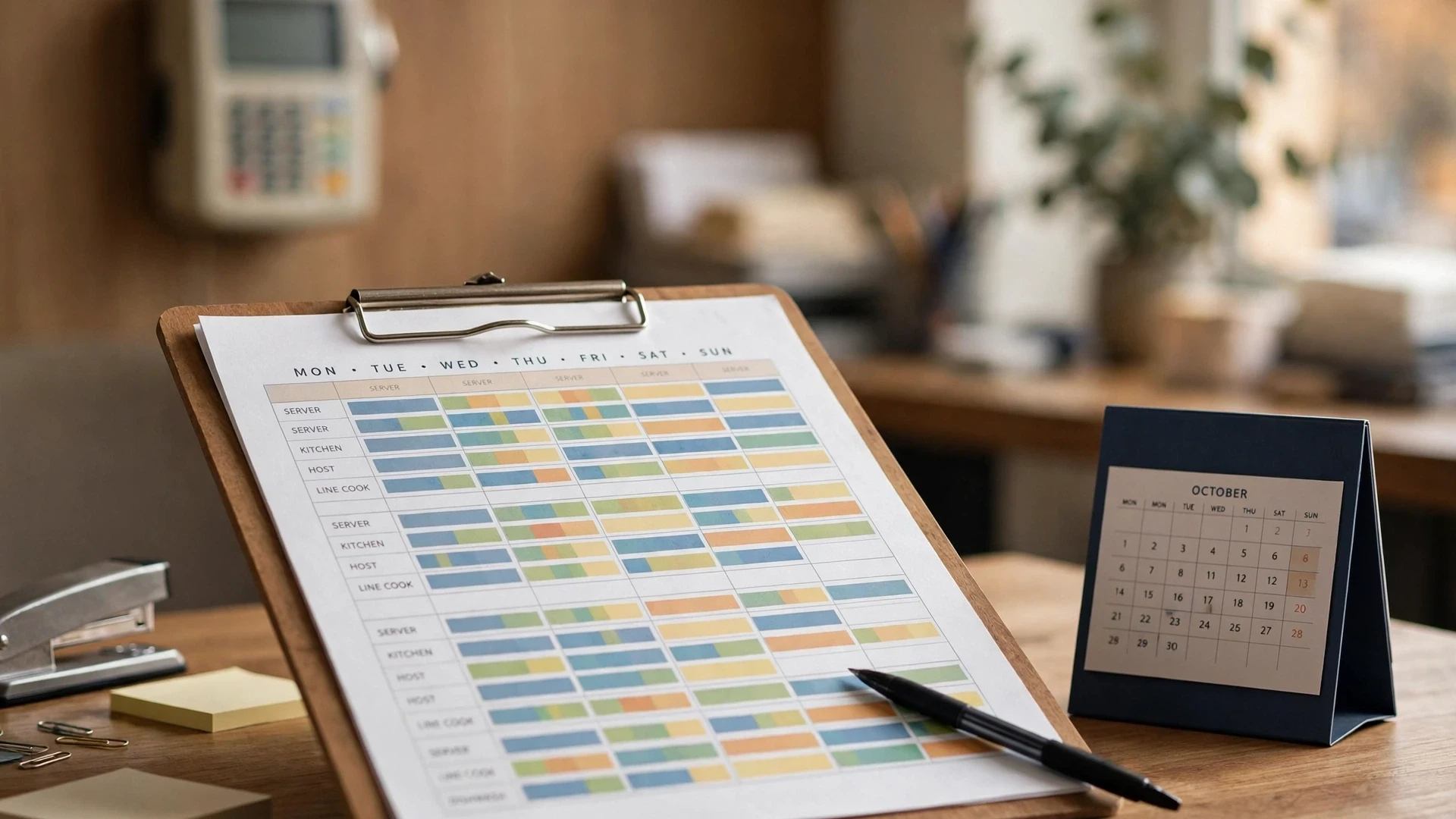
A restaurant schedule can be carefully built on Monday and become unreliable by Friday because of ordinary changes: an employee asks to swap a shift, someone calls out, a manager moves a person from lunch to dinner, a closer agrees to cover for a coworker, or a busy forecast creates a last-minute need for extra hands.
The operating risk is not the change itself. Restaurants need schedule flexibility. The risk appears when changes happen through private texts, verbal promises and multiple managers without one approved record. Coverage can look complete while a critical position is empty, overtime can appear after the fact, an employee can believe a swap was approved when the manager never saw it, and payroll can disagree with the posted schedule.
A shift-swap control gives the restaurant a simple way to change the plan without losing ownership of the plan.
Define the rule: a proposed swap is not an approved swap
Employees can find coverage, but management should define when responsibility officially transfers. A useful rule is: the original employee remains responsible for the scheduled shift until an authorized manager approves the change and the schedule record is updated.
That rule prevents the operation from treating a screenshot or a coworker’s “yes” as the final schedule.
Capture the minimum information
A shift-change request does not need a long form. It needs enough information for a manager to make a real coverage decision.
- Original employee and original shift.
- Proposed replacement employee.
- Position or station being covered.
- Date, start time and end time.
- Reason category if the restaurant tracks one; avoid collecting unnecessary personal detail.
- Whether the replacement is trained and authorized for the role.
- Expected weekly hours before and after the change.
- Manager decision and time of approval.
- Final schedule update status.
Check the role before the hours
Two employees can have the same number of available hours and still not be interchangeable. A host cannot automatically replace a line cook. A new cashier may not be ready to close alone. A server may be trained for dining-room service but not for a private event or bar role.
Before approving a swap, confirm that the replacement can perform the actual work required during that shift.
| Question | Why it matters |
| Is the employee trained for the assigned role? | Prevents coverage that exists only on paper. |
| Can the employee perform required opening or closing duties? | Protects tasks outside the visible service period. |
| Does the shift require a certification, permission or role-specific responsibility? | Avoids assigning work the employee cannot lawfully or safely perform. |
| Will the move create a gap on another shift? | Stops one solved problem from creating another. |
Check total hours and overtime exposure before approval
A swap can preserve headcount and still increase payroll. If the replacement already has a full schedule, taking another shift can change overtime exposure or create a scheduling issue under applicable state or local rules.
Use the employee’s expected weekly hours, not only the single shift, when approving the change. The restaurant should apply its payroll policy and applicable wage-and-hour rules; do not use a universal threshold other than the legal requirements that actually apply to the business.
For broader overtime diagnosis: Restaurant Overtime Control: Find and Fix Extra Hours
Use a simple approval sequence
1. Employee submits the proposed change through the restaurant’s approved channel.
2. Manager checks role qualification and whether the proposed replacement creates another coverage problem.
3. Manager checks expected weekly hours, rest considerations and any applicable scheduling-policy constraints.
4. Manager approves, rejects or proposes a different solution.
5. The master schedule is updated immediately.
6. Both employees receive the same final confirmation.
7. The time clock and payroll record are compared with the approved change after the shift.
Do not run schedule control from private manager messages
If every manager solves coverage in a different messaging thread, there is no single schedule. Use one approved channel or one schedule platform as the source of truth. Text messages can help employees coordinate, but the final decision needs to land in the restaurant’s controlled record.
Separate call-outs from voluntary swaps
A voluntary swap and an unexpected call-out are different operating events. A swap normally gives management time to evaluate the replacement. A call-out may require immediate recovery.
For call-outs, record the uncovered role, the time the absence became known, the first recovery action and the person who finally covered. Over several weeks, the restaurant can see whether coverage problems come from isolated emergencies or from a schedule that is consistently too fragile.
Build a backup ladder for same-day gaps
A practical backup ladder might be: qualified cross-trained employee already on site, qualified employee below weekly-hour limits, manager coverage, approved on-call or relief option where lawful and practical, then a deliberate service adjustment if staffing cannot be restored.
The purpose of the ladder is not to guarantee that every absence can be filled. It prevents frantic calls from replacing judgment.
Protect opening and closing shifts
Opening and closing swaps deserve extra attention because the visible service hours are only part of the work. Confirm key control tasks such as opening access, cash or security procedures under company policy, equipment checks, shutdown responsibilities and final handoff.
A replacement who can work the dining-room portion of the shift may not be ready to own the close.
Use a change log to find recurring schedule weakness
Track the reason category for schedule changes without turning the log into an employee surveillance file. Useful operational categories can include availability conflict, illness/call-out, manager-requested change, demand adjustment, transportation issue, training change or other.
After four weeks, look for patterns: repeated Friday closing gaps, the same role requiring emergency coverage, high swap volume after schedules are posted, or frequent manager-initiated changes.
Those patterns can point to availability data, staffing depth, schedule timing or forecast problems.
Example: a swap that looks harmless
Assume a server scheduled for Saturday dinner asks another experienced server to cover. The replacement is qualified and agrees. On the surface, coverage is solved.
Before approval, the manager sees that the replacement is also scheduled for a long Sunday shift and is already near the restaurant’s expected weekly-hour level. The manager chooses a different qualified employee with fewer hours.
The point is not that swaps are bad. The point is that the manager must see the whole schedule rather than only the empty box.
Manager recheck after the shift
- Did the approved replacement actually clock in?
- Did the role or station change from the approved plan?
- Did actual hours create unexpected overtime or payroll variance?
- Was another shift weakened to solve this one?
- Did the shift reveal a training or cross-coverage gap?
- Does the schedule need a permanent availability update?
Control employee availability changes separately
A swap request solves one date. An availability change affects future schedules. If an employee repeatedly requests the same day or daypart off after schedules are posted, management should not keep solving the pattern through weekly swaps. Use a separate availability-change process so the scheduling inputs are corrected before the next schedule is built.
The availability record should show the effective date and whether the change is temporary or ongoing. A manager can then distinguish a one-time emergency from a structural change in the employee’s workable schedule. This improves forecasting and reduces the number of avoidable swap requests after posting.
Protect the schedule from manager-created changes
Employees are not the only source of schedule instability. Managers can create just as much confusion by moving people between shifts verbally, extending a shift during service, asking someone to come in early or sending someone home without updating the controlled record.
Use the same discipline for manager-initiated changes: who authorized the change, why it was made, which role or hours changed and whether the master schedule or labor system was updated. This is particularly useful when actual labor cost is later compared with the original forecast.
Create a simple coverage decision table
When several employees can cover an open shift, managers need a fast way to choose the strongest option rather than the first person who replies.
- Role qualification: can the employee perform the exact station and opening/closing duties?
- Hours impact: what will the employee’s expected weekly hours become?
- Adjacent-shift impact: does the coverage weaken the employee’s next scheduled shift?
- Cross-training value: can the employee cover a role where the restaurant has limited depth?
- Reliability of the plan: has the employee clearly accepted the complete shift, not only part of it?
The table should support judgment, not create a rigid ranking. The best replacement is the person who protects service and labor control with the least downstream disruption.
Measure the schedule-change rate
A restaurant with frequent swaps can quantify the problem. One internal measure is schedule changes after posting divided by scheduled shifts for the period. The number itself is not an industry benchmark; it is a trend for the same operation.
Break the changes into employee-requested swaps, call-outs, manager-requested changes and demand-driven changes. A rising rate after a new scheduling process may indicate poor availability data. A high manager-change rate may indicate the forecast or original schedule is being built too early or without enough demand information.
Use a cutoff for non-emergency requests
For predictable requests, a restaurant can define an internal cutoff before the shift when non-emergency swap requests should normally be submitted. The cutoff should fit the business and applicable scheduling requirements. It should not be used to deny legitimate emergencies or rights protected by law or policy.
The operational purpose is to give managers enough time to review qualifications and labor impact rather than making every voluntary change a last-minute decision.
Audit the handoff between schedule and time clock
Once a week, compare a sample of approved schedule changes with actual punches. Look for replacement employees who never clocked in, employees who clocked extra time beyond the approved swap, or original employees who also worked part of the shift. This identifies communication errors before they become a recurring payroll-control problem.
If the time record differs from the approved schedule, do not change the time record to force it to match the plan. Actual compensable time must be handled under the restaurant’s payroll process and applicable law. The schedule-change log explains why the difference occurred; it does not replace accurate timekeeping.
Common shift-swap mistakes
Treating employee agreement as manager approval
Coverage can be unqualified or create hidden overtime.
Updating the group chat but not the master schedule
Managers, employees and payroll work from different versions.
Approving by headcount only
The replacement cannot perform the station or closing responsibility.
Ignoring downstream coverage
The substitute gives away another shift or creates a later gap.
Using the swap log as discipline by default
The log should first identify operating patterns. Attendance or conduct issues should follow the restaurant’s actual policy and applicable requirements.
Frequently asked questions
Should employees be allowed to arrange their own replacements?
They can help identify a qualified replacement if that fits company policy, but management should control final approval and schedule update.
Should every small schedule change require owner approval?
No. Define manager authority so routine changes can be handled quickly while unusual or high-impact changes escalate.
What if local predictive-scheduling rules apply?
Use the applicable state or local requirements. Scheduling laws vary by jurisdiction, and some can affect notice, penalties or rest between shifts.
Should a swap automatically change payroll?
The approved schedule change and actual time record should agree, but payroll must be based on actual compensable work under the restaurant’s payroll process and applicable law.
Next action
Take the next five shift changes and run them through one approval record: original shift, replacement, role qualification, expected weekly hours, manager approval and final schedule update. If any of those fields cannot be answered quickly, the restaurant does not yet have one reliable schedule.
Related guides:
- Restaurant Staff Scheduling: How to Build a Weekly Schedule Without Overstaffing
- Restaurant Overtime Control: Find and Fix Extra Hours
- Restaurant Cross-Training Matrix: Build Shift Coverage Without Training Everyone on Everything
References: