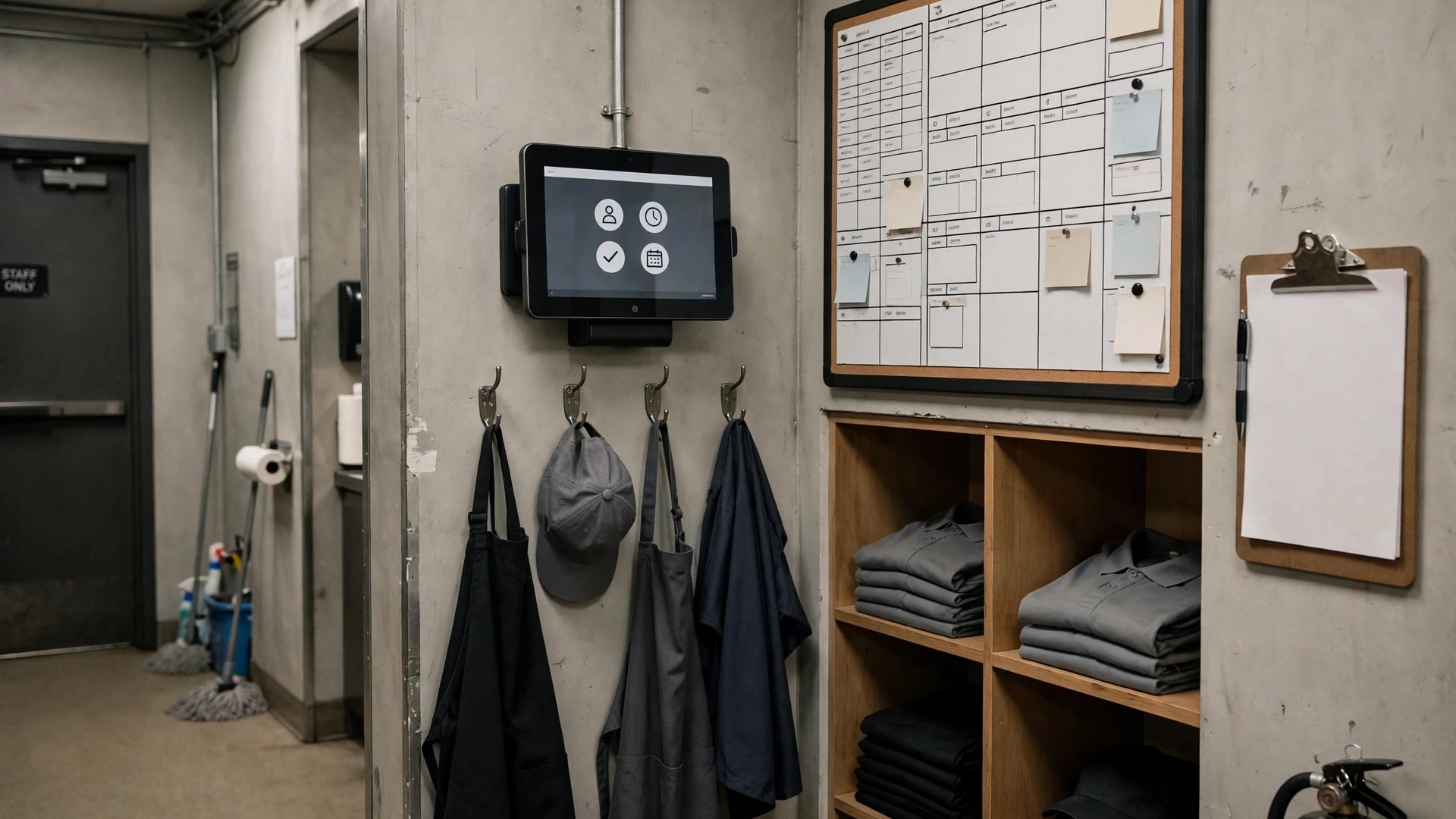
Restaurant time clock and attendance control is a payroll-accuracy system, not a minute-shaving exercise. It should make scheduled hours, actual hours, approved edits, breaks, overtime and attendance exceptions traceable before payroll is finalized. The operating goal is simple: employees should be paid for time worked, managers should be able to explain legitimate exceptions, and recurring schedule or closing problems should become visible in the data. Any policy or edit practice must also comply with applicable wage-and-hour rules and local break requirements; the control system should never be used to erase valid working time or create automatic deductions that do not reflect reality.
Why payroll accuracy starts before payroll day
Most timekeeping problems are easier to solve on the day they happen. A missed clock-out can be confirmed while the closing manager still remembers the shift; a late clock-in can be checked against the schedule and manager log; an unexpected overtime hour can be traced to a call-out, rush or closing delay. Waiting until payroll day turns small exceptions into a reconstruction exercise and increases the risk of rushed edits.
Daily exception review also separates employee behavior from operating-system problems. If one employee repeatedly forgets to punch, coaching may be appropriate. If half the closing team runs fifteen minutes late every Friday, the schedule, cleaning sequence or handoff may be unrealistic. The data should help management fix the cause rather than simply label every variance as “time theft.”
The control should be transparent. Employees need to know how to report a missed punch, who may edit a record, and how corrections are documented. Managers need a clear approval trail so legitimate corrections are distinguishable from arbitrary changes.
What the system should control
Timekeeping controls should protect both payroll accuracy and a fair correction process. The restaurant needs clear rules for ordinary punches and a documented path for exceptions, while local wage-and-hour requirements and company policy determine the legal boundaries of that process.
- clear clock-in and clock-out rules
- manager approval for manual edits
- break recording that matches local requirements and company policy
- late arrivals, missed punches and early departures coded consistently
- schedule-to-actual review by shift and daypart
- payroll audit trail that shows who changed what and why
Consistency here means applying the same timekeeping rules to comparable situations and documenting any manager override. Define how early clock-ins, late clock-outs, missed punches, approved overtime and break exceptions are handled, then make the exception path visible. The system should distinguish a scheduled change from an unauthorized variance and a genuine working-time correction from an attendance issue. That separation is essential for both fair payroll and useful labor analysis.
Core calculations and evidence
Timekeeping analysis should be built from auditable comparisons rather than invented efficiency formulas. Compare scheduled hours with actual paid hours, separate approved schedule changes and overtime, and count missed-punch or correction events. Those measures tell management whether the variance comes from workload, attendance, schedule design or record accuracy without treating every extra minute as the same problem.
- Scheduled hours vs actual hours (see also sales per labor hour)
- Unapproved overtime hours
- Missed-punch count and correction rate
- Labor variance = actual labor hours – scheduled labor hours (pair with labor forecasting)
For timekeeping, the useful comparisons are hours, payroll dollars and the reason for the variance. Ten extra hours caused by approved training are different from ten unexplained closing hours, even if both raise labor percentage. Pair schedule-to-actual data with the shift context before deciding whether the issue is attendance, scheduling, workload or manager approval.
A practical review workflow
Resolve timekeeping in the order that protects record accuracy: identify the exception, confirm the actual working time, document any correction, classify the operational cause, and only then decide whether coaching or scheduling action is needed. Payroll accuracy comes first; performance management follows as a separate step.
- publish a simple attendance and timekeeping policy
- make each employee responsible for their own punches
- route exceptions to a named manager rather than informal messages
- review same-day exceptions before they become payroll cleanup
- compare weekly scheduled and actual hours for patterns
- coach recurring behavior and fix system causes separately
The daily timekeeping review should close each exception with one clear disposition: factual payroll correction, approved schedule change, attendance follow-up, overtime explanation or operating-process fix. Do not bury recurring issues in a long action list. If the same closing role runs late three times, open one workflow or schedule correction and measure whether the pattern changes; keep the payroll record accurate regardless of that management action.
Classify timekeeping exceptions before acting
Not every variance means the same thing. Separate missed punches, schedule changes, late arrivals, early departures, overtime, manager-requested extensions and payroll-edit corrections. Then review frequency and impact. Ten extra minutes caused by a manager keeping a closer late is an operating decision; ten minutes caused by an employee remaining clocked in after leaving the work area is a different exception. The record should show which category applies and what evidence supports it.
Corrections to worked time should reflect the best available evidence and applicable law, not a preset deduction. If an exception is behavioral, coach the behavior separately from the payroll correction. If it is systemic, change the schedule, handoff, device access or manager approval process. This keeps payroll accuracy and performance management from being confused with each other.
Illustrative payroll-variance bridge
Suppose a closing team was scheduled for 42 labor hours but the time clock shows 45.5 paid hours. Do not label the 3.5-hour difference as one problem. Reconcile it into causes first.
| Bridge item | Illustrative hours | How the manager treats it |
|---|---|---|
| Scheduled hours | 42.0 | Starting plan |
| Manager-approved extension for late delivery | +1.5 | Valid working time; document the operating reason |
| Missed clock-out corrected from shift evidence | +0.5 | Factual payroll correction; keep the audit trail |
| Repeated closing overrun | +1.5 | Valid paid time, but investigate closing workload and schedule design |
| Actual paid hours | 45.5 | Payroll result after corrections are resolved |
The example is illustrative, not a target or benchmark. Its purpose is to show the review sequence: reconcile actual paid time first, explain each part of the schedule-to-actual gap, then decide which variance needs an operating fix. Cutting 3.5 hours from the next schedule without that bridge could remove needed labor while leaving the real closing problem untouched.
Timekeeping exception decision matrix
| Exception | Evidence to check | Record action | Management follow-up |
|---|---|---|---|
| Missed punch | Schedule, manager log, POS or other reliable shift evidence | Correct to the best-supported actual working time | Coach repeated missed punches separately |
| Manager-approved late finish | Manager instruction and actual work performed | Keep the worked time and document the reason | Review whether staffing or closing tasks caused the extension |
| Repeated late arrival | Actual punch history and approved schedule changes | Pay the time actually worked | Use the attendance process for recurring behavior |
| Recurring closing overrun | Role, daypart, closing checklist and sales volume | Preserve accurate hours | Redesign the schedule or closing workflow if the pattern is systemic |
| Break exception | Actual break record, employee report and applicable policy/law | Correct the record to reflect reality | Investigate workload or coverage if exceptions repeat |
The matrix is a management aid, not legal advice. Wage-and-hour requirements vary by jurisdiction, so configure rounding, breaks, overtime and correction procedures with qualified payroll or legal guidance where needed.
Build an exception report managers can clear daily
A useful timekeeping view is not a giant payroll report. Show employee, scheduled start and end, actual start and end, exception type, manager note, edit status and approval. Add weekly totals for actual hours, overtime and repeated exceptions. That lets the closing or opening manager resolve obvious issues while evidence is fresh and lets payroll focus on the smaller number that genuinely needs investigation.
Keep the raw time record intact and make edits auditable. Where the system supports it, preserve who made the correction, when it was made and why. The purpose of the manager note is not to justify removing time; it is to explain the factual correction or the operational reason for the variance.
Use three review windows
Review missed punches and unusual clock events each day. Review scheduled-versus-actual hours and overtime each week. Review recurring attendance patterns on the cadence required by company policy and applicable law. Keeping these windows separate prevents payroll accuracy work from turning into informal disciplinary action and helps managers see when the schedule itself is creating repeated variance.
Time clock mistakes that create risk
- Automatically rounding or deducting time without confirming that the record reflects actual work and applicable rules.
- Letting managers edit punches without a reason or audit trail.
- Using payroll corrections as a substitute for coaching recurring attendance behavior.
- Ignoring repeated late clock-outs that are actually caused by unrealistic closing assignments.
- Comparing labor hours with the schedule but ignoring manager-approved shift changes.
- Assuming local break and overtime rules are the same everywhere.
Implementation checklist for a fair control
- Publish a clear timekeeping and correction procedure.
- Confirm the policy with qualified payroll or legal guidance for the jurisdictions in which you operate.
- Make it easy for employees to report a missed or incorrect punch promptly.
- Require a manager reason for manual edits.
- Review daily exceptions before memories fade.
- Compare weekly actual hours with the approved schedule and known shift changes.
- Investigate recurring overtime by role, daypart and closing task.
- Keep payroll correction and performance coaching as related but separate processes.
Questions for repeated labor-hour variance
- Are employees actually working the extra time, or is the record incorrect?
- Which positions and dayparts create the largest scheduled-to-actual gap?
- Does the closing or opening task list fit the hours scheduled?
- Are call-outs or late deliveries creating unplanned extensions?
- Are manual edits concentrated under one manager or one device?
- What change would prevent the exception rather than merely correct it after payroll?
Time clock and attendance FAQ
Should a restaurant automatically deduct meal breaks?
That depends on applicable law and the actual break arrangement. A system should not assume a break occurred when an employee worked through it. Operators should configure payroll practices with qualified guidance for their jurisdiction.
What should happen after a missed punch?
Use the best available evidence to correct the record promptly, document the reason and then address recurring behavior through the appropriate management process. The payroll record and the coaching conversation serve different purposes.
Is scheduled time the same as paid time?
No. The schedule is the operating plan. Paid time must reflect applicable wage-and-hour rules and actual working time, subject to lawful policies and verified corrections.
How do I reduce overtime without pressuring staff to clock out early?
Investigate why overtime occurs: schedule design, call-outs, prep volume, closing tasks, delivery timing or manager decisions. Fix the workload or staffing plan rather than manipulating time records.
Five-minute payroll release check
- Filter for missing punches, manual edits, overtime and break exceptions.
- Confirm every correction has enough evidence to support the actual time worked.
- Check that manager-approved schedule changes are not being treated as attendance violations.
- Scan for repeated closing or opening overruns that need a workflow fix.
- Escalate any unresolved pay, break or overtime issue before payroll is finalized.
If the payroll file passes those five checks, the manager can release it with a clear record of what was corrected and what operating follow-up remains. This is intentionally separate from disciplinary decisions so accurate pay is never delayed while a performance issue is investigated.
Next step
Begin with one week of actual punches and manager edits. Clear the factual payroll corrections first, then group repeated exceptions by role, manager and daypart. The first useful improvement may be a better closing schedule, a clearer correction process or a device fix—not a stricter time policy.
Contextual next step: Use the free Labor Cost Calculator to see how hours and labor dollars affect your labor percentage before changing the schedule. Open the free tools
Train managers with exception scenarios
Use realistic scenarios instead of a lecture: a missed clock-out after closing, a manager asking a cook to stay late, a shift swap that was approved but not updated, or a break record that does not match what actually happened. Ask the manager which part is a payroll correction, which part is an attendance issue, what evidence is needed, and what should be documented. The goal is to make consistent, lawful decisions under ordinary shift pressure.
Look for patterns by position and daypart
Repeated time variance is more useful when grouped. If one closer runs late, it may be individual. If every dishwasher runs late on weekends, closing volume or task design is more likely. If missed punches cluster around one terminal, device placement may be the issue. Grouping exceptions by position, manager, daypart and location helps the restaurant fix systems instead of assuming every variance has the same cause.
Connect time records to labor planning
The labor forecast, weekly schedule and actual time records should tell one story. Large recurring gaps mean the planning model or task design needs review. A manager log can provide the context that the numbers lack: unexpected rush, equipment failure, late vendor, staff call-out or extra cleaning. Use that context to improve the next schedule rather than repeatedly correcting the same payroll exception.
The control is accurate pay plus better planning
A good system ends with accurate pay, a documented audit trail and fewer preventable exceptions over time. It should not create pressure to work off the clock, discourage lawful breaks or substitute software rules for local legal requirements. When the data shows a recurring operational cause, the success measure is not fewer edits alone; it is a better schedule or workflow that makes those edits unnecessary.
Audit the edits, not only the hours
Manual edits deserve their own review because they can reveal training, device or process problems. Track which shifts generate corrections, the stated reason, who approved the change and whether the employee disputes it. A sudden cluster of edits is a prompt to verify the timekeeping process, not evidence of wrongdoing by itself.
Resolve disputed or unclear time records before payroll release
- Freeze the disputed record from casual editing. Keep the original punch history and identify exactly which start, end or break entry is in question.
- Collect the best available shift evidence. Check the approved schedule, manager log, shift-swap record and other reliable operational records permitted by company policy.
- Confirm the employee’s account. Give the employee a clear way to report what happened; do not treat the schedule as proof of actual hours worked.
- Correct the payroll record to the best-supported actual working time. Document who made the change, why it was made and what evidence supported it.
- Separate the follow-up. If the cause is attendance, device access, scheduling or manager practice, open that management action separately so payroll accuracy is not delayed by a performance investigation.
If the evidence is still conflicting, escalate the record through the restaurant’s payroll or HR process before payroll is finalized. The operating principle is conservative: preserve accurate paid time, preserve the audit trail and avoid turning an unresolved record into an automatic deduction.