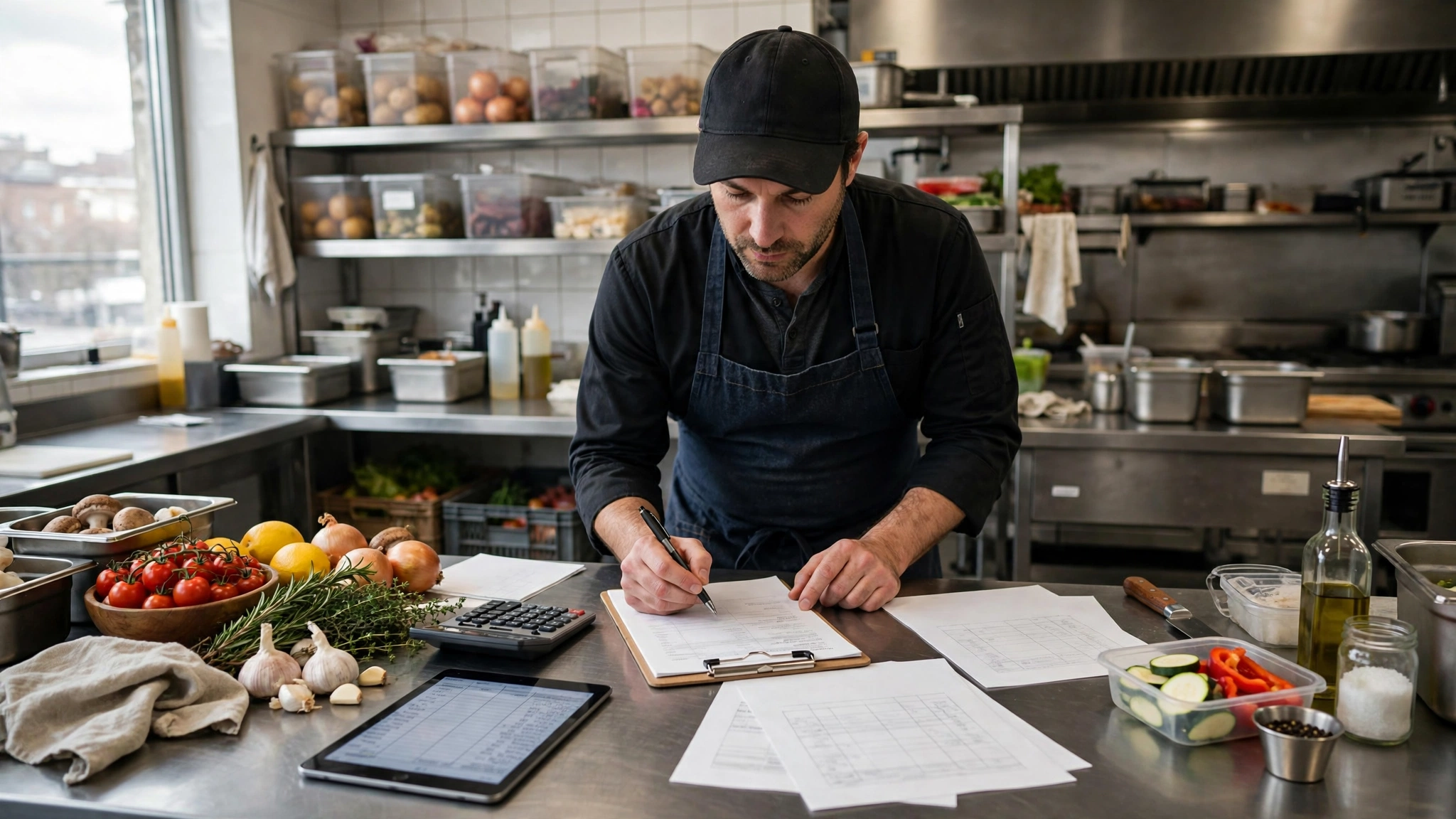
Food Cost & Profitability
Food cost is not controlled by one calculation at month-end. It is controlled by a chain of daily operating decisions: what you buy, what you receive, how you store it, how you portion it, what you waste, and whether the selling price still makes sense.
Start with the right food-cost formula
For a period, the basic actual food-cost calculation is:
Food cost % = Cost of food used ÷ Food sales × 100
Cost of food used is normally built from beginning inventory, purchases, transfers and ending inventory. The exact accounting treatment can vary, so keep your method consistent from period to period. The percentage matters, but the variance from your own expected cost matters even more.
1. Standardize every important recipe
If cooks use different quantities on different shifts, theoretical food cost has no stable meaning. Standardize ingredients, batch yield and portion size for core menu items. Record usable yield where trimming or cooking loss is significant.
- Use one approved recipe version.
- Record ingredient quantities in consistent units.
- Define the finished yield.
- Specify the serving portion.
- Update ingredient prices when supplier costs change materially.
See also: How to Standardize Recipes for Cost and Consistency.
2. Control receiving, not just ordering
A purchase order can be correct while the delivery is wrong. Receiving should verify quantity, specification, condition and price before stock enters the kitchen. Short deliveries, substitutions and unnoticed price changes can all raise food cost without appearing as kitchen waste.
3. Count high-value and high-risk items more often
You do not need to count every item every day. A practical control is to identify items that are expensive, fast-moving, easy to misuse or frequently out of stock. Count those on a tighter rhythm and use a full inventory count on a fixed weekly or monthly schedule.
For a broader system, read Restaurant Inventory Management Basics for Operators.
4. Separate waste from normal yield loss
Trim loss, cooking loss, spoilage, overproduction, returned food and preparation mistakes are not the same problem. Record them separately when practical. If all loss is placed in one “waste” bucket, managers cannot identify the root cause.
5. Protect portion control
Small over-portions repeated hundreds of times become a large cost. Use scales, ladles, scoops, portion bags, slicer settings or visual standards where appropriate. The objective is not to make service mechanical; it is to make the guest experience and the cost repeatable.
6. Compare actual cost with expected cost
Actual food cost tells you what happened. Expected or theoretical food cost estimates what should have happened based on standard recipes and sales mix. The gap between the two is where operators should investigate.
- Receiving errors
- Unrecorded waste
- Recipe or portion drift
- Incorrect inventory counts
- Price changes not updated in recipes
- Staff meals or transfers not recorded
7. Review weekly before waiting for the P&L
A monthly P&L is useful, but it is too slow for many operational corrections. A short weekly review can combine purchases, sales, key inventory movements, waste and major supplier-price changes. The purpose is to catch drift while the cause is still visible.
A simple weekly food-cost routine
- Update major supplier prices.
- Review unusual purchase quantities.
- Count priority inventory items.
- Review waste and void patterns.
- Check portion and recipe compliance.
- Compare actual results with expected performance.
- Assign one corrective action for the next week.
Manager takeaway
Do not manage food cost as a single percentage. Manage the operating controls that create that percentage.