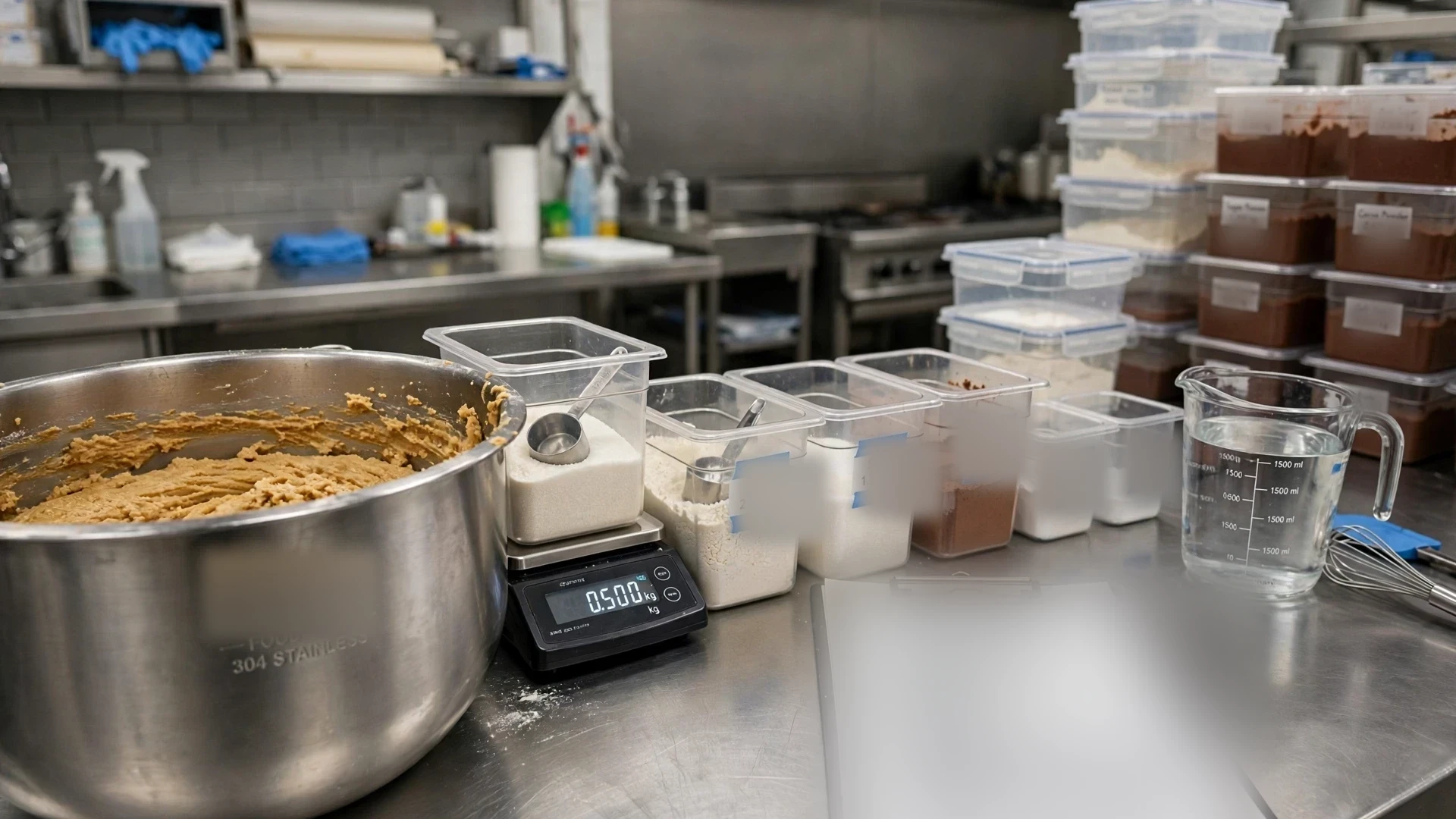
Scaling a recipe is arithmetic; producing a batch is a process
Multiplying ingredient quantities does not guarantee the same product at a larger scale. Vessel size, mixing energy, heat transfer, evaporation, cooling time and holding all change as batch size grows. A batch recipe therefore needs both a formula and a production method: target yield, maximum vessel load, order of addition, processing checkpoints, finished weight or volume, portion expectation and release standard.
The safest operating rule is to scale only within a tested range. When volume exceeds that range, run multiple validated batches instead of assuming the largest pot or mixer should be filled to capacity.
Define the batch unit before multiplying anything
Choose a standard batch such as 10 kg finished sauce, 40 liters of soup or 80 portions of dough. Base scaling on the production unit that the kitchen can repeat with existing equipment. Record expected raw input and expected finished yield so the batch can be checked after cooking, not only before.
Avoid informal instructions like “double the recipe” when staff may start from different source recipes or pan sizes. The batch sheet should state the exact base version and the permitted multiplier.
Separate linear ingredients from process-sensitive ingredients
Many ingredients scale proportionally, but some do not behave perfectly linearly. Salt, thickeners, leavening, acids, spices and reduction-sensitive liquids may need tested adjustments depending on the recipe. The correct approach is not to guess a universal scaling factor; it is to validate the large batch and record the tested quantity.
Flag process-sensitive ingredients on the batch sheet and add a tasting or physical checkpoint before final adjustment. That reduces the risk of trying to rescue an entire production run at the end.
Equipment capacity sets the real batch ceiling
A mixer, kettle, stockpot, braising pan or oven has a practical working capacity that can be lower than its physical volume. Overfilling can produce uneven mixing, boil-over, slow heating, inconsistent reduction or unsafe handling. Define the tested working load for each production method and make that capacity visible in prep planning.
When demand exceeds the tested batch ceiling, schedule multiple lots and sequence them. A reliable two-batch process is usually better than one oversized batch that behaves differently every time.
Stage ingredients to protect sequence and traceability
Pre-stage ingredients by batch, not by the entire day, when confusion or allergen risk is possible. Label weighed components, separate ingredients that enter at different stages and verify high-impact ingredients before they are added. A simple two-person check for salt, allergens or expensive proteins can prevent a large write-off.
Use lot or supplier traceability where required by the operation, especially for high-risk ingredients and central production. The batch record should make it possible to identify what went into the finished lot if a quality problem appears later.
Control the process with checkpoints
The best checkpoints depend on the product. Sauces may use temperature, reduction volume and viscosity; dough may use finished dough temperature and weight; soup may use yield and seasoning; braises may use cooked weight and tenderness. Choose a few observable release criteria instead of vague “cook until done” instructions.
Record the actual result for the first batch of a shift or for any batch outside the normal range. Repeated deviations point to equipment, ingredient or method changes that should be investigated.
Yield is the bridge to costing and portions
Record finished usable yield after the batch is cooked and trimmed. Cost per unit of finished yield = total batch ingredient cost divided by usable finished yield. If the recipe is portioned, divide the usable yield by standard portion size to estimate portions. Compare actual portions with expected portions to detect over-reduction, loss, inaccurate scaling or portion drift.
For a deeper yield test, connect the batch record to the restaurant’s recipe-costing and yield tools rather than maintaining disconnected numbers.
Cooling and holding must be designed into the batch
Large batches can create food-safety risk because the mass cools or heats differently from a small recipe. Follow the restaurant’s approved food-safety plan and local rules for cooking, cooling, reheating and holding. The production sheet should specify approved pan depth, portioning, cooling method, labeling and storage destination where applicable.
Do not increase batch size if the operation cannot cool, hold or store the finished product within its safe procedure. Production capacity includes downstream handling, not just the cooking vessel.
Example: sauce scaled beyond the tested kettle load
A sauce that works at 20 liters is multiplied to 50 liters in the same kettle. The batch takes longer to heat, reduction is uneven and the cook adds extra thickener to compensate, creating a different product. The better response is to define 20 liters as the validated batch and schedule three lots, or formally test a new larger-kettle method before changing the standard.
The lesson is that batch size is a process parameter, not just a quantity field.
Batch production record
- Recipe and version.
- Batch number/date/time.
- Target finished yield.
- Permitted multiplier and vessel/equipment.
- Ingredient quantities with process-sensitive items highlighted.
- Critical sequence/checkpoints.
- Actual finished yield and release result.
- Cooling/holding destination where applicable.
- Operator and verifier initials for designated checks.
Common batch failures
- Scaling from an outdated recipe version.
- Filling equipment beyond the tested working capacity.
- Adding all ingredients at once because the quantities were pre-weighed.
- Using taste alone when yield or temperature is the real control.
- Skipping finished-yield measurement.
- Producing more than the cooling or storage system can safely handle.
- Letting staff “fix” every batch differently instead of updating the validated method.
FAQ
Q: Can every recipe be doubled? A: No. Ingredient behavior and process conditions may change; validate the larger batch.
Q: Is the largest batch always the most efficient? A: Not if it creates quality, cooling, handling or rework problems.
Q: What should be measured after cooking? A: At minimum the release criteria that matter for the product, often including finished yield.
Q: How do I know whether to run one big batch or several smaller ones? A: Use tested equipment capacity, process consistency, cooling/holding capability and demand timing.
Next action
Choose one high-volume prep item and convert it from a loose recipe into a controlled batch sheet. Define the base batch, tested multiplier, vessel, sequence, two or three checkpoints and finished yield. Run it for several production cycles and revise only when measured results show the standard needs to change.
Version control prevents “same recipe, different batch”
Put a version date or revision number on the batch sheet. When ingredient specification, vessel, cook method or target yield changes, update the version and retire old copies. Kitchens that keep several printed versions create invisible variation even when every cook believes they are following the standard.
Record the reason for a revision—supplier change, yield correction, equipment replacement or sensory adjustment. This makes later costing and troubleshooting much easier.
Use a first-batch release on high-risk production days
When a new operator, new ingredient lot, new equipment setting or unusually large production day is involved, designate the first batch as a verification batch. Check yield, texture, temperature or other product-specific criteria before the remaining production is committed.
A ten-minute pause after the first batch can prevent hours of rework. Once the process is stable, normal sampling can resume.
Additional operating detail
Batch planning should connect to the prep schedule. If a validated batch takes 55 minutes from staging to finished cooling, the prep list must start it early enough to meet service without rushing the final steps. Work backward from the required ready time and include realistic equipment queues. This prevents the common situation in which a recipe is technically standardized but operational timing still forces shortcuts.
When a batch fails release criteria, record the disposition. Rework, hold for review, downgrade to another approved use or discard according to the operation’s policy. The important point is traceability: a failed batch should not quietly disappear into normal production, because that erases the evidence needed to improve the process.
Let equipment capacity set the true batch size
A recipe can be mathematically scalable and still fail operationally. Before multiplying a formula, identify the limiting step in the real process: mixer fill, kettle agitation, pan depth, oven airflow, chilling surface area, holding capacity or the time staff can handle product safely between stages. The smallest practical limit usually determines the real batch size. If expected demand exceeds that capacity, schedule two or more controlled batches rather than forcing one oversized run. Repeated smaller batches also make yield and quality easier to compare and help isolate a problem to a specific lot if something goes wrong.
Control the handoff after production with the same discipline as mixing and cooking. Define how the finished batch is identified, what label or batch reference it receives, where it moves next, what quantity is released for service and what remains held or chilled under the operation’s procedure. Large-batch failures often occur after cooking when product is staged without a clear destination or when the next shift cannot tell which batch should be used first. A batch ID or time mark is useful when traceability matters because it connects finished product back to the recipe version, production record and later yield or quality review.
Review batch economics after the method is stable
Once the batch process is repeatable, compare expected yield, actual yield, labor time and loss between batch sizes. The largest batch is not automatically the most efficient. A very large run may create longer heating or cooling time, more residue left in equipment, more handling loss or more rework if a mistake occurs. A smaller batch may use slightly more setup labor but protect quality and reduce the financial exposure of one failed lot. Use several normal production runs before changing the standard so the decision is based on typical performance rather than one unusually good or bad day. Record the selected batch size in the recipe or production standard together with the equipment it assumes. If the restaurant changes mixer, vessel, oven or cooling method, retest the standard because the old capacity assumption may no longer be valid.
Define the stop rule for a bad batch
Every large-batch procedure should state when production must stop for review. Unexpected yield, wrong ingredient addition, equipment failure, missed process step, abnormal texture or an unresolved food-safety concern should not be pushed forward simply because the batch is large. Isolate and identify the affected lot, escalate according to the operation’s procedure and protect later batches from inheriting the same error. A clear stop rule is cheaper than multiplying one mistake across the rest of the production run.
Record the batch release quantity
At the end of production, reconcile what the batch was expected to yield with what was actually released, held, reworked or discarded. Even a simple quantity bridge makes unexplained loss visible and gives the next recipe-cost review evidence to work with.
Additional topic-specific operating notes
- critical process times and temperatures handled by the site food-safety program
- Scale factor = required yield / standard recipe yield
- Expected ingredient quantity = base quantity × scale factor
- Yield variance = actual finished yield – expected finished yield
- Portion count = usable finished yield / standard portion size
- calculate required finished quantity from forecast and par
- choose a batch size that fits equipment and handling capacity
- follow the tested sequence rather than combining steps casually
- record variance and adjust the standard only after repeated evidence
A soup recipe yields 20 liters in its tested form, but the kitchen needs 50 liters. A 2.5× multiplication may exceed the kettle’s effective working capacity or change heat-up time. The production plan therefore uses controlled sub-batches and combines them only where the recipe and food-safety procedure allow.
Manager release gate: decide whether the batch can enter service
Before a large batch leaves production, the kitchen lead should make a deliberate release decision. The point is not another signature; it is to prevent a batch with an unresolved yield, process or handling problem from becoming a service problem.
| Check | Evidence to compare | Release | Hold and investigate |
|---|---|---|---|
| Scale | Base yield, target yield, permitted multiplier | All quantities came from the same approved factor | Mixed recipe versions, manual additions or an unapproved multiplier |
| Process | Sequence, vessel, key time/temperature or product-specific checkpoint | Batch followed the validated method | Missed step, equipment fault or process condition outside the approved method |
| Finished yield | Expected versus actual usable weight, volume or portions | Variance is understood and acceptable for the product | Unexplained loss or gain large enough to affect portioning, cost or consistency |
| Quality | Product-specific release criteria such as texture, viscosity, seasoning or doneness | Criteria are met without unmeasured correction | Staff are trying to rescue the batch by adding ingredients without a controlled adjustment |
| Handoff | Containers, labels, destination, first-use sequence and holding/cooling plan | The next step is identified and can be executed safely | No clear destination, labeling gap or downstream capacity problem |
Troubleshoot by the point where the batch first drifted
- Wrong quantity before production: stop and reconcile the recipe version, scale factor and weighed ingredients before anything else is added.
- Process slows or behaves differently: check vessel load, heat transfer, mixer performance, pan depth or equipment queue before changing the formula.
- Finished yield misses target: record the actual yield, then inspect reduction, trim, residue, transfer loss and portion assumptions instead of immediately rewriting the recipe.
- Quality differs between containers: determine whether mixing, holding, portioning or the order of filling caused separation before blaming ingredient quantities.
- The same deviation repeats: treat it as a standard problem. Retest the batch size or method, document the result and issue a new recipe version rather than relying on shift-by-shift fixes.
For planning and verification, use the Restaurant Operator Lab tools library together with the related yield-testing guide. The useful chain is simple: required finished quantity → approved batch size → number of batches → actual finished yield → portions released. That makes production capacity, cost and service availability traceable to the same batch record.