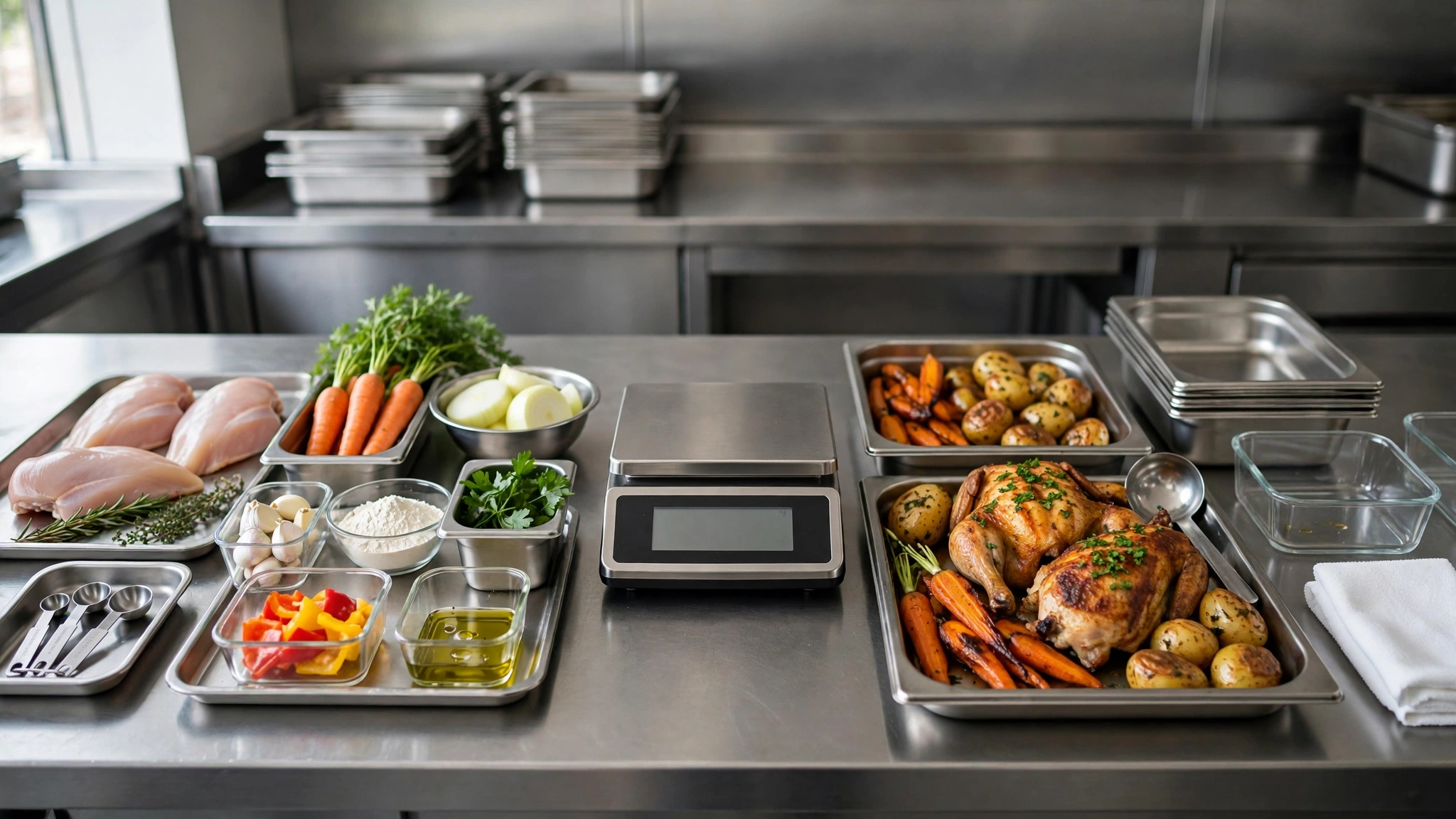
A restaurant can buy an ingredient for one price and still pay a very different price for the amount that actually reaches the plate.
The reason is yield.
Trim, bones, skin, peeling, cleaning, cooking loss, evaporation and portioning can all reduce the usable quantity of an ingredient. If recipe costing ignores those losses, the dish cost may look lower than it really is.
A yield test measures what the restaurant actually gets from a purchased ingredient and turns that result into a usable cost for recipes, purchasing and food-cost control.
What a yield test measures
A yield test compares the quantity purchased with the quantity that remains usable after preparation or cooking.
The basic formula is:
Yield % = Usable quantity ÷ Purchased quantity × 100
Illustrative example:
- Purchased beef: 10 kg
- Usable trimmed beef: 8.4 kg
8.4 ÷ 10 × 100 = 84% yield
That means 16% of the purchased weight did not remain as usable trimmed product.
Why yield changes the real cost
Suppose the 10 kg of beef cost $60.
Purchase cost per kilogram:
$60 ÷ 10 = $6.00 per purchased kg
But only 8.4 kg is usable.
Usable cost per kilogram:
$60 ÷ 8.4 = $7.14 per usable kg
If the restaurant costs the recipe at $6.00 per kilogram instead of $7.14, it understates the real ingredient cost.
Purchased weight and edible weight are not the same thing
It helps to separate two quantities:
- AP quantity — the amount as purchased,
- EP quantity — the edible or usable amount after normal preparation loss.
The terminology is common in foodservice costing because it makes the difference explicit.
If 20 kg of whole vegetables becomes 16 kg after trimming and cleaning:
AP = 20 kg
EP = 16 kg
Yield = 80%
Use the right type of yield test
Not every ingredient needs the same kind of test.
Three common types are:
- trim yield,
- cooking yield,
- full production yield.
The correct method depends on where the loss occurs and how the recipe is portioned.
Trim yield
Trim yield measures loss before cooking.
This is useful for ingredients such as:
- whole meat cuts,
- fish,
- fresh vegetables,
- fruit,
- products requiring peeling or deboning.
Example:
- Whole fish purchased: 12 kg
- Usable fillet after cleaning: 6.9 kg
6.9 ÷ 12 × 100 = 57.5% trim yield
The recipe should not be costed as if all 12 kg becomes sellable fillet.
Cooking yield
Cooking yield measures the weight remaining after cooking.
This matters for items that lose moisture or fat during cooking.
Examples include:
- roasted meat,
- grilled chicken,
- braised products,
- rice,
- pasta,
- fried products,
- sauces that reduce.
Illustrative example:
- Raw usable meat before cooking: 8.4 kg
- Cooked usable meat: 6.7 kg
6.7 ÷ 8.4 × 100 = approximately 79.8% cooking yield
Full production yield
Sometimes the restaurant needs to measure the entire path from purchase to finished usable product.
Using the previous beef example:
- Purchased weight: 10 kg
- Trimmed usable weight: 8.4 kg
- Cooked usable weight: 6.7 kg
Overall yield from purchase to cooked product:
6.7 ÷ 10 × 100 = 67%
If the restaurant portions the beef after cooking, this 67% overall yield is often more relevant to the finished portion cost than the trim yield alone.
Calculate the true cooked cost
If the original 10 kg cost $60 and the finished usable cooked weight is 6.7 kg:
$60 ÷ 6.7 = $8.96 per cooked usable kg
This is significantly different from the original $6.00 purchase cost per kilogram.
That difference is why yield testing matters.
Use a scale, not visual estimates
A yield test should be measured.
For weight-based ingredients, use a calibrated scale and record:
- gross purchased weight,
- packaging weight if relevant,
- trim weight,
- usable raw weight,
- cooked weight,
- usable finished weight.
Visual estimates are not reliable enough for cost control.
Remove packaging from the test
If a product arrives in a container, vacuum bag or tray, make sure packaging weight is not accidentally included in the usable ingredient weight.
For some products, a large amount of purge liquid or ice can also distort the result.
Define exactly what the purchased quantity represents before calculating yield.
Run the test using normal kitchen methods
A yield test should reflect the way the restaurant actually prepares the product.
Do not use unusually careful trimming during the test if the line normally trims differently.
Do not cook at a different temperature just to improve the result.
The goal is to measure the real process, not create an idealized number.
Use the employee and equipment normally involved
Yield can change because of:
- knife skill,
- trimming method,
- equipment,
- cooking time,
- temperature,
- holding time,
- product quality.
If the restaurant’s normal process is inconsistent, one yield test may not be enough.
Repeat the test
One test can be distorted by an unusual batch.
For important ingredients, run multiple tests across different deliveries or production days.
Then calculate an average.
Example:
| Test | Purchased weight | Usable weight | Yield |
|---|---|---|---|
| 1 | 10 kg | 8.3 kg | 83% |
| 2 | 10 kg | 8.5 kg | 85% |
| 3 | 10 kg | 8.4 kg | 84% |
Average yield:
(83% + 85% + 84%) ÷ 3 = 84%
This may be more reliable than building the recipe around one test.
Separate normal trim from avoidable waste
Yield testing should measure expected preparation loss, not hide poor execution.
Examples of normal yield loss:
- bones,
- inedible skin,
- necessary vegetable trim,
- normal moisture loss during cooking.
Examples of avoidable waste:
- excessive trimming,
- burned product,
- overcooking,
- incorrect cutting,
- unnecessary discard of usable product.
If avoidable waste is built into the standard yield, the restaurant can normalize bad performance.
Record by-product value when it is genuinely reused
Some trim has real operational value.
Examples:
- bones used for stock,
- vegetable trim used for broth,
- bread ends used for crumbs,
- fat rendered for another approved use.
If the by-product is consistently reused and has meaningful value, management may choose to account for it separately.
But avoid creating complicated theoretical credits for trim that is only occasionally used.
Yield affects portion cost
Suppose cooked beef costs $8.96 per usable kilogram.
A standard cooked portion is 180 g.
Portion cost:
0.180 kg × $8.96 = approximately $1.61
If the restaurant had incorrectly used the $6.00 purchase cost per kilogram:
0.180 kg × $6.00 = $1.08
The recipe would understate the cost by approximately $0.53 per portion.
Across 1,000 portions, that becomes approximately $530 of hidden cost in this illustrative example.
Yield affects purchasing quantities
If a recipe needs 50 kg of usable product, the restaurant must buy more than 50 kg when yield is below 100%.
The formula is:
Required purchase quantity = Required usable quantity ÷ Yield %
If 50 kg usable product is required and yield is 84%:
50 ÷ 0.84 = approximately 59.52 kg to purchase
Without the yield adjustment, the purchasing plan could leave the kitchen short.
Yield affects par levels
Inventory pars should reflect usable demand and the way the product is purchased.
If the kitchen needs 20 kg of usable trimmed product but the item is purchased untrimmed with an 80% yield, the purchasing quantity should be based on:
20 ÷ 0.80 = 25 kg purchased product
This connects yield directly to inventory planning.
See our Restaurant Inventory Par Levels guide for the broader planning process.
Yield affects supplier comparisons
Two suppliers can quote different prices for products that produce different usable yields.
Illustrative comparison:
| Supplier | Purchase price/kg | Yield | Usable cost/kg |
|---|---|---|---|
| A | $5.00 | 80% | $6.25 |
| B | $5.40 | 90% | $6.00 |
Supplier B appears more expensive at purchase but produces the lower usable cost in this example.
This is why supplier decisions should consider yield, specification and consistency—not just invoice price.
Our Restaurant Supplier Scorecard guide shows how to evaluate vendor performance more broadly.
Yield can expose poor specification
If yield is consistently weak, the problem may not be kitchen technique.
It may be the product specification.
Examples:
- too much external fat,
- inconsistent sizing,
- poor trimming at source,
- excess ice or purge,
- variable maturity or quality,
- incorrect grade.
A yield record gives the restaurant evidence to discuss with the supplier.
Track yield by supplier when quality varies
If the same ingredient is purchased from multiple vendors, compare actual yield.
A supplier with a higher quoted price may produce:
- less trim,
- better portion consistency,
- lower prep labor,
- more usable servings.
That can make the higher-priced item economically stronger.
Yield can also affect labor
Whole or less-processed ingredients may be cheaper but require more preparation.
A more processed product may cost more per purchased kilogram but reduce:
- trim labor,
- training complexity,
- yield variation,
- prep time,
- waste handling.
When comparing product formats, consider both usable food cost and operational labor.
Use yield tests for proteins first
For many restaurants, proteins have the greatest financial impact.
High-priority yield-test candidates include:
- beef cuts,
- whole chicken,
- fish,
- lamb,
- seafood,
- roasted or braised meats.
Small percentage differences on expensive, high-volume ingredients can materially affect food cost.
Vegetables also matter when trim is significant
Vegetable yield should be tested when:
- trim is large,
- the ingredient is used heavily,
- quality varies by supplier or season,
- the restaurant portions by usable weight.
Examples include:
- pineapple,
- avocado,
- whole lettuce,
- root vegetables,
- whole onions,
- fresh herbs in large volume.
Do not waste time yield-testing everything
Yield testing should be proportional to financial importance.
There is little value in spending management time measuring negligible trim on a low-cost ingredient.
Prioritize ingredients that are:
- expensive,
- high volume,
- highly variable,
- heavily trimmed,
- significantly affected by cooking loss.
Measure batch recipe yield too
Yield testing is not limited to raw ingredients.
Batch recipes should also have a measured finished yield.
Examples:
- soup,
- sauce,
- dough,
- marinade,
- stock,
- rice,
- dessert base.
Suppose a sauce batch costs $28 and the finished usable yield is 7 kg.
$28 ÷ 7 = $4.00 per usable kg
If one portion uses 50 g:
0.05 kg × $4.00 = $0.20 per portion
Use finished volume when weight is not practical
Some recipes are easier to measure by volume or portion count.
For example:
- 12 liters finished soup,
- 40 portions of dessert,
- 60 bread rolls,
- 30 sauce cups.
The principle is the same: divide total batch cost by the actual finished usable yield.
Check whether holding changes yield
Some products continue to lose quality or moisture during holding.
If the restaurant cooks a product at 3:00 p.m. and serves it through 9:00 p.m., the usable yield at service may differ from the immediate post-cook yield.
For important products, test yield at the point the portion is actually served.
Cooking method can change economics
The same ingredient may produce different yields under different cooking methods.
For example:
- low-temperature roast,
- high-temperature roast,
- braise,
- grill,
- fry.
A slightly slower cooking method that retains more usable weight may improve portion economics, provided quality and operational capacity remain acceptable.
Do not chase yield at the expense of quality
The objective is not maximum weight retention at any cost.
A product that retains more water but delivers worse texture, flavor or safety performance is not automatically better.
Yield must support the restaurant’s quality standard.
Use yield to audit recipe standards
Suppose a recipe assumes 75% cooked yield but repeated production tests show 67%.
The restaurant should investigate:
- is the recipe assumption outdated?
- is the kitchen overcooking?
- has the supplier specification changed?
- is holding loss higher than expected?
- is the testing method inconsistent?
Do not simply change the standard until the cause is understood.
Connect yield with actual-versus-theoretical food cost
If the theoretical recipe assumes an unrealistic yield, actual food usage will appear worse than expected.
That can create a false variance.
Accurate yield standards improve the quality of theoretical food-cost calculations.
See our Actual vs Theoretical Food Cost guide for the full variance process.
Yield tests should have a version date
Record when the test was performed.
Yield may change when:
- supplier changes,
- product grade changes,
- pack size changes,
- prep method changes,
- equipment changes,
- portion specification changes.
A result from two years ago may no longer represent the current operation.
A practical yield-test sheet
| Field | Example |
|---|---|
| Ingredient | Beef striploin |
| Supplier | Supplier A |
| Purchase weight | 10.00 kg |
| Trim weight | 1.60 kg |
| Raw usable weight | 8.40 kg |
| Cooked usable weight | 6.70 kg |
| Purchase cost | $60.00 |
| Overall yield | 67% |
| Cooked usable cost/kg | $8.96 |
The figures above are illustrative.
Run a yield test step by step
- Choose the ingredient and normal supplier specification.
- Record the purchase cost and gross purchased quantity.
- Remove packaging and record the true product weight.
- Prepare the ingredient using the normal kitchen method.
- Record trim and raw usable weight.
- Cook using the normal standard where relevant.
- Record cooked usable weight.
- Calculate trim, cooking and overall yield.
- Calculate usable cost per unit.
- Repeat the test if the ingredient is important or variable.
- Update recipe-cost and purchasing standards if the result is reliable.
Use tolerance ranges for variable ingredients
Natural products are not identical.
Instead of pretending yield is always exactly 84.0%, the restaurant may use an acceptable range.
For example:
Expected yield: 82%–85%
If repeated results fall below the range, investigate the product or process.
This is more practical than treating every small difference as a failure.
Investigate sudden yield deterioration
If an ingredient normally yields 84% and suddenly drops to 76%, check:
- supplier or product change,
- employee trimming method,
- product size,
- quality variation,
- scale accuracy,
- recording error.
A sudden yield change can be an early warning of a purchasing or training problem.
Compare yield with waste logs
If trim or cooking loss is unusually high, check whether some of the difference is actually avoidable waste.
Our Restaurant Waste Log guide can help separate normal yield loss from operational waste.
Connect yield with portion control
Accurate usable cost is only one half of the control.
The other half is serving the correct portion.
If the usable cost is $8.96 per kilogram and the recipe standard is 180 g, but the kitchen serves 210 g, the restaurant still loses control.
Yield determines the real unit cost.
Portion control determines how much of that unit cost goes onto each plate.
Use yield in menu pricing decisions
A menu item priced from raw purchase cost can appear more profitable than it really is.
Once yield-adjusted cost is added, management may discover that:
- the selling price needs review,
- the portion is too large,
- the product specification is inefficient,
- a different supplier produces better usable economics.
See our Menu Item Profitability guide for how cost connects to contribution margin.
Document the test so another manager can repeat it
A useful yield test should record:
- date,
- ingredient,
- supplier,
- product specification,
- employee performing prep,
- cooking method,
- all measured weights,
- calculated yields,
- purchase cost,
- usable cost.
If another trained manager cannot repeat the method, the standard is too dependent on one person.
Review yield when supplier performance changes
A supplier can continue sending the same named product while the usable performance deteriorates.
Yield testing gives procurement a measurable way to detect that change.
It can also support supplier conversations with evidence instead of opinion.
The goal is not a perfect percentage
A yield test is valuable because it makes invisible loss visible.
It tells the restaurant how much usable product it actually receives, what that usable product truly costs and whether the current recipe, supplier and prep method still make financial sense.
For high-value ingredients, that information affects purchasing, portioning, food cost, menu pricing and profitability at the same time.
When yield is measured instead of guessed, recipe costing becomes much more trustworthy.
Track yield variance against the approved standard
Once a standard yield is approved, compare production tests with that benchmark rather than treating every result in isolation.
Yield variance % = Actual yield % − Standard yield %
If the approved yield is 84% and the latest test produces 78%, the variance is −6 percentage points. Repeated unfavorable variance should trigger a review of supplier specification, prep technique, equipment, holding or measurement.
Define when a yield test must be repeated
Retest important ingredients after a supplier change, product-grade change, major price movement, equipment change, recipe change or repeated variance outside the accepted range. A fixed annual retest can also be useful for high-value ingredients even when no obvious change has occurred.
Use the yield and portion-cost calculator
For a quick tested batch or ingredient calculation, use the Restaurant Recipe Yield & Portion Cost Calculator. Enter starting quantity, usable quantity, total cost and standard portion size to calculate yield percentage, usable-unit cost, theoretical portions and cost per portion.
Frequently asked questions
What is the difference between AP cost and EP cost?
AP cost is based on the product as purchased. EP cost reflects the cost of the edible or usable quantity after normal preparation loss. Recipes should use the cost that matches the form in which the ingredient is actually portioned.
How many yield tests are enough?
One test may be enough for a very stable low-risk ingredient, but high-value or variable products benefit from repeated tests across normal deliveries so the standard is not built on one unusual batch.
Should poor yield automatically be blamed on the supplier?
No. Check measurement, employee technique, equipment, cooking method and product specification before assigning the cause.
Operational note: The formulas and examples in this guide are illustrative. Yield standards should reflect your own supplier specifications, preparation methods, equipment, food-safety procedures and actual production data.