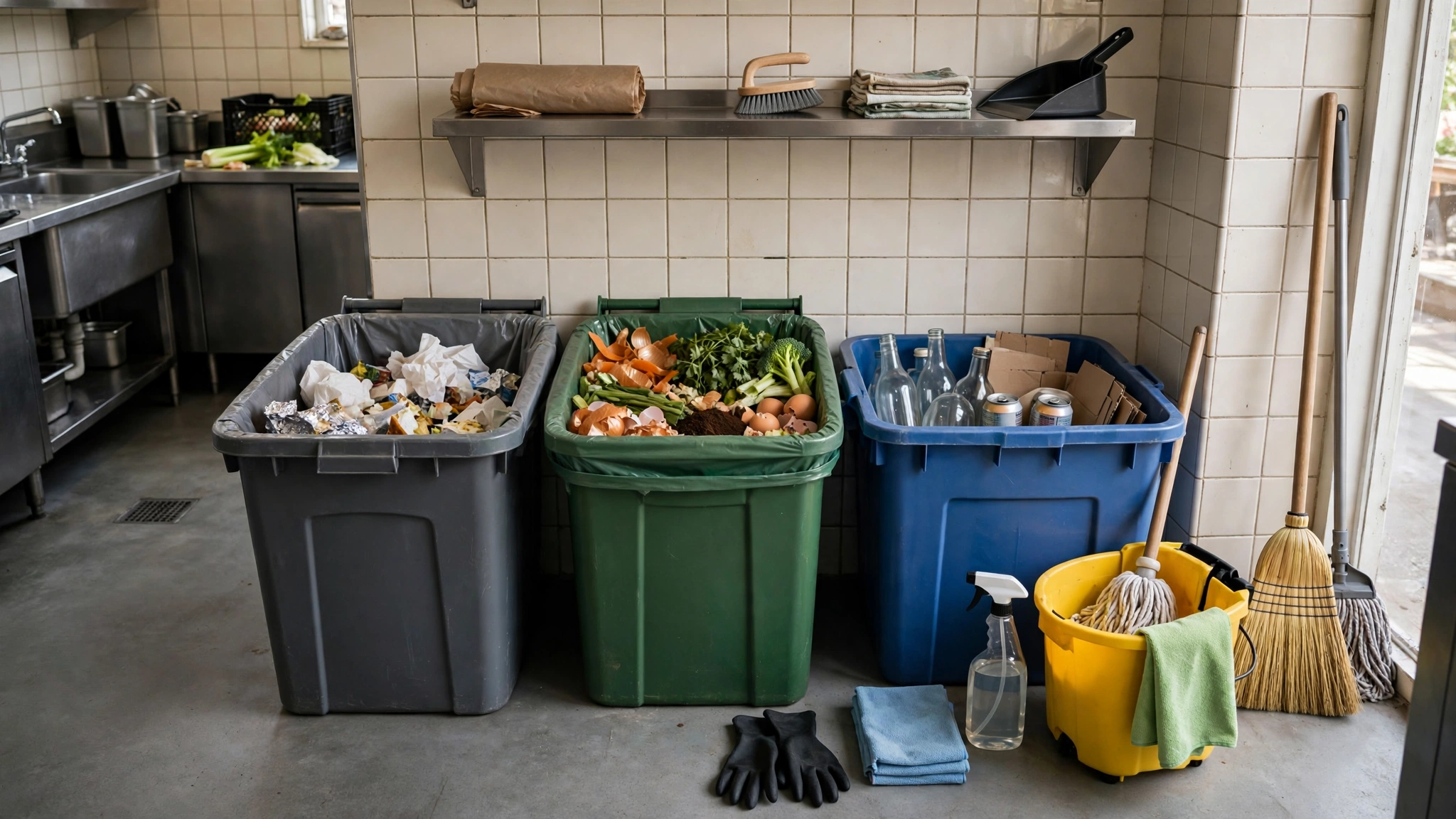
Most restaurants know they are wasting food. Far fewer can answer the more useful question: what exactly are we wasting, why are we wasting it, and how much is it costing us?
A waste log turns vague frustration into something a manager can act on.
Without a log, the same conversations repeat:
“We need to be more careful with prep.”
“We are throwing away too much chicken.”
“Why is the food cost high this month?”
Those statements may be true, but they do not tell you what to fix.
A good restaurant waste log is simple enough for the team to use during a real shift and detailed enough to reveal patterns over time. It should not feel like accounting paperwork. It should feel like an operating control.
What a restaurant waste log should record
At minimum, record:
- date,
- item,
- quantity,
- unit,
- reason for waste,
- estimated cost,
- person or station responsible for recording it.
For example:
| Item | Qty | Reason | Estimated cost |
|---|---|---|---|
| Chicken breast | 2.5 kg | Over-prepped | $10.25 |
| Tomatoes | 3 kg | Spoiled in storage | $6.60 |
| Rice | 1 tray | Cooked too early | $4.20 |
The exact format matters less than consistency.
Separate waste by reason
If every entry is simply labeled “waste,” the log will not tell you what to change.
Use a small number of clear reason codes.
A practical set might be:
- Over-prep — more product prepared than needed.
- Spoilage — product expired, deteriorated or was stored too long.
- Trim/yield loss — excessive trimming or poor usable yield.
- Cooking error — burnt, overcooked, undercooked or incorrectly prepared.
- Wrong order — item made incorrectly or duplicated.
- Customer return — returned or rejected after service.
- Damage — dropped, crushed, leaked or otherwise unusable.
- Portion error — portion too large or inconsistent.
Do not create twenty categories on day one. Staff will stop using them.
Track waste in the unit the kitchen understands
A waste log becomes unreliable when units keep changing.
Chicken might be recorded as:
- 2 pieces,
- one bag,
- half a tray,
- 1.4 kg.
That makes comparison difficult.
Choose a sensible standard unit for each important item.
For proteins, kilograms may work well. For canned products, cans may be easier. For bottled sauces, bottles or milliliters may make more sense.
The important thing is that the same item is recorded the same way every time.
Estimate the cost of waste
Quantity alone can be misleading.
Throwing away 5 kg of low-cost vegetables may matter less financially than wasting 2 kg of premium protein.
A simple calculation is:
Waste cost = quantity wasted × unit cost
If chicken costs $4.10 per kg and 2.5 kg is wasted:
2.5 × $4.10 = $10.25 waste cost
Do this consistently and the manager can rank waste by financial impact instead of emotion.
Use actual purchase cost where practical
If purchase prices move frequently, the waste cost should be updated periodically.
You do not need a perfect real-time valuation system for a small restaurant, but using an old cost from six months ago can hide the real impact.
This is especially important for:
- meat,
- seafood,
- oil,
- dairy,
- imported ingredients,
- products with volatile supplier pricing.
This is where waste tracking connects directly with food cost control.
Do not punish staff for reporting waste
This is one of the most important management rules.
If staff believe that recording waste will get them blamed, they will hide it.
Then the waste still happens, but the manager loses the information needed to reduce it.
The goal is not to make people afraid of entering a mistake. The goal is to identify repeated causes.
A single burnt tray during a difficult service is not the same as the same station burning a tray every Friday.
One is an event. The other is a system problem.
Make recording easy during service
If the waste log is locked in the office, staff will forget to use it.
Place the process where waste actually occurs.
Depending on the restaurant, that might mean:
- a clipboard near the prep area,
- a simple shared sheet on a tablet,
- a waste-entry screen in restaurant software,
- a small paper form collected at close.
The best tool is the one the team actually uses.
Review the log every day for five minutes
The waste log is useless if it is only opened at month-end.
A manager should scan it daily and look for:
- one unusually expensive item,
- repeat waste from the same station,
- unexpected spoilage,
- large over-prep,
- items being returned frequently.
This does not need a meeting.
Five minutes is often enough to catch something early.
Review patterns weekly
Daily review catches incidents. Weekly review reveals patterns.
At the end of the week, summarize waste by:
- item,
- waste reason,
- station,
- day of week,
- cost.
You may discover that:
- Friday prep is consistently too high,
- one vegetable spoils before it is used,
- one menu item has frequent returns,
- one shift is over-portioning protein,
- delivery-day product gets buried behind older stock.
Those are actionable findings.
A real-world example: the Friday chicken problem
Imagine a casual restaurant keeps recording chicken waste every Friday night.
The kitchen team assumes the problem is portioning.
The waste log shows something different.
Most entries are marked over-prep, not portion error.
The restaurant is preparing 55 kg before dinner because that is what the old prep sheet says.
But recent Friday sales only require around 44–47 kg.
The problem is not the cooks. The prep target is outdated.
A simple change to the production plan may eliminate most of the waste.
This is exactly why a waste log should connect to the restaurant prep list.
Use the log to improve par levels
Repeated spoilage often means the restaurant is holding too much stock.
Suppose fresh herbs are being discarded every Tuesday before the next delivery.
The issue may be:
- order quantity too high,
- delivery frequency too low,
- poor rotation,
- incorrect storage,
- sales volume lower than expected.
If the order quantity is the problem, adjust the par level.
A waste log should change decisions, not merely record losses.
Compare waste with inventory variance
Not all food-cost variance is waste, and not all waste is recorded correctly.
But the two should be reviewed together.
If inventory counts show a large unexplained loss in cooking oil while the waste log shows almost no oil waste, investigate further.
Possible causes include:
- portion inconsistency,
- unrecorded waste,
- receiving errors,
- counting errors,
- incorrect unit conversion.
Your weekly inventory count gives you one side of the picture. The waste log gives you another.
Track waste percentage
One useful metric is waste as a percentage of food sales.
A simple version is:
Waste cost ÷ food sales × 100
Example:
- weekly recorded waste: $420
- weekly food sales: $28,000
$420 ÷ $28,000 × 100 = 1.5%
The percentage itself is not useful without context. Different restaurant formats, menus and production systems create different normal ranges.
Use your own trend first.
If your restaurant moves from 1.8% to 1.2% while sales and quality remain stable, that is meaningful operational improvement.
Do not chase zero waste
Zero waste sounds attractive, but it is not always a sensible operating target.
Some waste is unavoidable:
- normal trimming,
- quality rejection,
- testing,
- minor breakage,
- legitimate customer returns.
The objective is not to make employees afraid to discard unsafe or poor-quality food.
The objective is to reduce avoidable waste without damaging quality, service or food safety.
That distinction is important.
Separate edible leftovers from waste decisions
Do not automatically reuse leftover food simply to reduce the waste number.
Any reuse, cooling, reheating, storage or repurposing must follow the food-safety rules and procedures applicable to the operation.
A lower waste percentage is never worth creating a safety problem.
Watch menu items with frequent returns
Waste is not always a kitchen-prep issue.
Customer returns can reveal:
- poor recipe execution,
- menu description mismatch,
- portion problem,
- quality inconsistency,
- service communication problems.
If one item is repeatedly returned, review the item itself rather than treating each return as an isolated event.
Include overproduction at closing
Many restaurants record obvious kitchen mistakes but ignore food left over at close.
That can be the most valuable waste data of all.
If six portions of rice, four portions of chicken and one tray of sauce remain unsellable every Tuesday, the production plan is telling you something.
Record closing overproduction consistently.
Then compare it with sales by day and daypart.
Use a simple weekly waste review
A manager can summarize the week with five questions:
- What item cost us the most in waste?
- What was the most common waste reason?
- Which station or process produced repeated waste?
- Was the problem purchasing, receiving, storage, prep, cooking or service?
- What one change will we test next week?
That final question matters.
If no action comes from the log, the log is just paperwork.
Common waste-log mistakes
Recording only major waste
Small repeated losses can become significant over a month.
Using vague reasons
“Kitchen waste” does not tell the manager whether to adjust prep, training, ordering or storage.
Changing units constantly
Inconsistent measurement destroys comparability.
Reviewing the log only when food cost is bad
By then, the pattern may be several weeks old.
Using the log to punish staff
This encourages under-reporting and makes the data less trustworthy.
Recording waste without cost
Quantity alone makes it harder to prioritize.
Start small
If the restaurant has never tracked waste, do not begin with every ingredient.
Start with the ten or twenty items that matter most financially.
For example:
- proteins,
- oil,
- dairy,
- high-cost produce,
- frequently spoiled prepared food.
Once the routine is stable, expand it.
A small waste log used every day is more valuable than a perfect spreadsheet nobody fills in.
The real purpose of the waste log
The waste log is not there to prove that waste exists.
Every restaurant already knows that.
Its job is to answer:
Where is the money leaking, why is it happening, and what should we change?
When the team can answer those questions consistently, food waste becomes manageable rather than mysterious.
For a broader set of reduction strategies, see How to Reduce Restaurant Waste Without Hurting Quality.
Use a Pareto view to focus management time
At the end of each week, rank waste by dollar value and calculate how much of total waste comes from the top few items or causes. Restaurants often find that a small number of recurring problems explain a large share of the cost.
A simple Pareto review prevents managers from spending equal time on every waste entry. Fix the largest repeated causes first, then work down the list.
Keep a waste action register
| Problem | Likely cause | Action | Owner | Review date |
|---|---|---|---|---|
| Friday chicken over-prep | Old prep target | Reduce Friday target and review sales | Kitchen lead | Next Monday |
| Herb spoilage | Par too high | Reduce order quantity | Purchasing | Next delivery cycle |
The log records the loss. The action register proves whether management is fixing the cause.
Frequently asked questions
Who should enter restaurant waste?
The person closest to the incident should record it where practical, while the manager reviews unusual or high-value entries. The process should be simple enough that reporting is not delayed until the end of the shift.
Should staff meals be recorded as waste?
Legitimate staff meals are better recorded as their own category rather than hidden inside waste. The objective is to distinguish approved consumption from avoidable loss.
How long should waste data be kept?
Keep enough history to identify recurring patterns by item, station, daypart and season. The appropriate retention period depends on the restaurant’s reporting system and management needs.
Operational note: Food handling, storage, reuse and disposal must follow the food-safety and legal requirements applicable to your jurisdiction and operation. Cost-reduction goals should never override food-safety requirements.