Weekly inventory counts usually fail for one of two reasons: they take too long, or nobody trusts the number at the end.
A manager starts counting after closing, gets interrupted three times, finds the same product in two places, discovers that one case was opened but never converted into units, and finally enters a number that “looks about right.”
That is not a counting problem. It is a system problem.
A good restaurant inventory count sheet should make the count faster, more repeatable and easier to review. The goal is not to count every object in the building with perfect precision. The goal is to create a reliable enough stock picture that purchasing, food cost and waste decisions improve.
Start by counting the same way every time
The fastest way to make inventory unreliable is to change the counting method every week.
Choose:
- the same count day,
- roughly the same time,
- the same storage order,
- the same unit of measure,
- the same responsible roles.
For example, if the restaurant counts every Sunday after close, keep that rhythm unless there is a clear reason to change it.
Consistency matters because a Monday morning count is not directly comparable with a Saturday-night count after a heavy service.
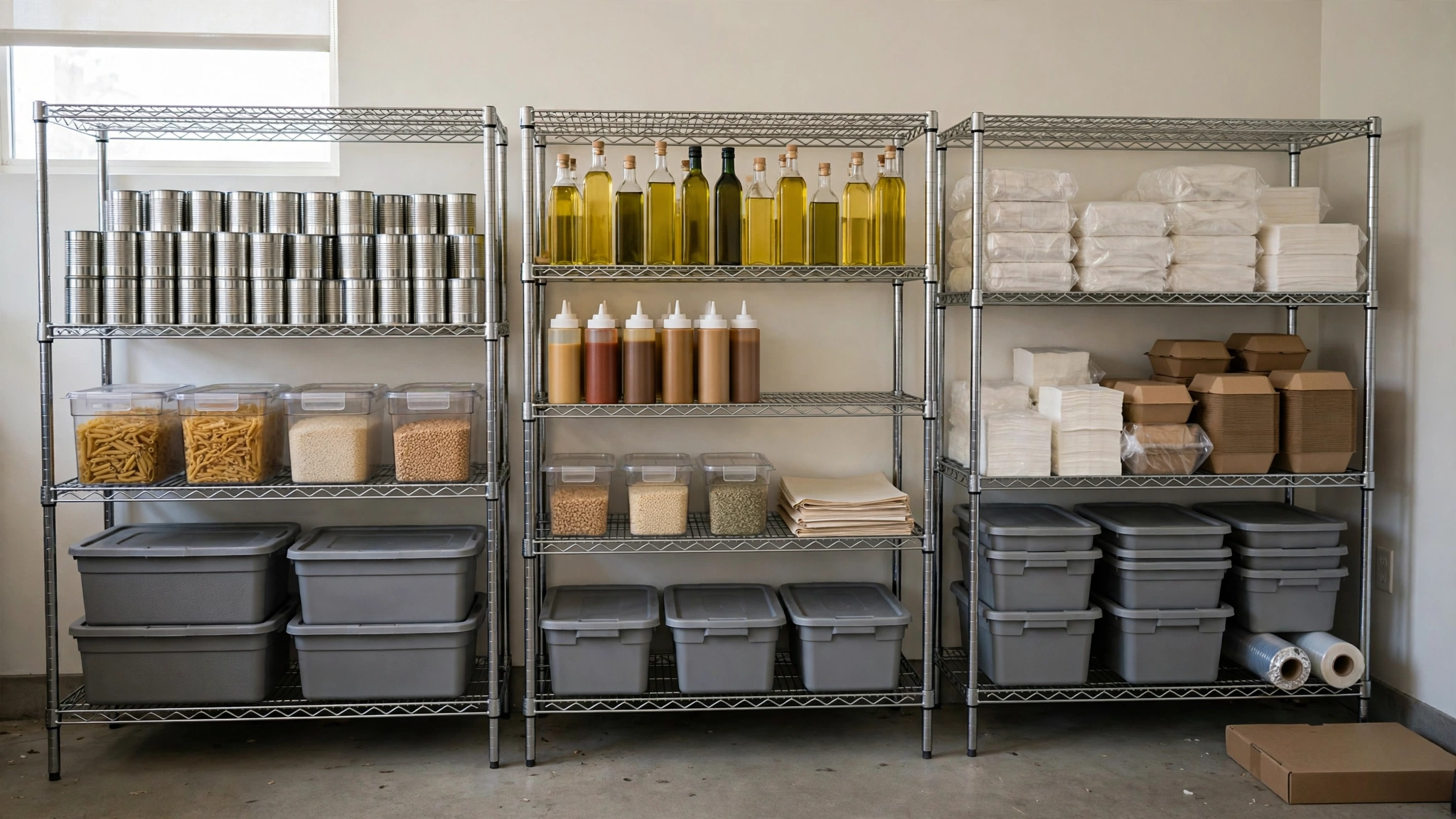
Count by physical location, not by supplier
Inventory sheets often become slow because products are listed alphabetically or by supplier while the person counting is walking through shelves, refrigerators and freezers.
A better count sheet follows the restaurant itself.
For example:
- dry storage,
- walk-in cooler,
- freezer,
- prep refrigerator,
- bar or beverage storage,
- line stock,
- backup storage.
This reduces backtracking and makes missing items easier to notice.
If the same product exists in several locations, list each location separately or build a clear rule for combining them.
Use one unit of measure per item
This sounds basic, but it causes a surprising number of bad counts.
Imagine cooking oil is purchased by case, stored by bottle and sometimes counted by liters.
If one week the sheet says “2 cases,” the next week says “9 bottles,” and another week says “18 liters,” the data becomes difficult to compare.
Choose one counting unit and stick with it.
Examples:
- chicken breast — kilograms,
- cooking oil — bottles,
- flour — kilograms,
- canned tomatoes — cans,
- soft drinks — units,
- frozen fries — bags.
The right unit is the one your team can count consistently.
Build conversion rules for partial cases
Open cases are normal. Guessing them differently every week is not.
Suppose a case contains 12 bottles.
If the restaurant counts in bottles, an unopened case simply equals 12 units.
If one case is open and contains 7 bottles, the count is 7—not “about half a case.”
For bulk products, define simple rules.
For example:
- full bag = 1.0,
- approximately three-quarters = 0.75,
- half = 0.50,
- quarter = 0.25.
The important thing is that the same approximation standard is used each time.
Do not count during heavy movement
Counting while the kitchen is still actively pulling product creates errors.
One employee counts six containers of sauce. Five minutes later, another cook removes two containers for prep. The count sheet is already wrong.
Where possible, count when stock movement is minimal.
If a section must remain active, count it last and communicate clearly with the team.
Clean storage before count day
Inventory is faster when the storage room is organized.
This is one reason good inventory management is partly a housekeeping discipline.
Before the count:
- remove empty boxes,
- discard approved waste correctly,
- group identical items together,
- move obvious duplicates into one location where practical,
- make labels visible,
- separate damaged or unusable stock.
A cluttered storeroom adds time and makes double counting more likely.
Our guide on Restaurant Inventory Management Basics covers the broader storage and counting discipline behind this process.
Use a simple count sheet structure
A practical sheet can be very simple:
| Item | Unit | Count | Unit cost | Inventory value |
|---|---|---|---|---|
| Chicken breast | kg | 38 | $4.10 | $155.80 |
| Cooking oil | bottle | 9 | $11.00 | $99.00 |
| Flour | kg | 52 | $0.85 | $44.20 |
The basic formula is:
Inventory value = count × unit cost
Once the sheet is stable, you can add columns for category, location or notes if they are genuinely useful.
Do not overload the sheet
A common mistake is trying to turn the count sheet into a complete purchasing, receiving and costing system.
If the person counting must enter supplier, invoice date, reorder point, minimum stock, last purchase price and five other fields, the count becomes slower and less accurate.
The inventory count sheet should primarily do one job:
record how much stock is physically on hand.
Other information can live elsewhere.
Use two people for high-value areas
For a small restaurant, one person can count many sections alone.
But high-value categories may benefit from a second person.
For example:
- meat,
- seafood,
- premium beverages,
- expensive imported ingredients.
One person counts. The other records or verifies.
This is especially useful when the same category has repeated variances.
Count what matters most first
Not every inventory item deserves equal management attention.
If time is limited, prioritize:
- high-value products,
- high-volume products,
- items with frequent shortages,
- items with high waste,
- products with volatile purchase prices.
A box of paper napkins matters operationally. It usually does not deserve the same counting attention as a freezer full of protein.
Compare count value, not just quantity
A quantity variance becomes more useful when translated into money.
Suppose the count is short by:
- 2 kg onions,
- 3 kg chicken,
- 1 bottle cooking oil.
Those shortages do not have equal financial importance.
Convert differences into value so the manager focuses attention where the loss is material.
Use inventory value to calculate food usage
Once inventory counts are reliable, they become useful for food-cost control.
A basic usage formula is:
Beginning inventory + purchases − ending inventory = inventory used
Example:
- Beginning inventory: $8,500
- Purchases: $12,000
- Ending inventory: $7,900
Inventory used:
$8,500 + $12,000 − $7,900 = $12,600
This is much more useful than simply looking at purchases for the week.
For the broader profitability connection, see How to Control Food Cost in a Small Restaurant.
Investigate large variances instead of recounting everything
If this week’s inventory value is dramatically different from expectation, do not immediately repeat the entire count.
Start with the biggest possible causes:
- large purchase not entered,
- wrong unit of measure,
- high-value item counted incorrectly,
- stock stored in an unusual location,
- supplier delivery not recorded correctly,
- waste not recorded,
- transfer between branches or areas.
One wrong case conversion can create a larger financial variance than twenty small counting errors.
A real-world example
Imagine a restaurant counts chicken every Sunday.
Week one shows 42 kg.
Week two shows 24 kg.
Sales were similar, and purchases were normal.
Before assuming theft or waste, the manager checks the process.
It turns out one unopened case in the freezer was missed because the sheet listed “Chicken Breast” under the walk-in section only.
The real problem was not the kitchen.
It was the count-sheet layout.
That is exactly why the physical order of the count sheet matters.
Use the same item names everywhere
Another common source of confusion is inconsistent naming.
The supplier invoice says:
Chicken Breast Fillet 2kg
The inventory sheet says:
Chicken
The recipe sheet says:
Boneless Breast
Eventually someone treats them as different products.
Standardize item names across purchasing, inventory and recipe costing where practical.
Connect receiving to inventory accuracy
A weekly count cannot fix a weak receiving process.
If the restaurant accepts four cases but records five, the inventory system starts wrong.
If the supplier substitutes a different pack size and nobody updates the unit, the count becomes confusing later.
That is why receiving and inventory control must work together.
Use the process in our Restaurant Receiving Checklist to protect the front end of the inventory cycle.
Set par levels after you trust the count
Par levels are only useful when on-hand stock is believable.
If the restaurant thinks it has 20 units but actually has 12, the reorder calculation is already wrong.
Build count discipline first. Then improve ordering with restaurant par levels.
A fast weekly inventory routine
For a small restaurant, a disciplined count can follow this sequence:
- Organize storage before counting.
- Stop unnecessary stock movement.
- Count in the same physical order.
- Use the same unit for every item.
- Record partial cases consistently.
- Verify high-value items.
- Calculate inventory value.
- Investigate major variances.
- Use the result for purchasing and food-cost review.
Use a count-sheet design that follows the room
The strongest inventory sheet is arranged in the order a person physically walks the storage area. Put section headers in the same sequence every week and list products in shelf order where practical. This reduces backtracking, missed locations and double counts.
A useful sheet can include location, item, counting unit, full-unit count, partial-unit count, total count, unit cost, inventory value and a short note field for exceptions.
| Location | Item | Unit | Full | Partial | Total | Unit cost | Value |
|---|---|---|---|---|---|---|---|
| Walk-in | Chicken breast | kg | 34 | 4 | 38 | $4.10 | $155.80 |
| Dry store | Cooking oil | bottle | 8 | 1 | 9 | $11.00 | $99.00 |
The figures above are illustrative.
Set a clear cutoff for receiving and transfers
Inventory can look wrong even when the physical count is accurate if deliveries, transfers or waste entries are posted to the wrong period. Define the cutoff that applies to the count. For example, a delivery received after the physical count should not quietly appear in the purchase total for the period being reconciled unless the accounting treatment matches that timing.
The same rule applies to inter-location transfers. If stock moves from the main storeroom to catering production before count time, both locations need to reflect that movement consistently.
Use blind counts for high-risk items when useful
If the counter sees the expected quantity before counting, there is a risk of unconsciously counting toward the expected number. For high-value or repeatedly problematic items, consider giving the person a sheet that shows the item and unit but not the expected on-hand quantity. Compare the result afterward.
This does not need to apply to every low-value item. Use it where the control value justifies the extra discipline.
Separate count accuracy from inventory variance
A bad count and a real operating variance are different problems. First make sure the physical count is reliable. Then compare actual stock with the expected stock.
If a high-value item shows an unusual difference, verify the count before investigating purchasing, waste, recipes or transfers. Once the physical number is trusted, use the inventory variance review process to trace the cause.
Recount only the exceptions that deserve it
Instead of recounting the entire restaurant, define exception rules. A recount may be appropriate when an item has a large dollar variance, an unusual percentage change, a repeated discrepancy, or a high control risk.
| Signal | Suggested response |
|---|---|
| Small one-time difference on low-value stock | Document and monitor |
| Large value difference | Immediate recount and transaction review |
| Repeated difference on same item | Recount plus root-cause investigation |
| High-value controlled item | Second-person verification |
These are operating examples, not universal thresholds. Set limits that fit your restaurant.
Use cycle counts between full weekly counts
A full weekly inventory is useful, but some restaurants benefit from shorter cycle counts for a small list of high-value or fast-moving items between full counts. Examples might include premium proteins, seafood, cooking oil, alcohol or another category that regularly creates large variances.
The purpose is not to duplicate the full count. It is to detect a problem while the events that caused it are still recent enough to investigate.
Turn the count into purchasing information
Once on-hand stock is trustworthy, compare it with par levels, upcoming demand and open purchase orders. Do not place an order from memory before the count result is reviewed.
A simple ordering reference is:
Order quantity = Target stock − Usable on-hand stock − Confirmed incoming stock
Only use this after the counting unit and purchasing unit are properly converted. If the count is in bottles and the supplier sells cases, the conversion needs to be explicit.
Document count corrections instead of overwriting history
If a number is corrected after review, keep a note of the original count, corrected count, reason and person approving the change. Silent edits make it difficult to learn whether errors are coming from counting, units, storage layout or data entry.
Weekly inventory count checklist
- Storage areas organized before count starts.
- Count time and cutoff rules confirmed.
- Stock movement minimized during the count.
- Sheet follows the physical storage route.
- Every item has one defined counting unit.
- Partial-case rules are consistent.
- High-value items receive verification where required.
- All storage locations are covered, including line and backup stock.
- Inventory value is calculated from current approved unit costs.
- Large exceptions are recounted before root-cause investigation.
- Corrections are documented rather than silently overwritten.
- Final count feeds purchasing and food-cost review.
Restaurant inventory count FAQ
How often should a restaurant count inventory?
Many operators use a full weekly count because it supports regular purchasing and food-cost review. Higher-risk items may be cycle-counted more often. The best frequency is the one the restaurant can perform consistently enough to create reliable decisions.
Should inventory be counted before or after deliveries?
Either can work if the cutoff is clear and purchases are recorded in the same period as the physical stock. Problems occur when the count and transaction timing do not match.
What is the best unit to use on an inventory sheet?
Use the unit the team can count consistently and reconcile to purchasing and recipe units. Avoid changing between cases, bottles, kilograms and other units from week to week.
How do you count partial cases?
Whenever possible, count in the smaller usable unit, such as bottles or cans. For bulk products that cannot be counted exactly, define a repeatable approximation rule and use it consistently.
Who should count restaurant inventory?
A trained employee can count routine sections, while high-value or repeatedly problematic areas may warrant a second-person verification. The key is clear ownership and a consistent method.
The goal is trust, not perfection
No physical count is perfectly precise.
The real question is whether the number is consistent enough for the owner or manager to make decisions from it.
If one week’s count says $8,000 and the next says $12,000 because different people used different units and different storage routes, the sheet is not helping.
If the count method is stable, the team starts to see patterns: over-ordering, stock-outs, unusual usage, waste and slow-moving product.
That is when inventory stops being a counting exercise and becomes an operating control.
Use the free weekly count sheet
If you want a ready-to-use single-count tool, open the Weekly Restaurant Inventory Count Sheet. It lets you enter item, unit, quantity and unit cost, then totals the counted inventory value without saving history.
Operational note: Inventory methods should be adapted to the restaurant’s products, storage conditions, accounting practices and food-safety requirements. The examples in this guide are illustrative.