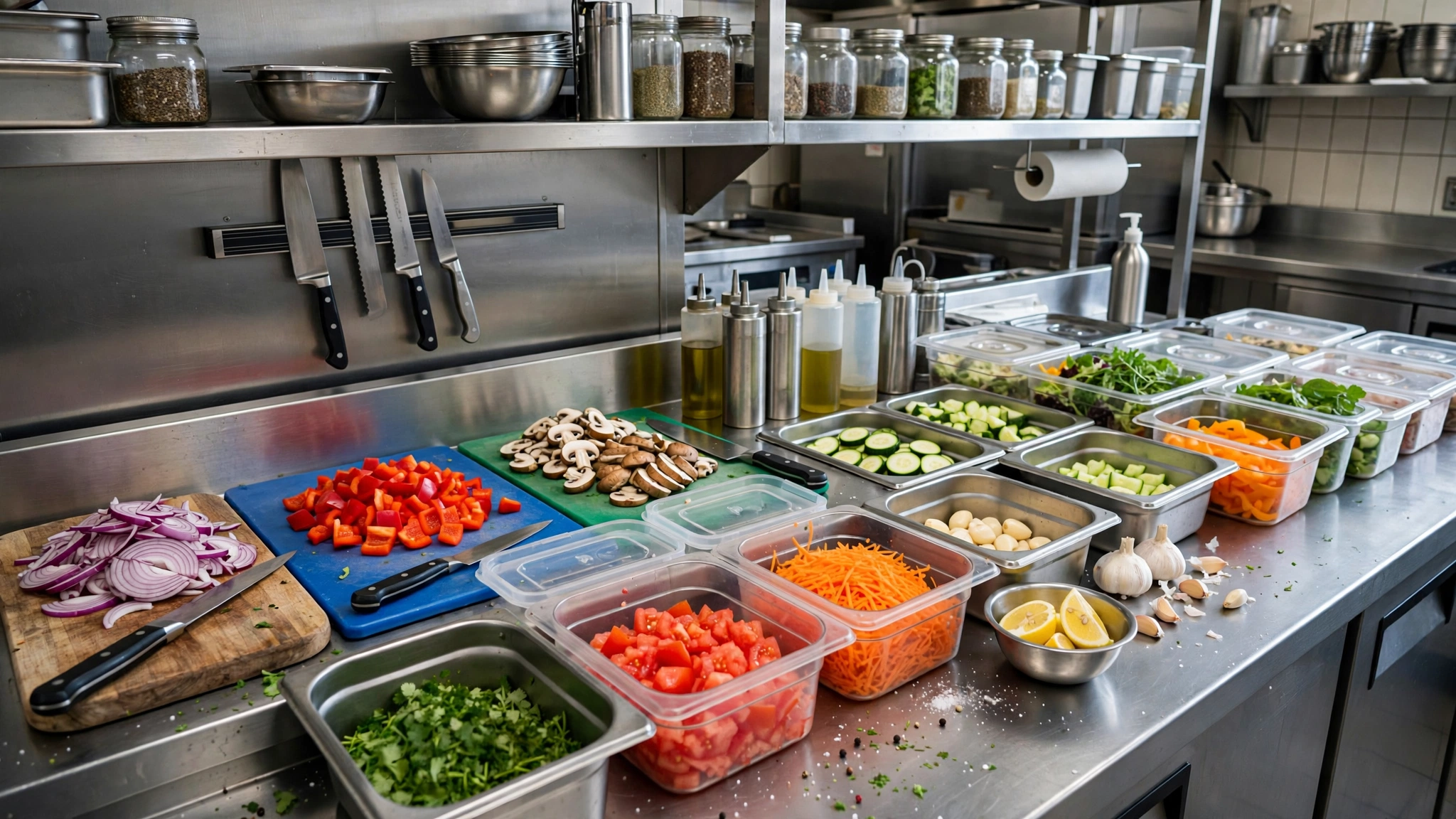
Most prep problems do not begin during the rush. They begin several hours earlier, when the kitchen prepares too much of the wrong item, too little of the right item, or simply works from habit instead of a plan.
A useful restaurant prep list is not just a checklist of things to chop, portion and cook. It is a short production plan that connects expected sales, current stock, recipe yield and the amount of food that should be ready before service starts.
When that system works, the kitchen feels calmer. When it does not, the same pattern repeats: one station runs out at 7:30 p.m., another has half a pan left at closing, and the team spends the last hour deciding whether to cook again or disappoint customers.
Quick planning formula: prep quantity = forecast demand + approved service buffer − usable prepared stock already on hand. Then convert that requirement into the restaurant’s tested recipe or batch yield, assign one owner and set a ready-by time. Use the par-level guide for raw-stock targets and the recipe-yield guide when batch output is uncertain.
What a restaurant prep list should actually do
A strong prep list should answer four questions for every important item:
- What needs to be prepared?
- How much should be prepared?
- Who is responsible?
- When should it be ready?
If the sheet only says “prep chicken,” it is not a production control. It is a reminder.
A better line would look more like:
| Item | Target | On hand | Prepare | Owner | Ready by |
|---|---|---|---|---|---|
| Marinated chicken | 24 kg | 8 kg | 16 kg | Prep cook | 3:00 PM |
| Garlic sauce | 10 L | 4 L | 6 L | Cold prep | 4:00 PM |
| Cooked rice | 6 pans | 1 pan | 5 pans | Hot kitchen | 5:00 PM |
Now the team can see what “done” means.
Start with expected sales, not yesterday’s habit
The easiest prep method is also one of the weakest: “We made 20 kg yesterday, so make 20 kg again.”
That can work on a stable weekday. It becomes dangerous when yesterday was a Tuesday and today is a Friday, when weather changes demand, when a promotion is running, or when a large reservation is expected.
You do not need sophisticated forecasting software to improve this. Even a simple review of recent comparable days is better than guessing.
Suppose the last four Fridays sold 118, 126, 121 and 132 chicken meals. If there is no special event today, preparing around the recent Friday pattern is more defensible than copying Thursday’s production.
The goal is not perfect forecasting. It is to replace memory with a repeatable reference point.
Convert forecasted sales into production quantities
This is where standardized recipes become operationally useful.
If one portion of a dish requires 180 grams of cooked chicken and you expect to sell 120 portions, the theoretical requirement is:
120 × 180 g = 21.6 kg cooked chicken
But the prep target may need adjustment for expected waste, trim loss, yield during cooking, items already prepared and a reasonable service buffer.
Do not hide poor yield behind a large “safety buffer.” If production regularly needs 15% more than the recipe suggests, investigate the recipe, portioning or cooking loss.
Our guide on standardizing recipes explains why a reliable yield is essential for both production and costing.
Subtract usable stock already on hand
Before making a new batch, check what is already available and usable.
Prep quantity = target stock − usable quantity on hand
If the kitchen wants 12 liters of soup ready for service and already has 5 liters that are still within the restaurant’s approved quality and food-safety process, the new batch requirement is 7 liters—not 12.
This is where prep planning and inventory control overlap. If the team cannot trust the “on hand” number, the prep list will always be partly guesswork.
Separate pre-service production from backup production
Not everything needs to be fully produced before the doors open.
A kitchen often works better with two levels:
- Opening quantity: what should be ready at the start of service.
- Backup quantity: what can be finished quickly if demand is stronger than expected.
Imagine a small burger shop expecting a busy dinner. Instead of cooking every possible component in advance, the team may prepare enough for the first service wave and keep properly stored backup components ready for rapid replenishment.
This protects quality and reduces the temptation to overproduce simply because “we might get busy.”
Use service checkpoints
A prep list should not disappear once service begins.
Build one or two short checkpoints into the shift. For example:
- 5:30 PM — opening levels confirmed,
- 7:00 PM — high-volume items reviewed,
- 8:30 PM — final production decision for late service.
At each checkpoint, the manager does not need a full inventory count. The team only needs to review the items most likely to run out or generate waste.
Do not treat every item the same
The right prep strategy depends on the product. Some items are fast to replenish, some slow; some carry high waste risk, others do not.
A sauce that takes ten minutes to mix is different from a protein that requires hours of marination. A garnish prepared in five minutes is different from a baked item that needs a full production cycle.
Give the most attention to items that combine high sales impact and long replenishment time.
Prioritize the prep list
Priority A — must be ready
High-volume items that would immediately disrupt service if missing: core proteins, main sauces, rice or starch base, signature dough or high-volume sandwich fillings.
Priority B — important but replenishable
Items needed regularly but relatively quick to produce again.
Priority C — low-volume or optional
Items where overproduction is more damaging than a short wait for replenishment.
This helps a small team decide what to do first when prep time is tight.
Assign ownership by station
“The kitchen” should not own the prep list. People should.
A practical sheet assigns each line to a role or station: hot kitchen, cold prep, bakery, grill station, storekeeper or opening supervisor.
That does not mean the same person must always perform the task. It means there is no ambiguity about who is expected to make sure it gets done.
Record shortages before they become service problems
The prep list should have a small exception field.
Useful notes might include:
- supplier short-delivered chicken,
- tomatoes below expected quality,
- mixer unavailable,
- two trays rejected,
- unexpected catering order used part of stock,
- prep started late because opening staff arrived late.
That information explains why actual production differed from the plan and gives management something concrete to fix.
Measure leftovers after service
If you want prep planning to improve, closing information has to feed tomorrow’s plan.
| Item | Prepared | Sold/used | Usable leftover | Waste |
|---|---|---|---|---|
| Chicken | 24 kg | 21 kg | 2 kg | 1 kg |
| Rice | 6 pans | 5 pans | 0.5 pan | 0.5 pan |
| Sauce | 10 L | 8.5 L | 1.5 L | 0 |
After a few weeks, patterns appear. Maybe Friday rice is consistently overproduced. Maybe chicken is always tight on payday weekends. Maybe one sauce has a large leftover because its menu item is declining.
This is how the prep list becomes smarter over time.
Connect prep planning to waste control
Overproduction is often treated as a waste problem at closing, but the root cause may have happened during prep.
If a restaurant throws away the same item three nights per week, the first question should not be “Why did the team waste it?”
Ask instead: Why did we decide to produce that quantity in the first place?
Our restaurant waste guide goes deeper into this distinction.
Watch for prep lists that become permanent fiction
A prep sheet can look professional and still be useless if the target quantities never change.
If “tomato prep = 8 kg” is printed permanently on the sheet, the restaurant eventually stops thinking about whether 8 kg makes sense today.
Targets should change when meaningful conditions change: day of week, sales trend, season, promotions, large bookings, menu changes or supplier issues.
The sheet should support judgment, not replace it.
A 15-minute manager routine
Before major prep begins:
- Check today’s expected sales level.
- Review the five to ten critical prep items.
- Check usable stock already available.
- Set target quantities.
- Assign responsibility.
- Note any supply or staffing problem.
During service, review critical items at the planned checkpoint and authorize only the backup production actually needed.
At close, record major leftovers and waste and use that information when setting the next comparable day’s targets.
That small loop is more valuable than a large production sheet that nobody uses consistently.
Common restaurant prep-list mistakes
Preparing to maximum capacity
The fact that a container holds 10 kg does not mean you need 10 kg.
Ignoring stock already prepared
This creates unnecessary duplicate batches and makes older product harder to rotate.
Using the same target every day
Monday and Saturday rarely deserve identical production levels.
Leaving responsibility unclear
If everyone assumes somebody else checked the backup stock, nobody did.
Reviewing waste but not changing tomorrow’s plan
Waste data only becomes useful when it changes a future decision.
Turn the sales forecast into a prep quantity with one repeatable formula
For major items, the prep decision can be built from a few controlled inputs instead of instinct.
Prep requirement = Forecast demand + Service buffer − Usable opening stock
If forecast demand is 18 kg, the approved buffer is 2 kg and 6 kg of usable product is already on hand, the new prep requirement is 14 kg. The buffer should reflect real replenishment time and demand variation, not become a place to hide chronic overproduction.
Convert unit demand into recipe batches
When an item is produced in fixed batches, convert the prep requirement into the tested batch yield.
Required batches = Prep requirement ÷ Standard batch yield
If a sauce target requires 14 liters and the approved recipe yields 5 liters per batch, the kitchen needs three batches if partial scaling has not been tested. That produces 15 liters, so the manager should know that one liter is intentional planned excess rather than unexplained overproduction.
Schedule long-lead items first
A good prep list is also a timing plan. Sort critical items by the time they need before they become service-ready: thawing where approved, marination, proofing, cooking, cooling, chilling, portioning or finishing.
| Item | Target | Lead time | Ready by | Start by |
|---|---|---|---|---|
| Marinated chicken | 16 kg | 3 hours | 4:30 PM | 1:30 PM |
| Garlic sauce | 6 L | 40 min | 4:00 PM | 3:20 PM |
| Rice | 5 pans | 50 min | 5:00 PM | 4:10 PM |
The figures above are illustrative. Actual lead times should come from the restaurant’s approved production method.
Check equipment and station capacity before assigning the list
Several tasks can each look reasonable and still collide operationally if they need the same oven, mixer, fryer, prep table or employee at the same time. Before finalizing the list, check the bottleneck resources during the critical prep window.
When capacity is tight, sequence work by service risk: long-lead, high-volume and difficult-to-replenish items first; short-lead backup items later.
Use par levels differently from prep targets
Inventory par tells the operation how much stock it wants available. A prep target tells the kitchen how much finished or semi-finished product should be ready for a particular service period. They are connected but not interchangeable.
If the storeroom has enough raw product but the kitchen has not converted it into the prepared form needed for service, the restaurant can still stock out operationally. Conversely, producing to a fixed prep par without checking demand can create waste.
Build one production sheet that closes the loop
| Item | Forecast demand | Usable on hand | Buffer | Prepare | Owner | Ready by | Actual leftover |
|---|---|---|---|---|---|---|---|
| Chicken | 22 kg | 7 kg | 2 kg | 17 kg | Prep cook | 4:30 PM | |
| Sauce | 8 L | 3 L | 1 L | 6 L | Cold prep | 4:00 PM |
The final column matters because tomorrow’s decision should learn from today’s outcome. Repeated leftovers should push the next comparable-day target down unless there is a clear reason not to. Repeated early stock-outs should trigger a review of forecast, buffer, batch timing or portion control.
Separate forecast error from production error
If the kitchen runs out, do not automatically increase tomorrow’s prep. First ask what failed. The sales forecast may have been too low, the batch may have yielded less than standard, portions may have drifted, waste may have occurred, or backup production may have started too late.
This distinction prevents the restaurant from solving every problem by making more food.
Use a shortage-and-leftover review by cause
| Result | Possible cause | Next check |
|---|---|---|
| Early stock-out | Forecast too low | Comparable-day demand |
| Early stock-out | Portion or yield drift | Recipe and portion standard |
| High leftover | Opening batch too large | Opening vs refill split |
| High leftover | Demand weaker than forecast | Forecast assumptions |
| Late prep | Capacity conflict | Equipment and station schedule |
Restaurant prep-list checklist
- Expected sales reviewed for the correct daypart.
- Critical items identified.
- Usable prepared stock counted before new production is assigned.
- Recipe yield used to convert demand into batches.
- Opening quantity and backup quantity separated where practical.
- Long-lead tasks scheduled backward from ready-by time.
- Equipment and station conflicts checked.
- Every task has one owner.
- Service checkpoints assigned to high-risk items.
- Shortages, leftovers and waste recorded by cause.
- Next comparable day’s target adjusted from actual results.
Restaurant prep list FAQ
What should be on a restaurant prep list?
At minimum: item, target quantity, usable stock on hand, quantity to prepare, responsible station or employee and ready-by time. A stronger list also captures batch yield, buffer, service checkpoint and actual leftover.
How do you calculate how much food to prep?
Start with forecast demand, add a controlled service buffer and subtract usable opening stock. Then convert the result into the standardized recipe batches the kitchen actually produces.
How often should prep targets change?
Change them when demand, menu mix, reservations, promotions, seasonality, supply or recent leftover patterns materially change. Avoid printing the same target permanently if the business is not equally busy every day.
What is the difference between a prep list and a par level?
A par level is an inventory target. A prep list is a production plan for what should be ready for service. One controls stock availability; the other controls conversion of stock into service-ready product.
The objective is a calmer service
The best prep list is not the most detailed one. It is the one that makes service more predictable.
When the team knows what must be ready, why that quantity was chosen and what can be replenished later, the kitchen spends less time reacting.
That usually means fewer emergency batches, fewer avoidable leftovers and fewer arguments about who was supposed to prepare what.
In practical terms, a good prep system turns production from a habit into a daily decision.
Operational note: The examples in this article are illustrative. Actual production quantities, holding practices, shelf-life rules and food-safety requirements depend on the food, equipment and applicable local requirements. Use approved procedures for your operation.