A meal prep business can look attractive because the model promises repeat customers, planned production, and recurring weekly sales. But the owner’s real earnings still depend on the same fundamentals as any other food business: pricing discipline, contribution per unit, labor efficiency, and retention.
People often ask how much meal prep business owners make as if there is one answer. There is not.
A meal prep operator with strong subscriber retention and efficient packaging can build a healthy business. Another operator with weak retention, high delivery costs, and low average order size can work very hard for disappointing results.
This article uses a hypothetical example. It is not a national average.
A simple subscriber-based example
Suppose the business has:
- 200 active subscribers
- Average weekly plan: 6 meals per subscriber
- Average selling price per meal: $11.50
Weekly meals sold:
200 × 6 = 1,200 meals
Weekly sales:
1,200 × $11.50 = $13,800
Annual sales:
$13,800 × 52 = $717,600
That is the starting point — not the owner’s income.
Contribution per meal
Now suppose the direct variable cost per meal is $4.30. This includes food, packaging, and delivery-related variable cost directly tied to volume.
Contribution per meal:
$11.50 − $4.30 = $7.20
Weekly contribution after variable cost:
1,200 × $7.20 = $8,640
That contribution must still cover fixed operating costs and owner compensation.
Weekly fixed operating costs
Suppose the meal prep business has weekly fixed costs of:
- Kitchen rent or licensed kitchen access
- Salaried support labor
- Insurance
- Software and subscriptions
- Vehicle or route overhead not directly variable
- Admin and other operating overhead
Total weekly fixed costs: $6,100
Weekly operating result before owner pay:
$8,640 − $6,100 = $2,540
Annual operating result before owner pay:
$2,540 × 52 = $132,080
Owner pay example
Now suppose the owner wants to pay themselves $65,000 per year.
Remaining profit after owner salary:
$132,080 − $65,000 = $67,080
So in this hypothetical example:
- Annual sales: $717,600
- Operating result before owner pay: $132,080
- Remaining profit after a $65,000 owner salary: $67,080
That may be a good result for a small independent operator — but it depends on retention, fulfillment discipline, and keeping the model stable.
Break-even subscriber logic
Because the contribution per meal is $7.20, the break-even volume can be estimated clearly.
Break-even meals per week before owner pay:
$6,100 ÷ $7.20 = 848 meals per week (rounded up)
If the average subscriber buys 6 meals per week, break-even subscribers before owner pay are:
848 ÷ 6 = 142 subscribers (rounded up)
Now include owner pay:
- Owner salary per week: $65,000 ÷ 52 = $1,250
- Total weekly cost including owner pay: $6,100 + $1,250 = $7,350
Break-even meals including owner pay:
$7,350 ÷ $7.20 = 1,021 meals per week (rounded up)
Break-even subscribers including owner pay:
1,021 ÷ 6 = 171 subscribers (rounded up)
This is a much more useful planning framework than simply hoping to “get a lot of customers.”
Why meal prep earnings vary so much
Subscriber retention matters more than one-time sales
A customer who stays for months is worth much more than a one-off order.
Delivery and packaging can quietly damage margin
Owners often underestimate the cost of getting meals to the customer in good condition.
Production efficiency changes everything
Portion control, batching, prep design, and scheduling strongly affect labor cost.
Growth can create complexity
More subscribers can improve scale, but only if kitchen capacity, delivery systems, and support staff keep up.
Scenario examples
Weak scenario
If subscriber count slips or packaging and delivery costs rise, owner earnings can deteriorate quickly.
Illustrative annual result after owner pay: –$9,500
Base scenario
A reasonably stable operator may produce a modest but respectable income.
Illustrative annual result after owner pay: $67,080
Better scenario
With stronger retention and better scale, the same model can become far more rewarding.
Illustrative annual result after owner pay: $139,000
All examples are hypothetical.
A transparent weekly owner-earnings worksheet
Subscriber counts alone are not earnings. In the base case, 200 active subscribers buy six meals each per week, yielding 1,200 meals. At $11.50 per meal, weekly sales are $13,800. With $4.30 of direct variable cost per meal, weekly variable costs are $5,160, so contribution is $8,640. Deducting $6,100 of weekly fixed operating cost leaves $2,540 before owner compensation. A $65,000 annual owner salary equals $1,250 per week, leaving $1,290 of weekly operating result after owner pay.
| Weekly line | Calculation | Illustrative amount |
|---|---|---|
| Completed meals | 200 subscribers × 6 meals | 1,200 |
| Sales | 1,200 × $11.50 | $13,800 |
| Variable cost | 1,200 × $4.30 | −$5,160 |
| Contribution | $13,800 − $5,160 | $8,640 |
| Fixed operating cost | Assumed weekly fixed overhead | −$6,100 |
| Result before owner salary | $8,640 − $6,100 | $2,540 |
| Owner salary | $65,000 ÷ 52 weeks | −$1,250 |
| Result after owner salary | $2,540 − $1,250 | $1,290 |
Multiplying the weekly after-owner result by 52 gives the article’s $67,080 annual example. This annualization assumes identical activity and cost levels in every one of the 52 weeks; a real operator should allow for holidays, paused subscriptions, seasonal demand, equipment downtime, refunds and production weeks with fewer orders.
Reconcile the low, base and stronger scenarios
The three annual cases can be traced to completed meal volume while holding the simplified $7.20 per-meal contribution, $6,100 weekly fixed cost and $65,000 annual owner salary unchanged. The fixed annual burden including owner compensation is $382,200: ($6,100 × 52) + $65,000. Only meal volume changes in this table.
| Scenario | Completed meals/year | Approx. average active subscribers (6 meals/week) | Approx. annual result after owner pay |
|---|---|---|---|
| Lower volume | 51,764 | 166 | −$9,500 |
| Base | 62,400 | 200 | +$67,080 |
| Higher volume | 72,389 | 232 | +$139,000 |
Formula: annual meals × $7.20 contribution − $382,200. The low and high figures are rounded and the subscriber equivalents are averages, not necessarily a fixed number of subscribers every week. These are constructed examples, not typical revenue or salary figures for the industry. Delivery-route expansion, additional labor, waste or extra equipment may change the cost structure before the higher-volume result is reached.
Why this differs from the companion startup-cost example
The companion meal prep startup budget uses a different illustrative operating case: $12.50 price per meal, $5.30 variable cost, seven meals per weekly subscriber, and a different fixed-expense assumption. Both examples happen to produce $7.20 contribution per meal, but they describe different hypothetical setups. Do not combine its subscriber break-even number with the 200-subscriber case in this article without rebuilding the assumptions.
When planning your own business, choose one consistent set of prices, meals per plan, subscriber counts, delivery arrangements and fixed costs. Record the version and date of each assumption so staff, lenders or advisers are not working from contradictory forecasts.
Retention and acquisition can determine whether subscribers translate into profit
An active subscriber is a customer who actually receives and pays for the modeled number of meals in a given week. A sign-up, paused account, failed payment and one-time purchase are not interchangeable. Track customers at the start of the week, new subscriptions, reactivations, cancellations, pauses and active customers at the end. Compare this count with paid fulfilled meals; otherwise the financial model can overstate demand.
For a simple sensitivity test, suppose an entirely hypothetical 5% of 200 active customers stop ordering each week. That is ten subscribers to replace just to maintain 200, before any growth. Acquiring customers through discounts or paid advertising can impose additional costs not represented by the $4.30 variable meal figure. Review acquisition spend and discounts explicitly instead of treating every new subscriber as pure additional margin.
Delivery and packing economics need a separate operating plan
The model assumes that direct meal-level costs include variable food, packaging and delivery expense. In a real kitchen, split that amount into ingredients and yield, containers and labels, and delivery costs such as route mileage, courier charges or per-stop fees. Be careful not to count the same courier expense again inside fixed weekly overhead. Fixed vehicle insurance, dispatch software and salaried operations staff may be overhead; per-order carrier charges usually vary with fulfillment.
Compare geographically dense routes with widely dispersed orders. The same weekly meal count can yield very different costs when drop-off locations, failed deliveries, delivery windows and returns differ. A recurring plan with six meals delivered together may cost less to fulfill than six separate deliveries, but that should be proven using actual route and packaging records rather than assumed automatically.
Capacity and food-safety controls before growth
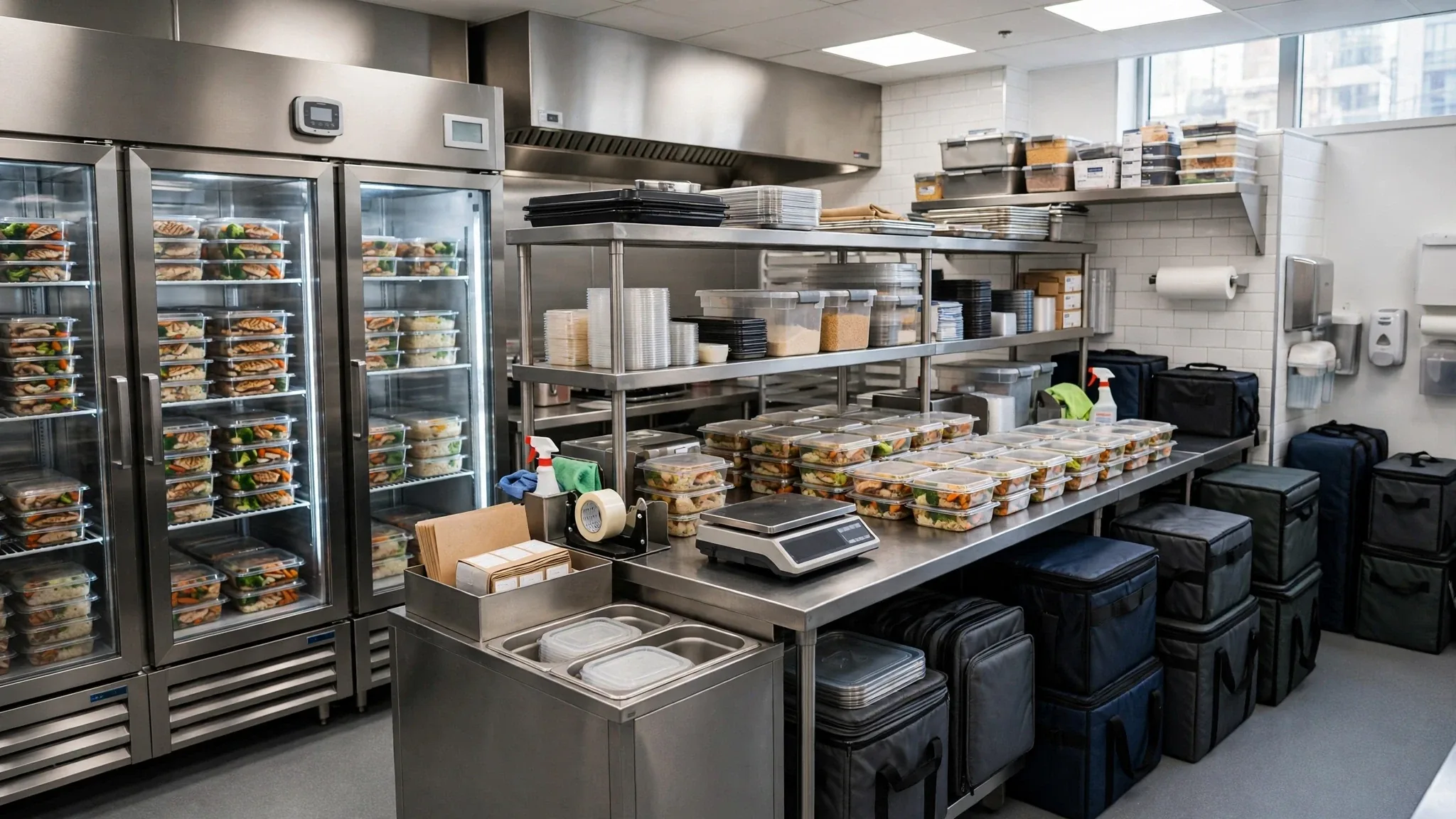
A kitchen producing 1,200 meals a week needs a production calendar, defined batch sizes, verified cold storage capacity and a documented handoff to packing and delivery. Show raw and ready-to-eat workflows clearly, keep cleaning chemicals away from food and packaging, and follow the food-safety controls required for each product and jurisdiction. A photograph of sealed containers does not establish safe handling or permitted shelf life.
Translate weekly meals into cooking batches, labor hours, chilling or cold-holding capacity, packaging time and delivery slots. Record what happens if one refrigeration unit fails or an important ingredient is rejected at receiving. Increasing subscribers faster than these capacities can reduce food safety and customer satisfaction while also raising waste and refunds.
Seven numbers a meal prep owner should review every week
- Active paying subscribers and meals fulfilled, separately from sign-ups or paused plans.
- Average paid price per meal after actual promotions and refunds.
- Direct food, packaging and delivery costs per completed meal.
- Meals lost to spoilage, wrong packing, failed delivery or customer refund.
- Labor hours by production, packing, delivery and administrative work.
- Fixed weekly obligations and the next thirteen weeks of expected cash payments.
- Owner compensation, operating result after that compensation, and reserve cash still available.
The purpose of this weekly review is to replace appealing subscriber headlines with measurable unit economics. Profit is meaningful only when a customer order has been produced accurately, delivered under appropriate controls, paid for and reconciled in the financial records.
For the initial capital requirements of a meal prep operation, the free startup budget planner can help separate launch spending from operating cash reserves. It is a separate calculation from the recurring subscriber-economics model here.
What happens if the average meal plan changes?
Six meals per active subscriber is an assumption, not a fixed property of subscription businesses. If the same 200 subscribers averaged only five paid meals weekly, weekly volume would be 1,000 rather than 1,200. At the unchanged $7.20 contribution per meal, contribution would be $7,200 instead of $8,640, a decline of $1,440 per week before any cost response. Over a hypothetical 52 identical weeks that is $74,880 less contribution. The business would need to adjust staffing, menu, route design or subscriber acquisition plans to respond. Track meals per paying customer alongside the customer count; a steady subscriber total can conceal declining meal volume.
Food-safety reference: The FDA Food Code 2026 is a model for retail and food-service controls, including the practices that local regulators may adopt. Meal prep operators should verify the rules applicable to their products, production location, cooling, cold holding, transport and delivery. The model is a reference to safe planning, not a certification or proof that any depicted kitchen is compliant.
FAQ
How many subscribers does a meal prep business need?
There is no universal number. In this example, the business needs roughly 142 subscribers to cover fixed cost and about 171 subscribers to cover fixed cost plus a $65,000 owner salary, assuming 6 meals per subscriber per week.
Is meal prep more profitable than a restaurant?
It can be, but not automatically. Lower front-of-house cost does not eliminate production, packaging, and delivery challenges.
Why is contribution per meal so important?
Because each meal sold contributes a fixed amount toward overhead. Without that number, subscriber counts by themselves are not very meaningful.
Final answer
Meal prep business owners can make very little, a reasonable income, or an excellent income depending on retention, unit economics, and operating discipline.
In the hypothetical example here:
- Annual sales: $717,600
- Operating result before owner pay: $132,080
- Remaining profit after a $65,000 owner salary: $67,080
If you want the matching setup article, see: