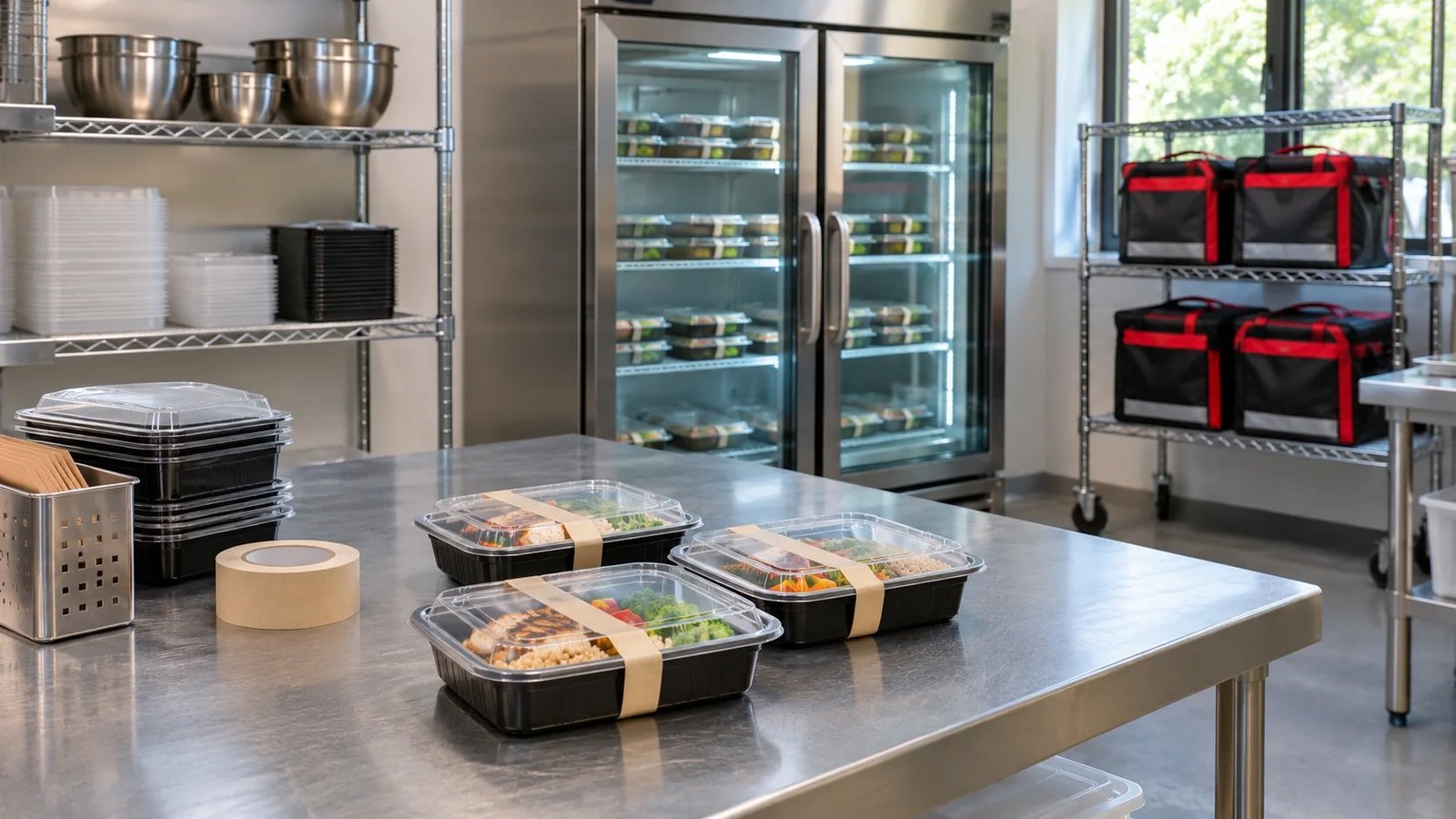
A meal prep business can start with a small menu and recurring orders, but that does not automatically make it a low-investment food business. You still need lawful food-production space, trained people, approved handling practices, suitable packaging, purchasing cash, reliable delivery, and a way to manage returns, failed deliveries and customer churn. A beautiful subscription website does not substitute for profitable unit economics.
Quick answer: The cost depends on whether you use a licensed shared kitchen, lease your own facility, make only shelf-stable products where legally allowed, or run a refrigerated ready-to-eat meal production and delivery operation. This article uses a hypothetical $116,000 initial cash requirement for a small commercial-kitchen meal prep operation, including a $28,000 opening cash reserve. It is not a U.S. industry startup average, not an approval to cook from home, and not a quote from a shared kitchen or delivery company.
Choose the legal operating model before choosing recipes
“Meal prep” can describe several different businesses. Some sell refrigerated fully cooked meals for pickup, others sell frozen meals delivered in insulated boxes, and others sell ingredient kits requiring customers to cook. Still others prepare weekly meals for gyms or corporate offices. Every model has different production, labeling, cold-chain, shelf-life, packaging and payment implications.
A rented shared kitchen can reduce the need for your own permanent build-out, but it can impose production-hour limits, storage fees, equipment-sharing rules and access restrictions. A leased standalone facility may provide control over scheduling while exposing the company to major occupancy and construction costs. Do not assume a residential kitchen is legal for refrigerated meat, poultry, rice or ready-to-eat packaged meals merely because other online sellers operate from home.
The FDA’s guide to starting a food business notes that applicable rules depend on the business, food and facility, including federal, state and local requirements. Retail food operations are frequently supervised by state or local authorities, while certain manufacturing, interstate and meat/poultry activities can trigger different regulatory regimes. Confirm the exact business model and licensing pathway with the agencies responsible for your location before paying for premises or promising delivery.
A worked example: $116,000 to launch a small meal prep company
The sample assumes an established licensed commercial kitchen arrangement with permitted cold storage, a limited weekly menu, online pre-orders, refrigerated meal packaging and local delivery. None of the amounts is a verified local price.
| Pre-launch use of cash | Illustrative amount |
|---|---|
| Shared commercial-kitchen deposits and upfront rental | $8,000 |
| Supplementary utensils, racks and production equipment | $12,000 |
| Refrigeration capacity and temperature-controlled transport setup | $16,000 |
| Initial ingredients, labels, containers and insulated packaging | $9,000 |
| Permits, insurance setup, professional and food-safety planning | $6,000 |
| Ordering website, POS/subscription setup and software | $5,000 |
| Delivery equipment, routing and dispatch setup | $6,000 |
| Menu testing, photography and launch marketing | $7,000 |
| Recruiting, training and pre-opening labor | $8,000 |
| Start-up and commissioning contingency | $11,000 |
| Pre-opening cash uses | $88,000 |
| Cash reserve for early operating weeks | $28,000 |
| Total startup cash modeled | $116,000 |
The $28,000 reserve is money intended to remain available after opening, not another upfront purchase. A business can report attractive product gross margins and still fail because it runs out of cash for payroll or packaging. Show each cash use when it will actually be paid. If a lender pays a refrigerator supplier directly, do not count that direct payment as cash deposited into the business account.
A ready-to-eat meal business delivering long distances may need a more expensive cold chain, temperature monitoring and packaging than the illustration provides. A facility with insufficient storage or narrow access hours can destroy the apparent savings of a cheaper rental agreement.
What the kitchen must handle on production day
Map the process from approved suppliers and receiving through chilled storage, ingredient preparation, cooking, safe cooling where required, portioning, packing, labeling, temperature-controlled storage and dispatch. Ask the kitchen manager which operations and equipment are included in the rental fee and which are billed by hour or by use.
Calculate saleable meals per production shift rather than comparing only the number of ovens and workstations. A batch might require cooking time, cooling space, inspection, labeling and a packing crew before it can be shipped. The slowest step sets actual capacity. If a process produces 600 meals but the safe cold storage can hold only 350, the sales forecast is operationally impossible without a different dispatch schedule.
For each menu item, produce a standardized recipe card with ingredient weights, allergen controls, portion size, packaging method, handling instructions approved for the product, and a documented food-safety procedure. Avoid publishing invented shelf-life claims or universally applicable cooling times. The FDA Food Code provides a model framework for retail jurisdictions, but local rules and the exact food process govern what is allowed.
Price the delivered meal, not just the ingredients
A beginner may see a meal sold for $12.50 with $3.00 of ingredients and conclude there is a $9.50 profit. That skips container and label costs, labor, delivery, payment fees, refunds, rejects, cold-chain expenses, and fixed kitchen rental.
Consider a deliberately hypothetical mix in which the average realized selling price is $12.50 per delivered meal, excluding sales tax, and the fully modeled variable cost is $5.30 per meal after ingredients, packaging, appropriate per-unit production and delivery expenses, and card fees. The contribution is $7.20 per meal toward the fixed operating costs and owner compensation.
| Per-meal variable economics | Illustrative dollars |
|---|---|
| Realized selling price | $12.50 |
| Ingredients and practical trim/waste allowance | ($3.10) |
| Meal container, label, bag and insulated components | ($0.85) |
| Order-variable payment and delivery expense | ($1.35) |
| Contribution before fixed costs | $7.20 |
For simplicity this example allocates all listed variable expenses to each meal, including a delivery allowance. Actual individual deliveries may be much more expensive than planned multi-order routes. If a customer collects seven meals in one batch, delivery cost per meal is different from seven separate deliveries. Some production labor may be fixed for a shift and some incremental per meal; classify the same wage expense once, not in both the variable costs and fixed payroll.
A discount that lowers realized revenue but leaves the cost per meal unchanged can sharply reduce contribution. Test introductory offers on a full customer-lifetime basis rather than focusing only on first-week signups.
Translate subscribers into meals and break-even volume
Suppose your typical active subscriber orders seven meals per week. If 170 subscribers each place their order, the modeled volume is 1,190 meals weekly, giving:
- Revenue: 1,190 × $12.50 = $14,875 per week.
- Modeled variable expense: 1,190 × $5.30 = $6,307 per week.
- Contribution: 1,190 × $7.20 = $8,568 per week.
Assume base kitchen rent, non-variable production staffing, management, insurance, recurring software, maintenance and other monthly commitments total $24,000 per month. The equivalent average weekly fixed cost is $24,000 × 12 ÷ 52 = $5,538.46. Therefore:
Weekly break-even meals = $5,538.46 ÷ $7.20 ≈ 769.23; round up to 770 meals. At exactly seven meals per active subscriber, that is 110 active ordering subscribers in that week.
The 110 figure is a mathematical illustration, not a market-sized customer acquisition target. An “active subscriber” here means one who actually pays for and receives seven meals during that week. Paused plans, skipped weeks, refunds and failed payments reduce realized orders. If owner wages are missing from fixed costs, add them before claiming break-even after paying the owner. If an extra vehicle or production employee is required above a volume threshold, the fixed-cost curve changes.
Use the SBA break-even calculator and our restaurant break-even tool to adapt the approach to your own delivery model.
Weekly subscriber scenarios and cash generation
Holding $12.50 realized price, $5.30 variable expense per meal, seven meals per subscriber and an average weekly fixed cost of $5,538.46:
| Paying subscribers this week | Meals delivered | Weekly sales | Approximate pre-owner operating remainder |
|---|---|---|---|
| 100 | 700 | $8,750 | −$498.46 |
| 170 | 1,190 | $14,875 | $3,029.54 |
| 220 | 1,540 | $19,250 | $5,549.54 |
These amounts ignore any volume-driven step increase in kitchen hours, delivery vehicles or staffing and exclude unmodeled income tax, interest, working-capital replenishment and owner wages. A business at 220 subscribers may need more refrigeration, additional preparation shifts and driver routes; do not extrapolate the table indefinitely.
Monthly and weekly periods should not be blended casually. For cash planning, use 52 weeks per year rather than assuming that every calendar month has exactly four weeks. The operating model and actual bank cash may diverge due to prepayments, outstanding supplier bills, subscription cancellations and the timing of payroll.
Subscriber retention can be more important than signups
A meal prep business can appear to grow by acquiring 40 subscribers a week while quietly losing 35. Track active paying households, meals per paying household, cancellation and pause rates, net recurring order volume, repeat cohorts and realized order contribution. Customer acquisition cost alone is not a sufficient metric; you need to know contribution recovered before the customer cancels.
For an illustration, a customer buying seven $12.50 meals generates $87.50 in weekly sales, but only seven × $7.20 = $50.40 of modeled contribution toward overhead before any extra customer-service or promotion expense. If acquiring the customer costs $60 and they quit after one paid week, the first-week contribution does not recover that acquisition cost. If they continue for multiple weeks, contribution can eventually cover acquisition expenditure—but only if delivery costs and refund levels remain within the assumptions.
Be careful with first-order discounts, coupon stacking and subscriptions that are paid in advance but fulfilled later. Customer cash received for future meals is not automatically free cash for owner distributions; the business still owes the meals or appropriate remedies.
Plan an achievable production calendar
A simple weekly cycle might have an order cutoff, purchasing day, receiving checks, prep, cooking, packing, quality verification, dispatch and a customer-service window. But the right timing depends on shelf life, local authority requirements, approved transport methods and the kitchen’s available shifts.
Use an order-to-production worksheet: paid meal orders by SKU, recipe quantities, expected usable yield, packaging count, assigned production hours and dispatch route. Build contingency stock conservatively; too much overproduction wastes food, but too little inventory creates refunds and lost trust. Our restaurant prep list guide provides an operational starting point; review it alongside your legally approved food-safety plan.
Treat refrigerated delivery as a validated operation, not a marketing slogan. Packaging, route length, vehicle conditions, time out of temperature control and product-specific requirements must align with the actual rules applicable to the foods sold. Use temperature records and documented corrective action rather than assuming an insulated bag always works.
A 13-week cash forecast exposes launch risks
Forecast beginning bank cash, subscription collections, wholesale invoices, recurring kitchen fees, ingredient payments, labor, packaging, insurance, software, delivery, debt and taxes each week. An attractive margin can fail to support rent when an annual software or insurance bill arrives at the wrong time.
Model three sales scenarios. In the conservative case, include slower signup growth, pauses or churn, extra packaging cost and one delayed delivery day. Identify the minimum projected bank balance, not only the end-of-quarter balance. If the model becomes negative before the next collection date, the business needs more startup liquidity or a different operating plan.
Try the free restaurant startup budget planner for a first estimate, then use our cash-flow forecasting guide to separate operating results from bank cash.
Licensing, labels and product safety: what to confirm
Food rules vary by product, production method and jurisdiction. Ready-to-eat refrigerated meals may present different hazards from shelf-stable packaged foods or uncooked ingredient kits. Confirm with the appropriate regulator whether the facility, labeling, allergens, manufacturing/retail classification, transport and intended geographic reach require particular permits or controls.
For example, interstate distribution and certain meat/poultry products can change which state, local or federal agency has jurisdiction. It would be irresponsible to assert that every U.S. meal-prep company can operate with a generic cottage-food registration. Begin with the FDA’s starting a food business resource and get a product-specific answer for your exact circumstances.
Launch checklist for a meal prep founder
- Define the product format and confirmed regulatory pathway before selling subscriptions.
- Verify an appropriately approved commercial kitchen and scheduled access.
- Plan ingredient sourcing, receiving, storage, preparation, safe handling and dispatch.
- Build detailed recipes and packaging specifications for every menu item.
- Classify variable production and delivery costs once; avoid double counting.
- Test subscription skips, churn, refunds and failed payments in the financial model.
- Confirm labeling and customer communication requirements with regulators.
- Validate actual capacity in a production and delivery trial with safe handling.
- Calculate break-even on paid meals actually delivered, not followers or signup leads.
- Prepare a conservative 13-week cash forecast before committing to paid marketing.
Frequently asked questions
Can I start a meal prep business from home?
That depends on the food, processing method, state and local laws, and possible federal requirements. Do not assume home-kitchen exemptions cover refrigerated fully prepared meals. Contact the authorities governing the actual foods and facility before taking orders.
Does a meal prep business require $116,000 to launch?
No. The $116,000 figure is a fictional worked budget for one small commercial-kitchen operation with $28,000 of post-opening reserve. The necessary investment can vary greatly and must be priced using actual quotes.
Is a seven-meal subscription profitable at $87.50?
Not necessarily. The example yields $50.40 of contribution per weekly subscription before fixed commitments and omitted owner items. Churn, acquisition costs, payment failure, route density and waste affect the final outcome.
How many subscribers does the example need to break even?
If all active paying subscribers order seven meals a week and per-meal contribution is $7.20, approximately 110 weekly paying subscribers cover the illustrative $5,538.46 weekly fixed cost. The target is not an industry benchmark or a guarantee. Once subscriptions are running, the meal prep owner earnings guide shows how subscriber retention, contribution per meal and delivery costs shape owner income.
Are meal subscriptions automatically better than single orders?
No. Predictable orders can improve purchasing and production, but subscriptions also create cancellation management, customer-service, fulfillment and possible refund obligations. A prepayment does not eliminate the future cost of delivering the meal.
Sources and methodology
- FDA — How to Start a Food Business: federal/state/local regulatory distinctions and home-based cautions.
- FDA — Food Code 2022: model retail food safety framework subject to local adoption.
- SBA — Break-even point calculator: volume and contribution calculation.
- National Restaurant Association — 2025 Operations Data Abstract: general restaurant expense context, not meal-prep startup-price data.
Editorial method: Every dollar in the $116,000 startup table, all subscription counts, $12.50 meal price, $5.30 variable cost, $24,000 monthly fixed expenses and the scenario results are fictional editorial assumptions. They do not represent nationwide averages, legal advice, a profitability claim or a food-safety approval.