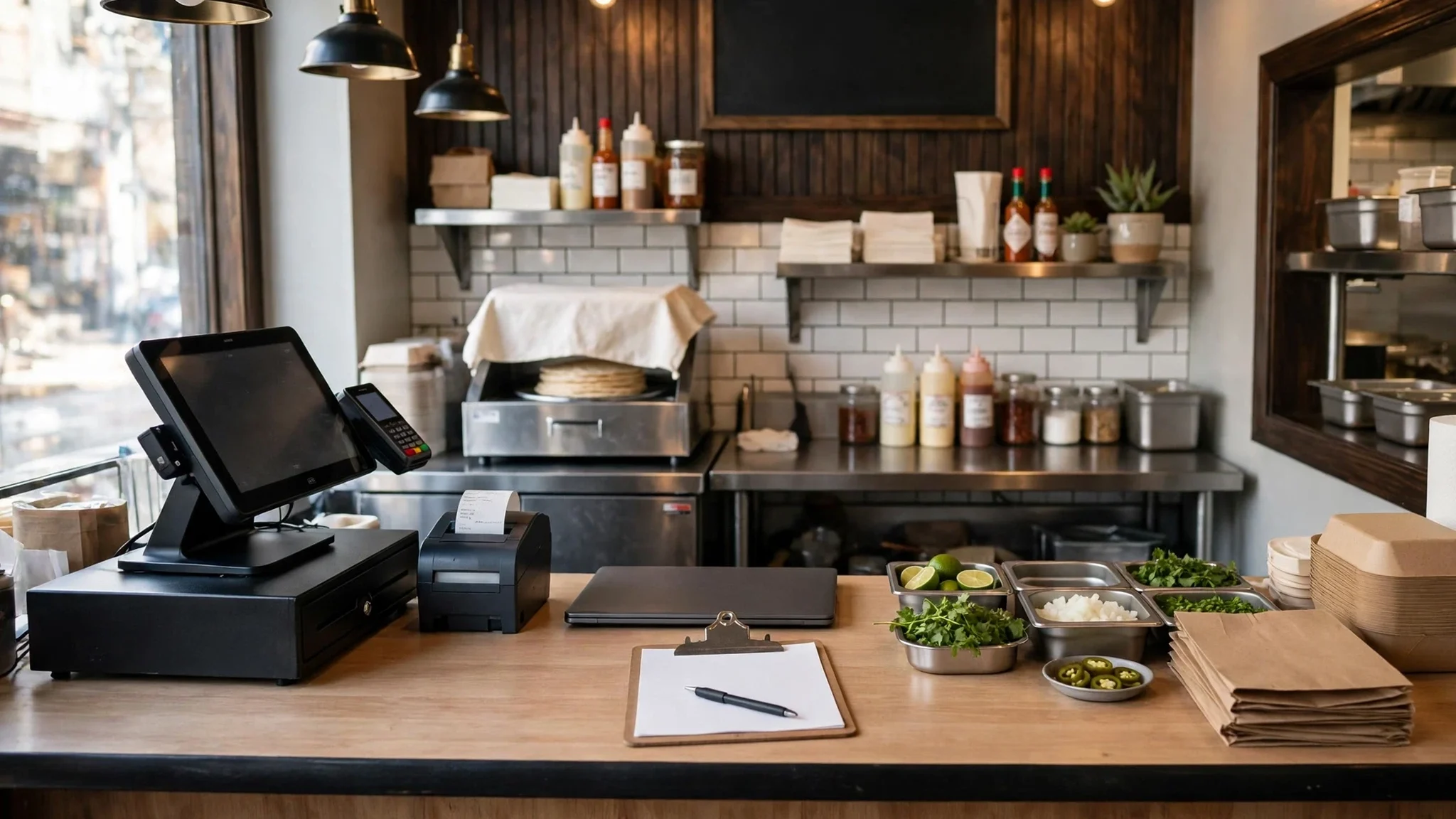
A taco shop can look busy and still leave the owner disappointed. That is because sales, operating profit, and owner take-home pay are not the same thing.
When people ask how much taco shop owners make, they often mean one of three different things:
- How much the shop sells
- How much profit the shop earns before owner compensation
- How much the owner can actually pay themselves after the business covers its costs
Those numbers can be very different.
This article uses a hypothetical taco shop example to show how owner earnings can work. It is not a national average or a guarantee.
A realistic hypothetical sales model
Suppose the taco shop averages:
- 140 orders per day
- Average order value: $14.00
- 30 days open per month
Monthly sales would be:
140 × $14 × 30 = $58,800
Annual sales would be:
$58,800 × 12 = $705,600
That sounds strong to many first-time owners. But revenue does not belong entirely to the owner.
What happens to the money?
Variable product cost
If food, beverages, packaging, and similar variable items equal 34% of sales, annual variable cost would be:
$705,600 × 34% = $239,904
That leaves contribution after variable cost of:
$705,600 − $239,904 = $465,696
Labor
Suppose wages, payroll taxes, and related labor cost total 25% of sales.
$705,600 × 25% = $176,400
Occupancy
Suppose rent and occupancy-related costs total 8% of sales.
$705,600 × 8% = $56,448
Other operating expenses
Suppose utilities, software, supplies, repairs, insurance, and other overhead total 17% of sales.
$705,600 × 17% = $119,952
Profit before the owner is paid
If we subtract those operating expenses, the hypothetical taco shop produces:
| Line | Annual amount |
|---|---|
| Sales | $705,600 |
| Variable product cost | –$239,904 |
| Labor | –$176,400 |
| Occupancy | –$56,448 |
| Other operating expenses | –$119,952 |
| Operating profit before owner pay | $112,896 |
This is not “money in the owner’s pocket” yet.
Profit after owner salary
Now suppose the owner wants a salary of $60,000 per year.
That leaves:
$112,896 − $60,000 = $52,896
So in this example:
- Sales: $705,600
- Operating profit before owner pay: $112,896
- Remaining profit after a $60,000 owner salary: $52,896
That remaining amount may still need to support debt service, taxes, reinvestment, or irregular cash needs depending on how the owner structures the business.
Daily break-even logic
Using the same assumptions:
- Average order value: $14.00
- Variable cost ratio: 34%
- Contribution per order: $9.24
- Monthly fixed costs before owner salary: $29,400
- Open days per month: 30
Break-even without owner salary:
$29,400 ÷ $9.24 = 3,182 orders per month
Daily break-even:
3,182 ÷ 30 = 107 orders per day (rounded up)
Now include the owner’s monthly salary equivalent of $5,000:
- Fixed costs including owner pay: $34,400
Break-even including owner salary:
$34,400 ÷ $9.24 = 3,723 orders per month
Daily break-even including owner pay:
3,723 ÷ 30 = 125 orders per day (rounded up)
That means the difference between “business survives” and “owner gets paid properly” can be meaningful.
Two scenario examples
Tougher scenario
If sales weaken or labor runs too high, owner earnings can collapse.
Illustrative annual result after owner pay: –$28,000
Better scenario
If volume is stronger and costs are controlled, owner compensation becomes more attractive.
Illustrative annual result after owner pay: $148,000
Both are hypothetical.
What most owners misunderstand
Busy does not mean profitable
A line at lunch can hide weak margins if food and labor are not controlled.
Owner salary is a real cost
If you work full-time in the shop, your labor should not disappear from the model.
Cash and profit are different
Loan payments, equipment replacements, and tax obligations can make a “profitable” shop feel cash-tight.
A single strong month proves very little
A stable annual result matters much more than one exciting weekend or holiday period.
Reconcile the sales and owner-income scenarios
The annual sales example above implies 50,400 completed orders: 140 per operating day × 30 days per month × 12 months. At $14 each that yields $705,600 in gross annual customer sales. The 34% variable cost ratio leaves a $9.24 contribution per order. In the baseline, the remaining cost categories total $352,800 per year: $176,400 labor, $56,448 occupancy and $119,952 other operating expense. A further $60,000 is allocated to owner salary.
To make the alternative cases reproducible, the table below holds this simplified $412,800 annual burden (operating overhead plus owner salary) constant and varies order volume. For this sensitivity exercise alone, expenses expressed as percentages in the base case are treated as equivalent short-run fixed amounts. In reality, labor, fees, repairs and utilities may rise with volume; a detailed business model should separate fixed and variable components.
| Annual operating case | Completed orders/year | Approximate orders/day (360 days) | Profit after $60,000 owner salary |
|---|---|---|---|
| Weak volume | 41,645 | 116 | −$28,000 |
| Base case | 50,400 | 140 | +$52,896 |
| Higher volume | 60,693 | 169 | +$148,000 |
Calculation: annual orders × $9.24 contribution − $352,800 operating overhead − $60,000 owner salary. The first and third rows round to the nearest dollar or hundred and are illustrative scenarios, not market averages. They do not include debt principal payments, owner income tax or a separate capital-expenditure budget. If delivery fees, promotions, overtime or spoilage vary by order count, revise contribution per order rather than assume the $9.24 stays unchanged.
Owner salary, profit and cash distributions are separate decisions
Owner salary pays for the labor the owner provides. Remaining operating profit is the business result after charging that salary in this model. The two can be combined only with clear labeling; otherwise comparisons between an owner-operated shop and one employing a hired manager will be misleading. The owner might work as general manager, shift leader, cook or bookkeeper, and those functions should be assigned realistic labor value even when no paycheck is initially taken.
A positive $52,896 annual remainder does not mean the owner should distribute that amount immediately. A business may owe principal on financing, need to replace equipment, face an income-tax obligation, or need more inventory before a seasonal rush. Create a cash-distribution policy that protects an operating reserve and planned repairs; review it against actual bank balances rather than the profit statement alone.
Why a strong lunch rush can still produce weak profit
The average ticket is as important as the daily order count. If a shop sells only single low-priced items during a peak, ticket counts can grow faster than contribution dollars. Track the mix of tacos, sides, beverages, premium proteins and delivery orders, including the packaging and labor attached to each. An upsell that increases sales but requires costly ingredients or slows the line may be less attractive than it first appears.
The $9.24 contribution figure is a blended average, not the margin on every product. A dine-in order and a marketplace delivery order may carry very different processing, packaging and commission costs. Build separate channel contributions and combine them using the actual share of revenue or orders. Do not include the same delivery cost in both food/packaging and other overhead.
A small volume change with the same economics
If the shop serves twenty more orders each operating day for thirty days, that is 600 more orders per month. At $9.24 contribution, the incremental contribution before additional staffing and overhead is $5,544. The shop must still check whether the team, kitchen and inventory can handle the extra throughput without overtime, service failures or additional fixed expense. This example shows why management should model both volume and capacity, not only the sales target.
Weekly controls that support owner earnings
- Compare projected and actual orders: review counts by weekday, service window and sales channel. Averages hide weak weekday demand.
- Update recipe and packaging costs: use vendor invoices, portion yields and current menu prices, rather than old target percentages.
- Plan labor against demand: review scheduled versus actual hours, wages, and whether staffing matches prep and peak periods.
- Reconcile marketplace orders: verify fees, refunds, discounts and settlement timing against POS reports.
- Watch waste: log unsold proteins, tortillas, salsa, produce and disposables, then adapt prep levels.
- Separate owner pay: record salary consistently, and assess cash available for distributions only after obligations and reserves.
- Repeat the model monthly: update the break-even order target whenever rent, wages, menu prices or contribution per order change.
A useful owner review does not need dozens of KPIs. Start with completed orders, average check, contribution per order, labor hours, fixed operating costs, cash balance and owner compensation. These measures answer both whether the business is growing and whether that growth is generating cash.
To test the initial funding requirement separately from annual owner income, use the free restaurant startup budget planner. Its spending and reserve fields complement the operating break-even model but do not replace it.
Do not merge the two taco shop planning examples without recalculating
The companion taco shop startup article and this owner-earnings article use separate illustrative assumptions. The startup piece models a shop opening 26 days a month with $24,500 of fixed monthly cost and an opening cash reserve; this earnings article models 30 days a month, $29,400 in monthly operating overhead before a $5,000 owner salary. Both happen to use a $14 average ticket and $9.24 contribution per order, but the different staffing, opening days and expense burdens mean their break-even order counts are not interchangeable. For an actual shop, establish one calendar and expense structure before presenting an investment case to anyone.
Test price changes before assuming they improve take-home pay
At 50,400 annual orders, a hypothetical increase of $1 in average selling price changes the economics materially. If the variable cost ratio remains 34%, contribution would increase from $9.24 to $9.90 per order. That is $0.66 more contribution on each order, or $33,264 over 50,400 orders, before effects on customer demand, sales taxes, delivery fees or additional operating expense. In practice, a higher price may change the product mix and order frequency. Compare actual contribution dollars, not price alone, and avoid recommending an increase without testing local customer response.
The same logic works in reverse: if contribution falls by $0.50 per order while volume remains unchanged, annual contribution falls by $25,200. A small recurring cost change can consume much of the remaining operating profit. This sensitivity explains why routine recipe-cost and packaging reviews are essential to protecting owner earnings.
Labor-cost reference: The U.S. Bureau of Labor Statistics guide to food service managers can help frame the role of a paid manager when comparing owner-operated and managed shops. Occupational employee wages are not evidence of typical taco shop owner earnings. The $60,000 owner salary in this article is an assumed input, not a figure quoted from BLS.
FAQ
How much can a taco shop owner pay themselves?
It depends on sales volume, margin control, labor efficiency, and debt structure. In this example, the owner salary is $60,000, with additional remaining profit possible.
Is $700,000 in annual sales enough for a taco shop owner to make good money?
It can be, but not automatically. High labor, weak pricing, poor food cost control, or heavy debt can reduce owner earnings sharply.
Do taco shop owners make money from every sale?
Not in the way many people think. Each sale contributes toward fixed costs first. Real owner income only appears after the full expense structure is covered.
What should I calculate first?
Start with contribution per order, fixed monthly cost, and break-even volume. Then check whether the projected volume is realistic.
Final answer
A taco shop owner’s earnings can range from disappointing to attractive depending on volume and discipline.
In the hypothetical example here:
- Annual sales: $705,600
- Operating profit before owner pay: $112,896
- Remaining profit after a $60,000 owner salary: $52,896
That is why “How much do taco shop owners make?” never has one universal answer.
Related guides: