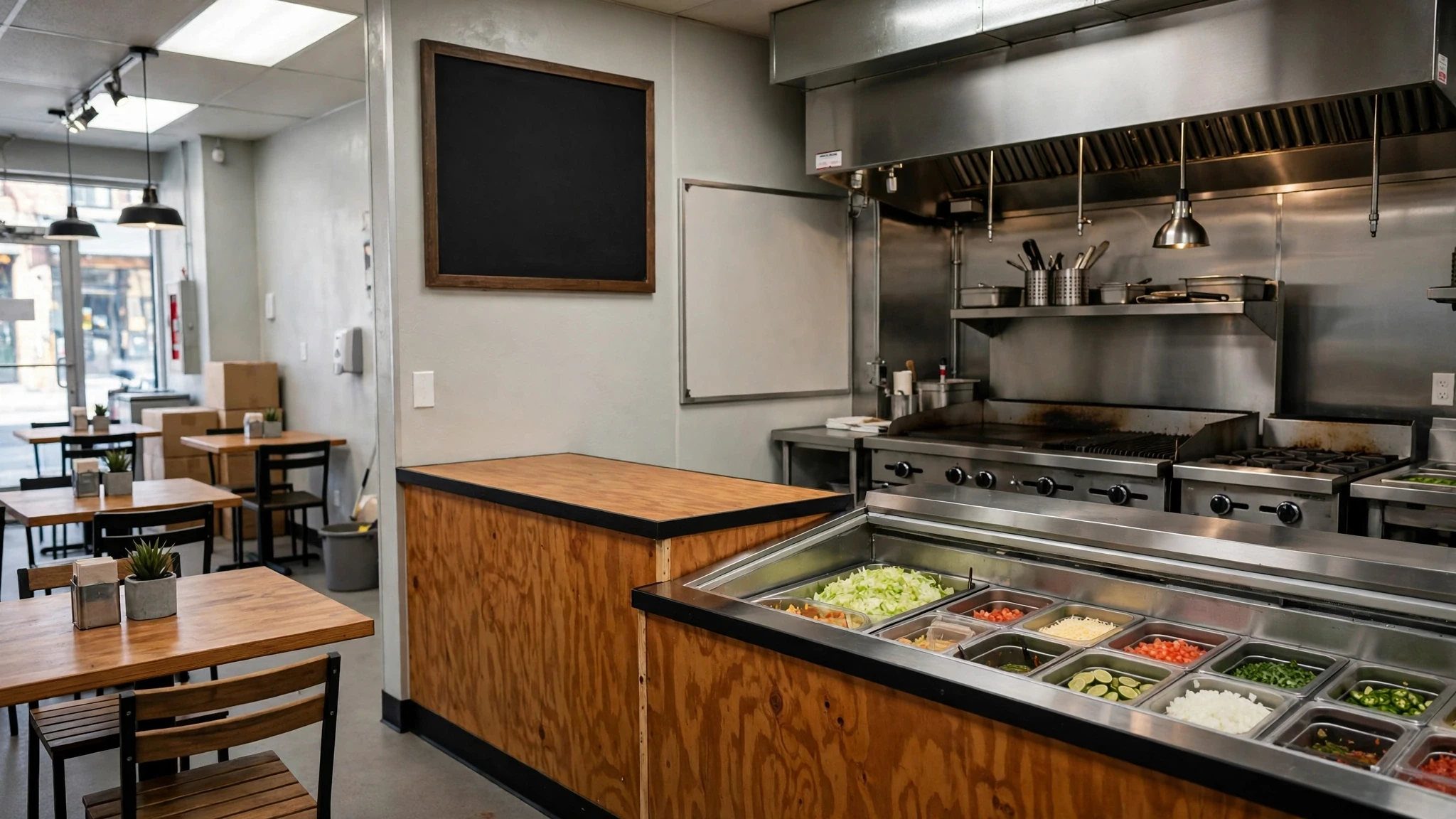
Opening a taco shop can cost much more than people expect. The menu may look simple, but the business still needs a compliant kitchen, ventilation, refrigeration, prep space, POS equipment, opening inventory, staff hiring, and enough cash to survive the first months.
A small independent taco shop might open for less than a full-service restaurant, but it can still require a serious capital commitment. The exact number depends on the lease, city, build-out condition, menu complexity, and whether the shop focuses on walk-in traffic, delivery, late-night service, or all three.
A practical answer is this: many small taco shops will need a six-figure opening budget, plus a separate cash reserve.
This article uses a hypothetical example to show how the budget can work. It is not a national average or a promise of what your business will cost.
A sample taco shop startup budget
In this example, the taco shop needs $154,000 in pre-opening spending and a $42,000 opening cash reserve.
That creates a total required funding target of:
- Pre-opening costs: $154,000
- Cash reserve: $42,000
- Total required funding: $196,000
| Budget line | Sample amount |
|---|---|
| Lease deposits and initial rent | $14,000 |
| Construction and fit-out | $39,000 |
| Kitchen equipment | $31,000 |
| Ventilation and grease-related work | $16,000 |
| Furniture, counter, and guest area | $11,000 |
| Permits, licenses, insurance, and setup fees | $7,000 |
| POS, payment devices, and technology | $4,500 |
| Opening inventory and packaging | $8,500 |
| Hiring, uniforms, and pre-opening payroll | $8,000 |
| Launch marketing | $4,000 |
| Contingency | $11,000 |
| Pre-opening subtotal | $154,000 |
| Opening cash reserve | $42,000 |
| Total required funding | $196,000 |
Where the money usually goes
1. Lease deposits and initial rent
Even a small quick-service space usually requires several payments before opening. Landlords may want a security deposit, first month’s rent, and sometimes additional funds depending on tenant risk.
Sample amount: $14,000
2. Construction and fit-out
This is often the biggest surprise. Even a “small” taco shop may need plumbing changes, electrical upgrades, flooring, wall finishes, counters, signage preparation, and code-related adjustments.
Sample amount: $39,000
3. Kitchen equipment
A taco concept may need a flat-top grill, prep refrigeration, reach-in storage, hot holding, sinks, smallwares, and possibly a tortilla station or fryer depending on the menu.
Sample amount: $31,000
4. Ventilation and grease-related work
If the menu includes grilled meats, fried items, or other grease-producing cooking, ventilation and fire suppression can become a meaningful capital line. Grease handling and code compliance can also add cost.
Sample amount: $16,000
5. Furniture, counter, and guest area
A small taco shop may not have a large dining room, but it still needs functional front-of-house furniture, menu boards, queue space, and customer-facing fixtures.
Sample amount: $11,000
6. Permits, licenses, insurance, and setup fees
This line may include formation costs, local permits, health-related fees, opening insurance, music or software setup, and other one-time administrative costs.
Sample amount: $7,000
7. POS, payment devices, and technology
Even a small shop needs a checkout system, receipt printer, kitchen ticket flow, payment hardware, and often internet and camera installation.
Sample amount: $4,500
8. Opening inventory and packaging
The first order is not only food. It often includes packaging, beverages, paper goods, cleaning materials, and backup stock.
Sample amount: $8,500
9. Hiring, uniforms, and pre-opening payroll
Recruitment, training, and test runs cost money before revenue becomes stable.
Sample amount: $8,000
10. Launch marketing
A taco shop can open quietly, but that does not mean it should. Local awareness, social content, promotions, and opening-week marketing need some budget.
Sample amount: $4,000
11. Contingency
Unexpected small overruns happen in almost every build. A contingency line does not remove risk, but it prevents every surprise from becoming a funding crisis.
Sample amount: $11,000
12. Opening cash reserve
This is not the same as build-out cost. It is the money that helps the business absorb a slow start, unstable staffing, and uneven weekly cash flow.
Sample amount: $42,000
Why the reserve matters so much
Many owners focus on “What will it cost to build?” but not enough on “How much cash will the business burn while it is still stabilizing?”
A taco shop may open with sales that are below the owner’s expectations for several weeks or months. Even if food cost is under control, the business still needs to cover payroll, rent, utilities, software, and debt service. Once the shop is trading, the taco shop owner earnings guide shows how sales, operating profit and owner pay separate in a sample year.
That is why the reserve in this example is $42,000, not a token number. A small deli startup budget follows the same logic for a counter built around slicers and refrigerated prep.
If you want to test your own assumptions, use the site’s free startup budget planner on the Startup Costs & Owner Earnings hub.
Example break-even logic
Suppose this taco shop has:
- Average order value: $14.00
- Variable cost ratio: 34%
- Contribution per order: $9.24
- Monthly fixed costs: $24,500
- Open days per month: 26
Break-even orders per month:
$24,500 ÷ $9.24 = 2,652 orders per month
Break-even orders per day:
2,652 ÷ 26 = 102 orders per day
That does not mean 102 daily orders will make the owner wealthy. It means the business is roughly covering its fixed operating structure under that assumption set.
Three useful scenario views
A startup budget is only half the picture. Owners should also ask how the business behaves if sales or costs move in the wrong direction.
Weak-start scenario
If sales open softer than planned, the shop may lose money early and burn cash more quickly than expected.
Illustrative monthly result: –$4,700
Base scenario
If sales and costs operate near the original plan, the business may cover expenses with only a modest cushion.
Illustrative monthly result: $1,300
Stronger scenario
If sales volume is healthy and labor is controlled, the shop can create a more comfortable monthly operating result.
Illustrative monthly result: $8,900
These are hypothetical examples, not a national benchmark.
Common taco shop cost mistakes
Underestimating grease and ventilation needs
A menu built around cooked proteins may trigger more expensive hood or related work than the owner expects.
Using an unrealistic rent assumption
A “great location” can destroy the budget if occupancy cost becomes too heavy relative to sales.
Ignoring pre-opening payroll
Training and opening preparation are real cash uses, even before the first stable week of sales.
Confusing total project cost with cash reserve
A shop that spends every dollar on construction may still be underfunded on day one.
How the taco shop sales scenarios are calculated
The weak, base and stronger operating results above can be reproduced using the same $14 average ticket, 34% variable cost ratio, $9.24 contribution per order, and $24,500 monthly fixed cost. The only input changed below is order count. These are deliberately constructed planning cases, not measured results from a representative sample of U.S. taco shops.
| Planning case | Orders per month | Average orders per open day (26 days) | Approximate monthly operating result |
|---|---|---|---|
| Weak start | 2,143 | 82 | −$4,700 |
| Base case | 2,792 | 107 | +$1,300 |
| Stronger case | 3,615 | 139 | +$8,900 |
Method: Monthly operating result = completed orders × $9.24 contribution − $24,500 fixed operating costs. Figures are rounded to the nearest $100; daily orders are averages, not guaranteed demand. This simplified result is before financing principal payments, income taxes and any owner compensation not already included in fixed costs. If a platform commission or additional labor is incurred on higher sales, update the variable or fixed cost assumptions rather than copying these results unchanged.
What to check before signing a taco shop lease
Before committing to the premises, ask the landlord and a qualified contractor to document what equipment and cooking methods the space can actually support. A low advertised rent is not a bargain when the intended menu requires work the premises cannot accommodate. Obtain a written list of permitted uses, an equipment layout, available electrical and gas capacity, ventilation conditions, plumbing requirements and any grease-management obligations. Confirm which party pays for improvements and whether the lease allows an approval contingency.
Request quotes tied to the actual menu, not simply a generic restaurant build-out. A concept serving tacos assembled from purchased cooked proteins has a different production flow from one grilling meats, frying sides, and making tortillas on site. Cold storage, preparation benches, handwashing access, allergen handling and customer pickup flow should be shown in one workable plan. Check local health, building and fire requirements before treating any contractor estimate as complete.
Compare the scope of each equipment quotation
- Specify whether prices include delivery, installation, commissioning, training, warranties and any required inspections.
- Verify that refrigerators, prep tables and hot-holding equipment have usable capacity for peak-day production rather than just fitting the floor plan.
- Ask how the shop will operate when a critical grill, refrigeration unit, payment terminal or fryer fails, and include a realistic response cost.
- Separate reusable smallwares, replacement supplies and first-month packaging from permanent equipment, so spending is not counted twice.
- Keep supplier quotes and a dated revision log. A budget is only decision-ready when the figures are tied to a defined layout and operating scope.
Test the opening reserve against cash burn
The $42,000 reserve in this example is a planning choice, not a recommended amount for every shop. At a hypothetical net cash burn of $7,000 per month, it represents six months of support; at $14,000 per month, only three months. Real cash flow is uneven: payroll and rent fall on fixed dates, while equipment repairs, slow openings and delayed card settlements may create extra demands. A cash reserve calculation should include the cash timing of sales taxes, financing, deposits and vendor payment terms where applicable.
Build a weekly cash calendar for at least the first thirteen weeks. Enter starting cash, expected customer receipts, supplier payments, payroll, rent, utilities, debt obligations and one-off opening bills. Use separate low/base/high sales assumptions. The shop may show a positive contribution margin and still run short of cash before customer volume settles.
A practical pre-opening decision checklist
- Demand: Test whether the location and service hours can realistically deliver approximately 102 completed orders per open day just to reach this illustrative operating break-even point.
- Menu: Cost individual taco proteins, sides, drinks, packaging and expected waste, not only an average blended food-cost percentage.
- Labor: Schedule for preparation, peak throughput and cleanup, including quiet periods that still require minimum staffing.
- Equipment: Confirm the cooking and refrigeration layout supports the menu and meets applicable requirements.
- Working capital: Keep the construction contingency separate from the cash needed to operate after opening.
- Decision gate: Recalculate if a major lease, equipment or payroll quote exceeds its allocated budget line.
This checklist is intended to help an owner question assumptions before spending money. Any specific lease, design, regulatory or tax decision requires the local facts and appropriate professional advice.
Independent reference points: The U.S. Small Business Administration business-planning resources explain how to research a market and calculate startup requirements. For food-service layout and safe operating procedures, the FDA Food Code 2026 is a model for regulators, not a substitute for the laws actually adopted by the state or local authority. These sources inform planning methods; neither verifies the illustrative $196,000 estimate above.
FAQ
Is a taco shop cheaper to open than a full-service restaurant?
Often yes, but not always. A taco shop usually has a smaller front-of-house and simpler service model, but kitchen compliance, equipment, and build-out still cost real money.
What is the biggest cost in opening a taco shop?
Build-out, kitchen equipment, and ventilation-related work are often among the largest lines.
How much reserve should a taco shop have?
There is no universal answer. The right reserve depends on rent, payroll, opening sales stability, and whether the owner has backup funding. In the sample here, the reserve is $42,000.
Can I open a taco shop with much less than this example?
Possibly, especially in a second-generation space or smaller market. But cutting the budget on paper does not remove the underlying operating needs.
Final answer
A realistic answer to “How much does it cost to open a taco shop?” is often:
- Low end for a small simple setup: still potentially six figures
- Sample budget in this article: $196,000 total, including reserve
If you are planning a real project, the next step is not guessing a headline number. It is building a line-by-line budget and testing whether the business can survive its first months.
Related guides: