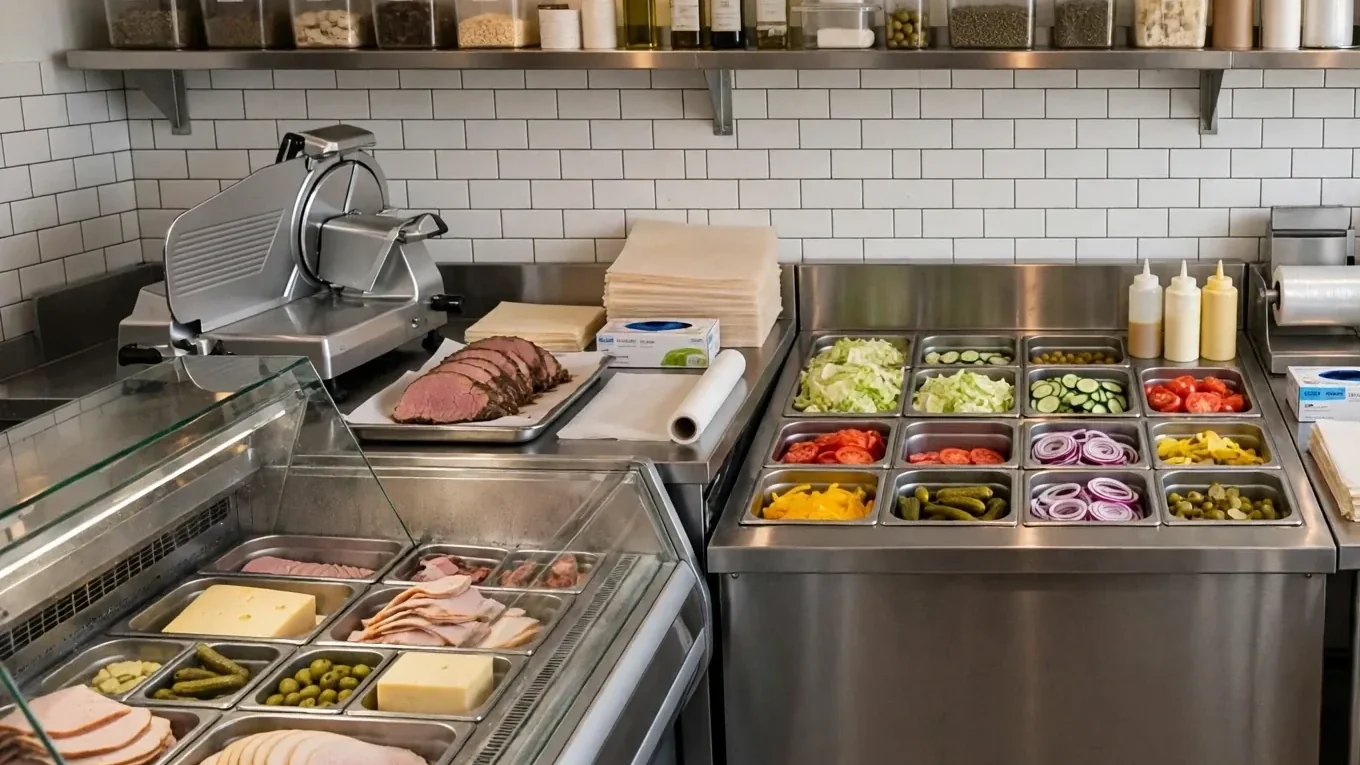
A small deli may appear simpler than a full restaurant, but it still requires a serious startup budget. Refrigerated prep, slicers, cold storage, counters, display equipment, and health-compliant food handling systems can make the opening cost higher than many first-time owners expect.
The real cost depends on whether the deli is mostly takeout, whether it prepares hot food, how much seating it offers, and how expensive the location is. But even a modest operation usually needs more than “equipment money.”
This article uses a hypothetical small deli example to show what the startup budget can look like. It is not a national average.
Sample deli startup budget
In this example:
- Pre-opening costs: $178,000
- Opening cash reserve: $50,000
- Total required funding: $228,000
| Budget line | Sample amount |
|---|---|
| Lease deposits and first rent | $16,000 |
| Build-out and counter construction | $46,000 |
| Kitchen and prep equipment | $34,000 |
| Slicers, display, and cold service equipment | $14,000 |
| Guest area, furniture, and fixtures | $12,000 |
| Permits, insurance, and opening admin | $8,000 |
| POS, technology, and setup | $5,000 |
| Opening inventory | $10,000 |
| Hiring and pre-opening payroll | $9,000 |
| Launch marketing | $5,000 |
| Contingency | $19,000 |
| Pre-opening subtotal | $178,000 |
| Opening reserve | $50,000 |
| Total required funding | $228,000 |
Main budget categories
Lease deposits and first rent
Sample amount: $16,000
Build-out and counter construction
A deli usually needs front counter work, refrigeration integration, prep flow, flooring, sinks, lighting, and customer-facing service design.
Sample amount: $46,000
Kitchen and prep equipment
This line may include prep refrigeration, reach-in refrigeration, work tables, sinks, hot holding if applicable, and other smallwares.
Sample amount: $34,000
Slicers, display, and cold service equipment
Slicers and refrigerated presentation can be central to the deli model.
Sample amount: $14,000
Guest area, furniture, and fixtures
Sample amount: $12,000
Permits, insurance, and opening admin
Sample amount: $8,000
POS, technology, and setup
Sample amount: $5,000
Opening inventory
Fresh deli ingredients can be expensive to launch because initial purchasing spans proteins, bread, condiments, beverages, packaging, and dry stock.
Sample amount: $10,000
Hiring and pre-opening payroll
Sample amount: $9,000
Launch marketing
Sample amount: $5,000
Contingency
Sample amount: $19,000
Opening reserve
Sample amount: $50,000
Why deli owners often underestimate cost
Refrigeration and display are not optional
A deli’s identity often depends on cold presentation and product quality. These items are not cheap.
Small spaces still need expensive compliance
A compact kitchen still needs code-compliant sinks, refrigeration, storage, and safe prep flow.
Inventory is more complex than it looks
A deli may manage perishable meats, cheeses, breads, produce, sauces, beverages, and packaging at the same time.
Example break-even calculation
Suppose the deli has:
- Average ticket: $18.00
- Variable cost ratio: 38%
- Contribution per order: $11.16
- Monthly fixed costs: $31,000
- Open days per month: 26
Break-even orders per month:
$31,000 ÷ $11.16 = 2,778 orders
Break-even orders per day:
2,778 ÷ 26 = 107 orders per day
That gives the owner a better operating target than simply hoping the shop feels busy. Once the deli is open, the deli owner earnings guide shows how revenue, operating profit and owner salary separate in a sample year.
Scenario thinking
Weak scenario
A slow-opening deli with thin lunch traffic and underused labor can lose money quickly.
Illustrative monthly result: –$6,200
Base scenario
A reasonably stable deli may cover fixed costs but still have a narrow margin.
Illustrative monthly result: $1,700
Stronger scenario
With better average ticket, repeat office traffic, and controlled labor, the deli can produce healthier operating results.
Illustrative monthly result: $10,400
All three are hypothetical.
Common budgeting mistakes
- Underfunding refrigerated equipment needs
- Ignoring spoilage risk in early inventory planning
- Using unrealistic labor assumptions for lunch rush execution
- Confusing construction cost with total cash needed to survive opening months
Verify the deli startup scenarios with real order counts
The opening budget above describes one hypothetical project. To test the operating side, assume an $18 average ticket, a 38% variable cost ratio, $11.16 contribution per completed order, and $31,000 of monthly fixed expense. Assume 26 opening days each month. Keeping those assumptions constant produces the following three scenarios; no claim is made that they represent typical deli performance.
| Case | Orders in a month | Average orders per open day | Approximate operating result |
|---|---|---|---|
| Weak demand | 2,222 | 85 | −$6,200 |
| Base | 2,930 | 113 | +$1,700 |
| Stronger demand | 3,710 | 143 | +$10,400 |
Formula: orders × $11.16 contribution − $31,000 monthly fixed costs. The result is rounded to the nearest $100. It excludes financing principal, taxes and any owner pay not already included in the fixed-cost assumption. At the illustrative break-even level of 2,778 monthly orders, the shop needs about 107 completed orders per open day. Test whether the prospective location can generate that demand outside its single busiest lunch hour.
Which deli format are you actually funding?
A cold sandwich deli, a delicatessen with sliced meats and cheeses, and a shop that also cooks hot breakfast or lunch items can require different equipment, staffing, service space and approvals. Define the planned menu first, including the number of made-to-order items, delivery orders, seated customers and any retail packaged foods. Then build the kitchen layout and budget around the work required to serve that menu.
A second-generation food space may contain useful plumbing, refrigeration, ventilation and electrical infrastructure, but it should not be assumed ready for a new operator. Have the condition and suitability of equipment inspected and document what the lease includes. A cheaper shell can become expensive once new cold storage, counters, electrical work, flooring and staff facilities are added.
A practical comparison of the proposed premises
- Customer flow: can customers queue, pay and collect orders without blocking food preparation or access?
- Cold preparation: are refrigerated make-lines, ingredient storage and cleaning facilities positioned to support the actual menu and safe workflows?
- Slicer operations: is there sufficient room for safe operation, cleaning, storage and maintenance without crowding food or packaging?
- Receiving and storage: can suppliers deliver food without mixing incoming deliveries with finished ready-to-eat products?
- Utilities: has an appropriately qualified person verified electrical service, plumbing, ventilation and equipment compatibility?
- Expansion: is there enough capacity for a realistic lunch rush, or would a modest sales increase require a second major rebuild?
How to obtain usable deli equipment quotes
For each line in the sample equipment budget, request comparable quotations using one written equipment list. A quotation should identify model, condition, delivery, installation, warranty, maintenance access, commissioning and any excluded items. Used equipment can reduce purchase cost, but evaluate condition, service history, available parts and the operational consequences of failure. Confirm regulatory and sanitation suitability rather than buying on price alone.
Preserve separate budget lines for refrigeration, display units and slicers even if the supplier offers a single package. Otherwise a late change in case size or refrigeration capacity can hide a material increase in fit-out cost. Keep contingency available for unknowns, and separate landlord-funded improvements from money that must be paid by the tenant.
Inventory and spoilage change the first-month cash requirement
The $10,000 opening inventory assumption is not necessarily the normal weekly inventory requirement. The deli may purchase small opening quantities of many proteins, cheeses, vegetables, breads, condiments, drinks and packaging types. Some expire quickly or must be ordered in larger cases than early sales justify. Plan a first-week purchasing schedule by ingredient, supplier minimum, lead time and usable shelf life, with a method for reordering based on actual demand.
Train receiving staff to check quantity, condition, required food-safety controls and invoice discrepancies before recording accepted goods. Then count inventory consistently, track waste by cause and compare recipe costs with the actual purchased quantities. These controls protect cash more effectively than simply setting one broad food-cost percentage. See the restaurant receiving checklist and free weekly inventory count sheet for the operating detail.
Stress-test the $50,000 opening cash reserve
A separate $50,000 reserve is included in the sample funding target of $228,000. At a hypothetical net cash burn of $10,000 per month, it represents five months. At $25,000 per month, it represents only two months. Neither example predicts actual burn: labor, deposits, utilities, debt payments and sales receipts occur on different dates, and an unexpected equipment replacement may shorten the runway.
Before signing a lease, produce a 13-week cash forecast and a supplier-payment calendar. Model a slow opening, a base case and a faster start, then ask the practical question: What bills must still be paid if weekday lunches are weaker than forecast? Keep that answer visible alongside the construction budget.
Final decision checks for an independent deli
- Complete a menu-specific fit-out scope and identify the permitting and inspection path.
- Obtain current local lease, construction, refrigeration and equipment quotes.
- Test the average order value using plausible product mix and local pricing, not only a desired sales total.
- Build a labor schedule for preparation, lunch, cleaning and restocking, including minimum staffing during quieter periods.
- Keep opening inventory, pre-opening payroll, construction contingency and post-opening reserve separate.
- Recalculate break-even whenever a material quote or opening assumption changes.
All dollar values here remain fictional editorial assumptions for a small U.S. deli example; local quotations and specialist advice are necessary before using the model for an actual investment.
Keep the opening-budget and owner-income models separate
The companion deli owner-earnings guide uses 150 tickets per day across 30 trading days per month, while this startup-cost example uses 26 trading days and a different $31,000 monthly fixed-cost structure. They describe different hypothetical planning cases. Do not apply the $228,000 funding target to the owner’s revenue projection and assume all other inputs are consistent. Replace both sets with the same lease, calendar, staffing plan, expected ticket value, ingredient costs and financing terms when building a real lender or investor forecast.
Two different ways a deli startup can become underfunded
Capital overrun: A cold display case, plumbing modification or electrical upgrade may cost more than the allowed budget. That is an upfront funding problem even if sales later meet the plan. Operating shortfall: The store may open within budget but receive fewer lunch orders than expected. Then payroll, rent and supplier invoices consume the post-opening reserve. Avoid combining the two risks into one generic contingency line. Use separate controls for construction change orders and weekly operating cash burn, with clear thresholds for revising the opening plan.
Before the final go/no-go decision, document the point at which the owner would delay opening, simplify the menu, postpone non-essential furniture spending, or raise more funding. That makes the plan useful during a cost overrun rather than only after the money has already been spent.
Useful public resources: The SBA business-planning guide covers the need for market research and startup-cost planning. The 2026 FDA Food Code offers a U.S. model for food-service safety controls; actual requirements follow the provisions adopted by the relevant jurisdiction. Neither source validates this example deli’s costs: obtain current local quotes and approvals.
FAQ
Is a deli cheaper to open than a full-service restaurant?
Often yes, but it still may require a high six-figure funding plan once build-out and reserve are included.
What is the biggest cost in opening a deli?
Build-out, refrigeration, prep equipment, and reserve cash are often the biggest categories.
Why does a deli need such a large reserve?
Because early sales may be inconsistent while labor, rent, and waste pressure remain real.
Final answer
A realistic answer to “How much does it cost to open a small deli?” is often well into six figures.
In the hypothetical example here:
- Pre-opening costs: $178,000
- Cash reserve: $50,000
- Total funding target: $228,000
Related guides: