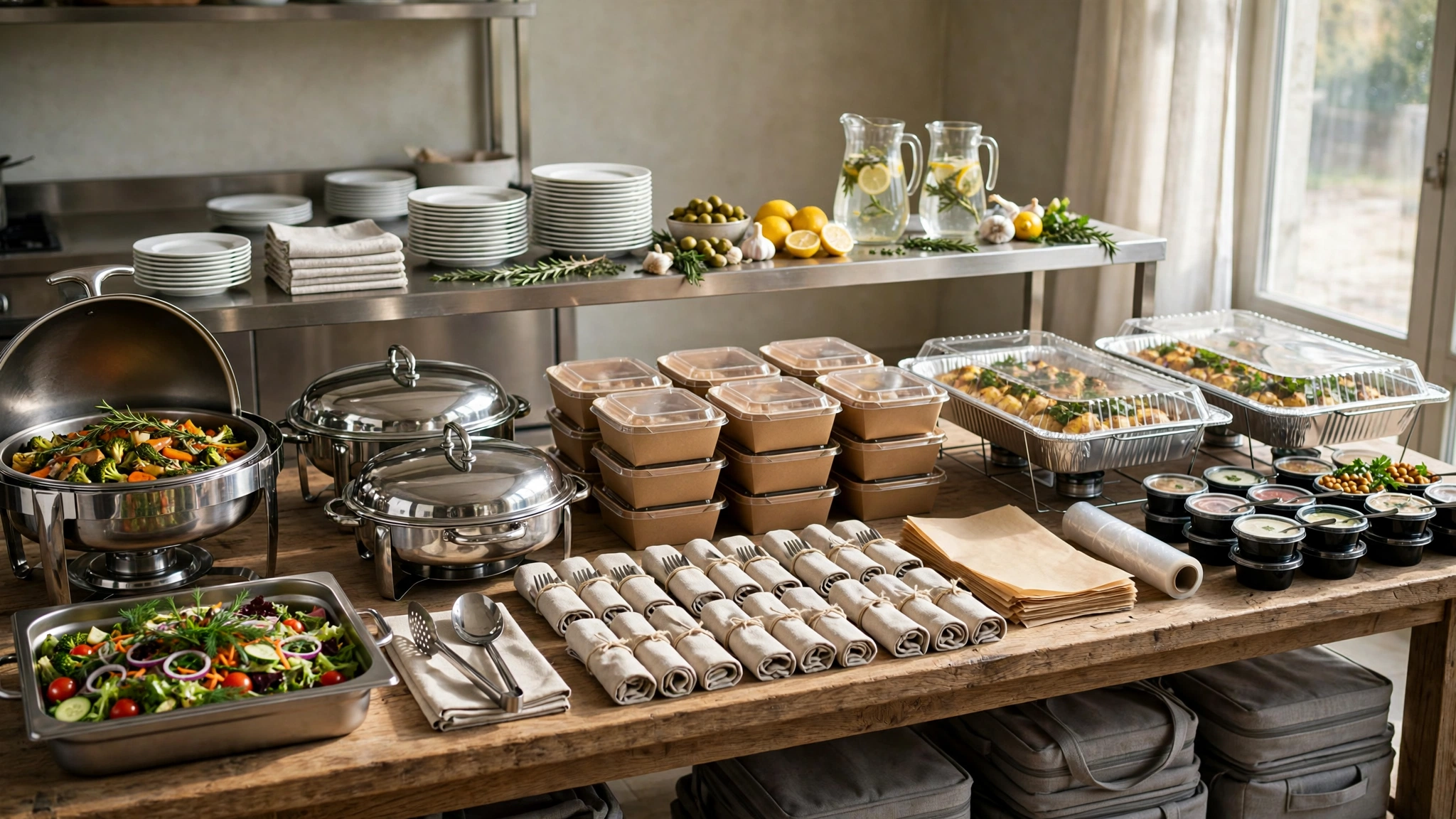
Catering can look profitable on the sales side and still disappoint on the bottom line if food, labor, transport, rentals and event-specific costs are not priced into the quote. The safest way to price a catering job is to build the price from the event economics rather than copying a competitor’s per-person rate.
This guide shows a practical costing method for restaurants, catering kitchens and small foodservice operators handling corporate meals, private events, worker meals, family gatherings and similar off-site orders.
Start with the full event cost, not just the food
A catering quote should account for every meaningful cost required to fulfill that specific event. At minimum, review:
- food and beverage ingredients,
- production labor,
- packing and disposable items,
- delivery or transport,
- on-site service labor if required,
- equipment or rental costs,
- event-specific purchases,
- waste and reasonable contingency,
- payment or platform fees where applicable.
If you price only from ingredient cost, the event can appear attractive while labor and logistics quietly consume the margin.
Step 1: Calculate food cost for the event
Build the menu from standardized recipes and expected guest count. For each item, calculate the quantity required and the ingredient cost at the quantities you actually expect to purchase.
A simple event food-cost calculation is:
Total event food cost = sum of all ingredient costs required for the event
For example, imagine a 100-person lunch with:
- rice dishes costing $145 in ingredients,
- protein costing $260,
- salads and sides costing $95,
- bread, sauces and condiments costing $55,
- dessert and beverages costing $85.
The estimated food cost would be $640.
Do not forget ingredients that look small individually but become material at scale, such as oil, sauces, garnish, ice, bread, disposable condiments and beverages.
If recipe quantities are not standardized yet, fix that first. Our guide on standardizing recipes for cost and consistency explains the basic process.
Step 2: Add production labor
Catering production often creates labor that does not exist during an ordinary shift. You may need earlier prep, extra cooks, packing staff or a dedicated loading team.
Estimate:
- number of additional labor hours,
- hourly wage or loaded labor cost,
- overtime exposure,
- supervisory time required specifically for the event.
Example:
| Labor item | Hours | Cost per hour | Total |
|---|---|---|---|
| Prep cook | 6 | $18 | $108 |
| Cook | 5 | $22 | $110 |
| Packing staff | 4 | $17 | $68 |
| Supervisor | 3 | $26 | $78 |
Total event-specific production labor in this example is $364.
Where existing staff can handle the event within normal scheduled hours, do not automatically treat their full shift as an incremental event cost. The objective is to understand what the order actually adds to the operation.
Step 3: Cost packaging and disposables
Packaging is one of the most commonly underestimated catering costs. Include items such as:
- meal boxes or trays,
- foil pans and lids,
- cups, cutlery and napkins,
- serving utensils,
- labels and stickers,
- thermal bags or disposable insulation,
- table covers or event-specific disposables.
If the packaging cost is $1.10 per guest for a 100-person event, that is another $110 before delivery.
Step 4: Add delivery and logistics
Delivery should be priced as a real operating cost, not treated as a courtesy unless the margin can support it.
Depending on the event, logistics may include:
- driver time,
- vehicle cost,
- fuel, tolls or parking,
- loading and unloading labor,
- multiple delivery runs,
- distance or waiting time,
- return trips for equipment.
A short nearby drop-off is fundamentally different from an event that requires a vehicle and staff to remain on site for several hours.
Step 5: Separate delivery-only from staffed service
Do not use one catering rate for two very different service models.
Delivery-only catering
The kitchen prepares, packs and delivers the food. The customer handles setup and service.
Staffed catering
Your team may handle setup, buffet service, replenishment, clearing and breakdown. This can require:
- servers,
- event captain or supervisor,
- transport time,
- setup time,
- service hours,
- breakdown and return travel.
That labor needs to be quoted separately or built explicitly into the event price.
Step 6: Add rentals and event-specific purchases
Some catering jobs require equipment that the restaurant does not normally provide. Examples include:
- chafing dishes,
- tables and linens,
- hot boxes,
- beverage dispensers,
- serving equipment,
- temporary storage or transport equipment.
If these are rented, include the rental cost plus any transport, cleaning or handling charges. If purchased specifically for one event, decide whether the full cost belongs to that event or whether the item will be reused and should be treated differently in your internal accounting.
Step 7: Build the true event cost
Using the earlier example:
| Cost category | Estimated cost |
|---|---|
| Food | $640 |
| Production labor | $364 |
| Packaging | $110 |
| Delivery/logistics | $90 |
| Event-specific supplies | $70 |
The estimated direct event cost is $1,274.
That number is much more useful than looking at food cost alone.
Step 8: Set a selling price that protects margin
Once the direct event cost is known, the selling price needs to cover that cost and leave enough contribution for overhead and profit.
If you want a target contribution margin of 35% on the selling price, the relationship is:
Selling price = direct event cost ÷ (1 − target contribution margin)
Using the example:
$1,274 ÷ 0.65 = $1,960 approximately.
For a fast one-event model, use the Restaurant Catering Pricing Calculator to combine food, labor and other direct costs with your own target contribution margin and optional guest count.
For 100 guests, that is about $19.60 per person before any tax or separately quoted extras that apply to the event.
This is an internal pricing method, not a universal market rate. Your actual selling price also needs to reflect positioning, local competition, service level, capacity and customer expectations.
Do not confuse food-cost percentage with event profitability
Suppose the event sells for $1,960 and food costs $640.
The food-cost percentage is approximately:
$640 ÷ $1,960 = 32.7%
That may look reasonable, but it does not tell you whether the event is profitable by itself. You still have labor, packaging, delivery and other direct costs.
This is why catering operators should review both food cost and total direct contribution. The same principle applies in ordinary restaurant operations; see Prime Cost Explained for Restaurant Owners for the broader relationship between food and labor.
Use minimum order values
Small catering orders can be operationally expensive because many fixed tasks happen regardless of guest count:
- confirming the order,
- preparing paperwork,
- staging packaging,
- loading a vehicle,
- making the delivery,
- coordinating with the customer.
A minimum order value can prevent the team from spending disproportionate time on orders that generate little contribution.
The threshold should come from your own economics. Estimate the minimum revenue required to justify the fixed effort of opening a catering job.
Use deposits and clear order deadlines
Catering creates purchasing and production commitments before the event date. A clear order process should define:
- when the order becomes confirmed,
- when final guest count is due,
- when menu changes stop,
- what payment or deposit is required,
- how cancellations or reductions are handled,
- what happens when the customer changes the order late.
The exact commercial terms depend on your market and legal environment, but the operating principle is universal: do not let major production commitments remain ambiguous.
Build a catering event sheet
Each confirmed event should have one control sheet that brings the operation together. It can include:
- customer and event details,
- guest count,
- menu and quantities,
- production schedule,
- packing list,
- equipment list,
- delivery time and address,
- assigned staff,
- special instructions,
- final quoted price,
- estimated event cost.
This reduces the risk that sales information sits in one message thread while the kitchen, driver and manager are working from different assumptions.
Review estimated versus actual cost after the event
The fastest way to improve catering pricing is to compare the estimate with what actually happened.
After the event, review:
- actual food used,
- actual labor hours,
- actual packaging consumed,
- delivery time and cost,
- unexpected purchases,
- leftover product or waste,
- customer changes that increased cost.
If actual results repeatedly differ from the quote, adjust the costing model. This is much more useful than simply raising all prices by a flat percentage.
Where excess production is a recurring problem, connect the review to your restaurant waste-control process.
Common catering pricing mistakes
Pricing only from competitor rates
A competitor may have different purchasing costs, labor rates, portion sizes or capacity. Their price is market information, not your cost model.
Ignoring packing labor
Large orders can consume significant time after cooking is finished. Packing is production work and should be planned accordingly.
Giving away delivery
Delivery can become expensive when routes are long, parking is difficult or the driver waits on site.
Failing to price small custom requests
Special packaging, individually labeled meals, separate dietary meals or unusual setup requirements may look minor but create labor and complexity.
Quoting before confirming the scope
A price is only meaningful when the operator knows guest count, menu, service style, delivery requirements and event timing.
Build the quote from contribution dollars as well as margin percentage
A percentage target is useful, but the operator should also look at the actual contribution dollars left after direct event costs. A small event can show an acceptable percentage and still contribute too few dollars to justify the administrative work, kitchen disruption or delivery time.
Event contribution = Selling price − Direct event cost
Using the earlier illustrative figures, a $1,960 selling price less $1,274 of direct event cost leaves $686 of contribution before overhead and profit. That dollar view helps management compare events of different sizes and complexity.
Calculate the minimum profitable guest count when fixed event costs are high
Some costs change with every guest while others happen once per event. Separating them can help explain why very small jobs are difficult to price.
Typical variable costs may include food, guest packaging and per-person disposables. Fixed or semi-fixed event costs may include planning time, loading, a delivery run, setup labor or an event captain minimum.
A simple planning reference is:
Minimum guests = Fixed event costs ÷ Contribution per guest before fixed event costs
This is not a universal pricing rule, but it can help an operator decide when a minimum order or minimum guest count is more sensible than forcing a high per-person rate onto a very small job.
Add a controlled contingency instead of hiding uncertainty
If the scope contains real uncertainty, identify it. Examples include uncertain parking, a long setup window, fragile rental equipment, weather-sensitive transport or a customer who has not finalized service details. Do not bury every possible risk in an arbitrary markup.
List the uncertain cost, estimate a reasonable allowance and state what would trigger a price revision before the quote is accepted. That makes the economics easier to review later.
Quote service tiers when customers need options
| Service level | Typical inclusions | Main cost drivers |
|---|---|---|
| Pickup | Food and agreed packaging | Food, production and packaging |
| Drop-off | Pickup package plus delivery | Driver time, vehicle, loading and route |
| Setup | Delivery plus basic setup | Additional labor and equipment handling |
| Staffed service | Setup, service, replenishment and breakdown | Service hours, supervision, travel and return handling |
Defining service levels prevents a delivery-only price from quietly expanding into a staffed-service obligation.
Create a quote worksheet before sending a price
| Quote input | What to confirm |
|---|---|
| Guest count | Expected and final guaranteed count |
| Menu | Recipes, portions and dietary variants |
| Food cost | Current ingredient cost at required quantities |
| Production labor | Incremental prep, cooking and packing hours |
| Packaging | Containers, utensils, labels and service pieces |
| Logistics | Distance, loading, parking, waiting and return trip |
| Service labor | Setup, event service, breakdown and supervision |
| Rentals | Rental, delivery, cleaning and damage exposure |
| Direct event cost | Total of all event-specific costs |
| Target contribution | Percentage and dollars |
| Final price | Price before applicable tax or separately stated charges |
Test the quote against capacity before accepting it
A profitable-looking order can still be a bad order if it displaces higher-value restaurant business or overloads the kitchen. Before confirming a large event, check oven, refrigeration, prep space, loading area, vehicle and labor capacity against normal restaurant demand.
If catering production competes with the regular service window, connect the quote to a dedicated catering production plan so management can see whether the promised quantities and ready times are actually feasible.
Track quote variance after every material event
Compare quoted cost with actual cost by category rather than looking only at the final total. A recurring labor overrun needs a different fix from recurring food overproduction or underestimated delivery time.
| Category | Quoted | Actual | Variance | Likely action |
|---|---|---|---|---|
| Food | $640 | $690 | +$50 | Review portion or yield assumption |
| Labor | $364 | $430 | +$66 | Review packing/setup hours |
| Delivery | $90 | $145 | +$55 | Review route and waiting-time pricing |
The figures above are illustrative.
Catering quote review checklist
- Guest count and service style confirmed.
- Menu costed from standardized recipes.
- Production and packing labor included.
- Packaging and disposable costs included.
- Delivery, parking, waiting and return logistics reviewed.
- Staffed-service hours and supervision included where applicable.
- Rentals and event-specific purchases included.
- Direct event cost calculated.
- Contribution percentage and contribution dollars reviewed.
- Minimum order or guest threshold checked.
- Capacity checked before acceptance.
- Deposit, deadline and change terms confirmed under the restaurant’s policy.
- Actual results scheduled for post-event review.
Catering pricing FAQ
How do you price catering per person?
Calculate the total event cost and required contribution first, then divide the final event price by the expected guest count. Starting with a market per-person rate before understanding the event cost can hide labor and logistics losses.
Should delivery be included in catering prices?
It can be bundled or stated separately, but the quote should still recover the real delivery cost. Distance, driver time, loading, parking, waiting and return trips can materially change event economics.
What costs are commonly missed in catering quotes?
Packing labor, labels, serving utensils, setup time, waiting time, return travel, rentals, dietary variants and last-minute custom requests are common examples.
How do you know if a catering event was profitable?
Compare actual event revenue with actual food, event-specific labor, packaging, logistics, rentals and other direct event costs. Then review the contribution left to cover overhead and profit.
A simple catering pricing workflow
- Confirm guest count and service style.
- Cost the menu from standardized recipes.
- Add event-specific production labor.
- Add packaging and disposables.
- Add delivery and logistics.
- Add staffing, rentals and special requirements.
- Calculate total direct event cost.
- Apply a target contribution margin.
- Check the resulting price against the market and event complexity.
- After the event, compare estimated and actual costs.
The goal is not to make every catering quote complicated. It is to make sure the price reflects the work the restaurant will actually perform.
Operational note: This guide provides general restaurant-management information. Taxes, deposits, cancellation terms, food-safety requirements, employment rules and catering regulations vary by jurisdiction. Apply the rules relevant to your operation and location.