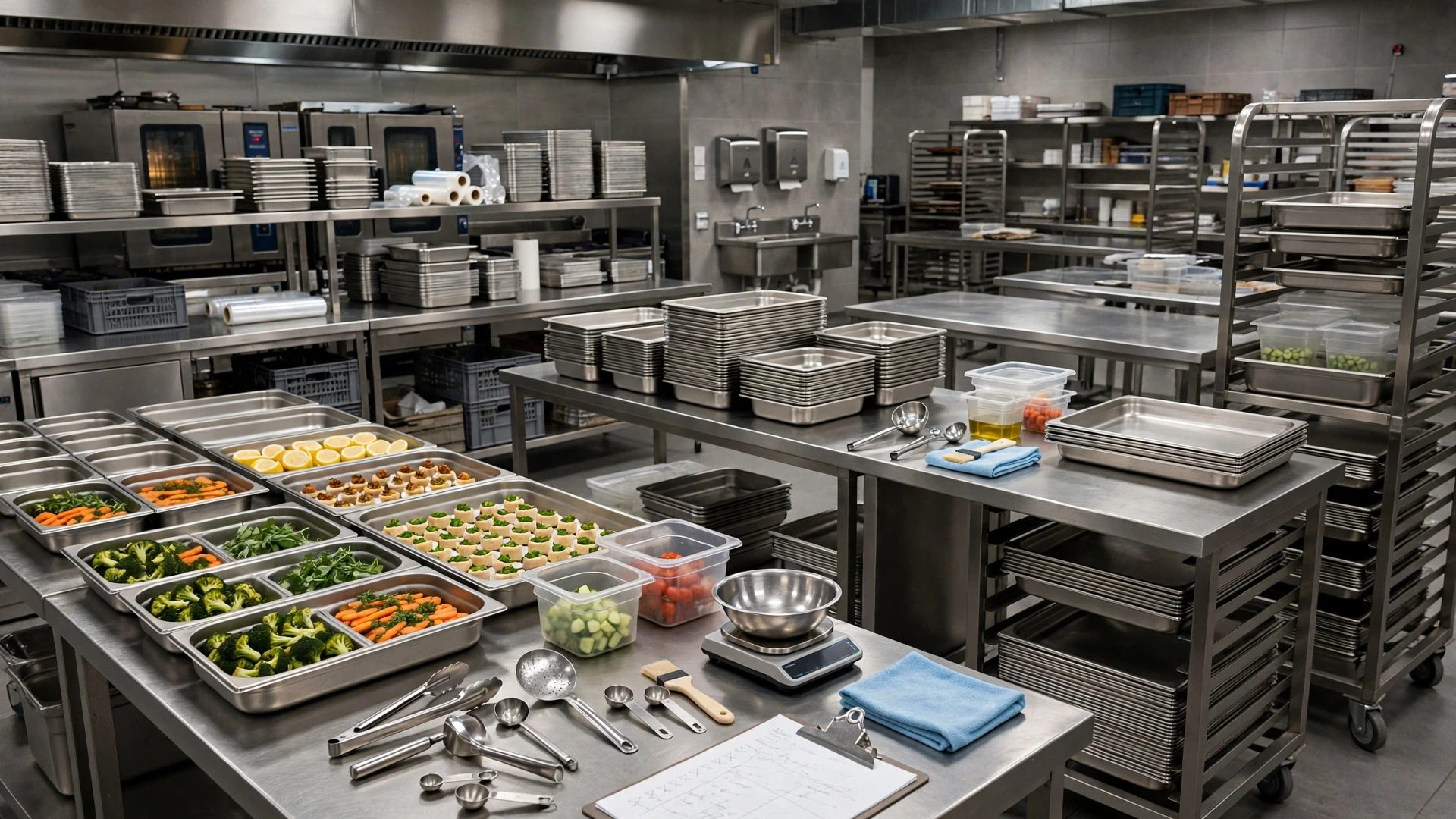
Catering becomes difficult when the kitchen treats a 150-guest event like an oversized restaurant shift.
The food may be familiar, but the operating problem is different. Everything has to be produced in the right quantity, at the right stage, in the right container, at the right temperature, and at the right time — often before the event has even started.
A strong catering production plan converts the event brief into a controlled sequence of purchasing, prep, cooking, holding, packing, dispatch and service.
This guide shows how to build that plan without relying on memory or last-minute improvisation.
Start with the event brief, not the kitchen
Before calculating a single batch, lock the operating facts.
The production team should know:
- confirmed guest count,
- service style,
- menu and portion standard,
- event date and service time,
- venue and travel time,
- onsite kitchen or reheating capability,
- dietary requirements,
- holding and transport restrictions,
- setup window,
- staffing plan.
Production errors often begin because the kitchen starts planning from an incomplete sales handover.
If the guest count is still moving, the production plan should show both the confirmed number and the planning number being used for purchasing and preparation.
Separate the confirmed guest count from the production quantity
The number of guests is not always the same as the number of portions you should produce.
Production quantity may need to account for:
- expected seconds,
- buffet behavior,
- staff meals,
- VIP or organizer meals,
- service loss,
- reasonable operational buffer.
The buffer should not be a random percentage added to every item.
Expensive protein, bread, rice, salad and dessert do not all require the same safety margin.
Use item-specific logic.
For example, a low-cost starch may justify a modest extra quantity, while an expensive protein should be controlled more tightly.
For the guest-count foundation, see Catering Food Quantity Planning: How Much Food Do You Need Per Guest?
Build a production matrix by menu item
Turn the menu into a table the kitchen can actually work from.
| Menu item | Standard portion | Planned portions | Total required | Batch size | Number of batches |
|---|---|---|---|---|---|
| Roast chicken | 180 g | 160 | 28.8 kg | 7.2 kg | 4 |
| Rice | 200 g | 165 | 33 kg | 11 kg | 3 |
| Salad | 100 g | 155 | 15.5 kg | 5.2 kg | 3 |
Figures are illustrative.
This single table forces the team to answer several important questions before production starts.
How much is needed? How much can the equipment handle at once? How many batches are required? Which items need to be produced first?
Convert recipes into event quantities carefully
If a standard recipe produces 20 portions and the event requires 160, the first calculation is simple:
160 ÷ 20 = 8 recipe batches
But multiplying every ingredient by eight is not always the end of the job.
Large-scale cooking can change:
- evaporation,
- cooking time,
- seasoning behavior,
- pan depth,
- heat transfer,
- finished yield.
That is why scaled recipes should be tested before they are used for major events.
See How to Scale Restaurant Recipes Without Losing Yield or Consistency.
Plan around equipment capacity
Catering volume is often limited by equipment, not by recipe math.
A kitchen may technically need 40 kg of roasted chicken, but the oven may safely and consistently handle only 10 kg per cycle.
That creates four production cycles.
Now the manager needs to know:
- loading time,
- cooking time,
- unloading time,
- recovery time between cycles,
- holding capacity after cooking.
Without this step, the production schedule can look perfect on paper and still be impossible in the actual kitchen.
Create a backward production timeline
The strongest catering plans work backward from service time.
Suppose buffet service starts at 7:00 PM.
Work backward:
- 7:00 PM — service begins,
- 6:40 PM — final buffet check,
- 6:20 PM — hot food placed into service equipment,
- 5:50 PM — delivery arrives and unloading begins,
- 5:20 PM — vehicle departs kitchen,
- 5:00 PM — loading complete,
- 4:40 PM — final packing and temperature checks,
- 4:15 PM — final hot-food batches complete,
- 3:00 PM onward — controlled cooking and replenishment production.
The exact timeline depends on the food, distance, equipment and local food-safety requirements. The principle is universal: service time should control the production clock.
Split prep into stages
Do not place every task on the event day.
Classify prep into three groups.
1. Advance prep
Tasks that can be completed earlier without hurting quality or safety.
Examples may include:
- dry ingredient scaling,
- label preparation,
- equipment staging,
- packaging assembly,
- some sauces or marinades where appropriate,
- non-food dispatch materials.
2. Day-before prep
Tasks that can be prepared the previous day under controlled storage.
This depends heavily on the product, quality standards and food-safety controls.
3. Event-day production
Items whose quality, texture or safety depend on same-day preparation or cooking.
This staged approach reduces event-day congestion.
Assign ownership to every production task
A task without an owner is a task the manager will probably discover late.
Each major production line should show:
- responsible person,
- start time,
- required quantity,
- batch count,
- completion deadline,
- holding or packing destination.
For a large event, this is more useful than giving the kitchen one long generic prep list.
Use batch cards for high-volume production
A batch card can prevent the team from losing track when the same recipe is produced repeatedly.
A simple batch card may include:
| Batch | Planned start | Planned finish | Actual finish | Yield | Status |
|---|---|---|---|---|---|
| Chicken 1 | 2:30 PM | 3:15 PM | Pending | ||
| Chicken 2 | 3:20 PM | 4:05 PM | Pending |
This creates a production rhythm and makes delay visible early.
Build a separate cold-food schedule
Hot production often gets most of the manager’s attention, but cold production can fail just as easily.
Salads, desserts, cold starters and garnishes need their own quantities, storage space, containers, labels and loading sequence.
Ask:
- How much cold storage is available?
- Which trays can be assembled early?
- Which items should be dressed only near service?
- Which items need final garnish onsite?
- What is the loading order?
Plan holding before cooking starts
Producing food successfully is only half the job.
The kitchen also needs enough capacity to hold finished food correctly before it leaves.
For each major item, define:
- finished container,
- number of containers,
- holding location,
- maximum practical holding window for quality,
- temperature-control procedure,
- replenishment sequence.
Do not allow the production schedule to create more finished food than the kitchen can safely and properly hold.
Separate production quantity from dispatch quantity
The kitchen may produce 20 trays, but dispatch must know exactly where those 20 trays are going.
A dispatch sheet should connect production to service.
For example:
| Item | Produced | Dispatched | Service location | Backup |
|---|---|---|---|---|
| Chicken | 12 trays | 10 trays | Main buffet | 2 trays |
| Rice | 9 trays | 8 trays | Main buffet | 1 tray |
Figures are illustrative.
This prevents the common problem of food being produced but not loaded, or loaded without a clear service destination.
Design the loading sequence around unloading
The first thing loaded is often the last thing that can be reached.
That means loading order should reflect how the team will unload at the venue.
Items needed immediately for setup should remain accessible.
Consider:
- buffet equipment,
- service utensils,
- cold food,
- hot food,
- backup food,
- disposables,
- signage,
- cleaning kit,
- emergency supplies.
Protect the final 60 minutes
The last hour before departure should not be filled with basic production work that should already be complete.
That hour is needed for:
- final cooking,
- quality checks,
- temperature verification,
- packing,
- count reconciliation,
- loading,
- dispatch sign-off.
If the team is still chopping basic vegetables or searching for containers during this window, the production plan is already behind.
Use readiness checkpoints
Instead of waiting until departure time to discover a delay, create checkpoints.
For example:
- 24 hours before — purchasing complete,
- 12 hours before — advance prep complete,
- 6 hours before — all equipment and packaging staged,
- 3 hours before — major batch production on schedule,
- 90 minutes before — only final production remains,
- 45 minutes before — packing and count verification,
- departure — dispatch sign-off.
Each checkpoint gives the manager time to recover before the event is at risk.
Build the labor plan from production hours, not only guest count
A 200-guest event with simple tray service may require less production labor than a 120-guest event with multiple hand-finished items.
Estimate labor by work content.
Consider:
- number of menu items,
- number of batches,
- knife and prep work,
- cooking cycles,
- assembly work,
- packing,
- loading,
- onsite setup.
This produces a more realistic staffing plan than using one employee-per-guest ratio.
Plan for bottlenecks, not average workload
The entire kitchen may not be overloaded. One station may be.
Common bottlenecks include:
- one oven,
- one fryer bank,
- one blast chiller,
- limited refrigeration,
- one packing table,
- one loading door.
The production manager should identify the narrowest point and build the schedule around it.
Do not schedule every item to finish at the same time
This is one of the fastest ways to overload the kitchen.
Different foods tolerate different production windows.
Schedule items according to quality sensitivity.
Items that hold well can finish earlier. Items that deteriorate quickly should finish closer to dispatch or service.
The sequence should protect both quality and capacity.
Create an exception plan
A professional catering plan assumes something may go wrong.
Define what the team will do if:
- guest count increases late,
- a supplier delivery is short,
- an oven fails,
- production runs 30 minutes late,
- a vehicle is delayed,
- a venue changes access time,
- a dietary requirement is added.
The goal is not to predict every problem. It is to know which decisions can be made quickly without creating chaos.
Track actual yield after the event
The production plan should become better after every event.
Record:
- planned quantity,
- actual quantity produced,
- actual quantity served,
- leftovers,
- waste,
- shortages,
- guest-count changes,
- timing problems.
This creates usable production history.
After several events, the operation can stop guessing and start planning from its own data.
Review overproduction separately from waste
Overproduction is not always the same as waste.
If 15 portions remain but are safely usable in another approved way, that is different from 15 portions that must be discarded.
Track both.
The important question is why the extra quantity existed.
Was the guest count wrong? Was the buffer too high? Was the portion assumption too generous? Did guests choose other menu items more heavily?
Connect production planning to event pricing
A menu may look profitable on ingredient cost but become weak once production complexity is considered.
Two catering menus with the same food cost can require very different:
- prep labor,
- equipment time,
- packing materials,
- transport capacity,
- onsite labor.
That is why production planning should inform pricing.
See How to Price Catering Events for Profit.
A practical catering production control sheet
For each event, one master sheet should summarize:
- event details,
- confirmed and planning guest count,
- menu items,
- portion standards,
- planned production quantities,
- batch sizes,
- batch count,
- responsible staff,
- start and finish times,
- holding method,
- container count,
- dispatch quantity,
- venue destination,
- final sign-off.
The sheet should be simple enough to use during production, not designed only for the office.
Run a final manager review before dispatch
Before the vehicle leaves, one responsible manager should confirm:
- All menu items are complete.
- Quantities match the dispatch plan.
- Dietary items are separated and labeled.
- Hot and cold holding controls are in place.
- Service equipment and utensils are loaded.
- Backup food is identified.
- Venue contact and access details are confirmed.
- The driver or event lead has the final event sheet.
This is the handoff point between kitchen production and event execution.
The best production plan removes surprises before service
Catering production is not simply about making enough food.
It is about controlling quantity, capacity, timing, holding, packing and handoff as one operating system.
When the plan is built backward from service time, broken into realistic batches, assigned to specific people and checked at defined milestones, the kitchen becomes much less dependent on last-minute heroics.
That is the objective: not a busier team, but a more predictable event.
Identify the critical path
Some tasks can move without threatening the event. Others cannot. Mark the tasks that directly control departure or service time, such as final cooking cycles, blast chilling where required, packing, loading and travel. If one critical-path task slips, management should immediately adjust the downstream plan instead of waiting for the delay to compound.
Use a final go/no-go review before dispatch
Thirty to forty-five minutes before departure, the event lead should confirm whether every critical requirement is complete or has a controlled workaround. A simple go/no-go review can cover food quantity, dietary items, holding equipment, service equipment, transport, venue access and staffing.
Anything still rated red should have an owner and immediate action before the vehicle leaves.
Frequently asked questions
How early should catering production planning begin?
Planning should begin as soon as the event brief is stable enough to lock menu, service style, guest count assumptions and timing. Purchasing and long-lead items may need decisions well before production starts.
Should every catering item use the same production buffer?
No. Buffer size should reflect item cost, demand uncertainty, replenishment difficulty and the operational impact of running out.
What is the biggest catering production-planning mistake?
Building quantities without testing equipment capacity and timing. A mathematically correct production total can still be impossible to execute in the available kitchen and dispatch window.
Operational note: Food-safety requirements, temperature controls and holding limits vary by food type and jurisdiction. Build the production plan around your local regulatory requirements, approved procedures and the specific characteristics of the food being produced.