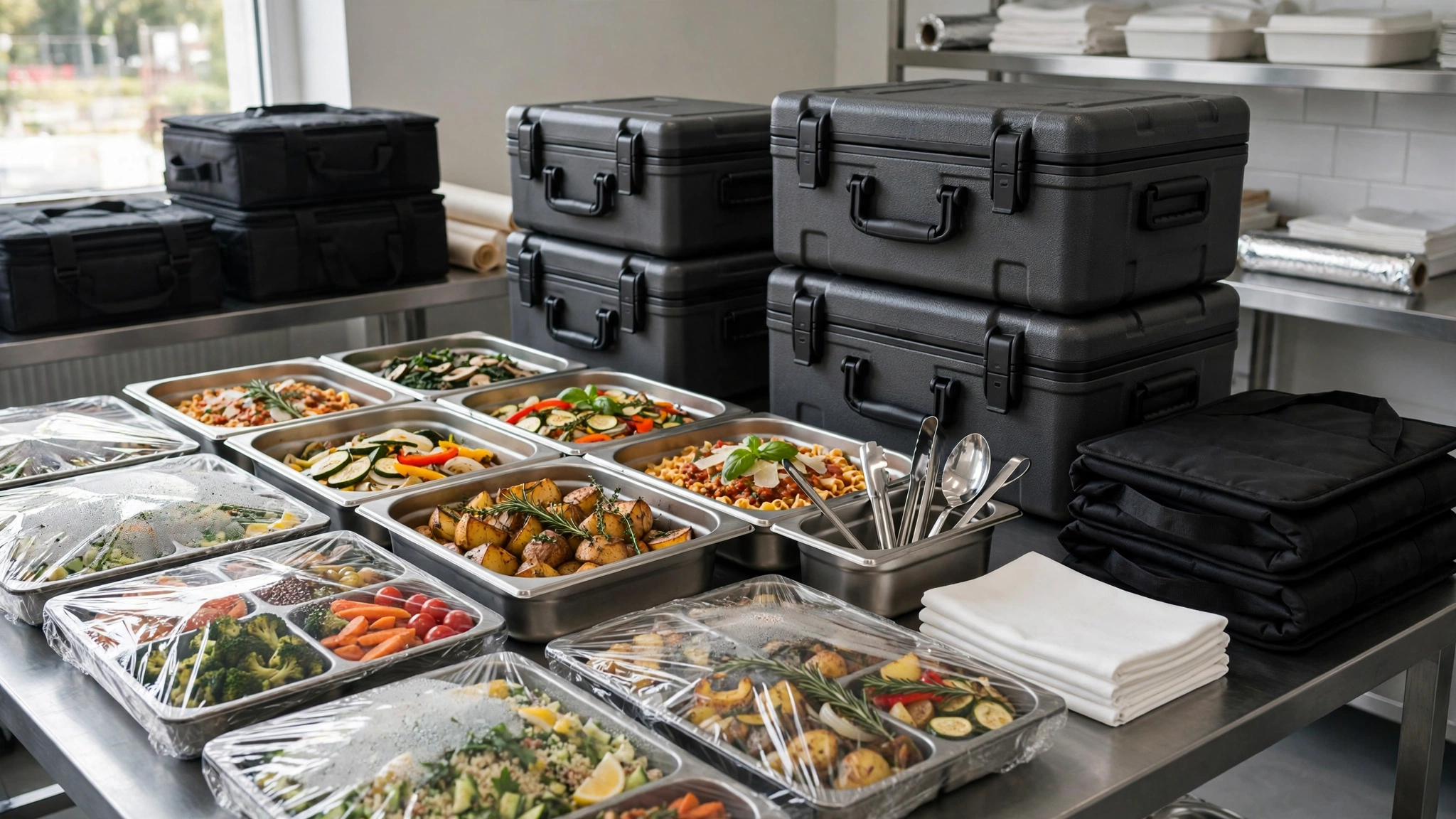
One of the easiest ways to lose money on a catering order is to guess the food quantity.
Make too little and the event feels poorly managed. Make too much and the profit disappears into leftovers, overproduction and unnecessary labor.
The right approach is not to search for one universal “food per guest” number. Catering quantity planning works better when you combine guest count, menu structure, service style, event length, expected appetite and a controlled production buffer.
This guide shows a practical way to do that.
Start with the guest count—but do not stop there
Guest count is the starting point, not the final answer.
A catering order for 100 guests can require very different food quantities depending on whether it is:
- a light business lunch,
- a wedding buffet,
- a boxed meal,
- a coffee break,
- a late-night event,
- a family-style dinner,
- a staff meal,
- a multi-course plated service.
Before calculating production, define the event type clearly.
Classify the service style
Service style changes consumption.
Plated service
Portions are controlled in the kitchen. This usually gives the restaurant the best control over food quantity because each plate has a defined specification.
Buffet service
Guests choose their own portions. Some take more protein, some more sides, and early guests may take larger portions than expected.
Buffets generally require a more careful buffer and stronger replenishment control.
Family-style service
Food is placed on tables for sharing. Quantity depends on table size, refill policy and how many menu items are offered.
Boxed meals
These are easier to control because each box follows a standard build.
If 120 boxes are ordered, the production system can be built around 120 controlled portions plus a defined backup quantity.
Build the menu before calculating quantity
Do not calculate each item independently without looking at the whole menu.
If a buffet includes:
- two proteins,
- two starches,
- three salads,
- bread,
- dessert,
the guest will not eat a full standalone portion of every item.
This is a common overproduction mistake.
The more variety offered, the more carefully each individual item should be scaled.
Separate menu items into roles
A practical way to plan is to classify dishes as:
- Main protein
- Secondary protein
- Starch
- Vegetable or side
- Salad
- Bread
- Dessert
- Beverage
Each role has a different contribution to the meal.
This prevents the team from treating every menu item as if each guest will consume one full portion.
Use portion standards, not vague estimates
The strongest catering systems start with standard portions.
For example, a restaurant may define a plated chicken portion as 180 grams cooked weight.
If the event requires 80 plated portions:
80 × 180 g = 14,400 g
That means 14.4 kg of finished usable chicken is required before considering any production buffer.
The same logic can be applied to rice, vegetables, sauces and desserts.
Plan from finished usable yield
This is where many catering calculations go wrong.
If you need 14.4 kg of cooked chicken, you may need considerably more than 14.4 kg raw product because of trimming and cooking loss.
Use:
Required raw quantity = Required finished quantity ÷ Yield percentage
Illustrative example:
- Required finished chicken: 14.4 kg
- Expected usable yield: 80%
14.4 ÷ 0.80 = 18 kg raw chicken
This is why recipe yield and catering production must be connected.
See How to Scale Restaurant Recipes Without Losing Yield or Consistency for the full scaling method.
Do not use the same buffer for every event
A production buffer protects the event against uncertainty.
But the buffer should reflect risk.
A small plated corporate lunch with a confirmed guest list may need less backup than a large buffet where attendance is uncertain.
Factors that may justify a larger buffer include:
- uncertain final attendance,
- buffet self-service,
- long event duration,
- high proportion of adult guests,
- limited ability to produce extra food on site,
- remote delivery location,
- highly popular menu items.
Factors that may justify a tighter buffer include:
- controlled plated service,
- exact confirmed guest count,
- pre-portioned meals,
- easy access to backup production,
- multiple menu items sharing demand.
Use item-specific buffers
The same buffer does not have to apply to every dish.
For example:
- a critical main protein may deserve a larger backup,
- bread may be easy and inexpensive to hold as reserve,
- a premium seafood item may need tighter control,
- rice can often be produced more flexibly than an expensive cooked protein.
This protects the guest experience without turning every event into overproduction.
A simple catering quantity formula
For a standardized plated item:
Guest count × Portion size × Buffer factor = Required finished quantity
Illustrative example:
- Guests: 100
- Cooked protein portion: 180 g
- Production buffer: 5%
Base requirement:
100 × 180 g = 18,000 g
With 5% buffer:
18,000 × 1.05 = 18,900 g
The kitchen would therefore target 18.9 kg of finished usable protein.
The exact buffer is an operational decision, not a universal standard.
Buffet planning needs a different mindset
Buffet guests do not consume each item equally.
Some dishes will be far more popular than others.
Use historical consumption whenever possible.
If your last five similar events show that:
- grilled chicken disappears quickly,
- a vegetable side consistently returns half-full,
- dessert consumption is lower at lunch than dinner,
that information is more valuable than a generic internet rule.
The best catering quantity model becomes more accurate after every event.
Track actual consumption after the event
For each significant event, record:
- guest count,
- quantity produced,
- quantity served,
- quantity returned,
- avoidable waste,
- items that ran short,
- items that were overproduced.
This turns experience into data.
After several events, you may discover that your assumed portion standard is consistently too high or too low.
Build a production factor for repeat events
Suppose a recurring corporate lunch has 150 guests.
Over several events, actual consumption of a particular rice dish averages 135 standard portions.
You now have evidence that actual demand for that dish is roughly 90% of guest count when served as part of that menu.
That does not mean every future event will behave identically.
But it is a much stronger starting point than producing 150 full portions automatically.
Plan for guest mix
Guest profile can materially change consumption.
Consider:
- adults versus children,
- business lunch versus celebration,
- daytime versus late evening,
- active outdoor event versus seated meeting,
- dietary restrictions,
- cultural menu expectations.
A standard portion system should therefore allow manager judgment rather than pretending every group consumes the same amount.
Do not forget dietary meals
Special meals should be counted separately.
Examples:
- vegetarian,
- vegan,
- allergy-sensitive meals,
- religious dietary requirements,
- client-requested alternatives.
Do not assume that extra standard meals can automatically replace these requests.
The event sheet should show the special-meal count clearly.
Plan by production batch, not only total weight
Once the total required quantity is known, convert it into practical kitchen batches.
Suppose 120 portions are needed, but the approved recipe produces 40 portions per batch.
The kitchen should plan:
- Batch 1: 40
- Batch 2: 40
- Batch 3: 40
If 130 portions are needed, the manager must decide whether to:
- produce a smaller validated final batch,
- produce a full fourth batch and accept controlled surplus,
- adjust the production standard.
This is much better than asking the kitchen to improvise quantities during production.
Connect quantity planning to the prep list
The catering order should flow into production planning.
Each menu item should have:
- required finished quantity,
- number of batches,
- prep date,
- production date,
- responsible station,
- packing requirement,
- final count check.
See How to Build a Restaurant Prep List for the operational structure behind this step.
Quantity planning affects pricing
Overproduction is not only a kitchen problem.
It changes the financial result of the event.
If the quote assumes 100 portions but the kitchen routinely produces enough for 120, the true food cost is higher than the sales estimate.
The pricing model should reflect realistic production quantities and expected waste.
For the financial side, see How to Price Catering Events for Profit.
A real-world planning example
Imagine a buffet for 200 guests with:
- two proteins,
- rice,
- one vegetable dish,
- salad,
- bread,
- dessert.
A weak plan simply prepares 200 full portions of every item.
That effectively plans for 400 full protein portions because two proteins are offered.
A stronger plan uses menu share.
For example, based on previous similar events, the operator may expect:
- 60% preference for protein A,
- 40% preference for protein B,
- plus a controlled backup for each.
The exact percentages should come from the restaurant’s own history where possible.
The important principle is that menu variety changes item-level demand.
Use a final quantity review before purchasing
Before the purchase order is finalized, review:
- latest confirmed guest count,
- menu changes,
- special meals,
- portion standards,
- yield assumptions,
- buffers,
- existing usable inventory,
- pack sizes,
- supplier lead times.
This prevents purchasing from being based on an outdated proposal.
Common catering quantity mistakes
Producing one full portion of every menu item for every guest
Menu variety is ignored and overproduction rises.
Calculating from raw weight only
Cooking and trimming losses distort the real portion yield.
Adding the same large buffer to every item
This creates hidden waste.
Ignoring equipment capacity
The total quantity may be correct while the production plan is impossible.
Not recording leftovers
The business repeats the same overproduction at the next event.
Changing the guest count without updating purchasing and prep
Different departments end up working from different numbers.
A practical catering quantity workflow
- Confirm expected guest count.
- Define service style.
- Finalize the menu structure.
- Set standard portions.
- Calculate finished quantity.
- Apply realistic yield factors.
- Add controlled item-specific buffers.
- Convert totals into production batches.
- Check equipment and storage capacity.
- Update purchasing.
- Build the prep and packing plan.
- Record actual consumption after the event.
The goal is controlled abundance
A catering client should never feel that the restaurant planned too tightly.
But “plenty of food” should not mean uncontrolled overproduction.
The strongest catering operations create the feeling of abundance through good menu design, replenishment and disciplined portion planning.
When guest count, recipe yield, batch production and actual consumption are connected, the kitchen can protect both service quality and event profitability.
Use a final production-versus-consumption review
After each significant event, compare what was produced with what was actually served or returned. A simple event review can include:
| Item | Produced | Served | Usable return | Waste | Action |
|---|---|---|---|---|---|
| Protein A | 125 portions | 116 | 5 | 4 | Reduce buffer slightly |
| Rice | 220 portions | 198 | 12 | 10 | Review production factor |
The figures are illustrative. This review is what turns catering experience into a repeatable quantity-planning system.
Track shortage risk separately from waste risk
Not every item deserves the same buffer. A premium protein may carry high waste cost, while bread or rice may be inexpensive insurance against an unexpected attendance increase. Rate each item by:
- financial cost of overproduction,
- guest impact if it runs out,
- ability to replenish during service,
- shelf life and reuse rules,
- production lead time.
This creates a more rational buffer than applying one blanket percentage to the entire menu.
Frequently asked questions
How much extra food should a caterer prepare?
There is no universal percentage. The correct buffer depends on service style, attendance certainty, menu mix, replenishment ability and the cost of overproduction. Use your own event history whenever possible.
Should buffet portions be larger than plated portions?
Buffet planning should account for self-service behavior and menu variety rather than simply increasing every portion. Historical consumption by item is more useful than one generic multiplier.
What is the best way to improve catering quantity accuracy?
Record actual production, consumption, leftovers and shortages after each comparable event, then update item-specific production factors for the next event.
Operational note: Portion sizes, production buffers and consumption patterns vary by menu, event type and customer group. The numerical examples in this guide are illustrative planning examples rather than universal serving standards. Food production, transport and holding should follow the food-safety requirements that apply to your operation.