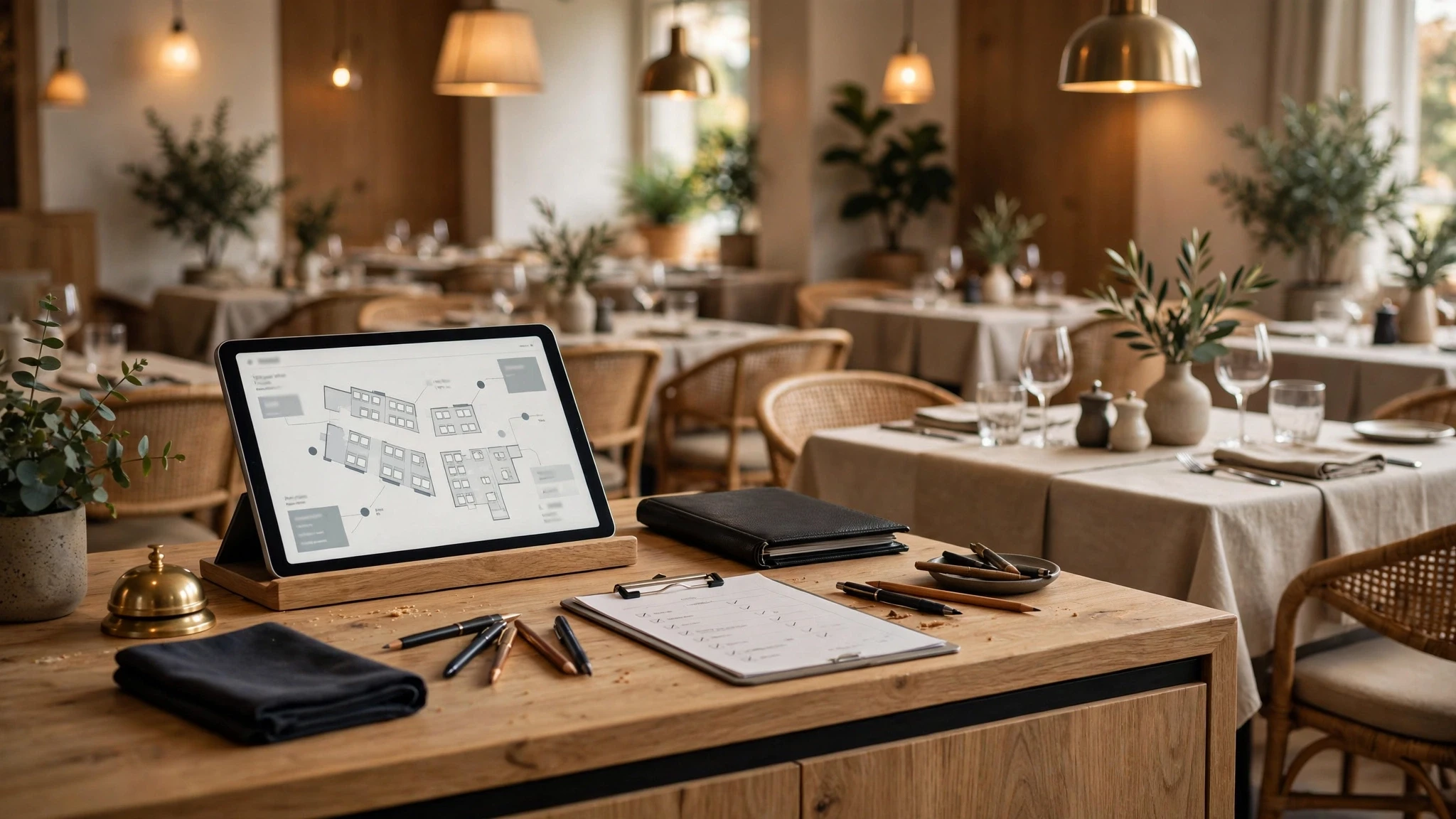
A restaurant can have empty tables and still quote a long wait. It can also seat guests quickly and overload the kitchen. The host stand sits between reservations, walk-ins, table turns, server sections, large parties, guest expectations and real-time dining-room conditions.
When that information is fragmented, hosts make decisions from memory: one table is actually paying, another has not been cleaned, a party is late, a server just received three tables, and the quote given twenty minutes ago no longer matches the current queue.
Host-stand control creates one live service picture: who is waiting, what tables are truly available, what the current bottleneck is, and which seating decision protects both the guest and the operation.
Define table status clearly
| Status | Operational meaning |
|---|---|
| Available | clean, set and approved for seating |
| Seated | guest party is at the table |
| Dining | active meal/service in progress |
| Check/closing | guest is near the end but table is not yet available |
| Dirty/reset | party has left; table cannot be seated yet |
| Held | deliberately unavailable for a reservation, large party or manager reason |
| Out of service | maintenance/layout/operational restriction |
The exact labels can differ. The important point is that every host and manager means the same thing when they use a status.
Do not mark a table available before it is actually seatable
An open square on a digital map is not enough. Availability should reflect physical readiness: previous guests have left, payment is complete, clearing/reset is finished, and any manager hold has been removed.
This keeps the wait quote based on usable capacity rather than theoretical seats.
Keep one live waitlist
Use one controlled waitlist or reservation/wait platform. Side lists on paper, private messages and verbal promises create duplicate or lost parties.
- Party name or identifier.
- Party size.
- Arrival/check-in time.
- Quoted wait range.
- Seating requirements or approved notes.
- Reservation status if applicable.
- Contact method where used.
- Current queue status: waiting, notified, seated, left/cancelled.
Collect only the information necessary for the service process and follow the business’s privacy practices.
Quote a range, not a fake promise
A quoted wait is an operating estimate. It should be based on current table status, parties ahead, table sizes likely to turn, reservations due and any service bottleneck.
Avoid treating a precise minute as a guarantee when the restaurant cannot control exactly when seated guests leave.
Build quote-time inputs
- Number and sizes of parties currently waiting.
- Usable tables by size and combination.
- Reservations due soon.
- Tables in check/closing status.
- Reset time.
- Server-section load.
- Kitchen or bar constraints that justify pacing.
- Large parties that consume multiple tables.
Use historical turn time carefully
Historical table-turn information can help forecasting, but it should not become a countdown clock imposed on guests. Use it as a planning input, then update the quote from real table status.
A two-top finishing dessert may turn later than its historical average; another table may leave early. The host stand needs both history and live observation.
Coordinate seating with server sections
A table can be physically available while a section is operationally overloaded. Seating three new parties to the same server within a few minutes can slow greetings, drink orders and kitchen firing.
Use rotation as a guide, not an absolute rule. Managers should be able to pause, skip or rebalance a section when service capacity requires it.
Separate fairness from sequence
A later-arriving two-top may be seated before an earlier six-top because a suitable two-top opens first. Explain the system internally so hosts do not feel forced to leave usable tables empty merely to preserve a single line.
The waitlist should track party-size fit as well as arrival sequence.
Control reservations and late arrivals
Define the restaurant’s actual reservation arrival and hold policy. Do not improvise a different grace period by host or shift.
If a reservation is late, follow the approved process for contact, table release and waitlist impact. The policy should be visible to the host team and consistent with the reservation platform or guest communication.
Handle early arrivals separately
An early reservation does not automatically create an immediate table obligation. Check whether the assigned or suitable table is available without disrupting other commitments.
Where possible, give the guest an accurate expectation rather than promising a seat simply because they arrived before the booked time.
Create large-party rules
Large parties can consume several tables and create long resets. The host plan should identify table combinations, arrival time, complete-party policy where applicable, server ownership and the effect on nearby reservations.
Do not assemble large-party tables ad hoc during the rush if the combination can be planned before service.
Use a pre-shift table map
1. Load confirmed reservations and large parties.
2. Mark tables held or out of service.
3. Confirm server sections and capacity limits.
4. Identify flexible table combinations.
5. Flag expected peak arrival windows.
6. Review known VIP/accessibility or service notes that are appropriate to retain.
7. Confirm who can override holds, quotes or seating sequence.
Create a quote escalation rule
Hosts should know when a wait estimate needs manager input. Examples include an unexpectedly stalled dining room, a kitchen pacing issue, a large-party delay, a system outage, a guest quoted far outside the current range, or an accessibility need requiring a limited table type.
Escalation prevents a junior host from solving a complex capacity problem alone.
Requote when the service picture changes
If the original estimate materially changes, update the waiting guest rather than letting the quoted time expire silently.
A re-quote should explain the revised expectation without blaming a specific seated guest. The host controls communication, not how quickly another party chooses to leave.
Track quote accuracy
For a sample of busy periods, compare quoted wait with actual seat time. Group results by party size and daypart.
Do not turn the data into a punishment metric. Use it to see whether estimates are consistently too optimistic, too conservative or distorted by a specific table-size shortage.
Use abandonment as a signal
Record when guests leave the waitlist before seating if the system supports it. A high walk-away rate may indicate long waits, poor quote accuracy, weak communication or a concept/location where guests have many nearby alternatives.
The pattern is more useful than one frustrated guest.
Keep the host stand connected to the dining room
Hosts should not stare only at the tablet. Real table status requires visual confirmation and communication with servers, bussers and managers.
A digital system is strongest when the dining-room process updates it quickly and accurately.
Plan for system outage
If the reservation or waitlist system becomes unavailable, use a simple approved fallback sheet with party, size, arrival, quote, contact and status. When systems return, reconcile the active queue instead of running two versions.
Manager recheck during peak
- Waitlist length by party size.
- Oldest waiting party versus quote.
- Tables stuck in check/dirty status.
- Server sections receiving too many simultaneous seats.
- Reservations due within the next window.
- Large-party impact on flexible tables.
- Guests whose quotes need an update.
- Tables held without a current reason.
Build a table-combination map before service
Restaurants with movable two-tops and four-tops should predefine which combinations are acceptable. A six-top created from three tables may block an aisle or remove two useful two-tops for the next hour. The host should know the approved combinations rather than redesigning the floor during the rush.
For each flexible combination, note the resulting party size, tables consumed, server section and any accessibility or aisle constraint. This makes large-party decisions faster and protects the rest of the seating plan.
Protect accessible seating without creating confusion
Some guests require a table location or configuration that is not interchangeable with every open table. The host process should make those needs visible only to the extent necessary for service, and the team should follow applicable accessibility requirements and the restaurant’s policy.
Do not treat an accessible table as permanently unavailable, but do avoid giving away the last suitable option without understanding the upcoming reservation/waitlist need.
Connect the host stand to kitchen pacing
If the kitchen is experiencing an unusual ticket backlog, management may temporarily pace seating or spread new tables across sections. The host should receive a clear instruction with a review point rather than a vague message to “slow down.”
Example: manager authorizes a five-minute pause on new walk-in seating while two large parties fire, then rechecks the line. That is different from artificially inflating every quoted wait for the rest of the night.
Create a no-show and cancellation view
Reservation cancellations and no-shows affect available capacity differently from walk-in demand. Track which reservations are cancelled, confirmed late, no-showed or released under the approved policy. This helps the manager understand whether unused tables come from conservative holds, guest behavior or slow resets.
Over time, daypart-specific no-show patterns can improve planning, but do not assume a future guest will no-show simply because a percentage did historically.
Use a host shift handoff
When the host changes during service, transfer the live operating picture: parties waiting, guests already notified, long waits, late reservations, tables held, large-party plans, out-of-service tables and any manager promise.
The handoff should take one or two minutes and use the live waitlist/table map. A verbal handoff with no shared record can lose the exact party that has already waited the longest.
Track seating friction, not only wait time
Useful internal observations include how many parties reject the first available table, how often table combinations are required, how many waits are caused by dirty/reset status, and how often a section is intentionally skipped because of service load.
These measures help distinguish a demand problem from a floor-layout, bussing or staffing problem.
Standardize guest notification
If the restaurant texts or calls waiting guests, define when a party is notified, how long the restaurant normally keeps the table before returning to the queue under its policy, and how the host records unsuccessful contact.
Do not invent the hold time shift by shift. Whatever rule the restaurant chooses should be visible to the team and communicated consistently to guests.
Run a post-peak host review
After a difficult rush, review the five longest waits and the five largest quote errors. For each, identify the dominant cause: no suitable table size, slow reset, late reservation, section overload, kitchen pacing, inaccurate status, large-party hold or unexpected guest behavior.
That review produces a specific improvement. If most misses came from slow resets, changing the wait-time formula will not solve the problem; the bussing/reset workflow needs attention.
Common host-stand mistakes
Quoting from habit
The same 30-minute quote is used whether five or twenty parties are waiting.
Using an empty table as proof of capacity
The table may be held, dirty, the wrong size or in an overloaded section.
No clear status language
One host says “open” while another means “guests are paying.”
Strict rotation regardless of service load
The system protects fairness on paper and creates poor service in practice.
No update when quotes slip
Guests feel forgotten even when the restaurant is actively working the queue.
Frequently asked questions
What is the best restaurant wait-time formula?
There is no single formula that replaces live table status. Use historical turn patterns, tables likely to become available, party-size fit, reservations and current service conditions.
Should hosts seat every available table immediately?
Not always. Managers may need to pace seating for server, kitchen or bar capacity while maintaining fair guest communication.
Should a later party ever be seated first?
Yes when a suitable table for that party opens and it does not work for the earlier party, provided the host process applies the rule consistently.
How often should table status update?
Fast enough that the host stand reflects the actual dining room. The exact workflow depends on the POS/reservation system and staff responsibilities.
Next action
During the next busy service, sample ten tables from the host map and compare the displayed status with the physical table. Then compare five quoted waits with actual seat times. Those two checks will show whether the problem is table-status accuracy, quote logic or both.
Related guides:
- Restaurant Service Standards: Build a Repeatable Sequence
- Restaurant Large-Party Service Plan
- Restaurant Reservation Technology
- Restaurant Guest Complaint Handling: A Practical Service Recovery System for Managers