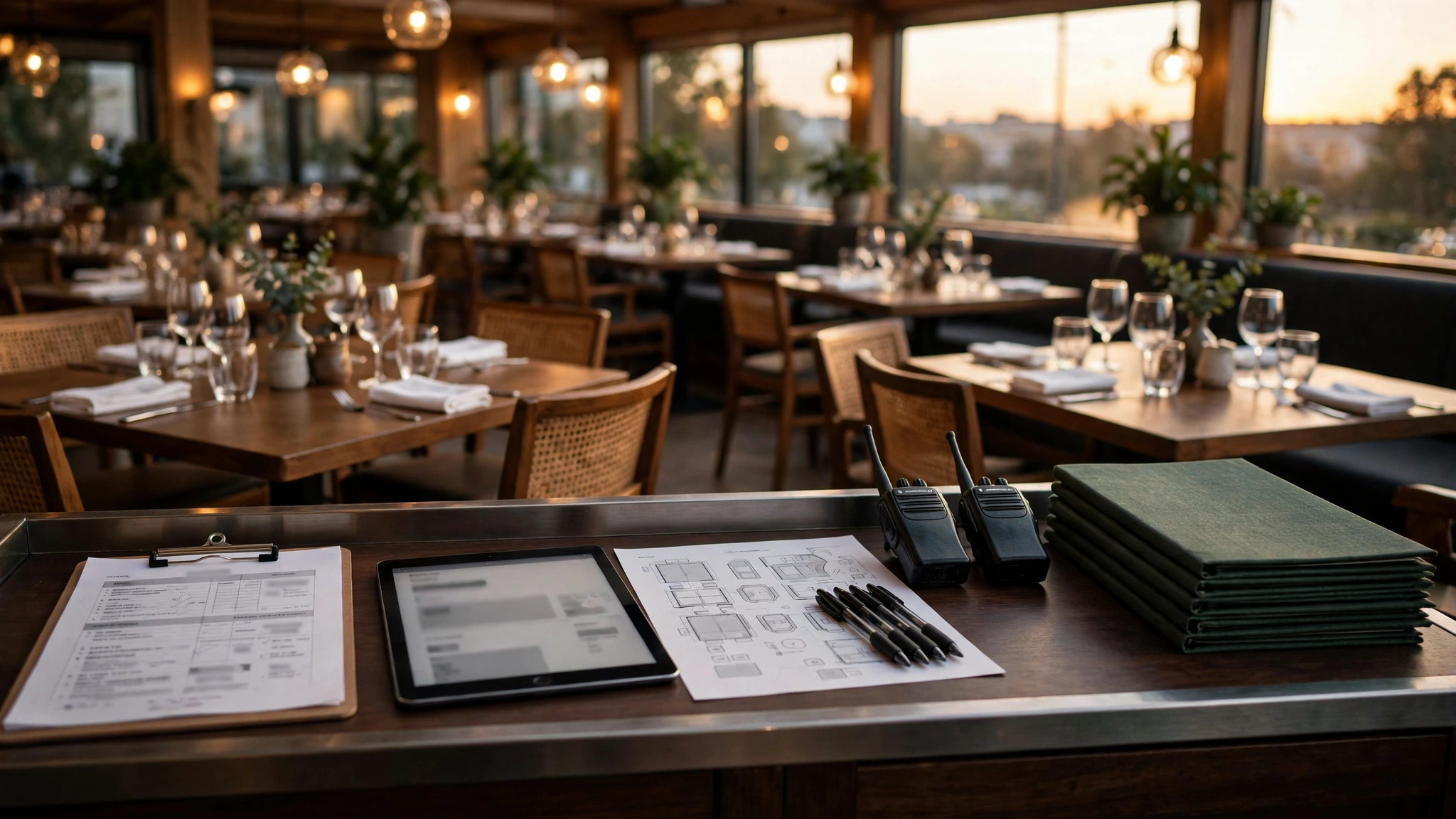
Restaurant service becomes inconsistent when standards exist only as phrases such as “give great hospitality,” “check on your tables,” or “be attentive.”
Those instructions sound positive but they are difficult to train, observe and improve.
A service standard should describe what the guest should reliably experience and what the employee should reliably do at each important stage of the visit.
That does not require robotic scripts.
The goal is a repeatable service sequence with room for natural human interaction.
Define the guest journey first
Map the service from the guest’s point of view.
A dine-in sequence may include:
- Arrival.
- Greeting.
- Seating or queue communication.
- Menu orientation.
- Beverage and order taking.
- Order confirmation.
- Food delivery.
- Quality follow-up.
- Table maintenance.
- Payment.
- Farewell.
- Reset for the next guest.
A counter-service restaurant will have a different sequence.
The sequence should match the actual concept.
Turn each stage into an observable standard
Weak standard:
Greet guests quickly.
More operational standard:
Acknowledge arriving guests promptly even when immediate seating is not possible; give the next clear step or realistic wait information.
Weak standard:
Check the table.
More operational standard:
After food delivery, verify that the order is complete and identify problems early enough to fix them while the guest is still eating.
The standard should describe behavior, not personality.
Avoid over-scripting
Scripts can help with legally required wording, complex product explanations or specific transaction steps.
But forcing every employee to repeat the same hospitality sentence can sound artificial.
Separate:
• required information,
• required action,
• optional natural wording.
Example:
Required information:
Tell the guest a product is unavailable before the order is placed.
Natural wording can vary by employee.
Build service standards around moments that affect the guest most
Not every interaction needs a formal standard.
Prioritize moments such as:
• first acknowledgment,
• accurate wait quote,
• order confirmation,
• allergy/escalation communication under approved procedure,
• correct delivery,
• missing-item response,
• complaint recovery,
• payment accuracy,
• farewell.
Standards should reduce important variation, not control every sentence.
Define timing carefully
Timing can be useful, but universal seconds-based targets often create bad behavior.
Instead of inventing an industry benchmark, define internal operating expectations based on the concept.
Examples:
• arrivals should be acknowledged before guests feel ignored,
• drinks should reach the table within the restaurant’s designed service pace,
• delays outside normal range should trigger proactive communication,
• checks should happen early enough to solve a problem before the meal is finished.
Where the restaurant uses numeric time targets, base them on its service model and observed capacity.
Separate hospitality from task completion
A server can complete every task and still create a poor experience.
Service standards should include both:
Functional standards
• order accuracy,
• timing,
• table maintenance,
• payment control,
• correct handoff.
Hospitality standards
• acknowledgment,
• clear communication,
• ownership of problems,
• respectful tone,
• adapting communication to the guest.
Do not score hospitality as fake enthusiasm. Focus on observable behavior.
Build standards by service model
Full service
May emphasize:
• greeting/seating,
• menu guidance,
• order pacing,
• table awareness,
• course coordination,
• payment/farewell.
Quick service
May emphasize:
• queue acknowledgment,
• order confirmation,
• speed with accuracy,
• pickup communication,
• dining-room cleanliness.
Takeout/delivery
May emphasize:
• order verification,
• packaging,
• labeling,
• pickup handoff,
• missing-item prevention.
One service checklist should not be forced onto every channel.
Write the sequence by role
Each role needs to know its part.
For example:
| Stage | Host | Server | Runner | Manager |
|---|---|---|---|---|
| Arrival | Greet/quote | – | – | Watch queue exceptions |
| Order | – | Take/confirm | – | Support complex issue |
| Delivery | – | Verify table | Deliver/announce | Escalate missing item |
| Recovery | Support | Own communication | Support | Approve recovery |
The structure prevents tasks from falling between roles.
Define handoff standards
Many service failures happen between employees rather than within one role.
Examples:
• host seats but server does not know,
• server rings item but modifier is unclear,
• runner drops food without identifying missing item,
• manager promises follow-up but next shift is not informed.
A handoff standard should define what information must transfer and who owns the next step.
Use order confirmation strategically
Order confirmation reduces preventable errors.
The standard might require confirmation when:
• modifier is complex,
• cooking preference matters,
• quantity is unusual,
• takeaway order has several bags/items,
• allergy communication follows the approved escalation procedure.
Do not create unnecessary repetition for every simple order if it slows the service model.
Build a missing-item response
If one item is missing at delivery, the employee should not disappear to investigate without communicating.
A useful standard is:
1. acknowledge the missing item,
2. take ownership,
3. confirm with the kitchen or POS,
4. give the guest an update,
5. escalate if delay exceeds the employee’s authority.
This prevents guests from needing to ask multiple employees.
Build delay communication into the standard
Silence makes waits feel worse.
The service standard should define when employees proactively update a guest about:
• long kitchen ticket,
• delayed beverage,
• unavailable item,
• table wait,
• payment/system delay.
Do not require employees to invent exact completion times they cannot control.
Use honest status and the next check point.
Define service-recovery authority
Employees need to know what they can fix without finding a manager.
Possible internal boundaries include:
• remake/re-fire procedure,
• replacement beverage,
• small recovery item,
• manager escalation threshold.
For the broader framework: Restaurant Guest Complaint Handling: A Practical Service Recovery System for Managers
Any financial authority should follow the restaurant’s approved policy.
Train standards through demonstration
A service manual is not enough.
Use:
- Explain the standard.
- Demonstrate it.
- Role-play common situations.
- Observe live service.
- Give one or two specific corrections.
- Recheck.
For the broader new-hire framework: Restaurant Staff Training Checklist: What Every New Hire Should Learn
Use scenarios instead of memorized phrases
Scenario training improves judgment.
Examples:
• guest arrives during a host rush,
• table has been waiting longer than normal,
• one entree is delayed,
• guest wants to change a modifier after order send,
• sold-out item was not communicated,
• payment terminal is slow.
Ask the employee to follow the standard while using natural language.
Use pre-shift meetings to reinforce one standard at a time
Do not reteach the entire service manual every day.
Pick one focus based on recent performance.
Example:
Tonight’s focus: when the kitchen is delayed, update the table before the guest asks.
For meeting structure: Restaurant Pre-Shift Meeting: How to Run a 10-Minute Team Briefing
Observe with a short service walk
Managers can audit service without hovering over every employee.
A 10-minute observation can check:
• arrival acknowledgment,
• wait communication,
• order accuracy behavior,
• table maintenance,
• visible guest confusion,
• payment queue,
• handoffs.
Record patterns, not every minor imperfection.
Use exception data as service-standard feedback
Repeated problems tell you which standard is weak.
Examples:
• repeated missing modifiers -> order confirmation/POS standard,
• repeated unacknowledged waits -> host communication,
• repeated cold food waiting at pass -> runner/handoff standard,
• repeated payment delays -> staffing/system issue.
Do not assume every complaint is a training problem. Process, staffing and technology can also cause the failure.
Avoid standards employees cannot execute
A restaurant might demand “immediate” service while staffing below the level required to provide it.
If the standard repeatedly fails despite capable staff, review:
• station workload,
• table count,
• menu complexity,
• POS flow,
• kitchen throughput,
• staffing,
• physical layout.
An unrealistic standard creates blame instead of improvement.
Connect service standards to table-turn flow
Faster service is not the same as rushing guests.
The sequence should remove avoidable waiting:
• delayed greeting,
• slow order entry,
• food sitting before delivery,
• late check presentation,
• payment process delay,
• slow reset.
For dining-room flow: Restaurant Table Turn Time: How to Improve Dining Room Flow Without Rushing Guests
Measure a few service indicators
Possible operational measures include:
• order accuracy,
• complaint reasons,
• ticket/guest wait time,
• remake rate,
• payment errors,
• review themes,
• manager recoveries.
Do not create a huge scorecard that staff cannot use.
The best measures identify where the service sequence breaks.
Example: standardizing a lunch sequence
A restaurant sees repeated lunch complaints about slow checks.
Observation finds servers are waiting until guests request the bill, then sharing one payment terminal.
Management changes the standard:
1. server confirms whether anything else is needed as meals finish,
2. check is prepared before the guest must signal repeatedly,
3. payment terminal coverage is assigned during peak,
4. manager watches payment queue during the last 30 minutes of lunch peak.
No script is required.
The change removes a process delay.
Review standards by daypart
Breakfast, lunch and dinner can require different emphasis.
Breakfast may prioritize speed and predictable routines.
Dinner may require more pacing and menu guidance.
Late-night service may have different staffing and security considerations.
The core hospitality principles can remain consistent while the workflow changes.
Keep standards short enough to use
A 40-page service manual may be necessary for training, but a shift reference should be much shorter.
Create a one-page sequence showing:
• stage,
• required action,
• key handoff,
• escalation trigger.
Employees can then learn deeper detail in training materials.
Manager calibration matters
If one manager accepts a standard and another corrects employees for the same behavior, service becomes unstable.
Managers should periodically calibrate:
• what acceptable performance looks like,
• which issues require coaching,
• which issues require process change,
• what employees are authorized to decide.
Build a short manager service scorecard
Managers need a consistent way to observe the standard.
A practical scorecard can use a small number of yes/no or needs-attention items:
• arrivals acknowledged,
• wait expectations communicated,
• orders confirmed where needed,
• food delivered with complete handoff,
• delays updated proactively,
• payment flow controlled,
• recovery escalations handled within authority.
Do not turn the scorecard into a secret employee ranking system. Its first purpose is to identify where the service process breaks.
Calibrate managers with the same scenarios
Once a month or after major changes, give managers the same three or four service scenarios and ask how they would coach them.
If one manager says a behavior is acceptable and another says it violates the standard, employees receive conflicting signals.
Calibration topics can include:
• delayed greeting during a rush,
• guest waiting for a missing side,
• complaint inside employee authority,
• table lingering during a waitlist,
• large takeaway pickup arriving early.
Use the discussion to clarify the standard, not to create more rules than the operation needs.
Retire standards that no longer serve the concept
Service standards should change when the restaurant changes.
A new order-at-table system, new pickup model, different menu, remodel or revised staffing model can make old steps unnecessary.
Review the sequence after meaningful operating changes and remove obsolete steps. A shorter current standard is more useful than a long manual containing yesterday’s process.
Common service-standard mistakes
Writing vague values instead of actions
“Be friendly” is hard to verify.
Over-scripting
Employees sound unnatural and stop thinking.
Using one model for every channel
Takeout, quick service and full service differ.
No handoff standards
Information disappears between roles.
Unrealistic timing
Staff are blamed for capacity problems.
Measuring only speed
Accuracy and hospitality suffer.
Training once and never rechecking
Standards drift.
Service standards checklist
- Guest journey is mapped.
- Critical touchpoints are selected.
- Each standard describes observable behavior.
- Required information is separated from optional wording.
- Role ownership is clear.
- Handoffs are defined.
- Delay communication is standardized.
- Recovery authority is documented.
- Standards match staffing and capacity.
- Managers use short observations to recheck.
- Pre-shift reinforcement targets recent problems.
- Exceptions feed back into the standard.
Frequently asked questions
Should restaurants use scripts?
Use scripts only where exact wording is operationally necessary. For most hospitality moments, define the required action and information while allowing natural language.
How many service standards should we have?
Enough to control the important guest journey without turning every interaction into a rule. Start with the highest-impact touchpoints.
How often should standards be reviewed?
Review after meaningful menu, staffing, technology or service-model changes and whenever recurring complaints show a weak process.
Who owns service standards?
Management should define and maintain them, but experienced front-line employees can provide valuable feedback about what is practical during real service.
Next action
Walk through one guest visit from arrival to payment and write only the ten moments where inconsistency can most damage the experience. For each moment, define one observable employee action and one escalation rule. That is the first version of a service standard your team can actually use.