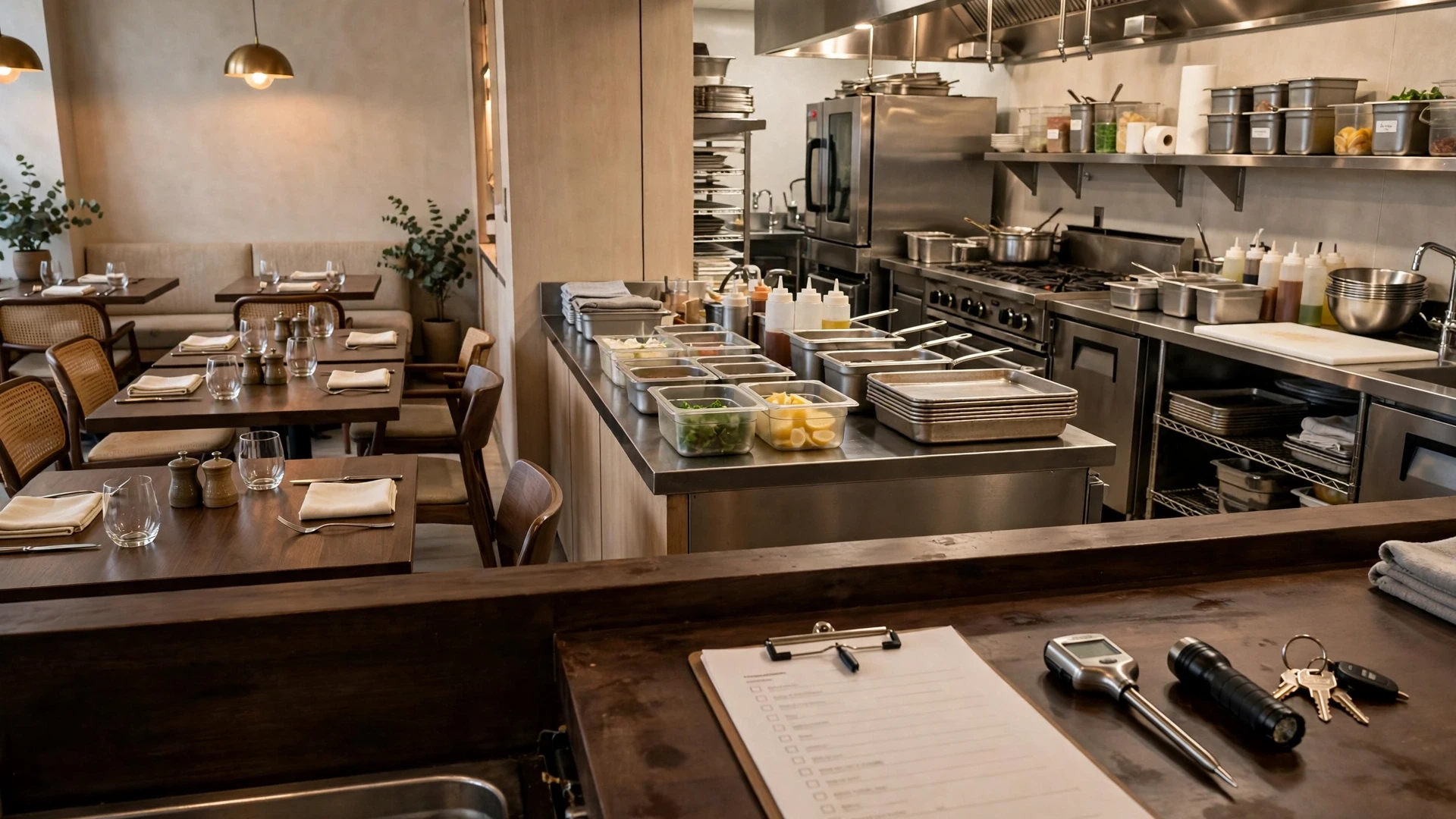
“Do your side work before you leave” sounds clear until five employees have five different ideas about what side work means.
One server refills condiments. Another rolls cutlery. A third assumes the closer will stock the service station. The dining room looks ready, but backup supplies are empty. One employee finishes in ten minutes while another gets stuck with forty minutes of work.
A side work system removes that ambiguity.
It defines which front-of-house tasks belong to which role, when the task should happen, what “complete” looks like and who verifies it.
The objective is not to create a longer cleaning list. It is to distribute the small operating tasks that keep service ready without relying on memory or the most responsible employee.
Separate side work from normal guest service
Side work usually supports service but is not the guest interaction itself.
Examples include:
• stocking service stations,
• polishing glassware,
• rolling or staging cutlery,
• refilling condiments,
• restocking napkins,
• organizing takeaway supplies,
• cleaning menus where used,
• resetting server stations,
• restocking beverage areas,
• checking high chairs,
• clearing non-service clutter.
The exact tasks depend on concept.
Do not use “side work” as a vague label for every undesirable task.
Divide side work by timing
A useful system has three groups.
Opening side work
Tasks required before service begins.
Examples:
• stock stations,
• stage menus,
• check condiments,
• prepare water/service items,
• verify takeaway supplies.
Running side work
Tasks maintained during service.
Examples:
• restock napkins,
• refill condiments,
• clear service stations,
• replenish cups,
• reset shared areas.
Closing side work
Tasks completed before shift handoff or departure.
Examples:
• final restock,
• wipe and reset stations,
• organize supplies,
• complete assigned cleaning,
• prepare the next shift.
This prevents opening tasks from being discovered at closing.
Build a side work inventory
Walk the front-of-house area and list every recurring support task.
Organize by zone:
• host stand,
• server stations,
• beverage station,
• dining room,
• takeaway pickup,
• patio,
• restroom check,
• storage,
• closing handoff.
Do not assign people yet.
First identify the full workload.
Define what complete means
Weak task:
Stock station.
Controlled task:
Refill napkins to marked par, stock 30 takeaway cutlery sets, refill receipt rolls, wipe shelf, remove empty cartons.
The second version is verifiable.
Use quantities, locations or visual standards where useful.
Assign side work by role
A role-based system is easier to maintain than random daily assignments.
Example:
| Role | Typical side work |
|---|---|
| Opener server | Main station setup, condiment par |
| Section server | Assigned service station |
| Bartender | Bar garnish and glassware |
| Host | Menus, waiting area, high chairs |
| Closer server | Final dining room reset |
| Shift lead | Verification and exceptions |
Adapt the roles to the concept.
Balance work by minutes, not number of tasks
Three tasks are not automatically equal to three other tasks.
Estimate normal completion time.
Example:
• roll 30 cutlery sets: 12 minutes,
• refill condiment station: 5 minutes,
• restock takeaway shelf: 8 minutes,
• polish glassware rack: 15 minutes.
The figures are illustrative.
If one role always receives forty minutes while another receives ten, resentment grows and employees rush the heavier assignment.
Avoid punitive side work
Do not use undesirable side work as an informal punishment.
That creates inconsistency and can produce workplace-management issues.
Assignments should follow:
• role,
• zone,
• rotation,
• workload,
• business need.
Performance problems should be handled through the restaurant’s normal management process.
Create station pars
Side work becomes faster when staff know the target quantity.
Examples:
• napkins: two sleeves,
• takeaway cutlery: 30 sets,
• receipt paper: 3 backup rolls,
• water glasses: 2 racks,
• condiment bottles: full marked shelf.
Use pars based on actual demand.
Do not overstock every station “just in case.”
Use visual standards
Photos can make side work more consistent.
A station standard can show:
• where items belong,
• how much stock is normal,
• what a clean station looks like,
• which labels face forward,
• what should not be stored there.
Visual standards reduce training time and argument.
Keep side work close to the role
Whenever possible, assign employees to areas they already use.
A server working section A can maintain the nearest service station.
The host can maintain host-stand supplies.
This improves accountability because the person sees the condition during the shift.
Do not create side work that conflicts with guests
Running side work should not pull employees away during peak demand.
Classify tasks by flexibility.
Must happen now
Example: service station is out of cutlery.
Can happen between tables
Example: refill menus.
Should wait until after peak
Example: reorganize backup storage.
This prevents managers from prioritizing a checklist over guest service.
Use side work during natural low-demand windows
Side work should fit the rhythm of the shift.
Good windows may include:
• before doors open,
• after initial setup,
• between rushes,
• after section consolidation,
• before final checkout.
The exact timing depends on the concept.
Protect labor-law and payroll requirements
Side work is work.
Employees must be paid according to applicable wage-and-hour rules for time they are required to work.
Rules affecting tipped employees, task types and time allocation can vary by jurisdiction.
The restaurant should align side work with applicable employment requirements and qualified payroll/legal guidance where needed.
Do not require unpaid work before clock-in or after clock-out.
Separate cleaning from deep cleaning
Front-of-house side work can include routine cleaning.
It should not become an uncontrolled substitute for specialized or deep-cleaning tasks.
Define boundaries.
Examples of routine side work may include:
• wipe a station,
• sanitize approved surfaces,
• sweep assigned area.
More complex cleaning may require:
• different training,
• chemicals,
• protective equipment,
• maintenance procedures.
Use the restaurant’s approved cleaning program.
Integrate side work with opening readiness
Opening side work should feed the pre-service readiness check.
A manager should not separately discover that:
• menus are missing,
• beverage station is empty,
• takeout supplies are not ready,
• server stations are incomplete.
For broader service readiness: Restaurant Pre-Service Readiness Checklist Before Opening
Side work is one input into readiness.
Integrate side work with closing
Closing side work should support the next day.
For the overall opening and closing control: How to Build a Daily Restaurant Opening and Closing Checklist
The side work system should be more detailed at role level, while the closing checklist confirms the operation is ready to shut down.
Use a checkout gate
An employee should not simply announce “I’m done.”
Create a short checkout sequence.
Example:
1. complete assigned side work,
2. check section status,
3. notify shift lead,
4. shift lead verifies material items,
5. close out POS/cash responsibilities where applicable,
6. manager releases employee.
The exact process should fit the restaurant.
Verify high-impact tasks, not every tiny detail
Managers do not need to inspect every folded napkin.
Verify the tasks where failure matters.
Examples:
• station stock,
• cash/POS responsibilities,
• high-value supplies,
• safety-sensitive close,
• handoff to next shift.
Use spot checks for lower-risk tasks.
Use sign-off selectively
A simple side work sheet might contain:
| Employee | Role | Assignment | Completed | Verified |
|---|---|---|---|---|
| Alex | Server | Station A | ✓ | ✓ |
| Mina | Host | Host stand | ✓ | ✓ |
| Jordan | Closer | Takeaway shelf | ✓ | Pending |
Do not create signatures for every small task if one role-level sign-off is enough.
Rotate unpopular assignments
Some tasks are naturally less desirable.
Examples:
• final patio reset,
• condiment refill,
• closing takeaway area.
Use a fair rotation where roles allow it.
Publish the rotation before the shift where practical.
Fairness reduces the tendency for employees to avoid tasks or negotiate at closing time.
Handle early cuts
When business slows, managers may cut employees before the scheduled end.
The side work plan needs a rule.
Options include:
• complete assigned early-cut tasks before release,
• transfer remaining work explicitly,
• reassign to the closing team,
• use a shortened early-cut checklist.
Do not let tasks disappear simply because a section closed early.
Transfer unfinished work deliberately
If an employee cannot finish because guest demand continues, transfer the task.
Record:
• task,
• new owner,
• status.
Do not blame an employee for unfinished side work when the manager kept them fully engaged with guests.
Build a running restock system
The best closing shift is one where stations were maintained throughout service.
If staff allow every station to fall empty until closing, the final workload becomes large.
Set running side work triggers.
Example:
• restock when napkins fall below one sleeve,
• refill takeaway sets when fewer than 10 remain,
• replenish glassware before the next rush.
These are internal examples, not universal standards.
Use side work to improve shift handoff
The outgoing shift should leave the next shift with:
• stocked stations,
• organized supplies,
• known exceptions.
If a supply is unavailable, the handoff should state it.
For manager-level handover: Restaurant Manager Logbook: How to Build a Better Shift Handover
Side work should reduce surprises between shifts.
Do not let managers silently redo failed side work
If a manager repeatedly fixes incomplete tasks without feedback, the system never improves.
Use a simple loop:
• identify the missed standard,
• show the employee,
• correct it,
• recheck,
• document repeated issues through the normal performance process.
The purpose is training and accountability, not conflict.
Measure completion problems by task
If the same task is missed repeatedly, investigate the system.
Possible causes:
• unclear standard,
• insufficient stock,
• task takes longer than assumed,
• storage is too far away,
• assignment is unfair,
• employees are released too early,
• manager verification is inconsistent.
Repeated failure is data.
Example: redesigning server side work
A restaurant has six servers.
The old system says:
Everyone does side work before leaving.
At closing, staff argue over:
• cutlery,
• condiments,
• takeaway supplies,
• dining room reset.
The manager redesigns the system:
• Server 1: Station A + napkins,
• Server 2: Station B + condiments,
• Server 3: takeaway supplies,
• Server 4: glassware,
• Server 5: dining room reset,
• Closer: final gaps only.
Each assignment is estimated at 12–18 minutes.
The result is not necessarily fewer total minutes. It is clearer ownership and less duplicated or missing work.
Build a side work matrix
A reusable matrix can contain:
| Task | Zone | Timing | Role | Standard | Verify |
|---|---|---|---|---|---|
| Napkins | Station A | Running/close | Server | 2 sleeves | Spot check |
| Menus | Host stand | Open/close | Host | Clean/full set | Host lead |
| Takeaway cutlery | Pickup | Running/close | Assigned server | 30 sets | Shift lead |
| Glassware | Beverage | Running | Bartender | Par rack | Visual |
This is more useful than a long undifferentiated checklist.
Side work workflow
Step 1: Inventory all recurring FOH support tasks
Walk every zone.
Step 2: Classify by opening, running or closing
Define timing.
Step 3: Write the completion standard
Use quantities or visual standards.
Step 4: Estimate normal minutes
Balance workload.
Step 5: Assign by role or rotation
Create ownership.
Step 6: Add running triggers
Prevent the closing workload from accumulating.
Step 7: Define checkout verification
Managers confirm important tasks.
Step 8: Handle early cuts explicitly
Transfer remaining work.
Step 9: Review repeated misses
Fix the system or retrain.
Step 10: Update when the operation changes
Menu, layout and volume can change side work.
Manager checklist
Before the shift starts, confirm:
• assignments are visible,
• roles are balanced,
• high-impact pars are known,
• employees know what “complete” means,
• early-cut rule is clear,
• verification owner is known.
Before releasing employees, confirm:
• guest responsibilities are closed or handed off,
• assigned side work is complete,
• material station stock is ready,
• unfinished work has a new owner,
• POS/cash closeout is complete where applicable.
Common side work failures
“Everyone owns it”
Usually nobody owns it.
Too many closing tasks
Running restock is weak.
Unequal assignments
Employees rush or resist the heavy role.
Unpaid side work
Creates legal and trust risk.
No completion standard
Managers and employees disagree.
Manager fixes everything
Employees never see the missed standard.
Side work during the rush
Guest service suffers.
Frequently asked questions
Should side work be assigned by section or by person?
Either can work. The key is visible ownership and balanced workload.
How much side work is reasonable?
There is no universal number. Measure the tasks, operating need and applicable employment requirements rather than using an arbitrary time target.
Should servers sign a checklist?
Use the lightest verification that creates accountability. One role-level sign-off may be enough.
What happens when someone is cut early?
Complete the defined early-cut tasks or transfer remaining tasks to a named employee before release.
Is cleaning side work?
Routine role-level cleaning can be. Deep or specialized cleaning should remain in the restaurant’s appropriate cleaning and safety process.
Next action
Tomorrow, write every recurring front-of-house support task on one sheet. Add five columns: zone, opening/running/closing, normal minutes, assigned role and completion standard. The tasks that have no owner or no definition are the ones most likely to be missed.