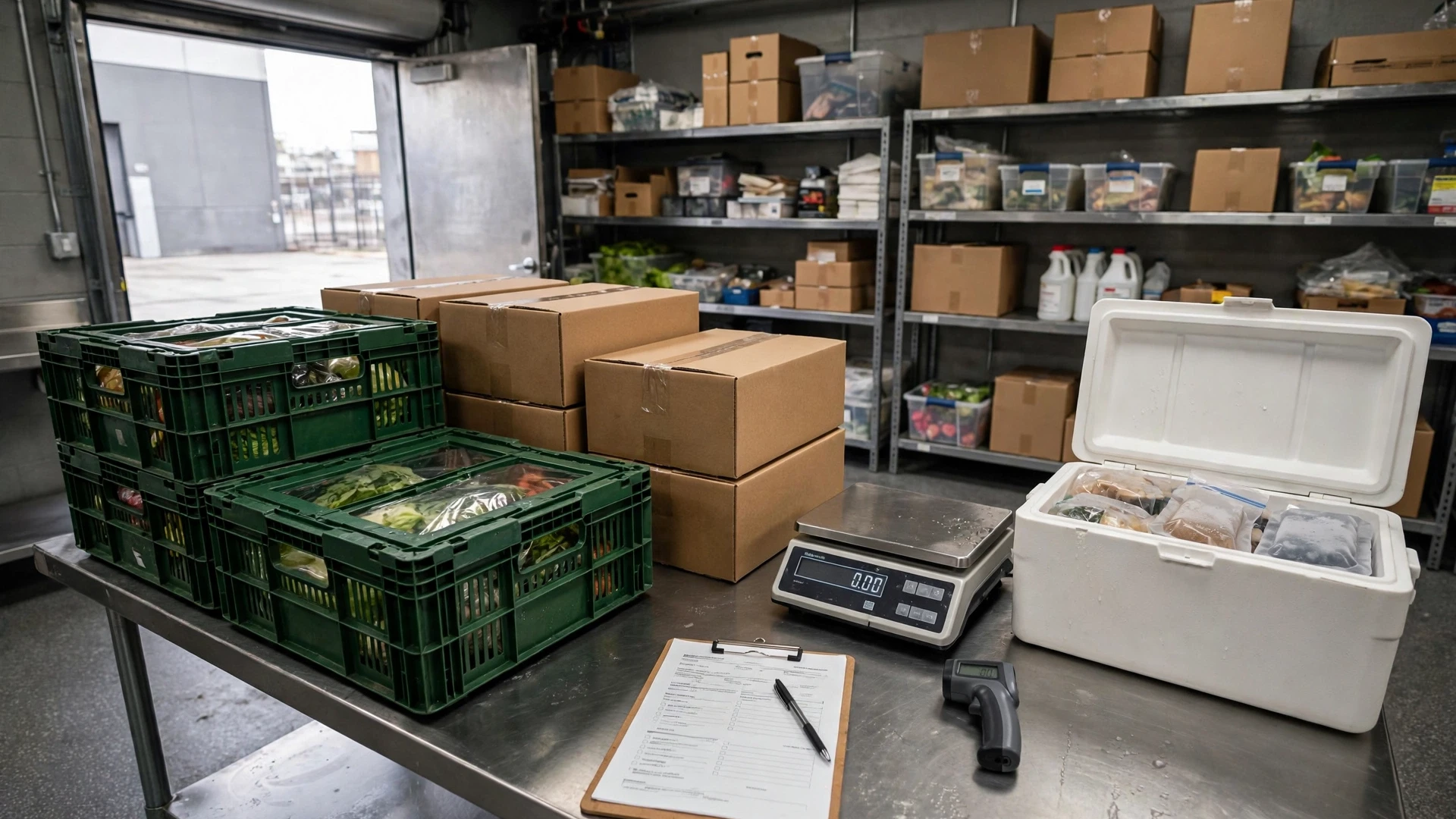
A restaurant can control purchase prices carefully and still lose money between the receiving door and the payment run.
The problem is usually not a dramatic fraud event. It is ordinary mismatch: an invoice bills ten cases when nine were received, a pack size changed without the unit conversion being updated, a delivery fee appeared after the order was approved, a shortage was noted at receiving but the promised credit never reached the account, or a substitute product was accepted at a different price and nobody reconciled the difference.
Supplier invoice reconciliation is the control that connects those events. Before an invoice is approved for payment, the restaurant checks whether the bill agrees with what was ordered, what was actually received and what exceptions were documented.
For an independent restaurant, this does not need to become a corporate accounts-payable department. It needs a repeatable match, a short exception queue and a clear rule for who can close each difference.
The three records that should agree
The basic control uses three sources:
1. The approved order or purchase order: what the restaurant intended to buy.
2. The receiving record: what physically arrived and was accepted.
3. The supplier invoice: what the supplier is asking the restaurant to pay.
The purpose is not to force every field to be identical. Legitimate differences happen. The purpose is to make differences visible before payment.
A practical match asks:
| Field | Approved order | Receiving record | Supplier invoice |
|---|---|---|---|
| Item/specification | Expected item | Item accepted | Item billed |
| Pack size | Ordered pack | Received pack | Billed pack |
| Quantity | Ordered quantity | Accepted quantity | Billed quantity |
| Unit price | Approved price | Note if changed | Billed price |
| Fees | Approved terms | Delivery note | Billed fees |
| Substitution | Approved rule | Actual substitute | Substitute billed |
| Credit needed | N/A | Short/damaged item | Credit shown or pending |
If the restaurant uses informal orders rather than formal purchase orders, the first record may be an approved order guide, email or supplier portal confirmation. The control principle is the same: there must be a reliable record of what management approved.
Related purchasing guide: Restaurant Purchase Order System: How to Control Ordering Before Food Cost Gets Out of Hand
Reconcile at the unit level, not just the invoice total
An invoice total can look reasonable even when several lines are wrong.
Suppose the expected invoice was about $1,900 and the supplier invoice is $1,918. A manager may approve it because the difference looks small. But the extra $18 might be made up of:
• one unapproved price increase on a high-volume ingredient,
• one case billed but not received,
• one new service fee,
• one credit from the prior delivery that is still missing.
Those are different operating problems. They should not disappear inside a total.
Start by matching the high-value, high-volume and exception-prone lines. A restaurant with limited administrative time does not have to treat a $0.10 low-volume difference with the same urgency as a repeated protein-price mismatch.
Normalize pack size before calling a price a mismatch
Supplier invoices often change packaging before the restaurant notices.
Example:
• Approved order: 4 cases, 12 kg per case, $54 per case.
• Invoice: 4 cases, 10 kg per case, $46 per case.
The invoice case price is lower, but the unit cost changed.
Approved cost per kg = $54 ÷ 12 = $4.50
Invoiced cost per kg = $46 ÷ 10 = $4.60
The line is not equivalent even though the invoice case price fell.
This is why the invoice-control sheet should carry the pack conversion or comparable unit for important items.
For a broader comparison method: Restaurant Supplier Price Comparison: Compare Quotes, Landed Cost and Buying Risk
Separate quantity variance from price variance
When one invoice line is different, identify the type of difference before taking action.
Quantity variance
Quantity variance = invoiced quantity − accepted receiving quantity
If the invoice bills 12 cases and receiving accepted 11, the one-case difference needs resolution.
Price variance
Price variance per unit = invoiced comparable unit price − approved comparable unit price
If 100 kg was accepted and the approved cost was $4.50/kg but the invoice shows $4.65/kg:
Price variance = ($4.65 − $4.50) × 100 = $15.00
That $15 may be legitimate if the restaurant approved a price change. If not, it belongs in the exception queue.
Fee variance
Delivery, fuel, handling or small-order charges should be checked against the commercial terms actually agreed with the supplier.
Do not assume a fee is invalid merely because it did not exist last month. Verify whether it was approved and whether it applies to the order.
Build an exception queue instead of holding the whole invoice hostage
A common failure is binary handling: either approve the whole invoice or refuse to process anything until every detail is perfect.
A better operational system isolates exceptions.
Possible statuses:
• matched,
• approved variance,
• credit requested,
• supplier clarification required,
• manager approval required,
• hold from payment,
• closed.
The exact accounting treatment depends on the restaurant’s bookkeeping and payment process. The operating control should make it obvious which part is unresolved.
Do not invent accounting entries if the restaurant’s accountant or finance process uses a different method.
Capture receiving discrepancies while the evidence exists
Invoice reconciliation is much harder when receiving was weak.
If a receiver notices a shortage, damage or incorrect substitution, record it at the time of delivery.
Useful evidence can include:
• supplier delivery note,
• quantity accepted,
• rejected quantity,
• item/pack received,
• manager initials where required,
• photo when appropriate under company policy,
• supplier driver acknowledgment where available,
• credit or replacement reference.
The receiving record should not become a photo archive for every normal delivery. Use evidence when an exception needs to be defended later.
Receiving workflow: Restaurant Receiving Checklist: Supplier Deliveries, Quality, Quantity and Invoice Control
Track supplier credits as money still owed to the restaurant
A credit request is not closed when someone emails the supplier.
It is closed when the restaurant can verify the agreed resolution.
A small credit log can include:
| Credit field | Example |
|---|---|
| Delivery date | Oct. 8 |
| Supplier | Supplier A |
| Invoice/delivery reference | INV-10482 |
| Reason | 1 case short |
| Expected credit | $54.00 |
| Request date | Oct. 8 |
| Supplier reference | CR-8821 |
| Status | Pending / received / disputed |
| Verified on |
If credits are not tracked, the restaurant can repeatedly absorb receiving errors even though staff are correctly identifying them.
Define who can approve a price difference
Not every variance requires owner approval. Not every variance should be silently accepted by the person entering bills.
Create restaurant-specific approval levels.
The rule can consider:
• dollar value,
• percentage movement,
• whether the specification changed,
• whether the change is recurring,
• whether a written supplier notice exists,
• whether the item is high-impact.
Avoid copying a universal threshold from another restaurant. A $25 difference may be material to one operation and trivial to another.
Price-change control: Restaurant Vendor Price Change Control: How to Catch Ingredient Cost Increases Before They Hit Margin
Handle substitutions as both a receiving and costing issue
A substitute may be operationally acceptable and still create an invoice mismatch.
Check:
• approved specification,
• pack conversion,
• unit cost,
• usable yield where relevant,
• allergen or product information that the restaurant’s safety process requires,
• whether the substitute is temporary or becomes the new standard.
If the substitute becomes recurring, update the item master and costing source. Do not leave the restaurant permanently reconciling the same “exception.”
Worked example: one invoice with four different problems
Assume a supplier invoice contains these lines:
| Item | Receiving result | Invoice result | Exception |
|---|---|---|---|
| Chicken | 8 cases accepted | 8 cases billed | Unit price +$3/case |
| Oil | 5 cases accepted | 6 cases billed | Quantity mismatch |
| Tomatoes | Approved substitute accepted | Substitute billed | Verify pack and price |
| Delivery fee | No fee expected | $18 fee | Terms check |
The manager should not label the invoice simply “wrong.”
The correct response is four separate decisions:
1. Chicken: verify whether the price increase was approved.
2. Oil: request correction or credit for the extra billed case.
3. Tomatoes: verify that the substitute price and pack conversion match the accepted product.
4. Delivery fee: compare with supplier terms and order minimums.
Only then should the restaurant know the amount that can be approved and the amount that remains unresolved.
The example is illustrative.
Reconcile timing matters
If the restaurant waits until the monthly bookkeeping close to investigate receiving problems, the people who saw the delivery may no longer remember it.
A practical timing model is:
At receiving
Record quantity, specification and exception evidence.
When the invoice arrives
Match the invoice against the approved order and receiving record.
Before payment
Clear or formally hold unresolved material exceptions.
Weekly
Review open credits, repeat supplier issues and aged exceptions.
This keeps invoice control close to the operational event.
Use an invoice reconciliation register
A simple register can include:
| Date | Supplier | Invoice | Amount | Match status | Exception value | Owner | Next action |
|---|---|---|---|---|---|---|---|
| 10/8 | Supplier A | 10482 | $1,918 | Exception | $87 | Purchasing | Await credit |
| 10/8 | Supplier B | 7754 | $640 | Matched | $0 | — | Approve |
The register is not a replacement for the accounting system. It is an operating view of what still needs attention.
Look for repeated exception patterns
One mismatch can be noise. Repeated mismatches are a management signal.
Patterns may reveal:
• supplier price updates not reaching purchasing,
• pack-size changes not reaching recipe costing,
• weak receiving counts,
• recurring delivery shortages,
• uncontrolled substitutions,
• duplicate ordering,
• credits that take too long to resolve.
A supplier scorecard can then use the evidence rather than impressions.
Supplier-performance guide: Restaurant Supplier Scorecard: How to Measure Vendor Performance
Keep invoice control separate from accounting advice
The operating team can verify what was ordered, received and billed. The restaurant’s accounting treatment, tax handling, accrual rules and payment authorization may require a bookkeeper, accountant or other qualified professional.
Do not turn the reconciliation sheet into an improvised accounting policy.
The control should answer a narrower question: is this supplier bill supported by the restaurant’s purchasing and receiving evidence, and are the exceptions clearly owned?
Common invoice-reconciliation failures
Paying from the invoice without checking receiving
The supplier bill becomes the only source of truth.
Checking only the total
Line-level price and quantity problems disappear inside a reasonable-looking invoice value.
Recording a shortage but not tracking the credit
The restaurant identifies the problem but never recovers the value.
Comparing case price after the pack changed
A lower case price can hide a higher unit cost.
Accepting every small variance automatically
Repeated small differences can become a supplier or process pattern.
Holding every invoice for tiny immaterial differences
The control becomes administratively expensive and staff work around it.
A weekly invoice-control routine
Once a week, the purchasing or management owner can review:
1. invoices still unmatched,
2. open supplier credits,
3. material price variances,
4. repeated quantity shortages,
5. new fees,
6. substitutions that need item-master updates,
7. exceptions older than the restaurant’s normal resolution cycle.
The review should end with clear next actions, not a growing spreadsheet of old differences.
Frequently asked questions
Does every restaurant need formal purchase orders?
No. The control needs a reliable approved-order record. A small restaurant may use an order guide or supplier confirmation if that record is consistent and reviewable.
Should every invoice line be checked manually?
The level of review should fit the restaurant’s volume, systems and risk. At minimum, material, high-volume and exception-prone items should not pass without a meaningful check.
What if the supplier changes a pack size but keeps the same item code?
Update the pack conversion and compare unit cost. The same code does not guarantee the economics are unchanged.
When is a supplier credit closed?
When the restaurant verifies the agreed correction, credit or replacement—not merely when the request is sent.
Is invoice reconciliation the same as supplier price comparison?
No. Supplier price comparison evaluates buying alternatives. Invoice reconciliation checks whether the bill matches the restaurant’s approved purchase and actual receipt.
Five-step implementation sequence
- Define the three documents that must match before payment: purchase order, receiving evidence and supplier invoice.
- Set tolerance and approval rules for price, quantity and pack-size differences.
- Route every mismatch to one named owner instead of paying first and investigating later.
- Track supplier credits and unresolved discrepancies until they are closed.
- Review repeated mismatch causes monthly and correct ordering, receiving or supplier setup.
Manager implementation checklist
- Purchase order is available before invoice approval.
- Received quantity and pack size are confirmed.
- Unit price and agreed charges are checked.
- Credits and shortages remain visible until closed.
- Payment exceptions have a documented approver.
Next action
Take the last five supplier invoices and choose one high-value item on each. Trace it backward to the receiving record and approved order. If any line cannot be supported without asking someone to remember what happened, that is the first gap to fix in the reconciliation process.