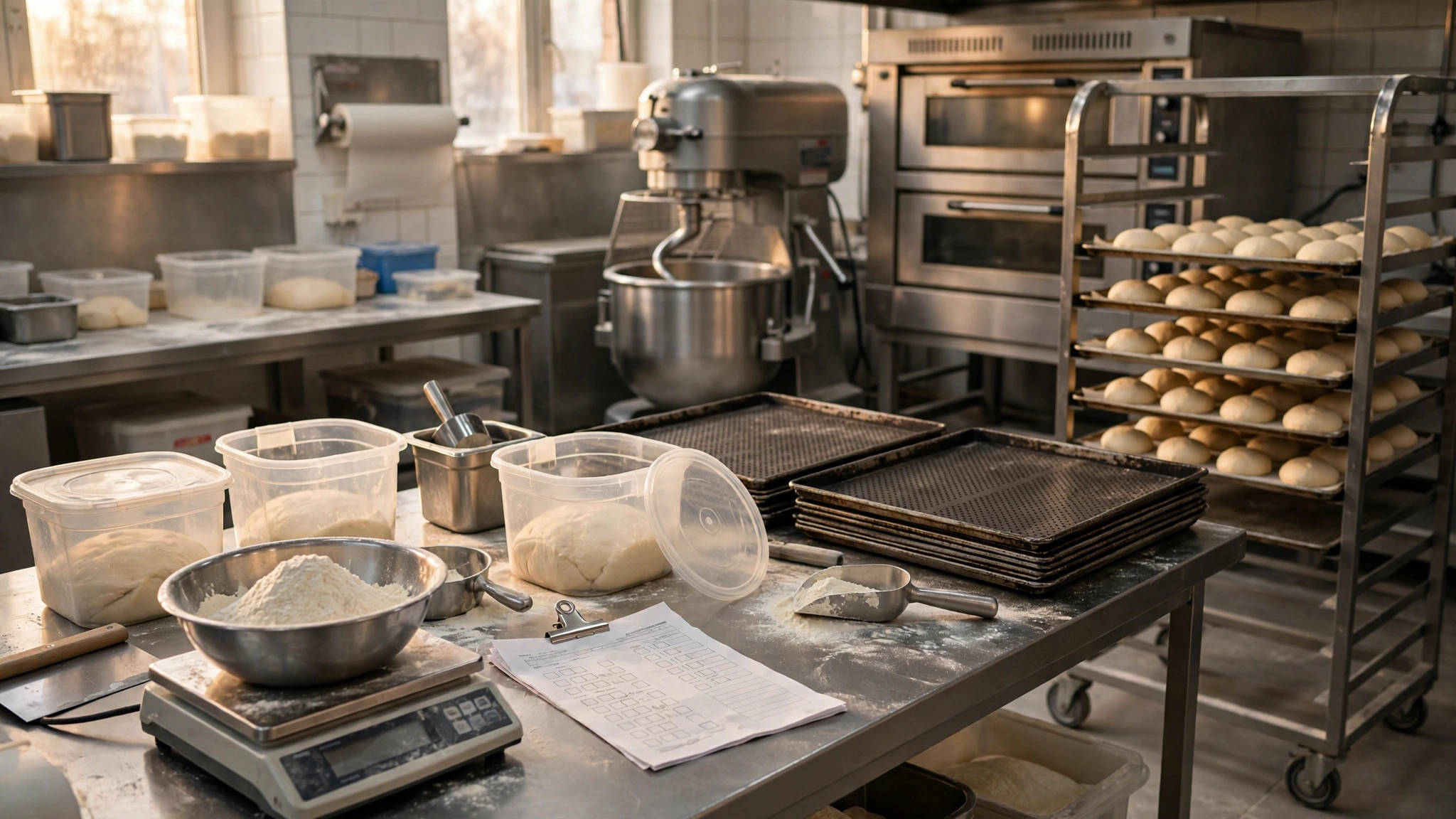
Batch planning is a demand-timing problem
A bakery can produce the correct total quantity for the day and still waste product if too much is baked too early. Batch planning connects forecast demand with proofing, oven capacity, freshness window, display space and replenishment time. The goal is not merely to avoid stockouts; it is to place the right quantity into each production wave so the display stays attractive without converting freshness into end-of-day waste.
This is why daily production should be planned in waves rather than one large morning target whenever the product and operation allow it.
Forecast by item and time window
Use recent comparable days, weekday pattern, reservations or preorders, weather/event context where meaningful, and current promotions. Break demand into service windows such as opening, mid-morning, lunch, afternoon and close. A croissant may peak early while bread, cakes or savory bakery items follow a different curve.
The forecast does not need to be perfect. It needs to be specific enough that managers can compare forecast, production and sell-through by wave and learn.
Separate products by production flexibility
Classify items as long-lead, short-lead, bake-from-ready, finish-to-order or not practical to replenish. Long fermentation or decorated products may need early commitment; cookies, rolls or certain pastries may allow staged baking. The production plan should exploit flexibility where it exists and protect capacity where it does not.
A single batch-planning rule across every bakery item usually creates either stockouts or overproduction.
Use par as a trigger, not a fixed final quantity
For replenishable products, define opening display par and refill trigger. The trigger should account for bake/proof/finish time so the next batch arrives before the display empties. A par that ignores lead time is only an inventory number, not a production control.
Late in the day, lower the refill quantity or stop production when expected remaining demand no longer justifies a full batch.
Oven and labor capacity set the wave size
Demand may justify more product than the bakery can produce at once without creating a bottleneck. Map oven decks, mixer capacity, proofing space, cooling racks and finishing labor. Sequence products so one wave does not compete for the same critical equipment at the same time.
Where two items share a dough or base, coordinate the batch to reduce setup time while still protecting the sales mix.
Build a simple batch-plan board
For each item: forecast by window, opening quantity, next production trigger, batch size, lead time, responsible person and actual sell-through. A whiteboard, spreadsheet or production system can work if the team updates it during the day.
The important field is “next decision time.” It tells the manager when to look again instead of waiting until the display is empty.
Use sell-through to revise the next wave
At each decision point, compare actual sales with forecast, remaining inventory, known preorders and time left in the trading day. Increase, reduce or cancel the next wave. Do not automatically produce the planned second batch if the first wave is moving slower than expected.
This rolling correction is what turns a forecast into active production control.
Example: reducing end-of-day pastry waste
A bakery normally bakes 120 pastries at 6 a.m. and frequently disposes of 25–30 late in the day. Sales data shows 70% of demand occurs before 11 a.m., but a smaller afternoon wave still exists. The bakery changes to 85 opening pieces, a 25-piece mid-morning refill trigger and an optional 15-piece afternoon batch only if sell-through reaches the threshold. Availability is protected while late waste falls.
The quantities are illustrative; use actual product lead time and demand.
Batch planning metrics
- Forecast accuracy by item/window.
- Sell-through before next wave.
- Stockout minutes or missed-demand events.
- End-of-day unsold units.
- Waste value, not only unit count.
- Emergency bake frequency.
- Average age/freshness of displayed product where measurable.
Common mistakes
- Planning only a daily total with no time curve.
- Using the same batch size all day.
- Refilling because the display “looks low” without considering remaining demand.
- Ignoring oven/proofer conflicts between items.
- Producing to yesterday’s waste-adjusted par without checking whether demand changed.
- Treating stockout avoidance as the only success metric.
FAQ
Q: Should a bakery try to end with zero product? A: Not necessarily; the right closing position balances availability, brand standards, donation/reuse policy and waste economics.
Q: How much history is enough? A: Use enough comparable days to see a pattern, then adjust for current known events.
Q: What if demand is highly unpredictable? A: Increase flexibility, shorten decision intervals and use smaller late waves where product/process allows.
Q: Should premium items get larger safety stock? A: Only if lost-sale value and brand impact justify the waste risk.
Next action
Choose five high-volume products and split yesterday’s sales into time windows. Compare when they sold with when they were produced. Redesign one item into an opening batch plus one controlled refill wave, then measure stockouts and closing waste for a week before expanding the method.
Use waste value, not only waste pieces
Ten unsold low-cost rolls and ten premium pastries do not create the same economic loss. Track both units and standard cost or contribution opportunity, in line with bakery yield and waste control. This helps managers decide where forecast improvement matters most.
When a product is intentionally carried as a display or availability standard, document that service objective so the remaining stock is not automatically treated as a forecasting failure.
Coordinate preorders with walk-in demand
Preorders and wholesale commitments should be reserved in the plan before setting retail display pars. Do not let a large preorder silently consume stock that the opening forecast assumed was available for walk-in customers.
Mark committed quantity separately from discretionary batch quantity. This distinction also prevents the team from interpreting preorder production as overbaking when reviewing end-of-day inventory.
Additional operating detail
Batch planning should also account for markdown, donation or approved repurposing policies. If the bakery has a planned end-of-day outlet for certain products, the economic cost of a small surplus may differ from product that must be discarded. Keep those policies explicit so planners do not hide overproduction behind an informal reuse practice that is inconsistent with food-safety or brand standards.
New products need a temporary learning period. Start with conservative batches, track sell-through by time window and increase only when demand repeats. Launch excitement can make one strong day look like a permanent baseline. A short trial history is more useful than immediately adding the item to the same production rules as mature products.
Manager implementation notes
A production-planning meeting should be short and numeric. Review yesterday’s or the comparable day’s sales, today’s known orders, the first-wave plan, any ingredient or equipment constraint and the decision times for later batches. The goal is not to debate every SKU. Focus on products where demand uncertainty, freshness or waste value is high enough to justify active management.
Link batch planning to purchasing quantities. If smaller, more frequent production waves consistently reduce finished-product waste but require ingredients to be available later in the day, purchasing and storage pars may need adjustment. Conversely, a product that routinely fails to sell after a certain time may justify a lower raw-material commitment. Production and inventory plans should learn from the same demand curve.
Further operating guidance
Use closing waste to adjust the forecast mathematically rather than emotionally. If a product repeatedly ends the day with 12 unsold units, do not automatically subtract 12 from tomorrow’s first batch. Check when sales stopped, whether stockouts happened earlier, whether the product was still fresh enough to sell and whether a late batch was unnecessary. The correct adjustment may be moving production later, shrinking the second wave or changing the refill trigger rather than reducing the opening display.
Capacity constraints should also influence the forecast. A product may have demand for 80 more units at noon, but if the oven, proofer or finishing team cannot deliver them without delaying higher-value items, the batch plan should prioritize the bottleneck. Production planning is therefore a portfolio decision across products, not a separate forecast for each SKU in isolation.
Use production waves instead of one all-day guess
One large opening batch maximizes early availability but can leave too much aging product later; very small batches protect freshness but can consume excessive labor and oven capacity. Divide the day into production waves based on sales history, known orders, shelf life and the minimum efficient batch for each product. Set a decision time before each later wave. At that point, compare sales pace, remaining sellable stock and upcoming commitments with the forecast, then produce, reduce or cancel the next batch. The control is the decision point, not blind adherence to the plan written before opening.
Separate committed demand from speculative display stock. Preorders, wholesale orders and event quantities should be reserved before calculating what is available for walk-in sales. Mark committed quantity, planned display quantity and any intentional safety stock separately so the same demand is not counted twice. This distinction also makes end-of-day waste analysis more useful: managers can tell whether excess came from forecast error, a cancellation or a deliberate availability standard. Link the production review back to purchasing pars when repeated smaller batches or late-day cutoffs change how much raw material the bakery genuinely needs on hand.
Measure forecast error by time window, not only by total day
A bakery can finish the day close to forecast and still run the operation poorly if it stocked out during the morning and overproduced late. Review forecast accuracy by meaningful selling window—opening, lunch, afternoon, evening—so the plan reflects when demand occurs as well as how much. A product may need a larger first wave and a much smaller second wave, while another sells steadily and benefits from even batches. Track the time of stockouts and the time excess became obvious. Those signals help managers move production earlier or later without automatically raising total quantity. If a recurring stockout happens before the next batch can be ready, the correction may be an earlier trigger or different batch size rather than a higher daily forecast. This time-window view connects production planning directly to guest availability and freshness.
Define what happens after a sellout
A sellout is not automatically a forecasting failure. For some products, selling out near the planned cutoff may be preferable to carrying excess late-day inventory. Define the intended availability window by item and record the sellout time. If the same high-value product disappears well before the desired window on comparable days, increase or move a batch. If it sells out near closing with little waste, the plan may already be working as intended.
Keep cutoff rules product-specific
Late-day production should reflect shelf life and selling pattern by product. A premium pastry with short quality life may need an earlier cutoff than a durable bread item. Product-specific cutoff rules protect freshness while keeping the planning logic explainable.
Additional topic-specific operating notes
- batch size matched to mixer, proofing and oven capacity
- unsold quantity recorded by item and production time
- Planned units = expected sales + safety quantity – opening stock
- Sell-through % = units sold / units produced × 100
- Waste % = unsold or discarded units / units produced × 100
- Batch variance = actual demand – planned demand
- schedule labor and equipment around overlapping product processes
- adjust the next comparable production plan from evidence
A bakery sells 120 croissants on average but demand is concentrated in the morning. Producing all 120 before opening maximizes availability but can increase late-day waste. Splitting production into an opening batch and a controlled refill batch may protect freshness and reduce leftover risk.
Useful next resource
Batch-wave decision table
The most useful control is the decision point before each later production wave. At that moment, compare actual sales pace, remaining sellable stock and the time required to produce the next batch.
| Condition at decision time | Likely action | Reason |
|---|---|---|
| Sales ahead of plan and stock low | Start the next batch earlier or increase it within capacity. | Protect availability without waiting for a stockout. |
| Sales on plan and stock balanced | Run the planned batch. | No evidence supports changing the schedule. |
| Sales behind plan and stock high | Reduce or cancel the next wave. | Protect freshness and limit late-day leftovers. |
| High demand but oven/proofer is constrained | Prioritize the products with the strongest demand and contribution. | Capacity is the binding constraint, not forecast alone. |
| Committed preorder demand remains | Reserve that quantity before adjusting walk-in production. | Do not consume stock already promised to another channel. |
Weekly batch-planning review
- Compare planned units with actual demand by selling window.
- Record stockout time for items that sold out.
- Record the quantity and age of meaningful leftovers.
- Identify whether error came from total quantity, batch timing or refill trigger.
- Change only the next comparable plan and keep the reason visible.
This separates forecasting error from timing error. A product can have the correct daily quantity and still perform poorly if the first wave is too small or the final wave is produced too late.
Use the Restaurant Operator Lab tools and related guides only when they directly support the decision described above. Open the free tools library