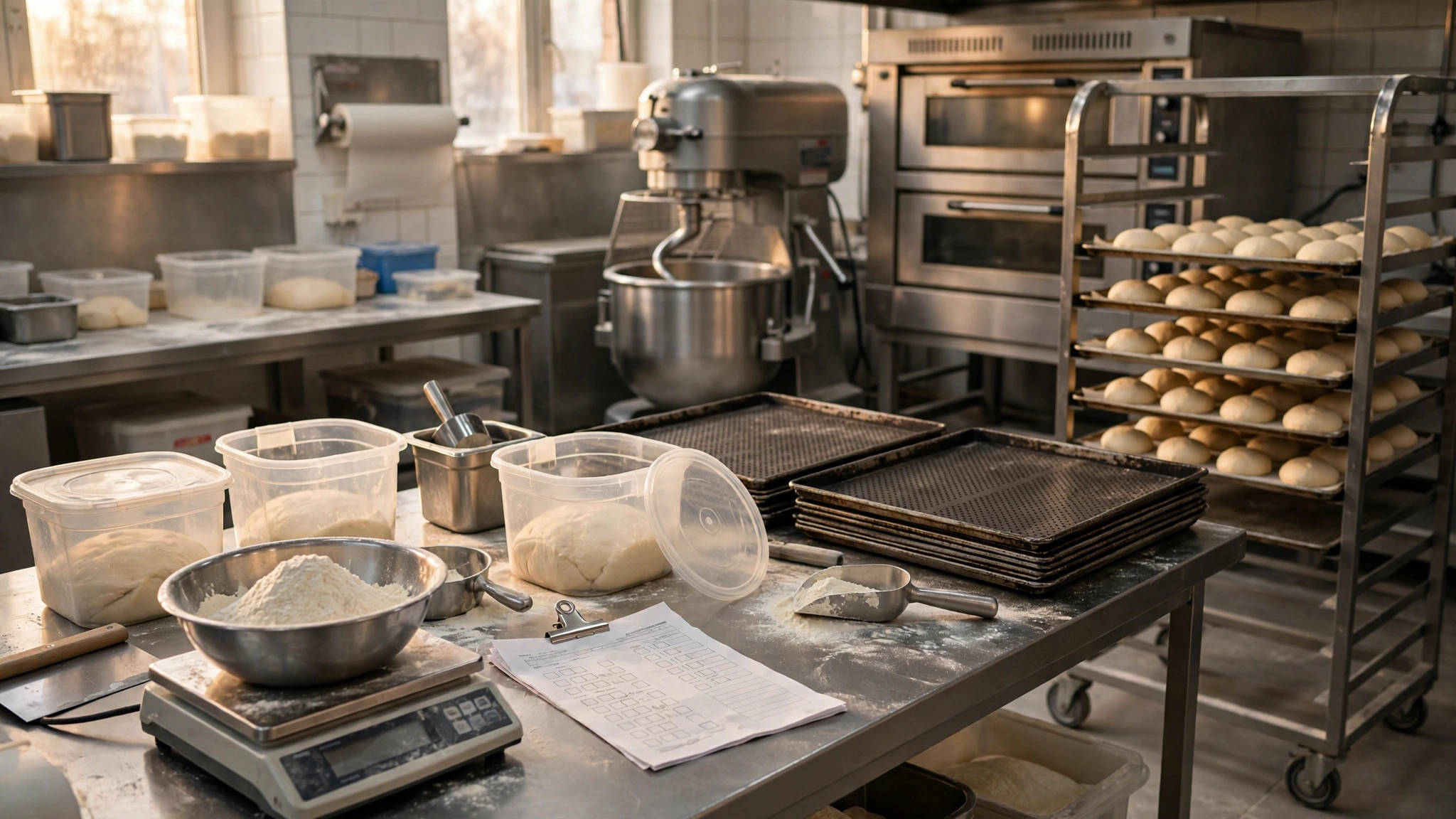
In many bakeries, the oven becomes the real production bottleneck long before the team realizes it.
Mixing can run on time. Dough can be divided correctly. Proofing can look good. Then three products become ready for the oven at once, one rack blocks another, a long-bake product occupies the deck, and the entire schedule starts waiting.
An oven loading plan converts the oven from a last-minute queue into a scheduled production resource.
The purpose is not to eliminate baker judgment. It is to coordinate product readiness, bake profiles, capacity and committed completion times before the conflict reaches the oven door.
Start by defining usable oven capacity
Do not schedule from the oven’s theoretical maximum.
Record practical usable capacity for each oven.
Depending on the bakery, that may be:
• trays per load,
• racks per load,
• deck positions,
• loaves per deck,
• pan count,
• product-specific capacity.
Also record constraints:
• products that require specific shelves/decks,
• airflow restrictions,
• steam requirements,
• temperature zones,
• loading/unloading time,
• recovery time where relevant.
The approved operating capacity should reflect the equipment and product standards used by the bakery.
Build a product bake-profile table
For each high-volume product, record:
| Product | Oven | Load capacity | Set point/process | Bake time | Typical load/unload |
|---|---|---|---|---|---|
| Country loaf | Deck 1 | 24 loaves | Product standard | 32 min | 5 min |
| Rolls | Rack oven | 12 trays | Product standard | 18 min | 4 min |
| Pastry | Rack oven | 10 trays | Product standard | 22 min | 4 min |
The values are illustrative.
Use tested product standards, not these example times or temperatures.
Schedule backward from product-ready time
The oven plan should connect to the production plan.
If a product must be cooled and packed by 11:00, work backward through:
• packaging time,
• cooling requirement,
• bake time,
• oven loading time,
• final proof or prep stage.
A product that needs 45 minutes cooling cannot be scheduled to leave the oven at 10:50 for an 11:00 dispatch.
Reserve oven slots
Think of the oven like a booked production resource.
Example:
| Time | Oven 1 | Oven 2 |
|---|---|---|
| 7:00-7:35 | Bread A | Pastry A |
| 7:40-8:05 | Bread B | Rolls |
| 8:10-8:35 | Bread C | Pastry B |
The schedule is illustrative.
The plan lets the team see conflicts before products are ready.
Include loading and unloading time
A 25-minute bake is not a 25-minute oven slot.
The slot may also include:
• loading,
• scoring/finishing immediately before load,
• door time,
• unloading,
• tray/rack movement,
• reset/recovery.
If these minutes are ignored, the schedule drifts progressively through the shift.
Group compatible products where appropriate
Some products can share oven time if their approved bake requirements are compatible.
Compatibility may depend on:
• temperature/process,
• humidity/steam needs,
• bake duration,
• aroma/flavor concerns,
• airflow,
• rack/deck configuration.
Do not combine products simply to increase utilization if product quality or safety is affected.
Protect products with narrow readiness windows
Some products can wait more easily than others.
The loading plan should identify priority products that become difficult to recover if oven access is delayed.
Possible categories:
• high sensitivity to proof window,
• committed wholesale deadline,
• opening product,
• high-volume retail replenishment,
• flexible later-day batch.
Priority should be planned, not decided only when the oven is already blocked.
Connect oven slots to fermentation
Fermentation and oven loading must be planned together.
A proofed product that reaches readiness 20 minutes before an oven slot can create quality problems or force improvisation.
For the timing framework: Bakery Fermentation Schedule: Plan Mix, Rest, Proof and Bake Times
The fermentation schedule should target realistic oven availability.
Connect oven slots to batch planning
Daily quantity plans determine how many loads the oven must handle.
If the bakery needs 360 rolls and one practical oven load is 120 rolls, the plan requires three loads plus handling time.
For broader daily batch quantities: Bakery Batch Planning: Match Production to Demand Without Overbaking
Do not approve production quantities without checking whether the oven can complete them inside the required window.
Calculate oven load hours
A simple capacity measure is:
Required oven minutes = Number of loads x Minutes per oven slot
Example:
• 4 bread loads x 38 minutes = 152 minutes,
• 3 pastry loads x 28 minutes = 84 minutes,
• 2 roll loads x 24 minutes = 48 minutes.
Total scheduled oven time:
152 + 84 + 48 = 284 minutes
The example is illustrative.
If the oven is available only 240 minutes during the critical morning window, the production plan is physically impossible unless capacity or timing changes.
Calculate utilization carefully
A simple internal measure can be:
Oven utilization = Scheduled productive oven minutes / Available oven minutes x 100
Very high utilization can look efficient but leave no room for:
• slight production delay,
• re-bake/remake,
• unexpected order,
• load/unload drift,
• equipment recovery.
Do not chase a universal utilization target. Use the bakery’s own variability and service commitments.
Build buffer time where variation is real
If a product’s slot frequently varies by several minutes, plan a small buffer rather than pretending every load is exact.
Buffers can be placed:
• between incompatible temperature profiles,
• before a committed wholesale load,
• after a historically variable product,
• before cleaning/changeover.
The right buffer is based on observed process data.
Account for temperature/process changes
Changing the oven process between products may require time.
The schedule should consider:
• heating/cooling transition,
• steam setup,
• rack/deck change,
• loading hardware,
• product-specific preparation.
Sequence compatible products to reduce unnecessary changeover where quality standards allow.
Use a queue board for ready products
A live oven queue can show:
• product,
• batch ID,
• ready time,
• assigned oven,
• planned load time,
• priority,
• status.
Possible statuses:
• NOT READY,
• READY,
• LOADING,
• BAKING,
• COOLING,
• HOLD/REVIEW.
This prevents the loudest employee from determining oven priority.
Define who controls the oven queue
One person should own sequencing during busy periods.
That may be:
• head baker,
• production lead,
• oven operator,
• bakery manager.
Other employees can report readiness, but one role should resolve conflicts.
Use actual load data
For one week, record:
• planned load time,
• actual load time,
• actual unload time,
• reason for delay,
• product outcome where relevant.
Then group delays by cause.
Examples:
• dough not ready,
• shaping late,
• previous load overran,
• oven not recovered,
• rack unavailable,
• labor unavailable,
• emergency order.
This identifies whether the oven is truly the bottleneck or simply where upstream delays become visible.
Separate oven delay from production delay
If a batch reaches the oven 25 minutes late because shaping ran behind, the oven schedule did not cause the delay.
Track:
Ready-to-load time vs actual load time
If the product was ready on time but loaded late, oven capacity/queue may be the issue.
If the product became ready late, investigate upstream production.
Build a peak-window plan
Many bakeries have a critical morning window when:
• retail opening stock,
• wholesale orders,
• café supply,
• delivery dispatch
all compete for oven time.
List the non-negotiable completion times first. Then fit flexible replenishment around them.
Protect wholesale and pre-order commitments
Committed orders should have reserved capacity.
Do not fill the oven schedule entirely with speculative retail production and then discover there is no slot for a paid pre-order.
Reserve:
• oven time,
• cooling time,
• packaging time,
• dispatch margin.
Use partial loads deliberately, not by accident
A bakery may wait to fill every load to maximize efficiency.
That can delay product unnecessarily.
Sometimes a partial load is the correct commercial decision when:
• committed order is due,
• product readiness window is narrow,
• later waiting would cause service loss,
• a low-volume specialty item must meet a schedule.
Record why partial loads occur so the bakery can see whether batch sizing should change.
Example: finding an impossible morning plan
Assume a bakery schedules between 6:00 and 9:00:
• four bread loads at 40 minutes each,
• three pastry loads at 30 minutes each,
• two roll loads at 25 minutes each.
Required time:
160 + 90 + 50 = 300 minutes
Available time in one oven:
180 minutes
Even before buffers, the schedule requires 120 minutes more than available.
The team must change at least one variable:
• second oven capacity,
• earlier/later production,
• different batch/load size,
• product quantity,
• product sequence.
The example is illustrative.
Coordinate cooling-space capacity
Oven throughput can create a downstream bottleneck.
If several large loads finish together, cooling racks may fill.
The plan should check:
• rack availability,
• cooling area,
• product separation,
• packaging timing,
• dispatch staging.
Increasing oven speed is not useful if the cooling area cannot receive the product.
Include cleaning and maintenance windows
Daily/weekly oven cleaning and maintenance should be scheduled, not squeezed in “when there is time.”
The production plan should block necessary downtime according to the bakery’s approved equipment procedures.
Technical service should be performed by qualified personnel where required.
Build a contingency plan for oven downtime
Know in advance:
• which products can move to another oven,
• which products cannot,
• reduced capacity if one oven fails,
• priority products,
• who can approve quantity changes,
• who contacts service.
A downtime plan protects the most important commitments first.
Build a product priority matrix
When two products compete for the same oven slot, the team needs a decision rule.
A simple priority matrix can consider:
• committed pickup/dispatch time,
• product sensitivity to waiting,
• lost sales if delayed,
• batch size,
• whether another oven can handle it,
• whether the next slot is acceptable.
The matrix does not replace baker judgment. It prevents oven priority from being decided only by who reaches the oven first.
Reforecast the oven plan when demand changes
Retail sales, pre-orders or wholesale changes can alter the day after production has started.
When the forecast changes, update the oven schedule rather than adding batches informally.
Ask:
- Which products need additional quantity?
- How many extra loads are required?
- Which existing slots are flexible?
- Will fermentation and proof timing still fit?
- Is cooling and packaging capacity available?
This makes the cost of just add another batch visible before it creates a queue.
Use oven-capacity data for equipment decisions
Persistent peak-window overload may justify capital investment, but measure the need first.
Collect several weeks of:
• required oven minutes,
• actual productive minutes,
• delayed batches,
• missed demand,
• overtime caused by oven limits,
• downtime.
If the overload is caused mainly by poor sequencing or upstream delays, another oven may not solve the problem. If committed demand consistently exceeds practical capacity even with disciplined scheduling, the data supports a stronger equipment case. Use the Restaurant Equipment Replacement Planning guide to test whether replacement or added capacity is operationally and financially justified.
Common oven-loading mistakes
Planning from batch quantities only
No one checks required oven minutes.
Ignoring load/unload time
The schedule drifts all morning.
Proofing independently from oven capacity
Ready dough waits.
Filling every slot to 100%
No recovery capacity exists.
Prioritizing by who asks first
Committed products can miss deadlines.
No actual-time data
The bakery cannot distinguish oven constraints from upstream delays.
Build tomorrow’s oven plan before mixing starts
- List every required oven load, the product quantity and the committed ready or dispatch time.
- Convert each load into a full oven slot that includes loading, bake time, unloading and realistic recovery or changeover time.
- Place protected wholesale and pre-order commitments on the timeline first.
- Fit retail and replenishment loads around those commitments while coordinating product readiness with fermentation and proof timing.
- Compare total required oven minutes with the actual available peak-window minutes before production begins.
- If the plan does not fit, change batch size, sequence, quantity or timing before dough reaches the oven queue.
- During production, record ready time, actual load time and delay cause so the team can separate oven constraints from upstream production delays.
- Use repeated delay data to revise the next plan and support equipment decisions only when disciplined scheduling still cannot meet committed demand.
Oven loading checklist
- Practical capacity by product is known.
- Bake profiles use approved product standards.
- Load and unload time is included.
- Required completion and cooling times are known.
- Oven slots are reserved.
- Compatible products are grouped only when appropriate.
- Fermentation and readiness are coordinated with oven slots.
- Wholesale and pre-orders receive protected capacity.
- Actual load and unload times are recorded.
- Delay causes are coded.
- Cooling and packaging capacity is checked.
- Maintenance and downtime are included.
Frequently asked questions
Should the oven always be full?
No. A full oven can improve utilization, but waiting to fill a load can damage timing or product quality. The correct decision depends on product and service commitments.
How do I know if I need another oven?
Measure required oven minutes, peak-window utilization and lost/delayed production first. Equipment investment should be based on persistent capacity need, not one busy day.
Should similar products always bake together?
Only when their approved bake requirements are compatible and product quality is not compromised.
Who should own the oven plan?
Use one production lead or oven operator during critical periods so priorities do not conflict.
Next action
Tomorrow, write every planned oven load on a timeline before production begins. Include five minutes of handling where needed rather than only bake time. Compare required oven minutes with actual available minutes. If the plan does not fit on paper, it will not fit during service either.