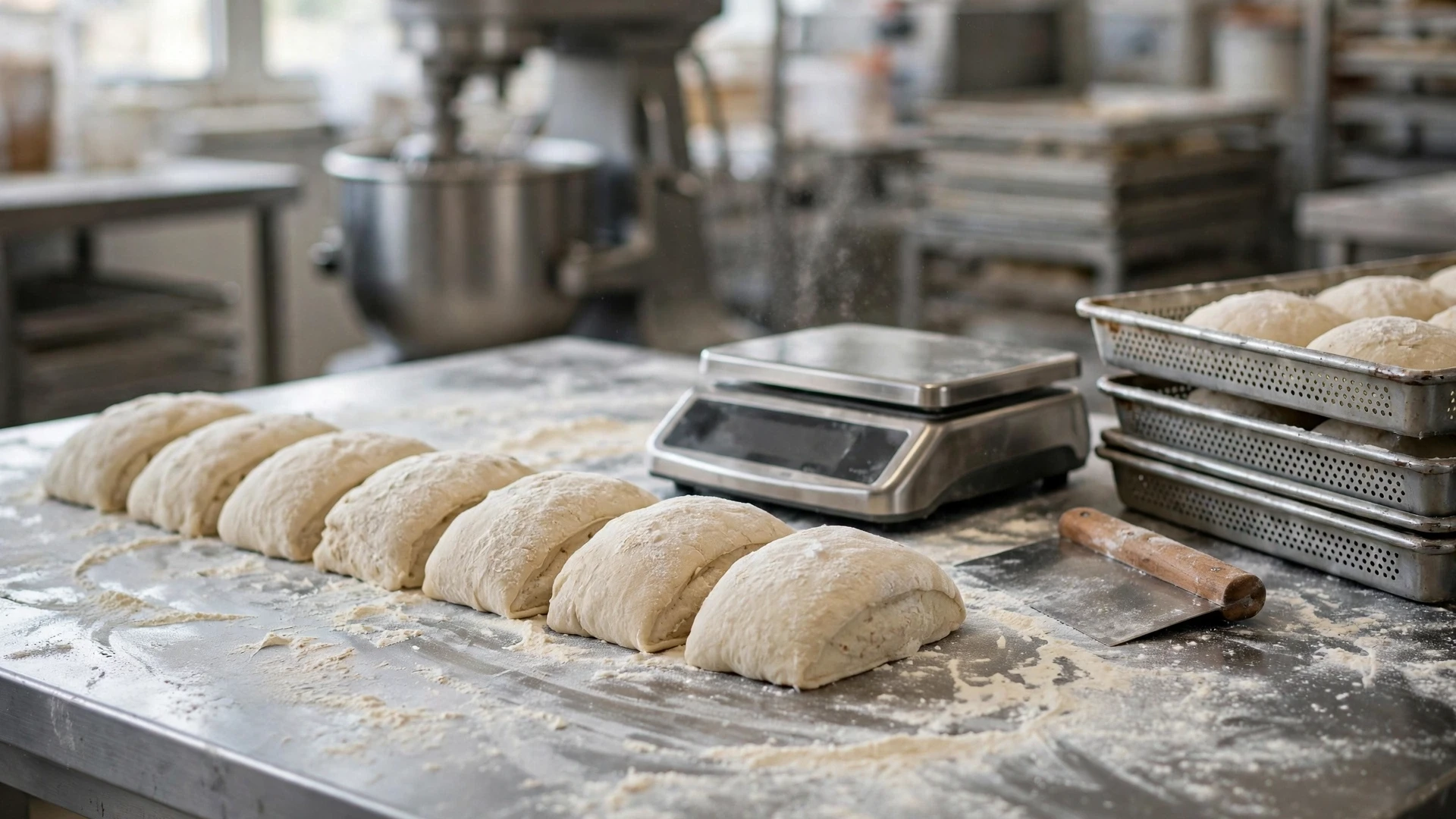
A bakery can have the correct dough formula and still produce inconsistent bread if the fermentation schedule changes every day.
Mixing starts late. Dough rests longer because the divider is busy. Proofing runs ahead of oven capacity. A cold room changes the pace. A warm afternoon pushes dough faster than the team expected. The bakers compensate by feel, but production becomes difficult to repeat.
A fermentation schedule gives the team a planned sequence from mixing through bake. It does not remove craft judgment. It gives that judgment a stable operating framework.
This article focuses on production scheduling, not a universal fermentation recipe. Dough formulation, food safety, product quality and process limits should follow the bakery’s approved standards.
Schedule backward from the required bake time
The easiest way to lose control is to start with “mix at 6:00” without knowing why.
Start with the required finished product time.
Example:
• bread must be baked and cooling by 10:30,
• bake time is 28 minutes,
• final proof normally takes 55 minutes,
• dividing/shaping takes 25 minutes,
• bulk fermentation target is 75 minutes,
• mix and initial handling take 20 minutes.
A rough backward plan becomes:
| Stage | Planned time |
|---|---|
| Bake complete | 10:30 |
| Load oven | 10:02 |
| Final proof starts | 9:07 |
| Shaping starts | 8:42 |
| Bulk fermentation starts | 7:27 |
| Mix starts | 7:07 |
The times are illustrative, not product standards.
The schedule makes dependencies visible.
Treat fermentation as a time-and-condition process
Clock time alone is not enough.
Fermentation rate can change with:
• dough temperature,
• room temperature,
• yeast level,
• preferment maturity,
• dough hydration,
• salt/sugar/fat content,
• flour characteristics,
• batch size,
• refrigeration or retarding conditions.
The bakery should define product-specific targets using its tested formula and process.
Do not turn an illustrative schedule into a food-safety or quality standard for another product.
Record desired dough temperature where the bakery uses it
Many bakeries control consistency by paying attention to dough temperature after mixing.
If the same formula finishes much warmer on one day, fermentation can move faster than the schedule expects.
A production record can include:
• target dough temperature,
• actual dough temperature,
• room condition,
• notable adjustment.
The exact target belongs to the bakery’s approved formula and process.
Separate the major stages
A practical fermentation schedule may include:
- Preferment build or maturity where used.
- Mixing.
- Bulk fermentation.
- Folds or intermediate handling.
- Dividing.
- Bench rest.
- Shaping.
- Final proof.
- Scoring or finishing.
- Baking.
- Cooling.
Not every dough uses every stage. The schedule should match the product.
Build the schedule around bottlenecks
Fermentation is biological, but production capacity is physical.
The schedule must fit:
• mixer capacity,
• bench space,
• divider/rounder capacity,
• racks,
• retarder/proofer space,
• oven loading windows,
• cooling space,
• available labor.
If final proof finishes for three products at the same time but only one can enter the oven, the schedule is broken even if each dough was fermented correctly.
For broader quantity planning: Bakery Batch Planning: Match Production to Demand Without Overbaking
Use batch IDs and planned timestamps
Every dough batch should be traceable through the schedule.
A simple sheet can include:
| Batch | Product | Mix | Bulk start | Divide | Proof start | Planned bake | Actual bake |
|---|---|---|---|---|---|---|---|
| B-101 | Country loaf | 7:00 | 7:18 | 8:35 | 9:05 | 10:00 | 10:04 |
The example is illustrative.
The actual column lets the bakery see where drift occurs.
Distinguish planned time from readiness
A schedule should tell the team when to check the dough, not force bakers to ignore product readiness.
For example:
Planned divide check: 8:35
At 8:35 the baker evaluates the product against the bakery’s approved readiness indicators.
If it is not ready, the delay is recorded and the downstream schedule is updated.
This protects quality while preserving operational visibility.
Build tolerance windows
A bakery schedule that works only if every stage happens to the minute will fail.
Create realistic windows.
Example:
• divide check between 8:30-8:40,
• proof readiness check between 9:50-10:05,
• planned oven slot 10:05.
The windows are illustrative.
The appropriate tolerance depends on the product and the bakery’s tested process.
Use color or status codes for production control
A visual system can help the team see which batches need attention.
Possible statuses:
• MIXING,
• BULK,
• READY TO DIVIDE,
• BENCH REST,
• PROOFING,
• READY FOR OVEN,
• BAKING,
• COOLING,
• HOLD/REVIEW.
The system can be on a board, spreadsheet or bakery production software.
The important point is that every batch has a visible state.
Plan overlapping batches deliberately
A bakery rarely produces one dough at a time from start to finish.
The schedule must coordinate overlapping stages.
Example:
• Batch A is in bulk fermentation,
• Batch B is being mixed,
• Batch C is shaping,
• Batch D is proofing,
• Batch E is in the oven.
The manager should check whether the same employee or equipment is required for two critical stages at once.
Use a capacity timeline
For each major resource, map the booking.
Mixer
• 6:30-6:50 Product A
• 7:00-7:20 Product B
• 7:35-7:55 Product C
Divider/bench
• 8:10-8:35 Product A
• 8:40-9:05 Product B
Proofer
• 8:45-9:45 Product A
• 9:10-10:05 Product B
Oven
• 9:50-10:18 Product A
• 10:20-10:48 Product B
The schedule is illustrative.
This makes conflicts obvious before the dough reaches the conflict. When oven capacity is the limiting resource, use the Bakery Oven Loading Plan to sequence products around realistic bake slots.
Adjust for daypart and product priority
Not every product has equal urgency.
A bakery may prioritize:
• opening bread,
• breakfast pastry,
• wholesale delivery,
• pre-orders,
• high-volume lunch items,
• later retail replenishment.
When capacity is tight, sequence by committed need rather than first batch mixed.
Cold fermentation requires a separate schedule
Retarded or refrigerated dough introduces another timing layer.
The bakery may need to control:
• chill start,
• refrigeration/retard window,
• pull time,
• tempering or final proof,
• bake slot.
Cold fermentation can move work away from the morning peak, but only if the bakery’s formula, process and food-safety controls support it.
Document the approved process rather than improvising from batch to batch.
Preferments need their own timeline
If a product uses a poolish, levain, sponge or other preferment, the schedule begins before the final mix.
Track:
• build time,
• target maturity window,
• storage condition where applicable,
• amount required for the next mix,
• backup action when maturity is early or late.
A final dough schedule that ignores preferment timing is incomplete.
Connect scaling to fermentation control
Batch size affects production flow.
If one batch is doubled, the team may need more time for:
• dividing,
• shaping,
• tray loading,
• proofing space,
• oven capacity.
For scaling and portion consistency: Dough Scaling and Portion Consistency: A Bakery Production Control System
The formula may scale mathematically while the process does not scale operationally.
Track actual stage times for one week
Do not guess how long production takes.
For each major product, record:
• mix start/end,
• bulk start/end,
• divide/shaping start/end,
• proof start/end,
• oven load/unload.
After a week, compare planned and actual.
Look for repeated drift.
Diagnose schedule drift by cause
Common causes include:
• dough temperature variation,
• room conditions,
• mixer delay,
• labor overlap,
• equipment bottleneck,
• batch too large,
• proofing capacity,
• oven congestion,
• late ingredient scaling,
• preferment timing.
Do not fix every late bake by starting earlier. That can create over-fermentation, unnecessary labor or another bottleneck.
Use a morning exception meeting
A five-minute bakery production check can review:
• which batches are on plan,
• which are early/late,
• current oven queue,
• urgent wholesale/pre-orders,
• equipment restrictions,
• labor gaps.
The meeting should update the schedule, not become a general discussion.
Example: managing a warm production day
Assume the bakery’s first dough finishes mixing noticeably warmer than normal and reaches the bakery’s readiness indicators earlier than scheduled.
The team should not simply leave the dough waiting for the planned clock time.
A controlled response could be:
1. confirm the batch status against the product standard,
2. move the divide/shaping window earlier,
3. check proofer and oven capacity,
4. adjust the next mix timing to avoid a collision,
5. record the temperature and timing variance,
6. review whether process inputs need adjustment under the bakery’s approved formula.
The example shows why the schedule must be dynamic while still controlled.
Coordinate the schedule with cooling and packaging
Baking is not the end of production.
A product may need cooling time before:
• slicing,
• glazing,
• filling,
• packaging,
• dispatch.
If the bakery promises a 10:30 wholesale pickup but product leaves the oven at 10:20 and requires cooling, the schedule was never realistic.
Keep food-safety controls separate and explicit
A fermentation schedule is an operations tool.
It does not replace required controls for:
• ingredient handling,
• temperature control,
• allergen management,
• cooling,
• storage,
• shelf life,
• sanitation.
Use approved procedures and applicable requirements for those controls.
Group products into scheduling families
A bakery with many SKUs does not need a completely different planning method for every item.
Group products with similar operating behavior, for example:
• same-day lean doughs,
• enriched doughs,
• laminated products,
• retarded products,
• long-fermented specialty items.
Each family can have its own scheduling template while individual formulas retain their specific process standards.
This reduces planning complexity without pretending every dough behaves the same.
Create an exception log for repeated timing problems
When a batch misses its expected timing, record the main reason rather than writing late.
Possible cause codes include:
• warm/cold dough,
• preferment early/late,
• mixer queue,
• labor unavailable,
• proofer capacity,
• oven capacity,
• ingredient scaling delay,
• formula/process deviation.
After several weeks, count the causes.
If most delays come from oven congestion, changing yeast or starting earlier will not solve the real problem. If most delays come from inconsistent dough temperature, the production team should focus upstream.
Rebuild the schedule after material process changes
Do not keep old timings after:
• mixer replacement,
• formula change,
• batch-size change,
• new flour specification,
• new proofing equipment,
• major staffing change,
• new overnight/retard process.
Run fresh timing observations and update the production schedule. A schedule based on yesterday’s process can create false precision.
Common fermentation scheduling mistakes
Scheduling only the mix time
Downstream capacity is ignored.
Treating clock time as the only readiness test
Product quality becomes rigid and inconsistent.
Overlapping too many critical stages
Labor and equipment conflicts appear at once.
Ignoring oven capacity
Proofed dough waits for space.
Starting earlier every time production is late
The true bottleneck remains hidden.
No actual-time record
The bakery cannot improve estimates.
Build tomorrow’s fermentation schedule
- Start with the required bake, cooling, packing or dispatch time for each important product.
- Work backward through bake, final proof, shaping, bench rest, dividing, bulk fermentation and mixing using the bakery’s tested process standards.
- Place every batch on one timeline and check mixer, bench, proofing and oven capacity for overlapping demand.
- Move or resize batches before production begins if two products need the same constrained resource at the same time.
- Record planned stage times and the actual times reached during production for priority products.
- When a batch runs early or late, record the cause rather than changing every future fermentation time immediately.
- Use repeated actual results to refine the next schedule while keeping food-safety and product-quality controls separate and current.
Fermentation schedule checklist
- Required bake or dispatch time is known.
- The schedule works backward from the finished requirement.
- Product-specific process stages are defined.
- Mixer, bench, proofing and oven capacity are checked.
- Batch IDs and planned timestamps are visible.
- Readiness checks are built into the plan.
- Actual stage times are recorded for important products.
- Deviations are coded by cause.
- Cooling and packaging time are included.
- Approved food-safety and quality procedures remain separate from the schedule.
Frequently asked questions
Should every bread have the same fermentation schedule?
No. Formulation, process, environment and product requirements differ. Build a tested schedule for each product family.
Is the schedule more important than baker judgment?
No. The schedule creates a repeatable operating plan. The baker still evaluates readiness using the bakery’s approved product standards.
How often should the schedule be updated?
Update when formula, batch size, equipment, staffing, demand pattern or observed production times change materially.
Can a spreadsheet manage fermentation timing?
Yes, if the operation is small enough. The tool matters less than having visible batch status, planned times and actual times.
Next action
Choose one high-volume dough and record every stage timestamp for five production days. Then build a backward schedule from the required bake time using the median actual stage durations. Mark where the real process most often drifts. That single product will show whether the bakery’s main problem is fermentation, labor or capacity.