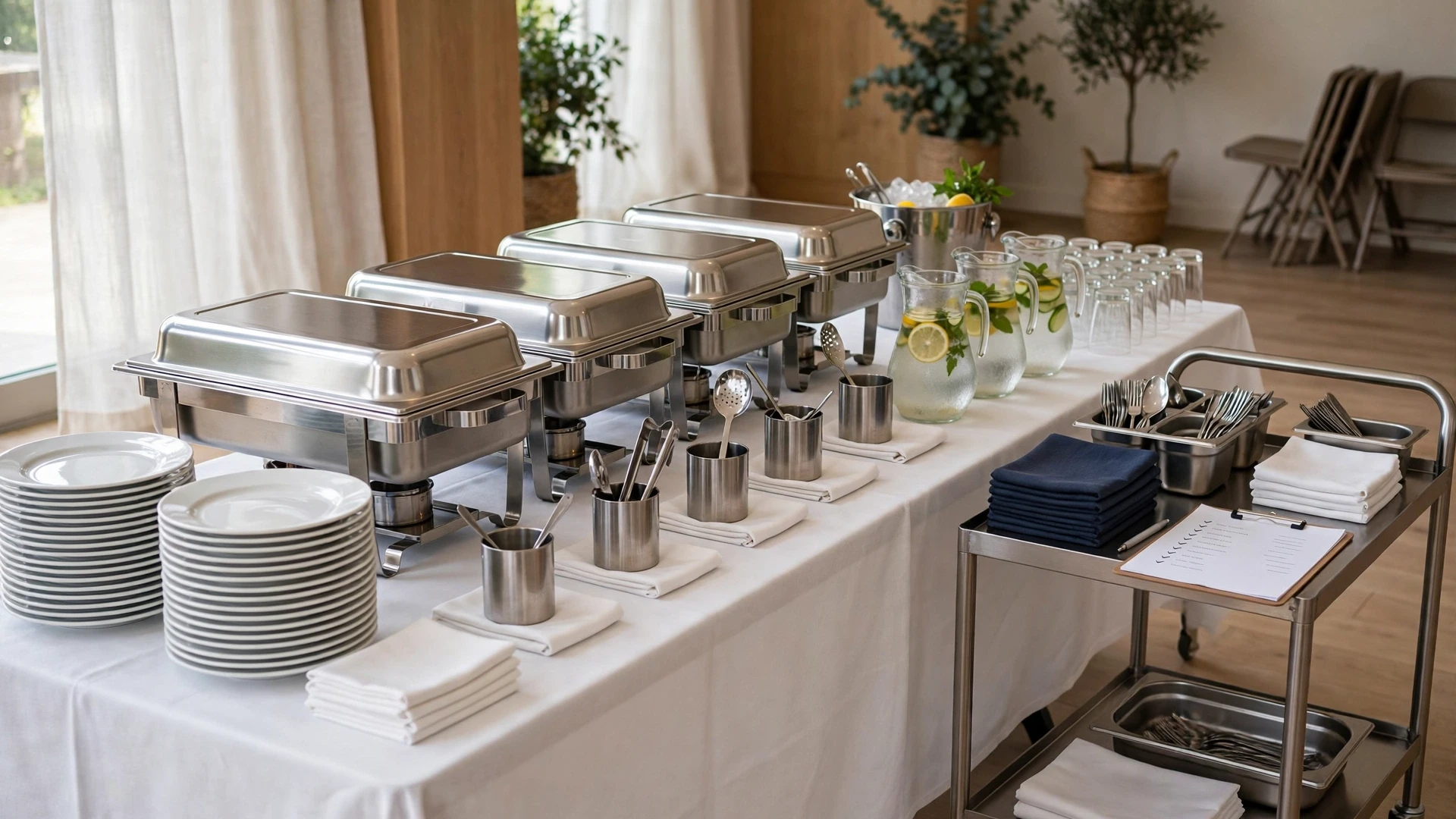
A buffet is a service system, not a row of chafers
Buffet setup planning has to balance guest flow, food quality, holding, replenishment, accessibility, equipment, staffing and the physical room. The best-looking line can still fail if guests queue across an entrance, hot food refills must cross the queue, plates are trapped at one end or the highest-demand dish is served from a single small pan.
Plan the buffet on paper before arrival. Show guest direction, station sequence, refill path, backup staging and the service team’s movement. This turns setup from decoration into operational design.
Start with the guest journey
Identify where guests enter the buffet, where they collect plates, how they move, where beverages and condiments sit, and how they exit without crossing the next group. For larger counts, consider whether two-sided service or duplicated high-demand stations would reduce queue pressure. The right answer depends on room geometry and menu, not a universal buffet layout.
Keep service flow separate from back-of-house refill flow where possible. Staff carrying hot pans should not fight upstream through the guest queue.
Sequence the menu deliberately
Place items in an order that supports both guest decisions and pan capacity. Plates first, then logical courses or categories, with condiments and sauces positioned where they do not create a bottleneck. Very popular items may need larger service areas, multiple utensils or duplicate pans.
Consider what guests tend to take together. If a sauce belongs with one item, place it near that item rather than forcing guests to stop later and reverse direction.
Design replenishment before the first pan goes out
For every hot or cold item, define the backup location, refill trigger and person responsible. A buffet without a refill plan eventually becomes a reactive carrying exercise. Use smaller, more frequent pans when that protects freshness and reduces waste, provided the replenishment route and labor can support it.
The refill trigger can be visual, time-based or quantity-based. The important point is that staff know when to move before the pan looks empty to guests.
Holding and display controls must match the food-safety plan
Follow the operation’s approved food-safety procedures and applicable requirements for hot and cold holding, time control, utensils and protection from contamination. Setup should leave enough room for equipment to function properly and for staff to monitor product without disturbing guests.
Do not overload a pan simply to reduce refills if the result is poor quality or unsafe holding. Buffet quantity planning and buffet setup are connected but not identical problems.
Create a service-zone map
Divide the event into guest zone, active buffet zone, replenishment lane, backup food staging, equipment/utensil reserve and waste/clearing area. The map helps supervisors assign staff and prevents boxes, spare linens and empty pans from accumulating behind the display.
For outdoor or temporary venues, add wind, power, shade, floor stability and distance from the production or holding area to the plan.
Capacity planning for popular items
Use expected guest count and portion assumptions to identify items likely to empty fastest. The food quantity plan tells you total production; the buffet plan decides how much appears at once and how quickly it can be replaced.
If one carving or action station has a fixed service rate, estimate whether it can serve the guest wave. A beautiful station that can plate only half the required guests per minute becomes the event’s bottleneck.
Example: two-sided buffet prevents a queue
A 160-guest event is scheduled to release tables in four groups. The menu has one popular protein and several quick sides. Instead of one long line, the planner duplicates the protein and sides on two mirrored service points while keeping salads and desserts separate. Refill staging sits behind both lines. The setup uses more serving equipment but reduces queue length and keeps the popular protein from becoming a single bottleneck.
The numbers are illustrative; actual layout depends on venue, menu and staffing.
Pre-opening buffet release check
- Guest path is clear and does not block doors or service routes.
- Tables and equipment are stable.
- Holding equipment is operating as required.
- Every menu item has the correct utensil and label/identifier.
- Backup food is staged and assigned.
- Refill route is clear.
- Dietary/allergen communication follows the event plan.
- Waste/dirty-pan route is separate from clean refill flow.
- Supervisor knows who releases guests and who controls refills.
Common setup mistakes
- Designing only for appearance and ignoring refill flow.
- Putting the most popular item at a single narrow point.
- Staging backups so far away that pans empty before refills arrive.
- Using oversized display pans that damage quality or create excess end-of-event waste.
- Placing beverages where they block food service.
- Failing to test the path with actual tables, doors and venue obstacles.
FAQ
Q: Should buffets always flow in one direction? A: Not always; room layout and guest count may favor two-sided or multiple stations, but the direction should be obvious.
Q: How much food should be on display at once? A: Enough for the service wave while protecting quality and holding; total production and display par are separate calculations.
Q: Who owns refills? A: Assign named zones or products rather than assuming the whole team will notice.
Q: How do I reduce end-of-event waste? A: Use phased display, smaller late-service refills and good guest-count/portion planning.
Next action
Before the next event, draw the room and trace two paths with a pen: the guest path and the refill path. If they cross repeatedly, redesign the layout. Then identify the two fastest-moving items and assign their display par, backup location and refill trigger before setup begins.
Plan accessibility and guest usability
Buffet layout should consider children, older guests, mobility devices and venue accessibility requirements. Avoid narrow pinch points, unstable reaching and condiment placement that forces guests to lean over hot equipment. Where the venue or event has specific accessibility needs, coordinate with the planner in advance.
Operational efficiency is not a reason to create an inaccessible service path. Good layout improves both guest comfort and staff movement.
Use clearing flow to protect the active buffet
Dirty plates, used utensils and empty pans should leave through a route that does not cross clean refill staging. Assign a landing point for used serviceware and a runner or stewarding path. Without this plan, the back of the buffet becomes congested as the event progresses.
A clean close is designed at setup. Leave physical space for empty carriers, dirty pans and waste so they do not invade the refill lane.
Additional operating detail
A buffet supervisor should watch both queue behavior and food movement during service. If guests repeatedly stop at one item, the solution may be a second utensil, duplicated pan, clearer label or different sequence. If refills repeatedly arrive late, move the backup staging point or assign a dedicated runner. The live buffet is a feedback system; use what happens in the first service wave to adjust the rest of the event.
After the event, compare what was produced, what was displayed, what was replenished and what remained. This helps separate quantity-planning error from setup error. Excess food in the kitchen is different from excess food repeatedly placed on the buffet. The distinction matters when deciding whether to change production or display pars.
Manager implementation notes
When the event includes multiple dietary labels or self-service allergen concerns, the buffet plan should follow the caterer’s established communication and separation procedure. Placement, utensils and labels must be designed so guests and service staff can identify the intended item without relying on memory. If the operation cannot safely provide a self-service arrangement for a particular special meal, use a controlled alternative service method rather than forcing every product onto the main line.
Measure buffet performance with more than guest count. Record first-queue length or release time, refill frequency, pans returned with significant leftovers, item shortages and any point where staff had to cross guest traffic. These observations turn one event into planning data for the next. Over time, the caterer can build layout standards for recurring venue sizes and service styles instead of designing every buffet from zero.
Plan refill movement as carefully as guest movement
A buffet can look attractive and still be difficult to operate when service staff must cross the guest queue to replace pans. Map the refill route before the event: where fresh pans approach, where empties leave, where backup utensils are stored and where staff can pause without blocking guests. Define a refill trigger appropriate to each product rather than waiting until a pan is empty. The trigger can be a remaining quantity, elapsed time or a visual standard. Predictable replenishment reduces queues and avoids the common overreaction of filling the next pan too deeply because the previous one ran out.
After service, compare leftovers with refill timing. A pan returned nearly full may reflect overproduction, a late refill or weak demand; a pan that repeatedly empties before replacement may indicate an undersized pan, an awkward route or underestimated demand. Track these observations by item and venue when the caterer repeats similar events. Over time, the event history becomes a practical planning library for pan size, refill frequency and staffing instead of relying on a generic quantity-per-guest assumption. Include dietary or allergen communication in the layout so special meals remain identifiable and do not depend on staff memory during the busiest service period.
Separate visual abundance from service control
Buffet teams often equate a full-looking display with good service, but overfilled pans can increase holding time, waste and refill difficulty. Decide where visual abundance truly matters and where smaller, more frequent pans can maintain a fresh appearance with better control. The answer can differ by item: a stable dry product may tolerate a larger display while a delicate hot item benefits from smaller replenishment waves. Train staff to read both the presentation standard and the operational trigger, so they do not refill simply because a pan looks half empty. After the event, compare guest flow, refill frequency, returned quantity and staff travel distance. A visually attractive setup that requires constant crossing, emergency refills or large leftovers is not yet an efficient buffet design. The best layout balances guest confidence with replenishment discipline and practical back-of-house access.
Use a service reset plan
For long events, plan how the buffet will be restored between waves of guests. The reset can include replacing tired garnishes, consolidating pans, changing utensils, cleaning the guest-facing area and re-establishing labels without interrupting food control. A defined reset prevents the display from slowly degrading over several hours and gives staff a predictable moment to correct presentation and replenishment issues before the next demand wave.
Assign one refill owner per zone
When several staff members refill the same buffet without clear zones, two people may replace one item while another pan empties. Assign refill responsibility by station or section and give the supervisor authority to rebalance staff when demand shifts.
Additional topic-specific operating notes
- equipment and power needs confirmed with venue constraints
- allergen and dietary labels handled according to the event plan
- refill path kept separate from guest congestion where possible
- backup product staged with clear ownership for replenishment
- assign refill ownership by station or menu group
- record what ran too fast, too slow or created congestion for the next event
A buffet with two popular entrées placed in the same narrow section creates a queue even when food quantity is sufficient. Moving one item or duplicating a station can improve flow without changing the menu or staffing level.
Useful next resource
Buffet flow stress test before guests arrive
Before service, test the layout as if the first large wave of guests has already arrived. One person should walk the guest path while another walks the refill path. If those paths cross repeatedly, or if a refill cart must enter the guest queue, the layout still has an operating conflict even if it looks attractive.
| Stress-test question | What failure looks like | Preferred correction |
|---|---|---|
| Can guests reach popular items without one bottleneck? | Two high-demand dishes create one narrow queue. | Separate them, duplicate one station or widen access. |
| Can staff replace pans without crossing the guest line? | Refill staff repeatedly cut through guests. | Create a rear or side replenishment route. |
| Can special-diet items remain identifiable? | Labels or service utensils can be mixed during refills. | Use a controlled dedicated position and clear ownership. |
| Can the line absorb a short demand surge? | One pan empties before backup reaches the station. | Adjust pan size, backup location or refill trigger. |
Post-event improvement loop
- Record which item created the longest queue.
- Note every emergency refill and the reason it was late.
- Identify pans that returned nearly full.
- Record any staff path that interfered with guests.
- Change one layout or replenishment standard before the next comparable event.
This gives the catering team a repeatable learning system. The next buffet should start from evidence about flow, pan size and refill timing rather than from memory or a generic floor plan.
Use the Restaurant Operator Lab tools and related guides only when they directly support the decision described above. Open the free tools library