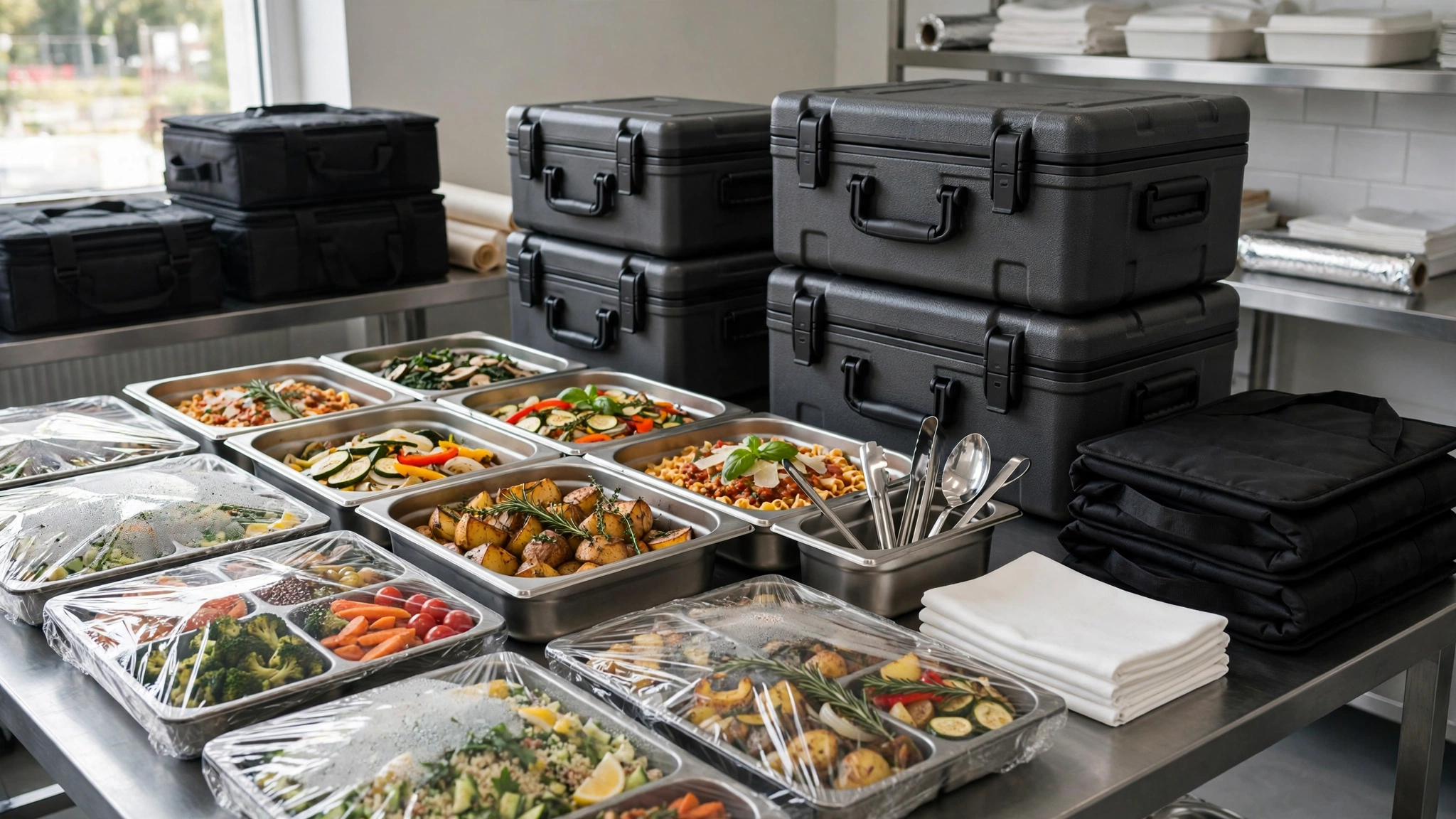
A restaurant catering BEO—short for Banquet Event Order—is the operating document that turns a sold event into an executable plan. It should tell the kitchen, service team, dispatch lead, and manager exactly what has been promised, in what quantities, at what times, for which location, and under which revision.
A useful BEO is not just an event summary. It is a controlled handoff between sales and operations. When the document is vague, teams fill gaps with assumptions. When it is structured, the event can be reviewed, produced, packed, delivered, set up, served, and closed with fewer surprises.
What a restaurant catering BEO should contain
There is no single universal BEO format that fits every restaurant. A simple pickup order may need one page; a staffed off-site event may need timing, equipment, room setup, service notes, transport details, and multiple owners. The core principle is the same: every operational promise should have a clear field, owner, quantity, time, or status.
| Section | What to capture | Why it matters |
|---|---|---|
| Event identity | Event name, client, date, location, contact details | Prevents teams from working from the wrong event or venue |
| Commercial scope | Service type, approved menu, guest count, inclusions, exclusions | Defines what operations must actually deliver |
| Timing | Production cutoff, dispatch, arrival, setup, service, breakdown | Turns one event time into a workable sequence |
| Quantities | Portions, pans, trays, beverages, disposables, equipment | Converts sales promises into production and packing requirements |
| Responsibilities | Kitchen lead, pack lead, driver, event lead, client contact | Makes ownership visible before the event starts |
| Exceptions | Allergies, access limits, late changes, substitutions, special setup | Surfaces risk before it becomes a service problem |
| Revision control | Version, revised by, revised at, change summary | Prevents an old printout or screenshot from becoming the working plan |
BEO vs proposal, invoice, and production sheet
These documents can contain overlapping information, but they solve different problems.
- Proposal or quote: explains what is being offered and at what price.
- Contract or confirmation: records what the client accepted, including commercial terms.
- Invoice: records what is billed or due.
- BEO: translates the accepted event into an operating plan.
- Production sheet: converts the BEO into kitchen-specific prep, batch, packing, and dispatch work.
The BEO should therefore be detailed enough to control the event, but not so overloaded that it becomes a substitute for every other document. For the kitchen handoff, see the restaurant catering production sheet. For event volume planning, use the catering production planning guide.
Start with one source of truth
The most important control is simple: the team should know which BEO is current. A catering event often changes after the first confirmation. Guest count moves, a menu item is replaced, access time changes, a client adds beverages, or the venue changes the loading instructions. If updates are spread across texts, email threads, handwritten notes, and old printouts, execution risk rises quickly.
Assign one version number or revision label to the working BEO. Every material update should change that revision and show who made the change. Old versions should be marked superseded rather than left looking valid.
A practical revision header can contain:
- BEO number or event ID
- Revision number
- Last revised date and time
- Revised by
- Reason for change
- Operations acknowledged by
This is not administrative decoration. It gives the kitchen and event team a quick answer to the question: “Are we all working from the same plan?”
Convert guest count into operational quantities
A guest count alone does not tell the kitchen what to prepare. The BEO should show the assumptions that turn attendance into quantities.
Portion quantity
For an item planned at one portion per guest:
Planned portions = confirmed guest count + approved contingency portions
If the concept uses a percentage contingency instead:
Planned portions = confirmed guest count × (1 + contingency rate)
The contingency rate is a management choice, not a universal benchmark. It should reflect the restaurant’s service format, replenishment method, contract terms, menu risk, and ability to produce more food during service.
Pan or tray quantity
If one hotel pan holds 20 planned portions and the event requires 110 portions:
Pans required = CEILING(110 ÷ 20) = 6 pans
The final pan may not be full, but the calculation gives the packing team a physical unit to prepare and count.
Beverage quantity
For a beverage planned at 1.5 servings per guest, with a 250 ml serving:
Liters required = guests × servings per guest × serving size ÷ 1,000
For 80 guests:
80 × 1.5 × 250 ÷ 1,000 = 30 liters
Again, servings per guest are an operating assumption, not an industry constant. Record the assumption on the BEO so the number can be reviewed rather than guessed.
For broader quantity planning, see Catering Food Quantity Planning. If you are still setting the selling price, use the Restaurant Catering Pricing Calculator and the guide on pricing catering events for profit.
Build a timing chain, not one event time
“Service at 7:00 PM” is not enough. The BEO should work backward and forward from service time.
| Milestone | Example planning question | Owner |
|---|---|---|
| Production complete | When must hot and cold production leave the line? | Kitchen lead |
| Pack complete | When must food, disposables, labels, and equipment be checked? | Pack lead |
| Dispatch | When must the vehicle leave? | Driver / dispatcher |
| Venue access | What is the earliest permitted loading or setup time? | Event lead |
| Setup complete | When must the room, buffet, or service stations be ready? | Event lead |
| Service start | When does guest service actually begin? | Service lead |
| Breakdown | When can equipment and leftovers be removed? | Event lead |
Where transport is involved, include realistic travel and loading time rather than relying on map time alone. The BEO should also capture venue constraints such as elevator access, loading dock restrictions, security check-in, parking, stairs, kitchen access, power availability, or a required contact on arrival.
Use exception triage before the event
Not every BEO issue deserves the same escalation. A simple triage table helps managers focus attention where a mistake would be costly or difficult to recover from.
| Exception | Suggested priority | Action before release |
|---|---|---|
| Unconfirmed guest count close to production cutoff | High | Get written confirmation or apply the approved contractual count |
| Allergy or dietary note without a specific item plan | High | Clarify ingredients, preparation, labeling, and service controls |
| Venue access or delivery instructions missing | High | Confirm access route, contact, parking, and timing |
| Late menu substitution | Medium to high | Check purchasing, production, labeling, pricing, and client approval |
| Minor garnish or presentation preference | Low to medium | Assign owner and confirm materials |
| Old BEO version still in circulation | High | Withdraw or mark superseded copies and reissue current revision |
The priority labels above are illustrative. Each restaurant should define escalation based on its own contracts, food safety system, staffing, production capability, and service model.
One-page BEO review worksheet
Before releasing the event to production, a manager can review the BEO using the following one-page structure.
| Event | Event name / ID: | Date: |
|---|---|---|
| Client | Primary contact: | Phone: |
| Venue | Address / access notes: | |
| Service | Pickup / delivery / staffed / buffet / plated: | Service time: |
| Guest count | Confirmed: | Contingency assumption: |
| Menu | Approved menu and substitutions: | |
| Dietary controls | Allergies / dietary requests / labels: | |
| Quantities | Portions / pans / beverages / disposables: | |
| Equipment | Hot boxes / chafers / tables / serviceware / return items: | |
| Timing | Pack complete: | Dispatch: |
| Arrival | Venue access: | Setup complete: |
| Owners | Kitchen / pack / driver / event lead: | |
| Revision | Version: | Last changed by: |
| Open exceptions | What must be resolved before release? | |
| Release | Manager approval: | Time: |
Change control: what happens after the BEO is released?
The event is most vulnerable when a late change is accepted but not propagated. A practical change-control sequence is:
- Record the request. Capture exactly what the client or venue asked to change.
- Assess impact. Check food, labor, equipment, transport, timing, pricing, and safety implications.
- Approve commercially if required. Do not let operations absorb an unapproved scope change by default.
- Update the BEO revision. Change the source document rather than relying on a side message.
- Notify affected owners. Kitchen, packing, dispatch, service, and finance may not all need the same update.
- Confirm acknowledgement. For material changes, make sure the relevant lead has seen the new revision.
- Retire the old version. Remove old printouts or mark them superseded.
A simple cause code can also make post-event review easier. Examples include client change, venue constraint, supplier issue, internal planning error, production variance, and dispatch error. These labels are only useful if evidence is recorded alongside them; they should not become shortcuts for blame.
Pre-event release checklist
- Confirm the event date, venue, contact, and service type.
- Confirm the current BEO revision and remove superseded copies.
- Confirm final or contractually applicable guest count.
- Review menu, substitutions, dietary requirements, and labels.
- Convert guest count into portions, pans, beverages, and disposables.
- Verify production, pack, dispatch, arrival, setup, and service times.
- Assign kitchen, packing, transport, and event owners.
- Confirm equipment, returnable items, fuel, power, and serviceware.
- Resolve high-priority exceptions before release.
- Confirm venue access, loading, parking, security, and on-site contact.
- Issue the final working revision to all affected leads.
- Record any approved late changes and acknowledgements.
Common BEO mistakes
1. Copying the sales proposal into operations
A proposal can describe the event well enough to sell it while still being too vague to execute. Operations needs quantities, times, owners, access details, and exception notes.
2. Hiding assumptions
If the kitchen does not know what portion factor, beverage assumption, or contingency created the final quantity, it cannot review the logic. Put the assumption next to the result.
3. Treating every change as a note
A message in a chat thread is not revision control. Material changes should update the current BEO and reach the teams affected by the change.
4. Missing the physical packing units
“120 portions” may still leave the packing team asking how many pans, trays, boxes, lids, labels, and serving utensils are required.
5. Assuming a service problem has one obvious cause
If food was short, do not immediately blame production or theft. Check the confirmed count, portion assumption, recipe yield, packing count, transport loss, replenishment, and actual service demand before assigning cause.
Post-event review: close the loop
The BEO becomes more valuable when it is used after the event. Compare the plan with what actually happened. Did the guest count change? Was production short or excessive? Did the vehicle leave on time? Was venue access different from the instructions? Were there emergency purchases, extra labor hours, missing equipment, or returned food?
Record the material variance, evidence, corrective action, owner, and recheck date. If the issue was a recurring planning problem, change the BEO template or operating checklist—not just the individual event file.
FAQ
What does BEO stand for in catering?
BEO stands for Banquet Event Order. In a restaurant catering operation, it is the working event document that translates the confirmed scope into operational details such as menu, guest count, quantities, timing, location, responsibilities, and special instructions.
Is a BEO the same as a catering contract?
No. A contract records the commercial agreement and terms. A BEO is primarily an execution document. Some businesses combine parts of both, but operations should still have a clear current document that can be used to run the event.
Who should prepare the BEO?
The role varies by business. It may be prepared by catering sales, an event coordinator, or a manager. More important than the job title is the handoff: operations should review the document before production is released.
When should a BEO be finalized?
There is no universal cutoff. The deadline should match the restaurant’s purchasing, prep, staffing, and contract requirements. The BEO can remain revision-controlled after that point, but late changes should follow an explicit approval and communication process.
Should a BEO include prices?
It can, especially if managers need to verify scope against the commercial agreement. But the operational BEO should not become harder to use because of unnecessary billing detail. Keep the fields that help the team execute and control the event.
What is the most important BEO control?
For many operations, it is version control. A detailed BEO still fails if the kitchen, driver, and event lead are working from different revisions.
Five-minute manager release test
Before the BEO is released, a manager should be able to answer five questions without opening another message thread:
- What exactly are we serving? The approved menu, substitutions, dietary controls, and service format are visible.
- How much are we preparing? Guest count, quantity assumptions, portions, pans, beverages, and disposables reconcile.
- When does each handoff happen? Production, packing, dispatch, arrival, setup, service, and breakdown times are assigned.
- Who owns each critical step? Kitchen, packing, transport, event lead, and client contact are named.
- What could still derail the event? Open exceptions are listed with an owner and a required resolution before release.
If any answer depends on “someone knows,” a private text message, or an old printout, the BEO is not yet ready. Fix the source document first, then release the current revision.
Bottom line
A strong restaurant catering BEO is a control document, not just an event memo. It should connect the sold scope to quantities, timing, ownership, venue constraints, revision control, and exception handling. Keep one current version, show the assumptions behind the numbers, release it through a manager review, and use post-event evidence to improve the next event.