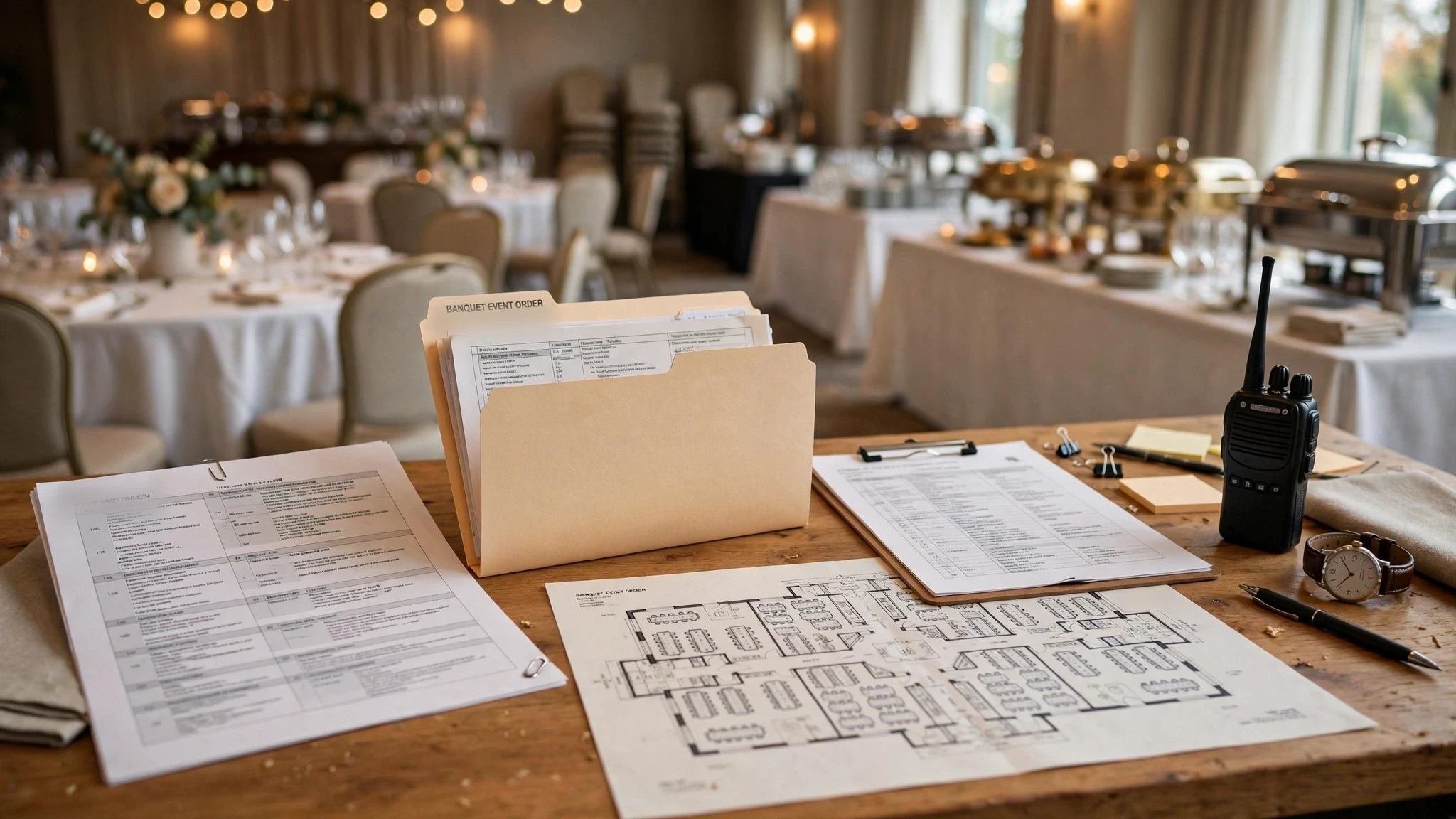
Catering teams can know what to do and still fail because they do not agree on when to do it.
The kitchen leaves on time but venue access starts later than expected. Rentals are delivered after setup should begin. The buffet is ready forty minutes before guests arrive. The event captain starts clearing while speeches are still running. Breakdown misses the loading-dock window.
An event timeline—often called a run of show—turns the event scope into a shared clock from load-in through final departure.
Start with fixed external times
- Venue access start.
- Loading dock/elevator reservation.
- Rental delivery window.
- Client/vendor setup access.
- Guest arrival.
- Ceremony/program start if relevant.
- Food-service start.
- Venue cutoff/curfew.
- Rental pickup.
- Final load-out/venue exit.
These times should come from the actual event/venue documents, not assumptions.
Work backward from guest-facing commitments
If dinner service begins at 7:00 PM, determine when the buffet/plating line must be ready, when food must arrive in the service area, when final heating/finishing occurs under the approved process, and when the vehicle must depart.
Backward planning protects the critical path.
Separate milestones from task detail
The event timeline does not need every small kitchen action. It should include cross-team milestones where one delay affects another team.
| Milestone | Owner | Dependency |
| Venue access | event captain | venue |
| Equipment/rental check-in | setup lead | vendor/load-in |
| Buffet/plating ready | culinary lead | food + equipment + service area |
| Guest doors open | FOH/event lead | room ready |
| Meal service start | event captain | client/program + culinary |
| Breakdown start | event captain | guest/program completion |
| Final load-out | captain/transport | equipment count + venue window |
Build three linked timelines
Complex events benefit from a culinary/production timeline, venue/setup timeline and guest/service timeline. They should connect at major milestones.
One giant list can hide dependencies if every department sees only its own tasks.
Plan travel and traffic margin deliberately
Transport time should use the actual route, vehicle, day/time and load requirements. Include enough planning margin for the event’s consequence and known conditions.
Do not publish a universal ‘leave 30 minutes early’ rule.
Map the critical path
The critical path contains tasks that cannot slip without moving the guest-facing commitment.
For a plated event, final food release, transport, hot holding, plating setup and service start may form the critical path. Decorating a non-essential sign may not.
Identify parallel work
While one team sets tables, another can set beverage stations and a third can stage back-of-house equipment—if the venue layout and staffing allow.
Parallel work shortens setup without pretending one person can do two things at once.
Assign every milestone an owner
Do not write ‘buffet ready 6:30’ without naming the role responsible for confirming readiness.
The owner may coordinate several employees; the point is one person knows they must close that milestone.
Add a status/exception column
During the event, use simple states such as on track, at risk, delayed, complete. For a delayed milestone, record the recovery action and whether the guest-facing schedule changes.
Build change triggers
The timeline should explain what happens if guest arrival moves, speeches run long, venue access is delayed or a supplier is late.
Not every delay should cause the culinary team to hold food indefinitely. Define who makes the service-time decision and how kitchen/service receive the update.
Connect the timeline to the BEO
The BEO defines the event scope; the run of show defines timing/execution. The documents should use the same current guest count, menu, service style and major commitments.
Restaurant Catering BEO: Banquet Event Order Template and Checklist.
Connect to equipment load-out
The timeline should include load completion and vehicle departure, not just venue arrival.
Catering Equipment and Rental Checklist: Control Load-Out, Returns and Charges.
Connect to guest-count changes
A late count increase can extend setup, service and breakdown. Update the timeline if staffing, seating, rentals or food service sequence changes materially.
Catering Final Guest Count Control: Lock Quantities Without Last-Minute Chaos.
Build a setup sequence
1. Venue access and safety/space check.
2. Unload critical equipment.
3. Confirm rentals/venue-provided items.
4. Set service/back-of-house work areas.
5. Set guest-facing tables/stations.
6. Receive/stage food under approved procedures.
7. Complete beverage/utensil/label setup.
8. Final quality and readiness walk.
9. Release room/service area for guest arrival.
Use readiness gates
Before guests arrive, the event captain can run a short gate: room, service equipment, food/service stations, staff positions, client/program update and safety/access paths.
If one gate is not ready, management knows where to focus instead of asking the whole team whether they are ‘good.’
Plan service transitions
Cocktail to dinner, buffet open to dessert, speeches to coffee, or ceremony to reception can create workload spikes.
Put transitions on the timeline and assign reset/clear/setup ownership.
Plan breakdown before the event starts
Breakdown needs a start trigger, rental separation, food/product disposition under approved procedures, waste handling, equipment count, vehicle loading and venue sign-off where applicable.
Without a planned sequence, the most tired part of the event becomes the least controlled.
Protect rental return windows
If rentals must be staged for overnight pickup or returned by a specific time, include that requirement in the run of show and equipment checklist.
Example: service time moves 20 minutes
The client program runs long and dinner moves from 7:00 to 7:20. The captain communicates one controlled update to culinary, service and venue contacts.
The team does not independently shift every task. Culinary manages food under the approved process; service shifts table/guest cues; breakdown milestones move only if the venue window allows.
Post-event timeline review
- Which milestone started late?
- What caused the first meaningful delay?
- Which delays recovered without guest impact?
- Where did teams wait for each other?
- Did venue/rental/vendor timing match commitments?
- Did service transitions have enough labor?
- Did breakdown finish within the venue window?
- What timing assumption should change next event?
Common timeline mistakes
Starting the timeline at guest arrival
Load-in and setup failures happen before the visible event.
No owner beside milestones
Everyone assumes someone else will close the task.
Too much detail
The critical path disappears inside hundreds of microtasks.
No recovery triggers
Every delay becomes a new meeting.
Breakdown omitted
Equipment and venue problems appear after service ends.
Frequently asked questions
How detailed should a catering run of show be?
Detailed enough to coordinate cross-team dependencies and guest-facing commitments, but not so detailed that every prep action hides the critical milestones.
Who owns the timeline?
Usually the event captain/event manager, with culinary, sales and setup leads responsible for their milestones.
Should the client receive the same timeline?
Share the level appropriate to the event. The internal operating timeline may contain staff/load details the client does not need.
How much setup buffer should be included?
Use venue access, event complexity, load path, staffing and risk. There is no universal percentage or number of minutes.
Next action
For the next event, write only eight milestone times from venue access to final departure. Add owner and dependency beside each. If those eight are clear, then add the supporting tasks needed to protect them.
Related guides: