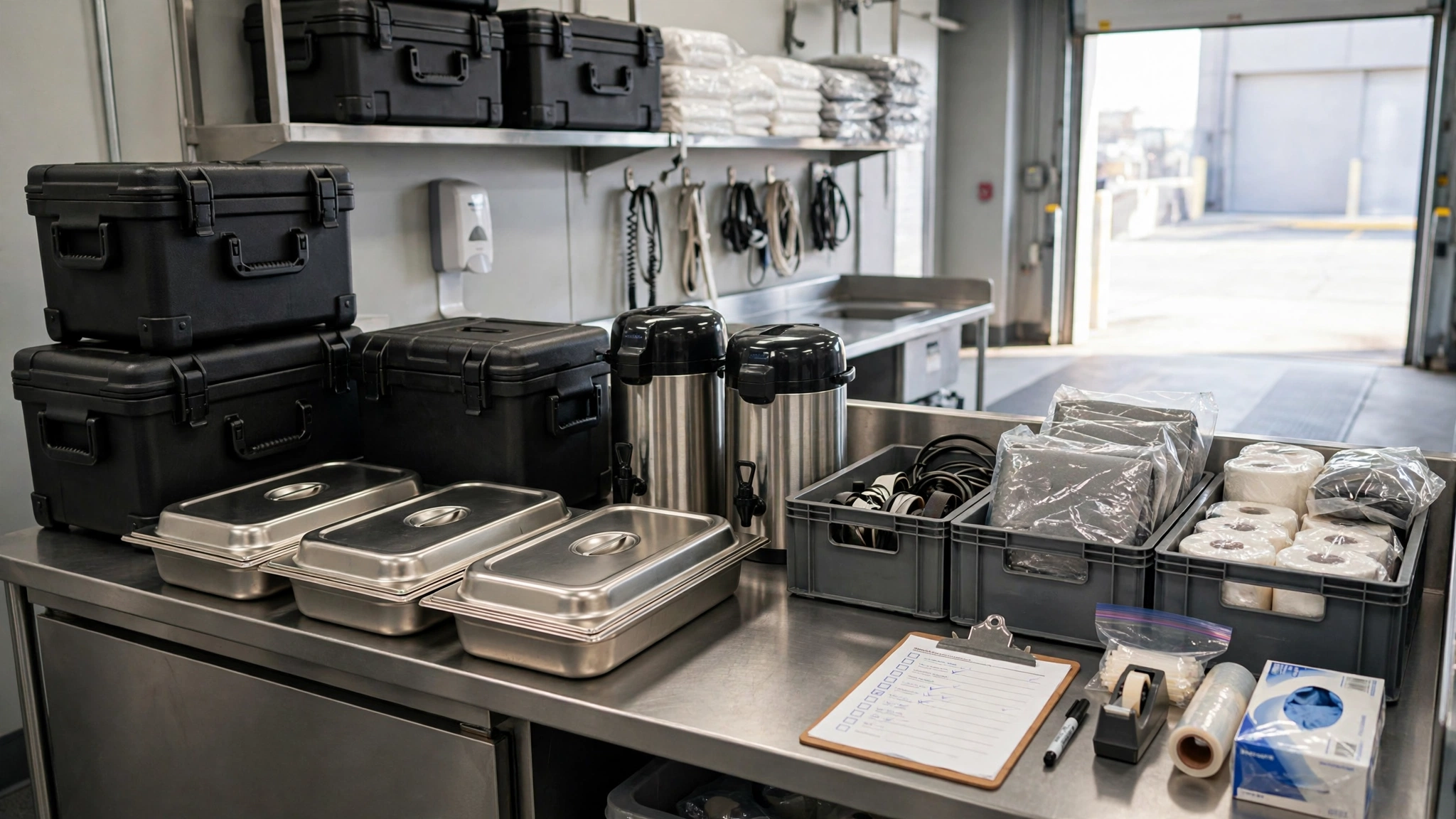
Dispatch is the last point where the kitchen can still fix the order
Once the vehicle leaves, a missing pan, wrong label, forgotten serving utensil or incorrect dietary item becomes expensive to recover. Catering dispatch control is therefore a release gate: the order does not leave because the clock says so; it leaves when the food, equipment, documents and route-critical items match the approved event plan.
A good dispatch process separates production completion from release. The kitchen may have finished cooking, but the dispatch lead still verifies count, identity, holding, packing sequence and event-specific requirements.
Build dispatch from the BEO or final event version
Use the latest approved banquet event order (BEO), catering order or event sheet as the single release reference. Old printouts are dangerous when guest count, timing, dietary requests or setup details have changed. Mark the revision or confirmation time and make sure production and dispatch are working from the same version.
For late changes, document who approved them and where the change appears in the release list. Verbal updates that exist only in one person’s memory are a common source of dispatch failure.
Use a zone-based staging area
Separate staged items by event and by temperature/equipment zone: hot food, cold food, ambient/dry goods, service equipment, disposables and documents. Physical separation prevents one event’s items from being loaded into another vehicle and makes the final count faster.
Tag carts or racks with event name/code, departure time and vehicle. Avoid mixing completed and incomplete orders in the same staging position without a clear status marker.
Count by production unit, not by memory
Dispatch should verify pans, trays, boxes, beverage units and equipment against the order. Use the unit the kitchen actually packed: “6 full hotel pans” is easier to verify than “food for 120” once the product is sealed. The guest-count calculation belongs earlier; dispatch confirms that the planned production units are physically present.
For items packed into multiple containers, record both the total and container sequence. This helps the event team know whether a missing box is a complete category or only a partial load.
Dietary and allergen items need identity control
Special meals should be clearly identified, separated enough to prevent mix-ups and matched to the event plan. Dispatch is not the place to invent a substitute because an item is missing. If an approved special meal is not present, stop the release of that component and escalate to the responsible manager.
Use labels that staff can actually read under event conditions. Avoid ambiguous abbreviations that only the kitchen understands. Follow the restaurant’s allergen and food-safety procedures for packaging and communication.
Temperature and holding checks happen before loading
Follow the operation’s food-safety plan and applicable requirements for hot and cold holding. Verify that containers, insulated carriers or refrigerated transport equipment are ready before food is packed into the vehicle. A correct kitchen temperature does not protect food if loading leaves it exposed for an uncontrolled period.
Record any required dispatch temperature checks and the time. The event team should know what must happen on arrival, including reheating, holding or immediate service procedures.
Load in the order the event will need items
The first item loaded is often the hardest to reach. Plan the vehicle so setup-critical equipment and first-service items are accessible when the team arrives. Heavy equipment should be secured appropriately, food protected from crushing or contamination, and hot/cold separation maintained according to the transport method.
A load map is especially useful for large events or multiple drops. It reduces unloading chaos and protects the service timeline.
Dispatch release gate
- Correct event/revision confirmed.
- All food units counted and identified.
- Dietary/allergen items verified.
- Required temperature/holding checks complete.
- Serving utensils, disposables and setup equipment counted.
- Documents, contacts and route details present.
- Vehicle/driver and departure time confirmed.
- One dispatch lead signs the release; unresolved red items stop departure.
Example: everything is cooked, but dispatch still stops the van
The hot food is complete and the driver is ready. During release, the dispatch lead finds the vegetarian meals listed on the final BEO are not on the cold rack and the chafer fuel count is short. Production is technically finished, but the event is not ready. The order remains in staging while the missing items are corrected. That delay is cheaper than discovering the failure at the venue.
This is the core value of dispatch control: it protects the event from the assumption that “cooked” means “complete.”
Create a dispatch exception log
Record event, missing/incorrect item, discovery time, immediate containment, owner, resolution and departure impact. Review exceptions after the event cycle. If the same item class is missed repeatedly—utensils, labels, dietary meals or beverages—the fix belongs in production planning or the pack list / production sheet, not in reminding dispatch to “be more careful.”
Common dispatch failures
- Using an outdated order revision.
- Counting guest numbers but not physical packed units.
- Mixing multiple events in one staging zone.
- Loading before temperature/holding equipment is ready.
- Treating special meals as a verbal note instead of a controlled item.
- Forgetting setup equipment because the kitchen focuses only on food.
- Allowing departure pressure to override an unresolved red exception.
FAQ
Q: Who should sign dispatch? A: One named person should own the release; production staff can verify components but ownership should be clear.
Q: Should drivers do the final count? A: Drivers can participate, but the restaurant should not depend on someone unfamiliar with production details to catch kitchen errors.
Q: How early should staging begin? A: Early enough to count and correct without compromising holding time or product quality.
Q: What if a late client change arrives during loading? A: Pause the affected release, update the approved event version and re-verify the changed components.
Next action
Use the next catering order to create a physical dispatch gate between “production complete” and “vehicle released.” Count packed units, verify special items, confirm holding and equipment, then sign the release. Track every exception for a month and move repeat failures upstream into the BEO, production sheet or packing standard.
Use container IDs for large multi-cart events
For complex events, assign container or cart IDs such as HOT-1, HOT-2, COLD-1 and EQUIP-1. The dispatch list then records which items live in each unit. This makes loading and venue unloading auditable and helps the event lead identify exactly what is missing without opening every carrier.
If a container is swapped during loading, update the map rather than relying on memory. This is especially valuable when more than one vehicle or delivery wave is involved.
Close the loop after the event
Dispatch errors should be reviewed while evidence is fresh. Compare the exception log with production, packing and event feedback. If a missing utensil came from the pack list, update the list; if an item was on the list but not staged, fix staging ownership; if a late client change caused confusion, improve revision control.
The dispatch team should not carry permanent blame for failures created upstream. Use the gate to identify where the system needs redesign.
Additional operating detail
Dispatch timing should be coordinated with route planning and event arrival windows. A perfect final check that happens too early can create unnecessary holding; a check that happens at the last minute creates pressure to waive exceptions. Work backward from departure and define when each zone must be ready for release. Large events benefit from staggered zone deadlines rather than one all-or-nothing completion time.
For recurring venues, keep venue-specific notes such as loading dock access, elevator restrictions, security check-in and carrying distance. Those details affect departure time and the order in which equipment should be loaded. Treat venue knowledge as part of the dispatch system so it is not trapped in one driver’s memory.
Manager implementation notes
Dispatch control should also include communications ownership. The event lead, driver and kitchen need one agreed channel for last-minute delays or access problems, and the contact list should distinguish who can authorize a client-facing change from who can simply report a delay. This prevents a driver from improvising a service promise or the kitchen from rebuilding an order because two people gave conflicting instructions.
For large events, conduct a short departure huddle after the physical count. Confirm destination, arrival contact, unload point, service start, dietary exceptions and the first setup priority. The huddle should take only a few minutes because the detailed data already lives in the dispatch sheet. Its purpose is to align the people who are about to leave the controlled kitchen environment and operate at the venue.
Design loading around the order of use at the venue
Packing only by food category can make unloading slow because the event crew must open several containers before finding the first items needed. For larger jobs, organize or label the load by sequence as well as temperature requirements: setup equipment, first-service food, later refills, beverage support, dietary items and breakdown supplies. The exact loading pattern depends on the vehicle and the food-safety system, but the crew should be able to locate the first critical items without unloading everything. A simple numbered container list or load map is especially valuable when the vehicle has several racks, compartments or event stops.
If the release check finds a shortage, damaged carrier, missing document, labeling error or dietary-item problem, close the exception before departure. “The manager knows” is not a resolution. Record what was missing, how it was contained, whether the item was replaced, whether an approved substitute or plan change was made, and who briefed the event lead. Finish with a short departure huddle covering destination, venue access, first setup priority and any controlled exception. This creates a clean handoff from kitchen to event team and gives post-event review reliable evidence instead of several memories of a rushed loading period.
Audit dispatch failures by where they entered the process
When something reaches the venue missing or wrong, do not automatically label it a dispatch failure. Trace the item backward. Was it omitted from the latest event order, missed during production, packed into the wrong event zone, counted incorrectly, loaded into another vehicle or left at the venue dock? The correction depends on where the failure entered the chain. Dispatch should catch many upstream mistakes, but it cannot compensate for unclear event revisions or production records that never contained the required item. Keep a small failure log with source stage, detection stage and corrective action. If the same class of error repeats, strengthen the earliest reliable control rather than adding another redundant final check. A good dispatch system becomes faster over time because upstream records improve and the release gate focuses on the few risks that still need physical verification.
Verify the vehicle release condition
The dispatch lead should verify that the assigned vehicle or transport setup is ready for the load: clean cargo area, required temperature-control equipment operating where applicable, restraints or racks available, route details present and no unrelated material blocking safe loading. This is not a mechanical inspection of the vehicle; it is a release check that the planned transport method is actually available in the condition assumed by the event plan.
Additional topic-specific operating notes
- event order or production sheet treated as the source of truth
- service ware and disposables counted separately from food
- dispatch time recorded with unresolved exceptions clearly handed over
- stage completed event components in a defined dispatch zone
- verify food against the final approved event document
- perform a two-person check for high-risk or high-value events
- release only after exceptions are resolved or explicitly accepted
A catering order has every food pan ready, but extension cords and beverage cups are missing. Production is “complete” while the event is not dispatch-ready. Separating food completion from dispatch completion catches the difference.
Useful next resource
Catering dispatch release gate
Dispatch should have a formal release point where one person confirms that the order is complete, labeled, loaded in the correct sequence and supported by the documents the event team needs. The objective is to prevent the vehicle from becoming the place where missing items are discovered.
| Release check | Evidence | Hold the dispatch if… |
|---|---|---|
| Food quantities | Production sheet versus packed count | A core menu item is short or the variance is unexplained. |
| Service equipment | Load list for pans, utensils, stands and heat/holding equipment where applicable | A critical service item has no approved substitute. |
| Labels and destination | Event name, route, contact and container labels | Two events could be confused or destination details are incomplete. |
| Temperature and holding plan | Approved transport and holding method | The team cannot maintain the required control during travel and setup. |
| Driver handoff | Load order, contact number and event notes | The driver cannot explain the first delivery action on arrival. |
Last ten minutes before departure
- Freeze changes to the load list except for an approved correction.
- Count critical food and equipment against the latest event document.
- Load in a sequence that keeps first-use items accessible.
- Record any controlled substitution or known exception.
- Get one named person to release the vehicle and record departure time.
A strong dispatch process reduces emergency calls after departure because responsibility moves cleanly from production to transport. Any item intentionally omitted or substituted should be written on the handoff rather than left as verbal knowledge.
Build the release list from a clear catering BEO, then connect it to your production, packing and dispatch sheet so the same event version drives prep and the final gate.