Scaling a catering recipe is not simply multiplying the ingredient list by the guest count. You must specify whether portions are raw or cooked, account for trim and cooking yield, convert recipe units consistently, and confirm that available pans, burners, refrigeration and ovens can safely handle the production. Without those checks, a mathematically correct multiplication can still produce a short buffet or an expensive oversized batch.
As a simple illustration, a catering order for 150 guests at five ounces of cooked edible chicken per person requires 150 × 5 oz = 750 oz, or 46.875 lb cooked chicken. If the restaurant’s tested raw-to-cooked usable yield is 75%, it needs 46.875 ÷ 0.75 = 62.5 lb of raw chicken before an explicitly approved extra purchase buffer. The yield, portion weight, price and guest count in these examples are hypothetical inputs, not universal foodservice standards.
Decide what the portion standard actually means
Before multiplying a recipe, define the measurement state. Does the menu promise five ounces of cooked edible protein on the plate? Does the original recipe specify five ounces of raw meat that will lose weight? Is a “cup of rice” a cooked-volume measure or a measured dry weight? Those are materially different quantities. Record usable portion weight, measured yield and expected service style so the kitchen and estimator follow the same standard.
For buffet service, guest count is not automatically equal to one full portion of every dish. If guests choose among several proteins, use a justified menu mix plus explicit safety and availability buffers. If a contracted plated menu specifies one chicken portion per attendee, a one-portion-per-guest calculation may be appropriate. The event’s final signed requirements should override casual assumptions.
Core recipe scaling formulas
- Finished usable quantity required = expected portions × edible portion weight.
- Raw required = finished usable quantity ÷ measured usable yield fraction.
- Scaled ingredient weight = original ingredient weight × (target finished recipe yield ÷ original tested finished recipe yield), when composition and process remain comparable.
- Actual cost per edible portion = purchased ingredient cost for the batch ÷ correctly portioned saleable units.
Do not treat the yield percentage as an independent “waste deduction” after already calculating an edible-pound cost from that same yield; that double-counts loss. See our recipe yield test and recipe scaling and consistency guides for foundational costing methods.
Worked example 1: chicken for a 150-person catering event
Assume a contract calls for a five-ounce cooked chicken serving for every guest. A kitchen yield test shows 75% cooked edible output from purchased raw weight after the actual trimming and cooking process. There is no evidence for this percentage outside the example; the operator must test the product and cooking method.
| Step | Calculation | Illustrative amount |
|---|---|---|
| Guaranteed diners | Signed order | 150 |
| Finished cooked serving size | Menu specification | 5 oz |
| Finished chicken required | 150 × 5 oz ÷ 16 | 46.875 lb |
| Usable cooked yield | Tested ratio | 75% |
| Raw amount needed | 46.875 ÷ 0.75 | 62.50 lb |
| Extra purchasing allowance | Hypothetical 5% of base raw need | 3.125 lb |
| Total planned raw purchase | 62.5 + 3.125 | 65.625 lb |
| Raw supplier price | Hypothetical | $3.80/lb |
| Ingredient purchase budget | 65.625 × $3.80 | $249.38 |
The extra 5% is an example purchasing allowance, not a regulatory requirement or reliable recommendation for every event. It may cover additional guests, product variation or handling loss but can also create waste. Record why the allowance was chosen. The nominal cost of the base 62.5 lb raw requirement would be $237.50, before any separately authorized allowance, seasoning or other ingredients.
Worked example 2: dry-to-cooked rice conversion
Suppose a smaller 80-person event promises an average six-ounce cooked edible rice serving, and a test yields 2.8 pounds of cooked rice for every pound of dry rice. The finished requirement is 80 × 6 oz ÷ 16 = 30 lb cooked rice. Dry rice required is 30 ÷ 2.8 = 10.714 lb. If purchasing or measuring is done in whole-pound increments and management rounds to 11 lb, the theoretical cooked output at that yield is 11 × 2.8 = 30.8 lb, or approximately 82 six-ounce servings.
At a hypothetical dry rice cost of $1.35 per pound, the 11-pound ingredient amount costs 11 × $1.35 = $14.85 before seasoning, oil, equipment, labor and serving. Do not apply the chicken yield percentage to rice or assume all rice varieties expand identically. Test yield using the exact preparation method and properly account for water absorption and portioning.
Pan capacity is an engineering constraint, not a guess
Once you know finished quantities, confirm approved batch and pan capacities from your actual equipment, pan dimensions, food depth, cooking method and safe loading instructions. A pan’s stamped “full-size” label does not tell you how many pounds of a specific food it can hold safely under your process.
As an illustrative logistics exercise, if a kitchen has tested that one production pan reliably holds 6 lb of this finished rice at its approved fill depth, 30 lb needs 30 ÷ 6 = 5 pans. If only three pans can fit in the relevant cooking or hot-holding equipment at once, production needs at least two waves, allowing for equipment recovery and safe holding. A six-pound capacity cannot be generalized to all foods, densities or pan sizes.
For chicken, confirm how many usable raw pounds can be loaded without crowding or preventing safe cooking. Scaling quantities into larger trays can change cooking time and temperature uniformity, so validate the process with a calibrated thermometer and approved standard rather than extrapolating small-batch timings.
Ingredient scaling: not everything is linear
Flour, meat and rice can often begin with proportional scaling, provided the original recipe and yield basis are valid. But seasonings, thickeners, yeast, acids, salt, spices and finishing liquid may behave differently in larger batches. Equipment heat transfer, evaporation surface area, mixing geometry and resting times can change the final product even when every weight is multiplied correctly. Test the new batch and standardize final adjusted amounts before quoting them as a dependable production recipe.
Suppose a sauce recipe makes 20 finished portions and uses 400 grams of a base ingredient. A first proportional estimate for 150 portions is 400 × (150 ÷ 20) = 3,000 grams. The estimator should not automatically multiply reduction time, sauce thickness or salt-to-taste instructions by 7.5. Those need a verified scaled procedure and quality check, especially when concentrated ingredients are involved.
How to budget the full catering recipe cost
Ingredient purchases are not the same as final cost per served meal. Budget planned usable quantities and any supplier minimums, then separately track incremental kitchen labor, disposables, catering-specific transport, equipment rentals, service staff and spoilage risk. For menu pricing, calculate event contribution = event revenue less costs that genuinely vary with taking that event, then confirm that the resulting contribution adequately supports fixed overhead and target earnings.
Example: the chicken budget above is $249.38 with its explicitly chosen purchasing allowance. If rice ingredient cost is $14.85 and a hypothetical set of other food ingredients costs $170, the example planned ingredients total $249.38 + $14.85 + $170 = $434.23. This combines two different illustrative portion scenarios; it is a budgeting demonstration, not a coherent claim for one specific 150-person menu. In a real event, all line quantities must correspond to the same guest count and final signed menu before summing.
Translate recipes into a production sheet
| Production field | What to capture |
|---|---|
| Event identifier and guarantee | Signed guests, menu and revision date |
| Dish and recipe version | Approved tested batch and allergy details |
| Portion specification | Cooked edible weight or defined volume |
| Demand and service allowance | Expected portions, approved buffer |
| Raw-to-cooked or dry-to-cooked yield | Actual documented test result |
| Raw purchase quantity | Conversion plus explicit purchasing increment |
| Pan and equipment capacity | Validated safe batch and loading constraints |
| Number of batches and start times | Station, owner and production window |
| Cost source | Current purchase price, yield-adjusted unit cost |
| Food-safety checks | Applicable cooking, cooling, holding and transport records |
| Actual result | Cooked yield, portions dispatched, leftovers, incidents |
Use the catering production sheet to connect calculated demand with batch preparation, labels, dispatch and the event captain’s final quantity check. Never allow an informal last-minute guest increase to bypass kitchen capacity and agreed changes to price and service scope.
Safety controls for scaled catering production
Large batch sizes can create new food-safety risk even when smaller recipes have performed well. Follow the applicable adopted local food code, written HACCP procedures if required, and the equipment manufacturer’s approved cooking, cooling and holding practices. The current federal model is the 2026 FDA Food Code, not a universally adopted regulation. The model includes cooked TCS food cooling criteria and temperature-control requirements; validate local applicability rather than treating a website article as the establishment’s approved food-safety plan.
Ingredient labels and allergen information must remain traceable when the batch is divided across pans or transported. Never simply stretch a recipe with an undisclosed substitute to meet an increased guest count. Label the actual recipe revision and confirm any dietary accommodations before production.
A practical pre-event test
- Confirm the signed menu and guest count with event sales.
- Translate every dish into finished portions, with a named measurement state and serving weight.
- Test or retrieve trustworthy kitchen-specific raw-to-finished yield and cooking loss data.
- Compute purchase quantities, compare against supplier pack sizes and include only approved allowances.
- Validate capacity per cooking and holding cycle before approving the kitchen schedule.
- Run a small controlled test of scaled seasonings, consistency and safe process where needed.
- Write recipe version, allergens, temperatures, hold times, responsible staff and actual outcomes into the production sheet.
- After service, compare prepared, served, safely handled surplus and discarded quantities against the plan for the next comparable event.
Frequently asked questions
Can I simply multiply a recipe by 10?
You can use multiplication as a starting estimate, but final quantities must account for yield, portion definition, pan/equipment capacity and any non-linear process variables. Test larger production before relying on an unvalidated batch.
Should I calculate protein from raw or cooked weight?
Use the weight state promised to the guest or specified in the approved recipe, then convert purchases using a measured relevant yield. Do not mix raw purchase pounds with cooked serving ounces without conversion.
Does a 10% surplus always prevent shortages?
No. Guest choice, recipe yield, plate size, special meals and service pattern matter. A generic buffer can add waste and still leave a popular dish short. Use actual event data and a documented authorization.
Is pan capacity the same as a container’s nominal volume?
No. Real safe usable capacity varies by product, fill depth, heat transfer, equipment and holding method. Verify the actual preparation standard and manufacturer guidance.
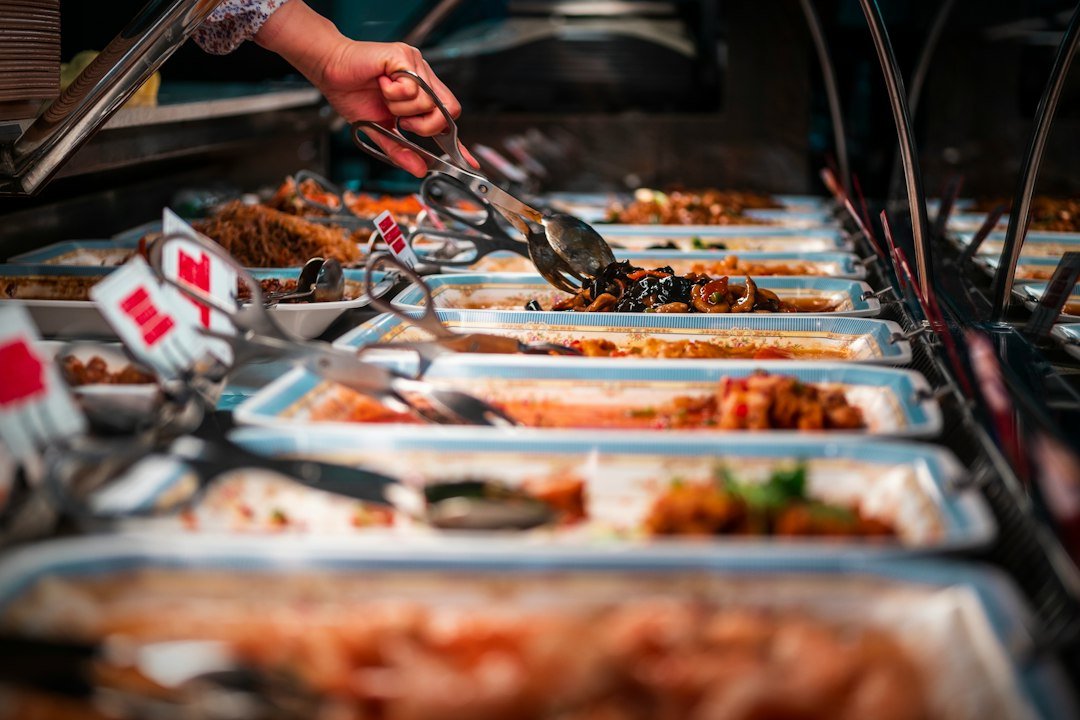
Featured photograph by Ulysse Pointcheval via Unsplash; see Unsplash license terms. The photograph is illustrative and does not depict this article’s hypothetical business examples.
Related guides and method
Combine these calculations with scaling recipes for consistency, edible yield tests, and catering production planning. Food-code reference: FDA Food Code 2026. All numerical values are original hypothetical examples; no recipe yield or wholesale price should be treated as an industry norm.