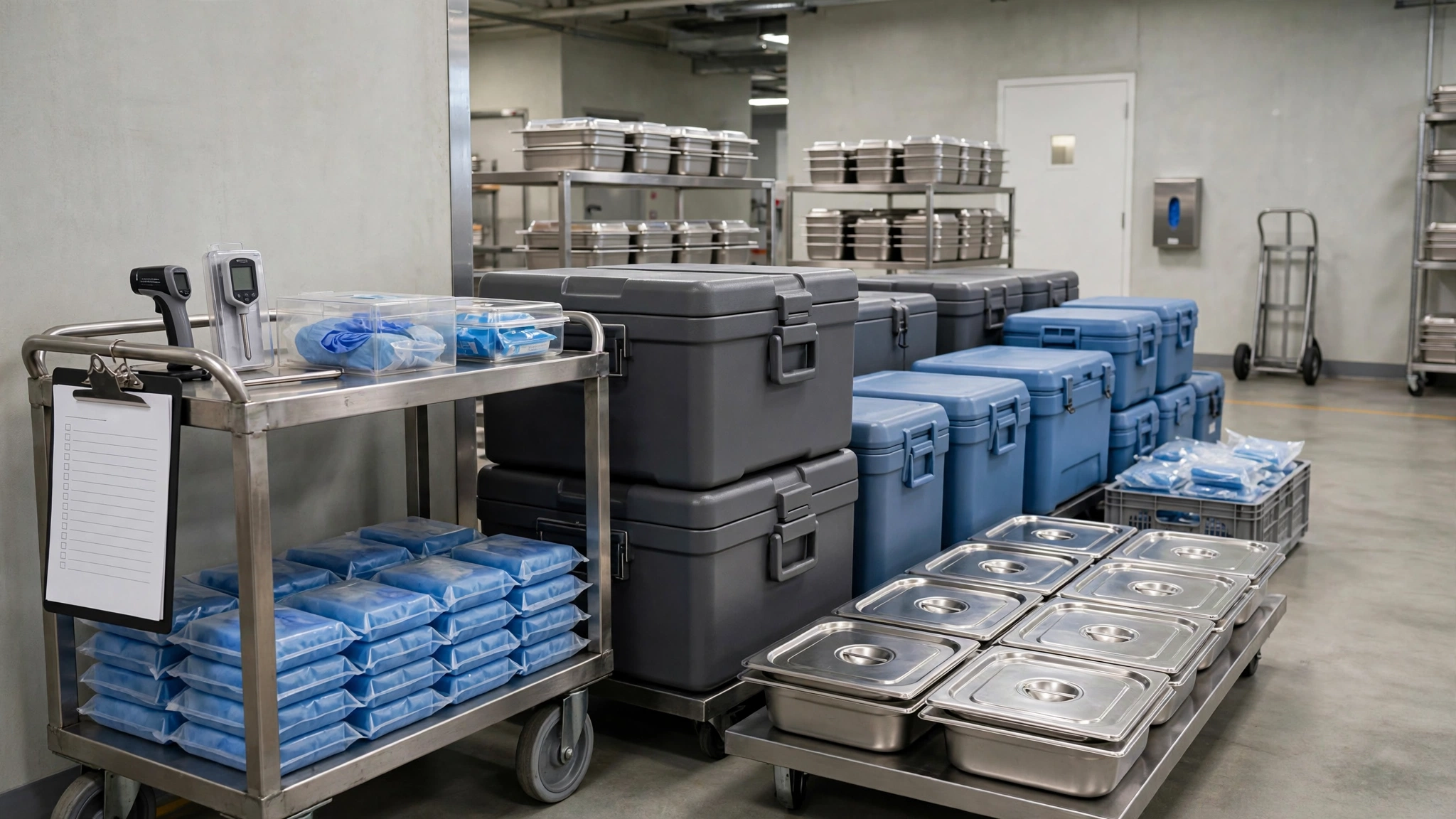
Transport begins in production planning
Food quality during transport is determined before the vehicle door closes. The menu, cook finish time, packaging, carrier capacity, route duration, arrival sequence and venue setup all interact. A dish that holds well for fifteen minutes may not hold well for seventy-five. Catering transport planning therefore starts by defining the quality and food-safety window each item can realistically tolerate. Tie that window to catering production planning so cook finish times match the route.
When the route exceeds that window, change the production or service method rather than hoping better packaging will solve everything.
Classify menu items by travel behavior
Group items by transport needs: hot and stable, hot but fragile, cold and stable, cold but condensation-sensitive, crisp/dry, sauce-dependent, assembled on site or finished on site. This classification informs container type, packing order and whether components should travel separately.
For example, fried items, dressed salads and delicate garnishes often need different handling from braises, baked pasta or sealed cold platters. The menu itself should influence logistics.
Choose containers around the product and route
Use food-safe containers and insulated carriers appropriate to the operation’s food-safety plan. Consider seal, venting, stackability, weight, leak risk, portion access and whether the food will continue to steam during travel. The most insulated container is not always the best quality choice if trapped steam destroys texture.
Standardize container sizes where possible so carrier capacity and vehicle loading can be planned rather than improvised.
Time control is a chain, not one timestamp
Track cook/pack completion, carrier loading, vehicle departure, arrival, setup completion and service start. These timestamps show how much of the product’s holding window is used in the kitchen, parking lot or venue rather than on the road itself.
If a route is thirty minutes but loading and setup add forty-five more, the food experiences a seventy-five-minute operational hold. Planning should use the full chain.
Protect hot and cold chains according to the approved plan
Follow the restaurant’s food-safety program and applicable local requirements for temperatures, time control, equipment and monitoring. Precondition hot or cold carriers when the procedure requires it, minimize uncontrolled loading time and verify required temperatures at defined points.
If control limits are not met, use the site’s corrective-action procedure. Do not rely on appearance or “it still feels warm/cold” as a release decision.
Loading sequence should match unloading and service
Secure heavy items, protect food from crushing or contamination and separate incompatible temperatures. Load the last-needed items first and the first-needed setup or food items where the event team can reach them. For multi-stop routes, separate each drop physically and label it clearly.
A simple vehicle map prevents the event team from unloading the entire van to find one box while food sits exposed.
Arrival is part of transport control
Define who receives the load, where carriers go, what equipment should already be ready and which products must be moved immediately into hot/cold holding. If the venue is not ready, the team needs a contingency plan rather than placing food on a table while staff search for power or chafers.
Confirm route access, parking, loading dock rules, elevator time and carry distance in advance for large events. The last 100 meters can consume more time than expected.
Quality checkpoints beyond temperature
Temperature is critical but not the only quality measure. Check sauce separation, crust softness, condensation, garnish condition, package integrity, plate/portion shift and whether food has compacted during travel. Record recurring quality failures and change the process upstream.
A product that is safe but consistently arrives in poor condition may need a different menu role, container or finishing method.
Example: crisp item moved to on-site finishing
A fried item leaves the kitchen in a sealed insulated carrier and repeatedly arrives soft. The transport temperature is controlled, but trapped steam destroys texture. The operator changes the event method: the base product travels under the approved safe procedure and the final crisping/assembly is completed on site with appropriate equipment and controls. Quality improves without pretending the original packaging was adequate.
The exact solution depends on equipment, food-safety procedure and venue capability.
Transport plan fields
- Event and route.
- Departure/arrival/service times.
- Product class and container/carrier.
- Required control point/temperature according to site procedure.
- Load position and unload priority.
- On-site holding or finishing method.
- Contingency for delay or venue not ready.
- Responsible driver/event lead.
Common failures
- Planning only road time and ignoring loading/setup.
- Packing every item the same way.
- Using sealed containers for products harmed by condensation.
- Arriving before venue holding equipment is ready.
- Mixing multiple event drops in one load.
- Failing to document repeated quality problems because food remained technically safe.
FAQ
Q: How long can catered food be transported? A: There is no universal quality or safety time; follow the approved food-safety procedure and design the menu around the real route and service window.
Q: Should hot and cold food share a vehicle? A: Only with appropriate separation and control that meets the operation’s procedure.
Q: What matters most: carrier or route? A: Both, plus loading and setup time; the entire chain determines outcome.
Q: When should food be finished on site? A: When the menu, venue and approved process support it and transport would otherwise damage quality.
Next action
Take one frequent catering route and build a complete time chain from final cook step to guest service. Mark where quality or control time is being consumed. Then classify the menu items that travel poorly and change the packaging, production timing or on-site finishing method for the highest-risk item first.
Plan delay scenarios before departure
Traffic, elevator delays, venue access problems and client timing changes are normal catering risks. Define what the event lead does when arrival or service is delayed: who is contacted, how food remains under control, which items can tolerate the delay and which need a different corrective action.
A contingency plan should follow the operation’s food-safety procedure; it is not permission to extend holding limits informally. The goal is to make escalation quick when time is being lost.
Measure transport performance by product
After several events, compare complaints or quality notes by item rather than by route alone. If one menu item consistently loses texture while others travel well, redesign that product’s packaging or service method instead of overhauling the whole transport system.
This item-level review helps the catering menu evolve toward foods that travel reliably and identifies products better suited to on-site finishing.
Additional operating detail
Vehicle choice should match the event profile. Cargo volume, tie-down points, cleanable surfaces, separation capability, refrigeration where required and ease of loading all matter. A larger vehicle is not automatically safer if food shifts during transport or carriers cannot be secured. Standardize how carriers and equipment are restrained according to the operator’s approved procedure.
Use post-event notes to improve route standards. Record actual departure, arrival, unload completion and service start along with any quality problem. After several events, the restaurant can identify routes or venue types that consistently consume more time than planned and adjust production or departure assumptions before the next booking.
Manager implementation notes
Transport equipment should be inspected like any other production asset. Check carrier closures, insulation condition, gaskets where fitted, racks, wheels, straps and cleanability before the event day. Damaged carriers may still look usable while losing heat/cold performance or creating handling risk. Put recurring transport equipment on a maintenance and replacement schedule rather than discovering failures during loading.
For operations with frequent catering, create standard route profiles. A profile can include typical travel time, parking/access allowance, unload duration, elevator or security delay and the realistic setup window for a venue. Use the profile as a starting assumption and adjust for the specific event. This makes production timing more accurate and reduces the tendency to treat every booking as if road travel were the only time between kitchen and guest.
Further operating guidance
Create a transport-capacity standard for each carrier and vehicle configuration. Record how many hot boxes, cold carriers and equipment cases fit safely without crushing, blocking access or mixing incompatible loads. Capacity planning prevents the event team from discovering at departure that the physical load does not match the plan. It also helps sales and production understand when a larger vehicle or second trip must be priced into the event.
For recurring catering menus, assign each item a travel rating based on quality stability and setup complexity. A stable item can tolerate the normal route with little intervention; a fragile item may need shorter travel, separate components or on-site finishing. This rating gives sales and event planners a practical way to steer menu design before the kitchen is committed to an unrealistic transport method.
Match transport method to the food’s failure mode
Transport packaging should be selected for what can actually go wrong with the product. Crisp foods may lose quality from trapped steam, cold products need protection from ambient heat, sauces require secure leak control and delicate items may need physical separation. A single container type rarely serves every menu item well even if it is convenient for loading. Test difficult products on a realistic route before promising them for a large event, and evaluate condition after travel, holding and setup—not merely at the kitchen door. A product that looks excellent when packed can still fail after the full delivery chain.
Arrival and unloading are part of transport control. Parking, security, elevators, long corridors and venue access can add meaningful time that route mileage does not show. Capture those conditions when planning and give the event team a realistic arrival-to-service window. On arrival, verify container count and obvious condition before the crew disperses into setup work; early detection gives the event lead options if something is missing or compromised. For frequent venues, maintain route profiles with normal travel, access and unload allowances. These profiles improve production timing and reduce the habit of treating every booking as if road travel were the only time between kitchen and guest.
Create product-specific transport standards from repeated events
After several catering jobs, group quality notes by menu item rather than only by route. If one item repeatedly loses crispness, separates, dries out or arrives damaged while other items remain acceptable, the problem may be product design or packaging rather than transport time. Test a different container, venting approach, packing density, holding sequence or on-site finishing method and compare the result on the next similar event. When a method works consistently, record it as the product’s transport standard so future teams do not reinvent the solution. Some items may ultimately be better restricted to short routes or finished at the venue. Making that decision early protects both quality and brand reputation. Transport control should help the catering menu evolve toward products that can survive the real journey, not force every kitchen item into the same delivery model.
Record the handoff condition at the venue
When responsibility transfers from driver to event lead, confirm container count, obvious condition and any time-sensitive instruction. This short handoff is especially useful when the driver does not stay for service. If a problem is discovered later, the record clarifies whether it existed at departure, appeared during transport or arose after unloading. That distinction helps the caterer fix the right part of the chain instead of arguing from memory.
Additional topic-specific operating notes
- transport method matched to hot, cold or ambient product needs
- transport time and event access constraints built into the dispatch control plan
- holding equipment and service setup confirmed before departure
- temperature and food-safety controls follow the site plan and local requirements
- load in an order that supports safe handling and efficient unloading
A hot entrée and delicate chilled dessert leave on the same vehicle. The transport plan keeps their handling separate, loads service equipment so it can be removed first, and avoids forcing the event crew to unpack the entire vehicle to find one critical item.
Useful next resource
Transport failure-mode matrix
The transport plan should be designed around what can fail between the kitchen and the event. Different products need different controls, so the manager should classify the risk before choosing the container and loading sequence.
| Failure mode | Example symptom | Planning response |
|---|---|---|
| Heat or cold loss | Product arrives outside the intended holding condition | Shorten exposure, verify carrier performance and follow the approved food-safety plan. |
| Steam damage | Crisp product arrives soft | Change venting, packing density or finish at the venue. |
| Leak or movement damage | Sauce spills or plated components shift | Use secure containers, separators and load restraints. |
| Access delay | Food sits while staff wait for parking, elevator or security | Add venue access time to the route profile and arrival target. |
| Wrong unload sequence | Critical setup item is buried behind later-use stock | Load by order of use as well as temperature zone. |
Route qualification for a new venue
- Estimate drive time plus parking, access and unload time.
- Identify the most travel-sensitive menu item.
- Confirm the planned carrier can protect that item for the full time chain.
- Define the arrival check and who receives the handoff.
- After the event, record actual travel, unload time and any quality change.
If the venue becomes recurring, save those timings and constraints as a route profile. This prevents the next event from repeating the same access surprise and helps sales, production and dispatch work from the same realistic assumptions.
Use the Restaurant Operator Lab tools and related guides only when they directly support the decision described above. Pair this with dispatch control and catering production planning, or open the free tools library.