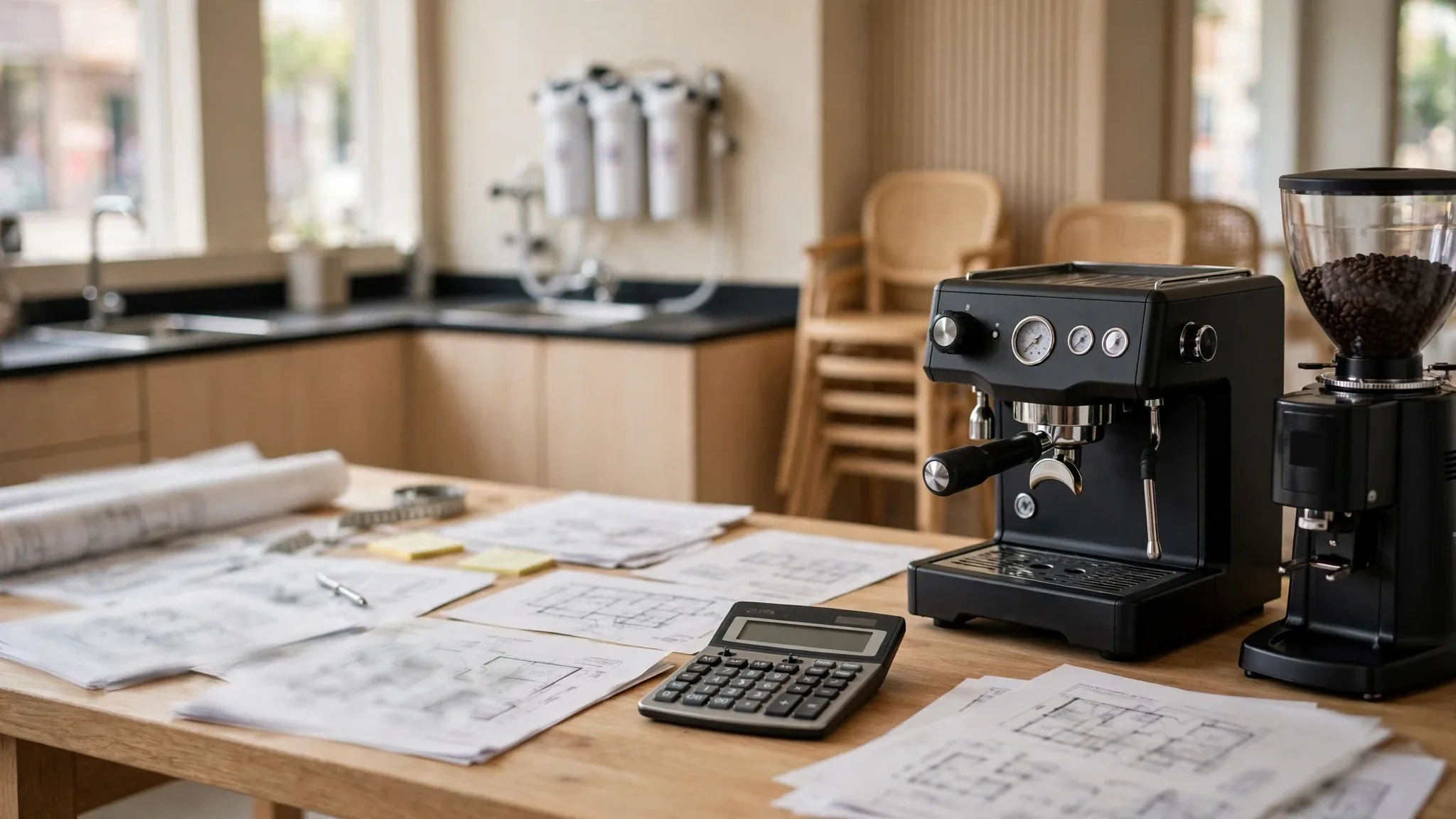
A coffee shop can start as a cart inside a market, a tiny grab-and-go counter or a neighborhood café with seats and a full pastry program. All three sell coffee, but they do not have the same opening budget. The cheapest espresso machine on a shopping list is rarely the biggest financial risk. For many first-time operators, that risk is paying for a beautiful fit-out while leaving too little cash to survive the first slow months. If your counter will focus on frozen desserts instead, the ice cream shop startup costs guide applies the same budgeting method to a scoop shop.
Quick answer: In the United States, startup costs depend primarily on format, location, condition of the premises, equipment and available operating cash. Square’s coffee-shop opening guide describes a broad $80,000–$300,000+ range for coffee shops, with smaller takeaway formats sometimes costing less. Toast’s 2026 coffee-shop guide also explains how a lean $50,000 cart or pop-up differs from a storefront. These are broad planning references, not a quote or a guaranteed minimum for your city.
Free opening budget worksheet: Enter your own local startup costs and cash reserve, calculate optional break-even orders, and download your estimate as a CSV. Sample amounts are illustrative.
Choose the format before calculating the cost
| Format | Main expense drivers | The operational trade-off |
|---|---|---|
| Coffee cart or pop-up | Portable equipment, approved operating location, water and power, storage, transport | Lower fixed occupancy expense; weather, event access and capacity constraints |
| Kiosk or counter within another business | Equipment, counter installation, shared-space agreement, utilities | Low seating cost; dependence on another operator and opening hours |
| Small grab-and-go storefront | Lease, plumbing, electrical work, equipment, sign, refrigeration | Greater control; lease and build-out commitments |
| Seated neighborhood café | Build-out, restrooms, HVAC, furniture, dishwashing, labor, food service | More revenue occasions; more occupancy and service complexity |
| Drive-through café | Site design, queue capacity, external works, ordering equipment | Potential throughput; site approvals and construction can dominate |
A café serving prepared hot food may require very different ventilation, refrigeration and grease-management work from a beverage-only counter. Make the menu decision before agreeing to a lease.
Build a line-item opening budget
Ask for written vendor quotes and separate one-time opening spending from monthly operating costs. If a quote already includes installation, do not list installation again. If the landlord reimburses improvements, show the gross bill, the expected reimbursement and the date cash actually arrives.
Premises and construction
Record security deposits, rent paid before opening, architect or engineer fees, counter design, electrical capacity, plumbing, water filtration, floor drains, bathrooms, signs, accessibility and inspections. Existing plumbing does not automatically mean it can handle commercial coffee equipment. Confirm use restrictions, permitted occupancy and whether the lease allows the actual food-and-beverage concept. A cheap lease with a costly utility upgrade may be the expensive option.
Coffee equipment and installation
Price the whole drink-production workflow: commercial espresso machine and grinders, batch brewer, water treatment, refrigerators, ice, milk storage, sinks, smallwares, cleaning equipment, POS, and equipment servicing. Ask each supplier whether the quote includes delivery, installation, water and electrical connections, warranty, training and preventive maintenance. Match capacity to the likely peak 15-minute rush rather than the largest machine you can finance.
Opening people, permits and inventory
Include payroll and training before the first paid order, menu testing, packaging, ingredients, license and inspection costs, initial insurance, photography, basic signage, and launch marketing. Local regulators—not a national article—determine the applicable permits and food-safety conditions. The FDA Food Code is a model adopted or adapted by jurisdictions; check your own city and state health department.
Contingency and working capital are not the same
A construction contingency addresses costs such as concealed wiring or equipment-installation surprises. Working capital is cash for rent, payroll, ingredients, loan payments and other obligations when early sales fail to cover them. Neither amount should silently disappear into the equipment budget.
Worked example: a hypothetical $233,000 small café
This example is illustrative, not a national average. Assume an independent café in an already suitable leased commercial space, without a drive-through or liquor service.
| Opening funding category | Illustrative amount |
|---|---|
| Lease deposits and pre-opening occupancy | $14,000 |
| Counter improvements, plumbing and electrical work | $75,000 |
| Coffee and refrigeration equipment, including installation | $42,000 |
| Furniture, signage and smallwares | $12,000 |
| Permits, legal setup, insurance and professional support | $6,000 |
| POS hardware and initial technology setup | $4,000 |
| Opening ingredients and packaging | $5,000 |
| Preopening staff training and testing | $9,000 |
| Launch marketing | $3,000 |
| Construction and purchasing contingency | $18,000 |
| Working-capital reserve | $45,000 |
| Total funding requirement | $233,000 |
A project with an unsuitable shell space could cost substantially more. A cart, borrowed equipment, or an existing licensed coffee counter might cost much less. Neither comparison proves that $233,000 is “typical.”
What does a coffee shop cost each month?
Build a 12-month forecast, not just an opening-day total. Your operating model should include occupancy costs (rent, CAM and utilities), wages and payroll taxes, coffee and food inputs, packaging, payment fees, software, insurance, maintenance, laundry, cleaning and marketing. Keep loan principal payments visible in a cash forecast even though principal is not a profit-and-loss expense. Distinguish cash spending from accounting expenses so you do not count equipment purchases twice.
Most importantly, distinguish variable costs from the costs you must pay even on a slow Tuesday. Some labor is a fixed scheduled baseline, while extra rush-hour labor can become variable or step-fixed.
Calculate break-even transactions, not imaginary customer counts
Suppose a café has $20,000 in monthly fixed operating expense and a 40% variable cost ratio (ingredients, transaction-linked packaging and fees, and other costs that genuinely rise with sales). Its contribution margin is 60%.
- Break-even sales = $20,000 / 0.60 = $33,333.33 per month.
- If average check is $9.00, approximate break-even checks = $33,333.33 / $9 = 3,704 checks per month, rounded up.
- At 26 operating days, that is about 143 checks per open day.
Checks and guests are not always the same. If one transaction includes drinks for two people, the number of guest visits may exceed the number of checks. Use Restaurant Operator Lab’s break-even calculator to model sales, checks and covers separately where relevant.
Now test demand. At 110 checks per day, $9.50 per check and 26 open days, sales would be $27,170. With 60% contribution, $16,302 remains before the $20,000 fixed expense: an operating loss of $3,698. At 180 checks per day on the same assumptions, sales become $44,460 and the model shows $6,676 before financing, taxes and any owner compensation not included in fixed expense. This illustrates sensitivity; it does not predict either result.
Five questions to answer before signing a lease
- How many real transactions can this location support? Count traffic and relevant purchase occasions across weekday mornings, afternoons and weekends. Pedestrians are not automatically customers.
- What is the actual spend per transaction? Build it from your proposed drinks, food attachment and realistic mix—not the price of your most expensive latte.
- How will peak demand be served? Estimate drinks per 15 minutes, handoff congestion and whether food preparation slows beverage throughput.
- When can you open? Add permit, equipment lead times, hiring and build-out delays to the cash model.
- Can you fund a slower sales ramp? Test scenarios below forecast instead of assuming opening-week sales remain permanent.
A practical three-scenario opening plan
Maintain a base case, a downside case and an upside case. Hold store hours, prices, traffic and staff assumptions separately so you know which lever changes the outcome. A base case may assume 150 checks a day and a $9.50 check; a downside case may use 100 checks and unexpected repairs; an upside case may involve 200 checks but require more paid labor. Calculate cash runway in all three. A business that is accounting-profitable can still run short of cash when loan principal, inventory purchases or unpaid build-out invoices come due.
Use the general restaurant startup cost framework for a broader funding checklist, the 13-week cash-flow forecast for the first operating months, and the daily sales report once the café opens.
Common coffee-shop budget mistakes
- Pricing equipment before confirming the water, power, drain and permitted menu requirements.
- Treating landlord improvement allowances as available cash before they are reimbursed.
- Ignoring preopening rent, payroll and inspections.
- Using total drink sales to estimate profit without accounting for milk, food waste, discounts, card fees and extra labor.
- Building a budget with no repair or replacement allowance for heavily used machines.
- Promising a drive-through service speed without testing traffic flow.
- Spending the last available dollar on construction and calling opening inventory “working capital.”
Coffee-shop opening checklist
- ☐ Concept, menu and production method defined.
- ☐ Lease use and permit requirements verified locally.
- ☐ Two or more written equipment and contractor quotes collected where practical.
- ☐ Installation, utility work and training explicitly included or separately costed.
- ☐ Total budget separates contingency from working capital.
- ☐ Baseline transaction count and average check modeled.
- ☐ Break-even and downside cash runway calculated.
- ☐ Owner labor and financing included in the correct places.
- ☐ Launch decision tied to evidence, not only enthusiasm.
Frequently asked questions
Can I open a coffee shop with $50,000?
A restricted cart, kiosk or pop-up may be feasible in some locations, depending on licensed-space access, equipment, permits and reserve cash. A full seated café needing substantial construction is a different undertaking. Get local quotes and operating forecasts before relying on a headline budget.
Is it cheaper to buy an existing café?
Sometimes the purchase includes usable approved infrastructure, but you must also price working-capital needs, deferred maintenance, equipment condition, lease assignment, inventory and customer concentration. Buying a business is not the same as buying its coffee machines.
What should I calculate after opening?
Daily checks, average check, drinks per labor hour, waste, beverage contribution and weekly cash balance. Later, compare these with the separate coffee-shop owner earnings article.
Bottom line
The right answer to “how much does it cost to open a coffee shop?” is a documented opening budget plus enough liquidity to survive a realistic sales ramp. Price the specific premises and menu first, then test the number of checks the business must sell every day. If the model only works when every chair is full, the plan needs revision before the lease is signed.
Research sources and scope
- Square: How to Start a Coffee Shop — broad U.S. startup cost context.
- Toast: How Much Does It Cost to Open a Coffee Shop in 2026? — formats and expense categories.
- FDA: 2026 Food Code — national model; actual rules are local.
Compare other food business models: Explore the startup costs and owner earnings guide library to compare the investment required and potential owner income across coffee shops, food trucks, catering businesses, bakeries, ghost kitchens and pizza shops.
Editorial note: All budgets, operating scenarios and transaction examples above are hypothetical; verify taxes, permits and financing with local professionals. Do not treat this article as a loan quote or a guaranteed business result.