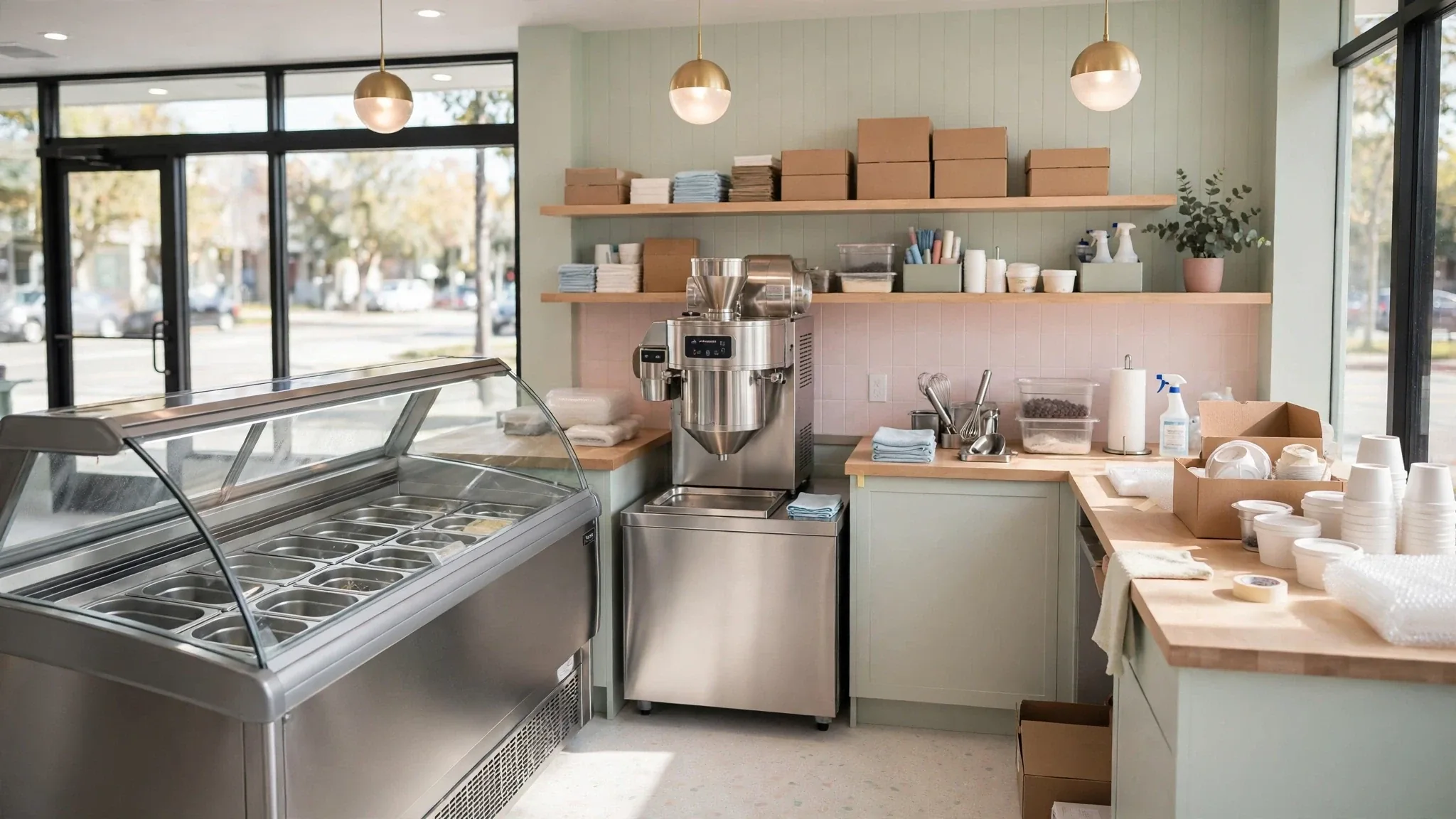
Opening an ice cream shop can look simpler than opening a restaurant. There may be no grill, dining room kitchen brigade or complicated cooked menu. But an ice cream shop is still a retail food business with a lease, refrigeration requirements, payroll, seasonal demand and a substantial amount of cash at risk before its first sale.
Quick answer: For a leased U.S. storefront, start with a project-specific budget rather than one supposed national price. A simple shop serving commercially manufactured ice cream can cost substantially less than a store making gelato or soft serve on site. A worked example below requires $148,000 in startup cash, including a $30,000 operating reserve. That is a hypothetical planning example—not a quote, average or prediction. Get actual bids for premises, equipment and permits before committing. Compare other business models in our startup costs and owner earnings guide.
Free opening budget worksheet: Enter your own local startup costs and cash reserve, calculate optional break-even orders, and download your estimate as a CSV. Sample amounts are illustrative.
Decide what kind of ice cream business you are opening
The single largest source of misleading online estimates is mixing different business models. A concession cart at a permitted event is not comparable to a built-out high-street shop. A shop scooping purchased tubs may need display cases, backup freezing capacity and sanitation infrastructure. A soft-serve operation adds machine purchasing, product-mix decisions and cleaning procedures. Making frozen dessert in-house can require production equipment, more extensive utilities, storage and potentially additional regulatory review.
Define the offer before looking for premises. Write down the core product, number of flavors, expected portion sizes, toppings, beverages, peak servings per hour and intended sales channels. If you buy equipment before settling that menu, you risk paying for machines that cannot support your true peak capacity or cost more to maintain than their incremental sales justify.
A kiosk may lower the build-out bill but also constrain storage and limit production. A storefront provides more control over branding, space and hours, yet adds rent commitments and the possibility of slow winter trade. Franchises may introduce fees, design specifications and contractual obligations; they should be budgeted separately.
A detailed sample startup budget
The following represents a hypothetical small independent scoop shop in an existing commercial retail unit. It assumes the owner purchases prepared ice cream from an approved supplier rather than manufacturing it on site. Amounts are estimates chosen solely to demonstrate the budgeting method.
| Startup item | Illustrative cash requirement |
|---|---|
| Lease deposits and upfront occupancy payments | $8,000 |
| Counter, electrical, plumbing and interior improvements | $42,000 |
| Freezing, dipping and refrigeration equipment | $28,000 |
| Furniture, signage and smallwares | $10,000 |
| POS and payment hardware | $2,500 |
| Permits, professional fees and initial insurance | $5,000 |
| Opening ingredients, packaging and supplies | $4,500 |
| Recruiting and pre-opening payroll | $5,000 |
| Launch marketing | $3,000 |
| Construction and installation contingency | $10,000 |
| Post-opening operating reserve | $30,000 |
| Total startup cash planned | $148,000 |
The $30,000 reserve is not a machine or pre-opening invoice. It is liquidity meant to support the store after launch when receipts may be below expectations. Do not count the same reserve again as a separate expense when presenting a cash-flow forecast. Likewise, a financed equipment purchase changes the timing of cash payments but does not make the equipment free.
Real costs can differ sharply. A second-generation retail space with compatible plumbing may save money, while a lease requiring electrical service upgrades, new drainage, accessible restroom modifications or major structural work may push costs far beyond this illustration.
The location decision is a financial decision
Traffic matters, but traffic alone does not justify rent. Visit prospective locations during summer and colder months if possible; count relevant walk-by customers, observe evening demand, note school and family activity, examine nearby dessert competitors and ask whether the shopping center stays lively after dinner.
Request a written schedule of base rent, common-area maintenance, insurance allocations, real-estate tax pass-throughs, annual increases and personal guarantees. A lease advertised at one monthly price can cost materially more after additional charges. Ask the landlord and local authority about permitted food use, plumbing, power capacity, signage and required approvals before signing an unconditional commitment.
Use a realistic sales forecast for each season. A store that appears profitable in July may have insufficient cash to cover fixed rent in January. A location with unusually high rent also reduces room for error when labor or ingredient costs rise.
Equipment: purchase for capacity and resilience
Common equipment can include a refrigerated dipping case, back-of-house freezers, a display refrigerator, handwashing and warewashing facilities, scales or measured scoops, topping storage, milkshake equipment, a POS terminal and an approved temperature-monitoring process.
Get quotes for installed cost, freight, warranty, maintenance, replacement parts, expected electrical load and any manufacturer service agreements. For used refrigeration, a low purchase price may be offset by breakdown risk or limited support. Before committing, have qualified installers verify that the location can safely run the equipment at the anticipated load.
Map peak throughput. If an order takes ninety seconds of hands-on staff time and most transactions arrive in a two-hour window, you need a staffing and counter design that handles queues without excessive delays. Do not infer capacity just by looking at freezer volume. Include the time to take payment, customize toppings, deliver the product and replenish supplies.
Food cost is more than the cost of the ice cream
Create portion-level recipes for each menu item: ice cream quantity, cone or cup, topping, sauce, spoon, napkin and waste allowance. Cost purchased tubs by usable servings, not merely by case count. A vendor changing tub size can quietly raise the cost per scoop even if the invoice price is unchanged.
For example, suppose a two-scoop order sells for $9.00 and its product plus disposables cost $2.70. The preliminary contribution is $6.30 per order before payment processing, variable labor, promotion expenses and other operating costs. The $6.30 is not net profit. Include sampling, spoiled product, overfilled portions, discounts and complimentary remakes in a separate variance review.
Related reading: Restaurant portion control and recipe costing.
Calculate break-even orders, not just a revenue goal
A useful operating model separates the costs that remain even with no customers from the costs incurred when another order is sold. For illustration, suppose the store has $17,000 per month in fixed expenses and retains $5.85 contribution per sale after all modeled variable costs.
Monthly break-even orders = $17,000 ÷ $5.85 = approximately 2,906 orders. If the store operates 25 days per month, that is about 117 orders per open day. Those are hypothetical inputs, not typical ice cream-shop performance. If the owner must also earn a salary, add that required cost to the plan before calculating a viable break-even threshold. Once the shop is trading, the ice cream shop owner earnings guide separates seasonal sales, SDE and realistic owner pay.
A small change in contribution is meaningful. If contribution falls to $5.25, break-even increases to approximately 3,239 orders per month. Rising ingredient cost, excessive coupons or higher processing expenses can therefore change the required customer volume even when rent is unchanged.
Use the restaurant break-even calculator for your own assumptions. Keep the time period consistent: monthly fixed costs must be compared with monthly order contribution. For another cold-menu counter, the juice bar startup costs guide applies the same break-even method to fresh juice and smoothies.
Build a seasonal forecast, not a flat twelve-month projection
Estimate monthly trading days, transactions per day and average ticket separately. An ice cream store may have pronounced warm-weather peaks, but tourism, indoor malls and school calendars can alter the pattern. Your forecast should be local. Never lift a seasonal sales curve from another state and assume it applies to your address.
Create three versions: conservative, base and strong. Each should include a monthly minimum cash balance after payroll, occupancy, inventory purchases, tax obligations and debt payments. The conservative case should test a delayed opening, weaker off-season sales and a meaningful freezer repair. A reserve sized only for opening week does not protect against these events.
One reasonable safeguard is to model opening month at less than the mature run rate. Your first weeks may require customer education and staff training while still carrying full occupancy cost. The point of a reserve is to avoid depending on perfect performance from the first day.
How licenses and food-safety controls affect the cost
Permits depend on the state, county, municipality, premises and product process. Confirm business registration, food establishment permits, occupancy and fire approvals, sales tax treatment, staff training and any special rules for making dairy or frozen desserts. A shop serving prepared commercial ice cream may face different requirements from one processing dairy ingredients on site. Get the correct answer from local authorities before buying production machinery.
Build a plan for reliable temperature control, cleaning, allergen communication, equipment failure and product disposition. The financial model should include approved cleaning supplies, testing or monitoring, replacement utensils and planned maintenance. An unexpected freezer outage can create both lost inventory and lost sales.
Opening checklist: verify the expensive assumptions
Before authorizing construction, confirm the lease permits the intended operation, utility capacity supports the exact equipment, vendors can deliver and service machinery, your menu costs are current and local approvals are understood. Match the final equipment layout to the order and pickup journey. Obtain written timelines, not verbal assurances.
Before opening, train employees on portion standards, allergen questions, sanitation, cash control and escalation of equipment alarms. Test several simulated peak hours and examine whether product, staffing and payment flow align. A soft opening is an operational trial, not a reason to hide missing permits or safety controls.
After opening, review four measures weekly: orders by daypart, realized average ticket, direct product-and-packaging cost per order and actual cash balance. Compare those with the sales forecast you used to sign the lease.
Frequently asked questions
Can I open an ice cream shop for much less than a full storefront budget?
Sometimes. A permitted cart, kiosk or small existing counter can require less fit-out and equipment. Those formats may also limit operating hours, storage, menu and revenue capacity. Compare complete startup cash and recurring obligations rather than purchase price alone.
Is soft serve cheaper than scooped ice cream?
There is no universal answer. Soft serve changes machine capital, cleaning routines, product mix, yield and maintenance. Scooped ice cream requires appropriate frozen storage, dipping equipment and inventory management. Price the specific menu and expected volume for each option.
Does a profitable summer guarantee annual profitability?
No. Seasonal demand can leave a profitable high-season operating statement alongside negative winter cash flow. An annual plan must carry rent, debt service and maintenance through weak months.
What should be done before signing a lease?
Confirm food-use approval, utilities, construction budget, occupancy charges, landlord obligations, exit conditions, contingency funds and a realistic break-even sales test. Consult qualified local professionals on legal and permit issues.
Sources and planning notes
- U.S. Small Business Administration: break-even point — fixed versus variable cost methodology.
- KaTom: ice cream shop planning and equipment categories — equipment and cost drivers, not a local quotation.
- Restaurant Association: opening an ice cream shop — broad 2026 U.S. published estimates, not validated national averages.
Editorial methodology: Every figure in the example budget and break-even calculation is illustrative and should be replaced by location-specific estimates. Figures should not be interpreted as national averages, guaranteed opening budgets or financial advice.