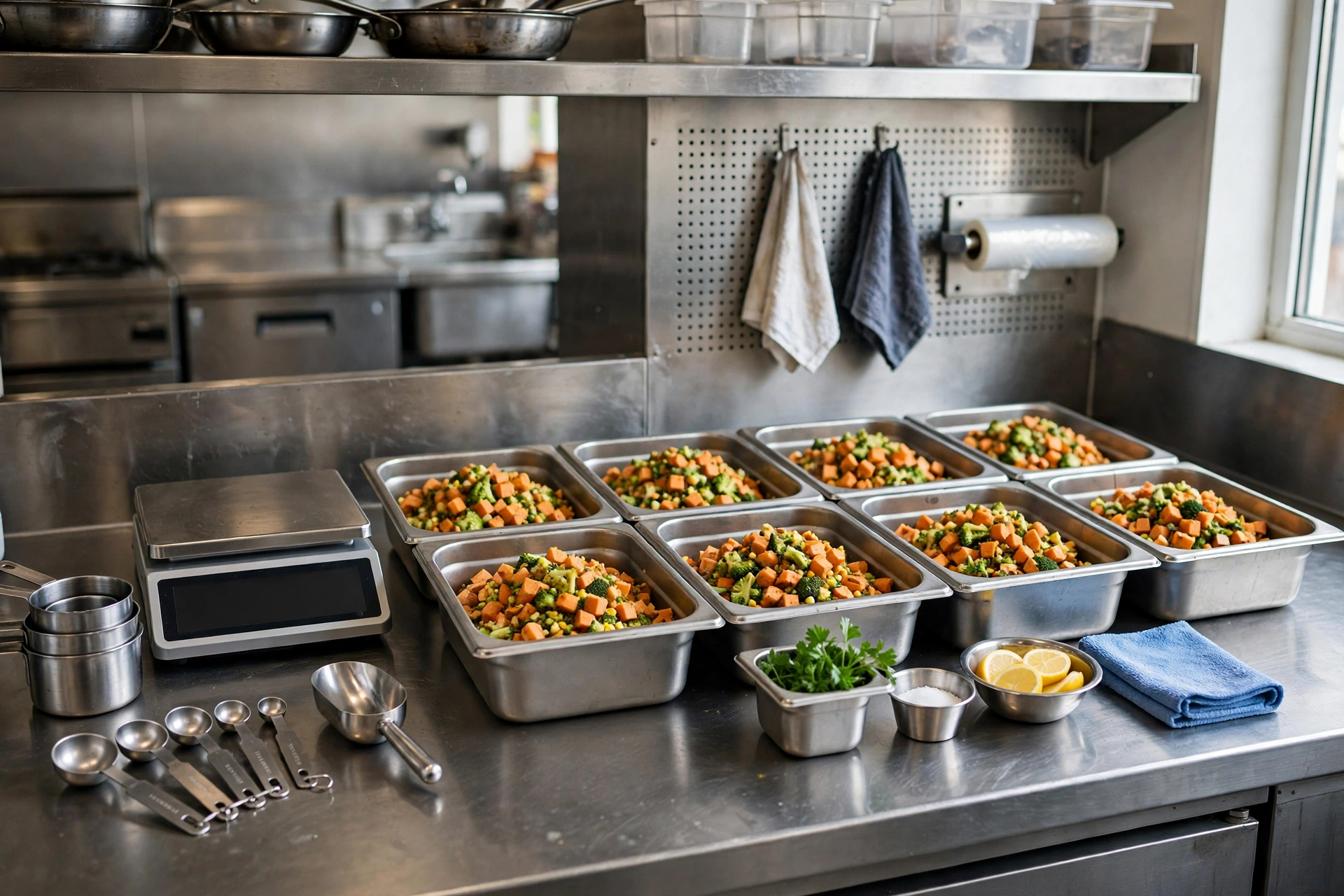
Portion control is often misunderstood as a cost-cutting exercise. In a well-run restaurant, it is really a consistency system. The goal is not to make plates smaller. The goal is to make sure the guest receives the portion the recipe, menu price and brand promise were built around—every time, on every shift, from every cook.
Quick answer: restaurant portion control means defining one approved serving quantity for each menu component, using a repeatable measuring method, and checking actual portions against that standard. The fastest control sequence is standard recipe → measured portion → spot check → inventory variance review.
When portions drift, several problems appear at once. Food cost rises, prep quantities become unreliable, stock runs out earlier than expected, plate presentation changes, nutritional or allergen information may become less dependable, and guests can receive noticeably different value from one visit to the next. Portion control therefore belongs at the intersection of recipe management, kitchen training, inventory control and guest experience.
What restaurant portion control actually means
A portion standard defines exactly how much of each component belongs in one sellable menu item. That standard may be expressed by weight, volume, count, slice, piece, scoop, ladle, bottle, packet or another repeatable measure. A burger may specify a 170 g cooked patty, 30 g sauce, two tomato slices and 110 g fries. A pasta dish may specify 240 g cooked pasta, 180 ml sauce, 90 g protein and 12 g garnish.
The standard should come from the approved recipe—not from habit, memory or what looks right during a busy service. If your recipes are not yet standardized, start with the restaurant recipe standardization process before trying to police portions at the pass.
Why portion drift becomes a food-cost problem
Suppose a chicken entrée is costed with a 180 g usable portion of chicken at a usable cost of $9.00 per kg. The planned protein cost is $1.62 per plate. If the kitchen regularly serves 205 g instead, the protein cost becomes about $1.85. The difference is only $0.23 per plate, but across 120 orders per day it becomes $27.60 per day, or roughly $828 over a 30-day month. That is before considering extra sauce, garnish or side portions.
This is why a small physical variance can produce a large financial variance. The approved recipe cost should therefore connect directly to your true dish-cost calculation and your actual-versus-theoretical food-cost review.
Choose the right control method for each ingredient
Not every ingredient should be controlled in the same way. High-cost proteins usually justify weighing. Soups, sauces and dressings are often better controlled with calibrated ladles or pumps. Fries, rice and vegetables may use weighed prep packs, scoops or marked containers. Cheese can be pre-portioned by weight. Sliced products may be controlled by slice count only if slice thickness is itself standardized. Bottled or packaged items are naturally controlled by count.
The best method is the one that is accurate enough for the ingredient’s financial risk but fast enough to survive a busy service. Requiring a scale for every pinch of garnish can slow the line without producing meaningful savings. Allowing staff to free-pour a high-cost sauce or free-hand an expensive protein creates the opposite problem. Control intensity should follow cost, variability and operational importance.
Separate purchased weight, edible weight and served weight
A common mistake is to set a portion from the supplier pack weight even though trimming or cooking changes what is actually available to serve. If 10 kg of raw product produces only 8.2 kg of usable cooked product, a 200 g served portion is based on the 8.2 kg—not the original 10 kg. Otherwise the recipe may appear cheaper than it really is and purchasing requirements will be understated.
Use a proper yield test when trimming, cooking loss, draining, thawing or other production steps materially change usable quantity. Portion control starts with the quantity that actually reaches the plate.
Build portion standards into prep, not only service
The easiest portion to control is often the one prepared correctly before service. High-risk items such as proteins, premium seafood, grated cheese, specialty toppings and expensive sauces can be pre-portioned during prep. This reduces decision-making on the line and makes the expected yield from a batch much easier to predict.
For example, if a cooked batch yields 9.6 kg and the standard portion is 160 g, the theoretical output is 60 portions. If only 54 saleable portions reach service, the six-portion gap should trigger a review of trim, spillage, staff meals, overportioning or unrecorded waste. This turns portion control into an operational measurement rather than a vague instruction to “use less.”
Create a plate-build standard
A written recipe is necessary, but line staff also need a fast visual reference. Each important menu item should have a plate-build standard showing the finished portion, placement of components, number of pieces, sauce location, garnish and appropriate service ware. A current photo can help, provided the photo represents the approved portion rather than a marketing-only presentation that the kitchen cannot reproduce.
Keep the standard at the workstation where it is used. A binder in the manager’s office is not an effective control during a rush. The line should be able to confirm the standard in seconds.
Control sides, sauces and toppings—not just the main protein
Many operators watch the steak or chicken closely while allowing sides, cheese, sauces, dressings and toppings to drift. Those smaller ingredients can quietly create a large combined variance. A dish may contain ten individually inexpensive components; if five are consistently over-portioned, the total cost leakage can be significant.
Side portions also affect perceived value. If one guest receives 90 g of fries and another receives 160 g, both cost control and consistency are failing. Standardize the complete plate, not only the most expensive component.
Takeout and delivery require their own checks
Packaging can change how a portion looks and performs. The same quantity of food may appear smaller in a wide container, sauces may need separate packaging, and items that lose texture in transit may require a different assembly method. The financial portion should still be controlled, but the packaging specification should be tested independently so the guest receives the intended value after travel.
Do not solve a packaging problem by casually increasing food quantity. First test container size, compartment layout, sauce separation and presentation. If the approved delivery portion genuinely needs to differ from dine-in, create a separate documented specification and cost it separately.
Account for modifiers and add-ons
Portion systems break when menu modifiers are not included. Extra cheese, double protein, sauce on the side, substitutions and premium toppings should each have defined quantities and, where appropriate, corresponding prices in the point-of-sale system. Otherwise the base recipe may be controlled perfectly while modifier usage creates unexplained cost variance.
A useful review compares modifier sales to ingredient usage. If 80 paid extra-cheese modifiers should consume 4 kg of cheese but the ingredient draw is materially higher, investigate preparation loss, unrecorded extras, staff meals or portion inconsistency.
Train with measurement before expecting judgment
New cooks should first learn the correct portion with a scale, measured scoop, ladle or count. Only after repeated correct execution should speed become the priority. “Eyeballing” is not a training method unless the employee has already calibrated their judgment against the real standard.
A simple training exercise is to ask a cook to portion the same item five times without looking at the scale, then weigh each portion. The spread between the smallest and largest result shows whether the station is stable. Repeating the exercise after coaching is more useful than simply telling staff they are over-portioning.
Use spot checks without turning the kitchen into a policing exercise
Managers should periodically weigh or count selected portions during prep and service, especially for high-cost or historically unstable items. The purpose is process correction, not catching people. If several employees make the same error, the standard, tool, station layout or training may be the real problem.
Record repeated findings by item and station. A pattern is more valuable than a single bad portion. Three weeks of consistent overportioning on one menu item deserves a process change; one isolated 5 g difference may not.
Measure portion variance in money, not only grams
Managers should translate physical variance into financial impact. If a premium ingredient costs $18 per kg and the average portion is 12 g above standard, the extra cost is about $0.216 per serving. At 900 servings per month, that is roughly $194 of monthly variance from one ingredient on one item.
This approach helps prioritize action. A 15 g variance in an inexpensive vegetable may matter less than a 5 g variance in a high-cost protein, cheese or specialty garnish. Focus management attention where the financial impact is greatest.
Connect portion control to waste records
Overportioning and waste are different problems, but they can hide each other. If cooks intentionally make portions larger because a batch would otherwise be discarded, food cost still rises even though the waste bin looks better. Conversely, a portion standard that is too large may create plate waste from guests.
Use a restaurant waste log alongside portion checks. If plate waste repeatedly affects the same side or garnish, investigate whether the standard itself should change. A good system protects both cost and guest satisfaction.
Do not reduce portions blindly when costs rise
Shrinking a portion may reduce food cost but can damage value perception and repeat business. When ingredient prices rise, first review supplier price, yield, menu mix, recipe design, waste, purchasing and selling price. If a portion change is justified, test the guest experience and update the recipe, cost, plate photo, prep quantities and menu description together.
For some dishes, a smaller portion with a better side composition may preserve value. For others, the correct decision is a price change. Use the menu-item contribution margin rather than food-cost percentage alone when deciding what to change.
Set tolerance bands for practical operations
No physical portioning process is perfectly exact. A reasonable tolerance band prevents managers from treating normal variation as failure. The acceptable range should depend on the ingredient, tool and risk. A pre-cut packaged item may require virtually no variation. A hand-cut garnish may allow more. A high-cost protein should have a tighter band than a low-cost side.
Document the acceptable range so managers evaluate consistently. If the standard is 180 g and the approved operating band is 176–184 g, everyone knows what “correct” means. The band should be operationally achievable and financially acceptable.
Audit tools as well as people
Scales need batteries and calibration. Ladles get swapped. Scoops disappear. Pumps may dispense different volumes after replacement. Slicers can be reset. Containers can change size. If a station’s portion suddenly drifts, check the tool before assuming employee behavior is the cause.
A monthly tool check can be simple: verify scales against a known weight, confirm ladle and scoop sizes, test pump output, review slicer settings and replace damaged measuring tools. This is a small maintenance task with direct cost-control value.
Create a weekly portion-control review
A practical weekly review should answer a few questions: Which high-cost items showed unusual usage? Which portions failed spot checks? Did any recipe, supplier pack size or yield change? Were there new modifiers or promotions? Did the waste log show recurring plate waste? Did actual food cost move away from theoretical cost?
The manager does not need to weigh every item every week. Use exception-based control. Start with high-cost, high-volume and historically unstable items, then rotate through the rest of the menu. This keeps the system useful without turning it into paperwork.
A simple implementation sequence
First, verify that the recipe and yield are current. Second, define the exact serving quantity for every important component. Third, choose the correct scale, scoop, ladle, pump, count or prep-pack method. Fourth, update the workstation reference and plate photo. Fifth, train the team by measurement. Sixth, run spot checks during real service. Seventh, compare theoretical usage with actual inventory movement. Finally, correct the process when repeated variance appears.
The goal is repeatable value
Strong portion control should be almost invisible to the guest. They should simply receive the same satisfying plate each time. Behind the scenes, the restaurant gains more accurate recipe costs, more reliable prep planning, cleaner inventory variance, fewer stock-outs and a clearer explanation of where food cost is moving.
Measure portion audit performance
For high-risk items, a simple audit rate can show whether the station is holding the standard:
Portion pass rate = Portions within approved tolerance ÷ Portions checked × 100
Do not turn the percentage into a punishment score. Use it to find unstable items, tools or stations that need retraining or process correction.
Frequently asked questions
How many portions should a manager spot-check?
Use a small representative sample often enough to reveal drift. High-cost, high-volume or historically unstable items deserve more frequent checks than low-risk items.
How often should portion tools be calibrated?
Check them on a defined routine and any time output changes unexpectedly, equipment is replaced or a variance appears.
Should portion standards change when supplier pack size changes?
The serving standard should change only when the approved recipe or guest proposition changes. Supplier pack changes may require new conversions, prep methods or yield calculations, not automatic portion changes.
Check the cost impact of the standard
Cost one approved portion, then compare the period-level food-cost result after the portion standard is operating consistently.
Recipe & Plate Cost Calculator → Food Cost Percentage Calculator →
The standard is not “serve less.” The standard is “serve exactly what we designed, priced and promised.” When portion control is built into recipes, prep, tools, training and weekly review, it becomes a quality-control system first and a cost-control system at the same time.