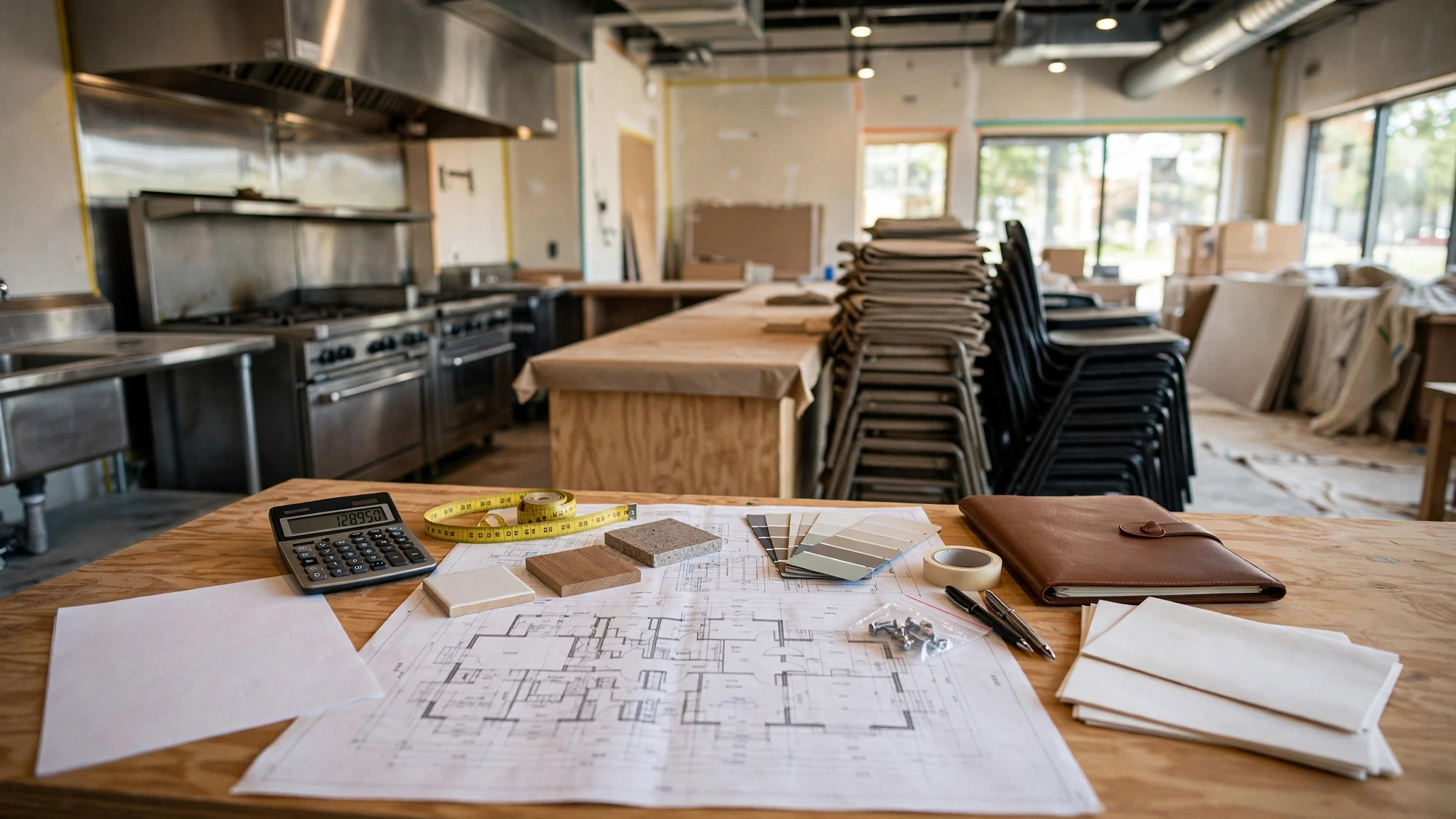
Free opening budget worksheet: Enter your own local startup costs and cash reserve, calculate optional break-even orders, and download your estimate as a CSV. Sample amounts are illustrative.
How much does it cost to open a restaurant?
The answer is not one reliable national dollar figure. A small takeout counter, a second-generation restaurant with an existing compliant kitchen and a full-service restaurant built from an empty storefront have dramatically different opening costs. Location, lease terms, local approvals, hood and ventilation work, utility capacity, equipment condition and available cash all change the answer. Planning a fry-and-glaze counter? The donut shop startup costs guide budgets fryers, ventilation, overnight production and an operating reserve.
Quick answer: The startup cost is cash required before opening plus the cash needed to survive the ramp-up afterward. Build a line-item estimate for the lease, design and construction, equipment, permits, technology, opening inventory, hiring and training, marketing, contingencies and operating cash runway. Obtain local bids before treating the total as a funding request.
This guide shows a U.S. restaurant owner how to structure that estimate. The example figures are hypothetical planning inputs, not verified market averages or quotes. Planning a café, kiosk or coffee cart instead? The coffee shop startup costs guide applies the same approach to a beverage-led format, and the catering business startup costs guide does the same for an off-site event kitchen. For a kitchen on wheels, see the food truck startup costs guide. Going delivery-only? The ghost kitchen startup costs guide budgets shared versus private kitchen space, delivery commissions and launch runway. Opening a bakery? The bakery startup costs guide covers ovens, production flow and working capital for that format. Opening a pizzeria? The pizza shop startup costs guide prices oven packages, build-out and break-even checks for a carryout or slice shop. Planning a scoop shop? The ice cream shop startup costs guide budgets dipping cabinets, refrigeration, seasonal demand and an operating reserve. Opening a fresh-juice counter? The juice bar startup costs guide prices juicers, blenders, produce waste and juice-safety controls. Planning a pickup-first kitchen instead? The takeout restaurant startup costs guide covers hood work, pickup layout and delivery commissions. Opening a lunch-driven deli counter? The sandwich shop startup costs guide budgets slicers, refrigerated prep, reserve cash and break-even checks. Launching weekly ready-to-eat meals instead? The meal prep business startup costs guide prices a shared-kitchen launch, packaging, delivery and subscriber break-even.
Separate three different money problems
A restaurant can have enough money to finish construction yet not enough money to pay suppliers during its first month. To avoid this, keep three budgets distinct.
1. Pre-opening investment. Cash required to secure and prepare the space, acquire assets, secure approvals, build systems and train employees before the first sale.
2. Post-opening operating runway. Money reserved for losses or cash shortfalls while sales ramp up. The restaurant might be above its operating break-even point and still have near-term cash shortages because card settlements, inventory purchases, deposits and loan repayments fall on different dates.
3. Contingency. A separate allowance for construction surprises, utility upgrades, permit delays, equipment issues or other risks not fully covered by the base quotes.
These categories can overlap if managed carelessly. Do not add the same rent deposit to both build-out and runway, or count the same contingency twice.
A complete restaurant startup cost checklist
Use the categories below to request actual quotes and deadlines. A line without an owner, cost basis or payment date is not yet a reliable budget item. For a concept-specific example, the small deli startup budget applies these categories to a counter-service deli.
| Cost group | Typical items to investigate | Why it matters |
|---|---|---|
| Lease and occupancy | Security deposits, prepaid rent, legal review, CAM, utilities | Signing the lease starts cash outflows before sales |
| Design and permits | Architect, engineering, plan review, local business and food permits | Changes to plans can reset approvals |
| Build-out | Plumbing, electrical, grease interceptor, HVAC, accessibility, restrooms, finishes | Site conditions can overturn a low estimate |
| Kitchen equipment | Hood, fire suppression, refrigeration, line equipment, dishwashing | Used equipment may need inspection, warranty or repairs |
| Furniture and smallwares | Seating, shelving, utensils, cookware, trays | Easy to underestimate until service rehearsals |
| POS and technology | POS terminals, networking, printers, KDS, security and subscriptions | Hardware and recurring contracts may have different due dates |
| Opening supplies | Food, beverage, packaging, cleaning materials | Opening inventory is a cash outflow, not the same as consumed food cost |
| Pre-opening labor | Recruiting, onboarding, training, trial service | Payroll begins before opening revenue |
| Launch marketing | Signage, photography, website, local campaign | Must be funded without relying on immediate results |
| Financing and insurance | Application fees, insurance deposits, interest during construction | Terms vary by lender and policy |
| Contingency and runway | Overrun reserve and first-month operating cash | Protects the opening plan from a single setback |
The U.S. Small Business Administration advises estimating startup costs together with market research and planning, rather than relying on an attractive headline cost figure. Use its business planning resources as a cross-check, then verify industry-specific rules with your local licensing agencies and qualified advisers.
Worked example: a hypothetical independent restaurant
The following is one illustrative scenario, not a recommended budget or current national average. Imagine an independent operator evaluating a leased space that needs substantial kitchen improvements.
| Pre-opening cash category | Illustrative cost |
|---|---|
| Lease deposits and prepaid occupancy | $18,000 |
| Design and build-out | $140,000 |
| Kitchen equipment and installation | $90,000 |
| Furniture and smallwares | $24,000 |
| POS, network and technology setup | $9,000 |
| Permits, fees and professional services | $14,000 |
| Initial food, packaging and cleaning stock | $12,000 |
| Recruiting and pre-opening payroll | $24,000 |
| Opening marketing and signage | $8,000 |
| Pre-opening contingency | $34,000 |
| Estimated pre-opening requirement | $373,000 |
Now assume management reserves $100,000 separately as a cash runway for the initial ramp-up, debt-related obligations and unexpected cash timing. In this scenario:
Total illustrative cash requirement = $373,000 + $100,000 = $473,000.
That does not mean restaurants normally cost $473,000 to open. It means this particular set of assumed scope, bids, timing and cash reserves would require that much funding. A different space could be radically cheaper or more expensive. Replace every line with a documented local estimate and revisit the runway when actual lease, lender and payroll terms are available.
Model the cost by payment date
A $90,000 equipment purchase is not necessarily due on the same day as the lease security deposit. Some vendors require deposits, production-stage payments and final delivery balances. Contractors may request progress draws. Payroll can begin weeks before opening.
Set up a simple cash calendar with columns for week, vendor, obligation, amount, payment trigger and funding source. Mark dependencies: equipment orders depend on electrical specifications; permit approval may depend on final ventilation drawings; opening marketing dates depend on construction certainty. The cash calendar is often more valuable than a single grand total because it shows which month your funding will run out.
Build that timing into the 13-week cash-flow forecast rather than assuming all cash leaves when sales begin.
Estimate operating break-even before signing the lease
A restaurant opening budget should be linked to an operating model. Suppose that after opening your restaurant expects $78,000 in monthly fixed and committed operating costs and that variable costs consume 38% of net sales. For this simplified model:
Contribution margin ratio = 1 − 0.38 = 62%.
Break-even monthly net sales = $78,000 ÷ 0.62 ≈ $125,806.
At a $25 average transaction, the restaurant would need approximately 5,033 checks per month. If an average check represents two covers, that is approximately 10,065 covers. Do not confuse checks with guests; use the break-even calculator with its optional guests-per-check input to model both.
This is a simplified operating break-even calculation. Taxes, debt principal, capital replacements and cash timing may require additional cash even when the model reports an operating surplus.
A hypothetical first four months
Assume the 62% contribution ratio and $78,000 fixed costs hold throughout the ramp-up:
| Month | Net sales | Approx. contribution | Operating result before separate financing/tax items |
|---|---|---|---|
| 1 | $85,000 | $52,700 | −$25,300 |
| 2 | $105,000 | $65,100 | −$12,900 |
| 3 | $120,000 | $74,400 | −$3,600 |
| 4 | $135,000 | $83,700 | +$5,700 |
The cumulative modeled shortfall over the first three months is $41,800. The separate $100,000 illustrative runway may also need to cover debt principal, inventory timing, settlement delays and other cash needs. It is not justified solely by the modeled operating losses. Test a slower opening and a later break-even date before deciding the reserve is adequate.
Test three scenarios, not one hopeful forecast
A realistic financing discussion includes:
- Base case: expected build-out, opening date, covers and average check supported by evidence.
- Downside case: construction overrun, opening delay and slower customer acquisition.
- Severe case: a critical permit or utility issue delays opening and requires more funding.
For the example budget, a 10% overrun on the $140,000 build-out adds $14,000. If the same project also incurs a separate $22,000 in additional delay-related cash costs, the extra cash call would be $36,000, before offsets or insurance. Those numbers are scenario assumptions, not risk probabilities.
A contingency is useful only if the business has access to it. A promised credit line that has not been approved and documented should not appear as available cash.
Why the lease can make or break the budget
Rent is rarely the entire occupancy cost. Investigate CAM charges, real estate taxes passed through the lease, insurance pass-throughs, annual escalations, maintenance allocation, personal guarantees and permitted uses. Confirm which improvements the landlord pays for and whether tenant improvement allowances reimburse you after work has already been paid for.
Read restaurant occupancy cost alongside restaurant location selection. A seemingly inexpensive restaurant space can become expensive after ventilation, grease-control and electrical infrastructure are priced.
Do not sign a long lease solely because a spreadsheet shows an attractive monthly rent-to-sales percentage. That sales figure must be supported by realistic local demand and capacity.
Equipment: buy for the menu and workflow
Equipment should follow a tested menu, production plan and target volume. If the menu needs two hot stations and limited refrigeration, designing a large kitchen around attractive used equipment can waste space and capital. Confirm utility connections, hood compatibility, fire suppression, food safety requirements, access for service technicians and preventive maintenance. For a grill-focused quick-service concept, the taco shop startup costs guide shows how equipment, ventilation and an opening reserve add up to a $196,000 sample budget.
Separate purchase price, installation, warranty/service, spares and ongoing energy/maintenance cost. A low purchase price can conceal long downtime or poor efficiency. For later replacement decisions, see equipment replacement planning.
Staff planning before opening
Recruiting is not the same as opening payroll. Budget for management hired early, training shifts, cleaning, stock receiving, POS setup, recipe tests and soft-opening service. Train the team on actual workflows before guests arrive, not just on job descriptions.
An opening payroll sheet should show role, headcount, planned training hours, pay rate, employer burden estimate, start date and approval owner. Avoid counting all new employees at the same number of training hours. Use the restaurant staff training checklist as a starting point for readiness.
Include licensing and professional advice—but avoid false precision
Restaurant permits and requirements vary by state, city, county, operating concept and type of food or alcohol service. Local health, building, fire, zoning and licensing authorities can have separate approval processes. The correct budget is a checklist of your location’s actual requirements, with quotes and timelines attached.
Do not assume the same permit list, cost or timeline applies in Miami, Denver and Chicago. Obtain a local code/permit review and qualified legal, tax and accounting advice before making irrevocable spending decisions.
Startup funding is not the same as projected profit
Lenders and partners will want more than an estimate of startup expenses. They need a credible business model: who will visit, why the location and concept are competitive, achievable capacity, realistic prices, staffing, financial controls and an evidence-based downside case.
Use the restaurant business plan guide to connect the budget with market analysis, opening milestones and funding assumptions. A headline forecast that ignores opening delays is not an operational plan.
Opening budget mistakes to avoid
- Treating the contractor’s estimate as the entire startup cost.
- Forgetting vendor deposits, insurance, professional fees and pre-opening payroll.
- Counting customer deposits or future sales as cash already available.
- Assuming full sales capacity immediately after opening.
- Budgeting only for opening day, not the next several months.
- Mixing equipment purchases with monthly operating costs without timing them.
- Ignoring the cost of permit delays and landlord-dependent work.
- Treating accounting profit as bank cash.
- Failing to document which estimates are real vendor quotes versus assumptions.
Restaurant startup budget checklist
- Concept, menu, capacity and service format defined.
- Location requirements and lease terms reviewed.
- Build-out and major equipment supported by quotes.
- Permit and approval dependencies identified.
- Technology and recurring contracts captured.
- Opening inventory and training payroll costed.
- Construction contingency kept separate from operating runway.
- Monthly break-even model tested.
- Slow-opening downside modeled.
- Every major cash payment placed on a dated calendar.
- Funding availability confirmed before commitments.
Next step
Create a spreadsheet with one row for every cost and four required columns: basis/quote, amount, payment date and owner. Then build a separate month-by-month operating cash scenario until the restaurant reaches stable sales. If the total funding requirement only works when opening occurs exactly on schedule and revenue hits the optimistic forecast, the plan is not ready for an irreversible lease commitment.
Compare other food business models: Explore the startup costs and owner earnings guide library to compare the investment required and potential owner income across coffee shops, food trucks, catering businesses, bakeries, ghost kitchens and pizza shops.
Editorial note: All dollar figures in the worked example are hypothetical and do not represent the average startup cost in the United States. This article is operational planning guidance, not legal, tax, accounting or lending advice.
Research and further reading
- U.S. Small Business Administration, Plan your business and calculate startup costs.
- National Restaurant Association, State of the Restaurant Industry 2026.
- National Restaurant Association, Elevated costs continue to pressure restaurant profitability.