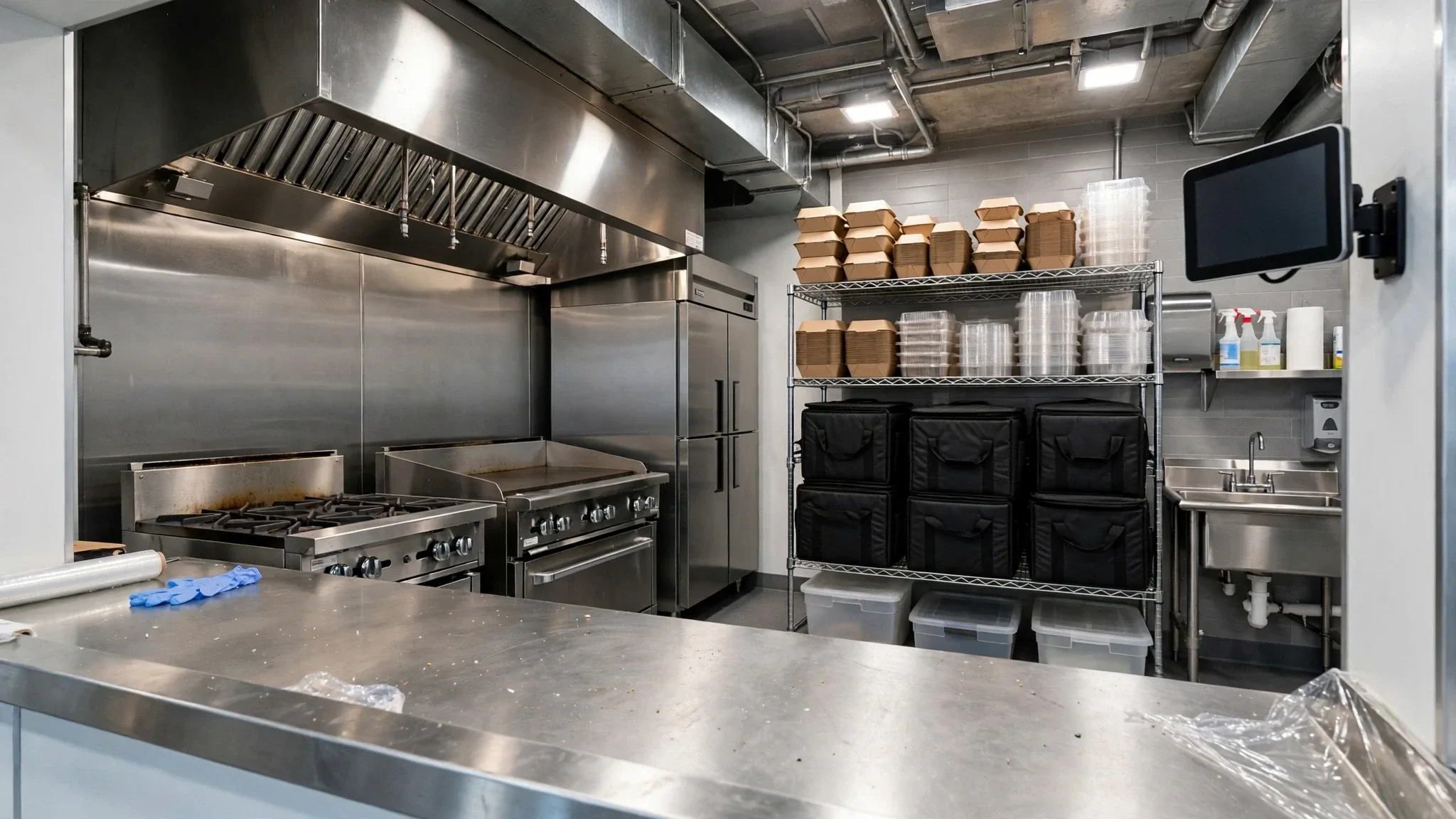
A ghost kitchen trades dining-room costs for a different financial challenge: nearly every order has to travel from the production line to a customer’s door, often through a platform that charges a commission. The absence of tables does not eliminate rent, labor, food-safety obligations, commercial equipment, insurance or startup losses. Before renting a stall or signing a delivery-platform agreement, an operator needs to know what the kitchen will cost to launch and what every order contributes afterward.
Quick answer: Published 2026 third-party estimates for U.S. ghost kitchens span widely. UpMenu describes roughly $20,000–$60,000 for a shared/commissary model and $100,000–$300,000+ for a dedicated build-out. Dots Platform discusses a different, narrower planning range. These figures are vendor-published estimates, not nationally verified medians or promises. A useful plan starts with the exact licensed premises and contract, then adds build-out, production, technology, packaging, working capital and a channel-fee model. Sources: UpMenu; Dots Platform.
Free opening budget worksheet: Enter your own local startup costs and cash reserve, calculate optional break-even orders, and download your estimate as a CSV. Sample amounts are illustrative.
Ghost kitchen, cloud kitchen or virtual restaurant?
These labels overlap, but the actual deal matters more than the name. A shared commissary kitchen may provide time blocks, communal storage and common equipment. A private managed kitchen suite may be a compact dedicated unit with some installed infrastructure. A stand-alone delivery-only restaurant owns or leases its fit-out and equipment. A virtual brand inside an existing restaurant uses idle capacity, but still needs accurate cost allocation, safe separation of operations and clarity about staffing and licensing.
A $2,000-a-month kitchen slot is not cheap if it lacks cold storage, restricts peak pickup times or forces a separate location for prep. A higher-priced turnkey kitchen might save costly permitting and build-out time. Request a complete schedule of rent, minimum term, utilities, security deposit, cleaning fees, equipment maintenance, storage, shared-service charges and exit penalties.
Start with the licensed operating model
Before budgeting ovens, verify that the facility and operator are authorized for the exact food processes and sales channels. A commercial kitchen’s existing license does not automatically mean every tenant can operate every concept under that license. Ask the responsible state or local authority who holds the food establishment permit, who is inspected, which processes require approval, and how delivery pickup and traceability are handled.
The FDA Food Code is a model used by jurisdictions to shape retail food rules, not a national license that overrides local agencies. Confirm the adopted requirements and any current amendments. FDA Food Code.
Ghost kitchen startup budget categories
| Cost category | Shared or managed kitchen considerations | Dedicated kitchen considerations |
|---|---|---|
| Space | Deposit, first rent, storage, operating-hour access | Lease, construction, permitted use, holding costs |
| Cooking equipment | Included or tenant-provided; compare condition | Full cooking line, extraction, refrigeration |
| Smallwares | Portioning, racks, utensils, sanitation | Full production setup and replacement stock |
| Systems | POS/KDS, printer, aggregator, Internet | Systems plus integrations and support |
| Delivery setup | Photos, menus, packaging, platform terms | Same, possibly multiple order channels |
| Compliance | Tenant permits, training, initial insurance | Plan reviews, build-out permits, inspections |
| Launch cash | Food inventory, packaging, training, marketing | Larger startup stock and training period |
| Runway | Cash for early losses and payout timing | Cash plus extended lease/build-out delays |
Watch for double-counting. If equipment is included in the rent, do not budget its full purchase price. If your platform already collects its own payment processing, do not casually stack a second full processing rate onto the same transactions without verifying your agreement.
Worked budget: one compact delivery-only brand
This is a hypothetical U.S. shared/managed-suite project. It is an itemized planning example, not a national average or quote. The suite includes some infrastructure but requires selected dedicated equipment and preparation.
| Upfront requirement | Example cost |
|---|---|
| Kitchen deposit and initial occupancy | $5,000 |
| Fit-out and compliance adjustments | $8,000 |
| Dedicated refrigeration/cooking equipment | $18,000 |
| POS/KDS, ordering integration and setup | $4,500 |
| Permits, training and initial insurance | $4,500 |
| Opening food inventory and packaging | $4,000 |
| Photography, menu launch and initial marketing | $4,500 |
| Hiring and test-service labor | $3,500 |
| Contingency for setup and delays | $7,000 |
| Post-opening cash reserve | $27,000 |
| Total planned cash requirement | $86,000 |
Here the $59,000 setup/contingency and $27,000 post-opening reserve are distinct. The reserve should cover operating shortfalls, not another copy of the same up-front invoices. A private kitchen with a new hood, grease system or electrical service can cost far more. Conversely, an existing restaurant introducing a virtual brand may spend less upfront, but it must not claim all shared labor and facility capacity is free.
Delivery commission changes the economics of every order
DoorDash’s U.S. merchant pricing page currently lists Marketplace delivery commission tiers of 15% Basic, 25% Plus, and 30% Premier for eligible partners, with separate pickup and optional marketing details. These are published platform-plan rates, not a universal rate for every platform, market or contract. Fees may change; review the actual agreement and transaction report. DoorDash merchant pricing.
Hypothetical $30 marketplace order:
| Per-order economics | Amount |
|---|---|
| Net menu revenue, excluding sales tax | $30.00 |
| Marketplace commission at illustrative 25% | −$7.50 |
| Food and disposable ingredients | −$9.00 |
| Packaging | −$1.50 |
| Incremental fulfillment labor | −$2.50 |
| Expected refunds/other genuinely variable cost | −$1.00 |
| Contribution before fixed overhead | $8.50 |
The $8.50 is 28.33% of sales. It is not net profit or owner salary. The example assumes processing is covered by the chosen commission structure and that taxes/tips/pass-through charges do not form part of the $30 revenue. If your contract has separate processing, add it; if advertising spend varies per order, include that too.
At $12,500 monthly fixed operating costs (rent, base wages, utilities, systems and insurance, in this hypothetical model), break-even orders are $12,500 ÷ $8.50 = 1,471 orders a month, or about 50 daily orders across 30 days. This uses one order contribution assumption; mix, discounts, minimum order values and staffing tiers can change the answer. The restaurant break-even calculator helps test other cost structures.
Shared kitchen versus private unit: decide with capacity and cash
A shared facility can reduce capital risk but may limit production, shelf space, allergens handling, equipment choice and dispatch windows. A private kitchen can simplify daily control while committing the owner to longer leases and potentially major mechanical works.
Compare both options using a three-year cost model: up-front cash required; guaranteed monthly payments; required staff; capacity at peak order hour; expected maintenance; delivery-zone reach; opportunity for direct ordering; and the cost of closing or moving. Do not choose a site based on the cheapest quoted monthly rent if it adds 20 minutes of delivery time or prevents simultaneous preparation of your intended menu.
Visit at lunch and dinner pickup times. Observe the location where couriers wait, temperature control at the handoff area, order staging space and whether access routes interfere with food production. Validate power, water, Internet reliability and emergency repair coverage before signing.
An operating menu designed for travel
Delivery-only operators often overbuild the menu. A dish that performs beautifully at the pass may arrive soggy or cold after 25 minutes, leading to refunds and expensive reacquisition. Before launch, select a manageable range of products with shared ingredients, predictable preparation and packaging that protects quality. Test it under real dispatch timings. A weekly meal prep company faces the same packaging and route questions with refrigerated meals; the meal prep business startup costs guide models that launch and its subscriber break-even.
Record a recipe specification, the package type, the expected handoff temperature/condition, minimum profitability by channel and the appropriate shelf life. Re-cost each dish after the packaging and commission assumptions are applied; a restaurant dine-in margin is not a delivery margin. The delivery menu engineering guide and order-accuracy guide cover the operational side.
Technology: protect against menu and order mismatches
The brand’s storefront, ordering platform, POS and kitchen display need a consistent item ID, modifier structure, price, tax treatment and availability. A missing modifier may produce a refund; a duplicated order import may produce the same meal twice; a delayed cancellation may waste ingredients and labor.
Before opening, run paid or controlled test orders through the entire system. Test a standard order, substitution, discount, sold-out item, cancellation, delayed courier and refund. Reconcile the final records using POS integration controls and the delivery reconciliation guide. Do not assume platform sales equal the bank deposit after commission, refunds and adjustments.
Working capital and settlement timing
A ghost kitchen can be profitable on paper and still short of cash if platforms pay later than suppliers, payroll or rent fall due. Keep a weekly forecast showing opening cash, platform receivables, deposit dates, food purchases, advertising charges, rent and wage payments. Model a sharp decline in orders after a launch promotion ends and a week when a platform suspends a listing.
Use the restaurant 13-week cash-flow forecast as a base. A planned reserve is a test of resilience, not money you can safely spend on another brand before the first brand works.
Seven common launch-budget mistakes
- Confusing lower capital with easier profit. Commission can eat the savings from no dining room.
- Comparing a shared-kitchen monthly fee with a full storefront cost. Include deposits, storage, insurance and production limits.
- Treating all app sales as incremental. Promotions may subsidize customers who would have ordered anyway.
- Omitting photographs and packaging trials. Poor listings and delivery failures reduce conversion and repeat orders.
- Overloading one menu. Too many prep methods raise labor, waste and error rates.
- Ignoring delayed settlement and refund adjustments. Cash deposits differ from booked sales.
- Opening multiple virtual brands before proving one. Shared inventory helps only if each brand contributes after its own marketing and fulfillment burden.
Pre-signing checklist
- ☐ Confirm the actual operator’s permit and inspection responsibilities.
- ☐ Inspect kitchen access, storage, hood, temperature control and courier staging.
- ☐ Get signed quotes for all equipment, software and contract add-ons.
- ☐ Calculate contribution for 10 representative menu orders by each delivery channel.
- ☐ Reconcile processing, marketplace commission, promotional fees and payouts.
- ☐ Test menu modifiers, cancellations, refunds and delayed sync.
- ☐ Model break-even by daily order count and by channel mix.
- ☐ Separate construction contingency, prepaid occupancy and post-opening runway.
- ☐ Set a stop rule for repeated negative-contribution promotions.
Frequently asked questions
Is a ghost kitchen cheaper than a restaurant?
It often requires less spending on a dining room and prime retail frontage, but the answer depends on licensing, equipment, rent and delivery cost. Total investment and achievable contribution matter more than the label. If you would rather run a storefront with its own pickup counter, the takeout restaurant startup costs guide builds a full opening budget for that model.
Can I run several brands from one kitchen?
Possibly, if local authorization, food-safety controls, staff capability and platform terms allow it. Brand count does not create additional oven capacity or guarantee profitable demand.
What if a delivery app advertises a lower commission?
Read all terms. Pickup fees, payment processing, sponsored listings, promotions, refunds and payout timing may still affect the realized contribution.
Do I need a website for direct orders?
Direct ordering may diversify demand, but has software, payment, fulfillment, customer acquisition and support costs. Compare net contribution per fulfilled order, not merely whether marketplace commission is avoided.
Bottom line
Build a ghost kitchen budget backward from verified kitchen access and per-order contribution. The real question is whether enough profitable orders can be served reliably to pay fixed expenses and eventually the owner. The companion ghost kitchen earnings guide models that earnings side in detail.
Research sources
- UpMenu: How to Start a Ghost Kitchen (2026) — cost ranges by model.
- Dots Platform: Ghost Kitchen Startup Costs (2026) — vendor cost categories.
- DoorDash: U.S. Merchant Pricing — published current commission tiers.
- FDA: Food Code — model food-safety rules and jurisdictional adoption.
- SBA: Break-even point — contribution-based formula.
Compare other food business models: Explore the startup costs and owner earnings guide library to compare the investment required and potential owner income across coffee shops, food trucks, catering businesses, bakeries, ghost kitchens and pizza shops.
Editorial note: All cost breakdowns, per-order calculations and break-even volumes are clearly labeled hypothetical models, not national averages or investment advice. Reviewed October 21, 2026.