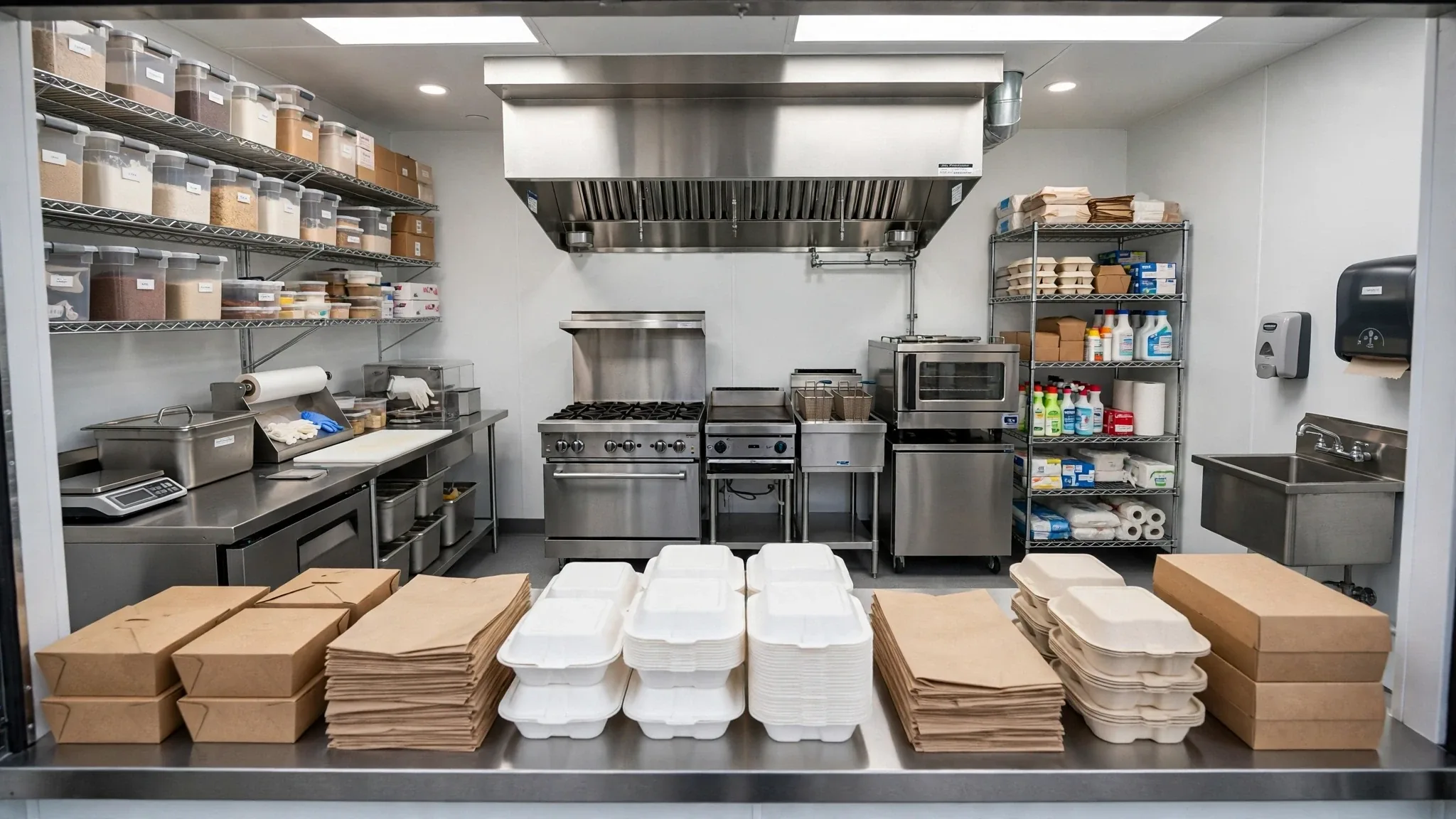
A takeout restaurant can eliminate most dining-room furniture and still require a serious opening investment. Food still has to be received, stored, prepared, cooked, held, packed and handed off under the rules that apply to its location. The operator also needs staff, working capital, a safe customer pickup flow and a way to collect orders without surrendering the entire contribution margin to order-processing and delivery expenses.
The critical question is not whether a takeout concept is automatically cheaper than a conventional restaurant. It is which costs disappear, which remain and which new off-premises costs take their place. A former restaurant space with a compliant kitchen may be a very different investment from a vacant retail shell.
This guide builds an itemized U.S. takeout restaurant opening budget, explains hidden risks and tests the order volume required to support the ongoing cost structure. All dollar amounts in the worked examples are illustrative planning assumptions, not nationwide averages, construction bids or promises about what your restaurant will cost.
Free planning tool: Build your own restaurant startup budget, separate opening expenses from cash reserves, and download the estimate. No signup; replace all example values with local quotes.
Quick answer: how much cash might you need?
For one hypothetical neighborhood takeout restaurant opening in a leased premises, our example totals $245,000 in cash requirements, including a $50,000 initial operating reserve. That figure illustrates the budgeting process rather than establishing a typical U.S. startup cost.
A business starting from a compliant second-generation kitchen may spend much less on alterations than one starting in a bare space. Extensive exhaust, plumbing, grease-management, electrical or fire-suppression work can make the build-out materially more expensive. A short-term shared kitchen could reduce initial construction, but it changes storage capacity, pickup access, scheduling and unit economics.
Do not sign a lease based on another operator’s budget. Obtain site-specific bids, inspect permitted use, and confirm the actual costs and timetable with local authorities and qualified contractors.
Start with the operating format
Three businesses can all advertise “takeout” and have very different cost structures:
- Pickup-first storefront: customers order online, by phone or at the counter and collect food. It needs an accessible pickup area and enough cooking capacity for peak demand.
- Pickup plus third-party delivery: the kitchen may be similar, but order software, packaging, platform fees, courier handoff and refund procedures become more important.
- Delivery-oriented kitchen with little customer frontage: the front-of-house cost may be lower, yet courier access, lease restrictions, marketplace dependency and separate delivery routes matter more.
Define the format first. A pizza takeout, rice-bowl counter, sandwich shop and fried-chicken concept do not use identical production or ventilation systems. Menu decisions determine equipment, utility capacity, preparation space and food-safety controls. A flat-top taco counter is one example: the taco shop startup costs guide breaks down its grill, hood and grease-related lines separately.
Example startup budget: $245,000
The following is an invented example for decision planning. It deliberately includes the startup cash reserve as its own line instead of hiding it inside a build-out estimate.
| Cash requirement | Illustrative amount | What to confirm |
|---|---|---|
| Lease deposits, initial rent and occupancy charges | $15,000 | Security deposit, prepaid rent, common-area charges, utility deposits |
| Construction, plumbing, electrical and ventilation | $80,000 | Permits, hood, fire suppression, grease handling, ADA-related access |
| Cooking, holding, refrigeration and wash equipment | $45,000 | Actual item quotes, installation and service support |
| POS, order routing and packaging setup | $8,000 | Hardware, configuration, labeling and packaging trials |
| Professional fees, licenses and opening inspections | $7,000 | Local jurisdiction’s actual requirements |
| Initial ingredients, disposables and supplies | $6,000 | Opening pars based on planned sales and vendor deliveries |
| Pre-opening recruiting, training and payroll | $9,000 | Paid training, manager setup and trial service |
| Signage, storefront and initial marketing | $5,000 | Permits, photos, menu, maps and launch promotions |
| Build-out and commissioning contingency | $20,000 | Unforeseen work before opening |
| Operating cash reserve | $50,000 | Slow ramp, payroll, supplier payments and utilities |
| Total example cash needed | $245,000 | Not a market quotation or national average |
The arithmetic is $15,000 + $80,000 + $45,000 + $8,000 + $7,000 + $6,000 + $9,000 + $5,000 + $20,000 + $50,000 = $245,000.
Treat these as cash-flow categories, not accounting expense classifications. A security deposit may ultimately be refundable, equipment may be depreciated, and operating reserves are cash held for future obligations. The amount needed on opening day is not identical to the amount that will appear as a first-year expense on the profit-and-loss statement.
The lease can determine whether the model works
A low advertised rent is not enough information. Confirm the total occupancy cost, permitted restaurant use, lease term, annual increases, common-area maintenance, property-tax pass-throughs, exclusivity conditions and responsibility for landlord systems.
Ask what the site was used for previously. Inspect exhaust paths, make-up air, hood and fire-suppression approvals, drains, grease-control equipment, electrical capacity and refrigeration placement. Do not assume that taking over an old restaurant makes its installations automatically compliant for your new menu.
A kitchen may technically fit the space while failing the business case. A location with difficult parking, no safe curbside pickup, poorly marked entry or drivers blocking other tenants can lose transactions during the precise peak hours the financial plan relies on.
See the existing restaurant location selection guide and restaurant occupancy-cost discussion before comparing leases.
Kitchen equipment: buy for the actual menu
Design the menu around a realistic peak-hour production plan rather than buying every appliance that sounds useful. A hot-food menu may need appropriate hoods, ranges or fryers, refrigerated prep tables, food holding, dishwashing and dedicated handwashing. A cold sandwich counter may face a different equipment and utility profile; the sandwich shop startup costs guide builds a separate opening budget for that format.
Request an equipment schedule that identifies each item’s dimensions, electrical and gas requirements, water and drainage requirements, ventilation needs and available service support. Include delivery, installation, commissioning and staff training in vendor quotes. A cheap used appliance can become expensive when downtime affects an entire Friday dinner period.
The most important test is how many complete orders the kitchen can make, pack and hand off during the busiest hour, not its theoretical daily capacity. Follow the existing kitchen ticket-time guide to define measurable capacity and bottlenecks.
Pickup and packaging are part of production
Takeout packaging is a repeat purchase that increases with orders; it is not a one-time opening expense. Your setup budget should nonetheless include testing containers, cups, lids, labels, seals, bags and the layout of the packing station.
Build a deliberate sequence: order arrives; ingredients and cooking stations receive the ticket; quality check occurs; sauces and sides are included; the bag is sealed or checked as appropriate; the finished order is assigned to the correct pickup or courier. The restaurant delivery order accuracy guide covers the operational handoff.
Test food quality after a realistic travel period. The best packaging may not be the least expensive container: heat, moisture, texture, leakage and portion appearance can affect refunds and repeat visits. For safety-sensitive foods, establish holding and transport procedures consistent with local health requirements rather than making food-safety decisions from generic internet advice.
Direct ordering and delivery apps are not economically identical
You may take orders through your own online ordering flow, phone, counter or third-party marketplaces. Compare them at a contribution level, not only by order count.
A useful planning formula is:
Net revenue received per order − food and packaging − channel-related payment or commission costs = order contribution before fixed and semi-fixed operating costs.
For example, assume, rather than assert as any platform’s actual contract, that 40% of a takeout restaurant’s orders pass through a third-party service charging an effective 20% commission on those orders. The weighted commission burden on total sales is 8% (40% × 20%). If the direct-channel percentage rises, the blended cost may fall, although direct orders still involve marketing, ordering software and payment-processing costs. Account for those separately to avoid counting them twice.
This illustration does not include promotions, delivery subsidies, refunds, chargebacks or taxes. Review contract-specific fees and the way they are assessed before modeling any actual provider.
Our online-ordering integration guide explains why menu data, pricing, modifiers and order status must stay consistent across systems.
Estimate working capital from the ramp, not wishful thinking
The illustrative budget reserves $50,000 for post-opening operations. That is not a rule that every takeout restaurant needs exactly that amount. Calculate a reserve from the real monthly obligations and cash collection cycle.
Start by projecting at least a conservative opening period with below-target order count. Model payment timing from processors and delivery partners, payroll frequency, supplier deposits, rent dates, taxes and essential repairs. Account for a normal ramp and a less favorable case. If rent and payroll are due before funds settle, an apparently profitable month can still create a cash shortage.
Use the restaurant 13-week cash-flow guide to put receipts and payments on actual dates. The restaurant startup opening budget provides a broader framework for non-takeout formats.
Worked break-even example: how many orders per day?
For an internally consistent hypothetical model, assume the following fully operating month:
| Model input | Illustrative assumption |
|---|---|
| Average order value, excluding sales tax | $22.00 |
| Food and packaging cost | 31% of sales |
| Blended delivery commission | 8% of sales |
| Contribution after those two variable items | 61% of sales |
| Contribution per order | $13.42 |
| Monthly labor, rent and other fixed/semi-fixed operating costs | $36,300 |
| Operating days | 30 |
Contribution per order = $22.00 × (1 − 0.31 − 0.08) = $13.42.
Break-even orders per month = $36,300 ÷ $13.42 = approximately 2,705 orders, rounded up.
Break-even orders per 30-day month = 2,705 ÷ 30 = approximately 91 orders per day.
This is a contribution-model break-even, not an owner take-home target. The simplified model treats the monthly labor, occupancy and other overhead figure as fixed for the calculation. In reality, some labor and other costs move as orders increase, commissions change by channel, and a full financial break-even may require extra cash for debt service or reinvestment. Do not interpret 91 orders as a safe target for an actual store without a detailed, site-specific model.
The free restaurant break-even calculator can help test your own assumptions. The U.S. Small Business Administration describes the general break-even relationship between fixed costs, unit price and variable unit costs.
Stress-test the opening before the first lease payment
Prepare at least three cases rather than using one optimistic order forecast:
- Slow opening: fewer customers, irregular repeat orders, more sampling or promotional discounts, full rent and training costs still payable.
- Planned baseline: repeatable daypart demand with expected staffing and customer mix.
- Demand spike: more orders that require additional production capacity, packaging, overtime or equipment; high gross sales alone do not prove higher profit.
For each, calculate contribution, fixed spending, available cash and the number of weeks before another capital contribution would be required. Also model a supplier price increase, a temporary equipment shutdown and a higher delivery-app share.
Avoid projecting every day as a typical Saturday. Analyze lunch versus dinner and weekday versus weekend performance. The restaurant daily sales report template supports this kind of tracking once the restaurant is operating.
A focused opening checklist
Before committing to launch, verify:
- A clear menu and expected average order value, with recipes costed on actual usable yield.
- The site is permitted for the intended foodservice activity and the landlord will approve any required alterations.
- A written schedule and cost for ventilation, grease management, fire protection, plumbing and accessible customer areas where applicable.
- Actual vendor quotes for equipment, installation, refrigeration, packaging and ongoing service.
- A measured order-routing and pickup process; tested food quality after transport.
- Written channel assumptions for direct orders, third-party delivery and payment processing.
- Paid staff training, safe operating procedures and local inspection requirements.
- Cash-flow forecast with enough room for a weak opening and delayed settlements.
- Monthly break-even calculated from contribution per order, not simply gross sales.
- A plan for documenting food waste, remakes, refunds, delivery errors and customer feedback.
Frequently asked questions
Is a takeout restaurant cheaper to start than a dine-in restaurant?
It can avoid some seating, table-service and customer-area costs, but kitchen systems, building-code work, safe pickup access and delivery operations may offset the savings. An existing compliant site may be much cheaper to adapt than a retail shell. There is no reliable universal cost differential.
Can I start a takeout restaurant from a home kitchen?
Do not assume so. Cottage-food and home-food rules differ by state, municipality and product. Many temperature-controlled prepared foods and restaurant-style operations require approved commercial facilities and permits. Obtain an answer from the actual regulator before selling.
Should a new takeout restaurant rely completely on delivery platforms?
Dependence concentrates acquisition and fee risk. A marketplace may generate orders, but the operator should compare net contribution per channel, customer relationships, settlement timing, refund handling and a viable direct-order strategy rather than choosing by order volume alone.
What number matters most before opening?
The amount of cash needed to survive until the store repeatedly generates enough contribution to cover operating commitments. Startup cost, monthly break-even, debt service and working-capital runway are related but separate decisions.
Bottom line
A takeout concept should be planned as a kitchen, fulfillment and cash-flow business, not merely a restaurant with the tables removed. The example budget of $245,000 shows how quickly premises, equipment and reserves add up; it does not predict your quote. The strongest opening decision is supported by real contractors’ estimates, production and pickup tests, a conservative order forecast and a channel-adjusted contribution model.
Continue with the companion guide, How Much Does a Small Takeout Restaurant Make?, to see how orders, delivery commissions and operating expenses affect possible income.
Sources and methodology
- National Restaurant Association: Off-Premises Restaurant Trends 2025 — takeout and delivery consumer behavior; not evidence of an individual restaurant’s revenue.
- National Restaurant Association: industry operating-margin analysis — 2024 survey information for limited-service restaurants, not takeout-only benchmarks.
- U.S. Small Business Administration: break-even method — contribution and fixed-cost planning method.
Editorial methodology: All startup budget rows, commission examples and unit economics in this article were constructed as hypothetical scenarios, not sourced price quotations, national averages or financial promises. Legal, food-safety, accessibility, employment and permit rules vary by jurisdiction; obtain professional and local verification.