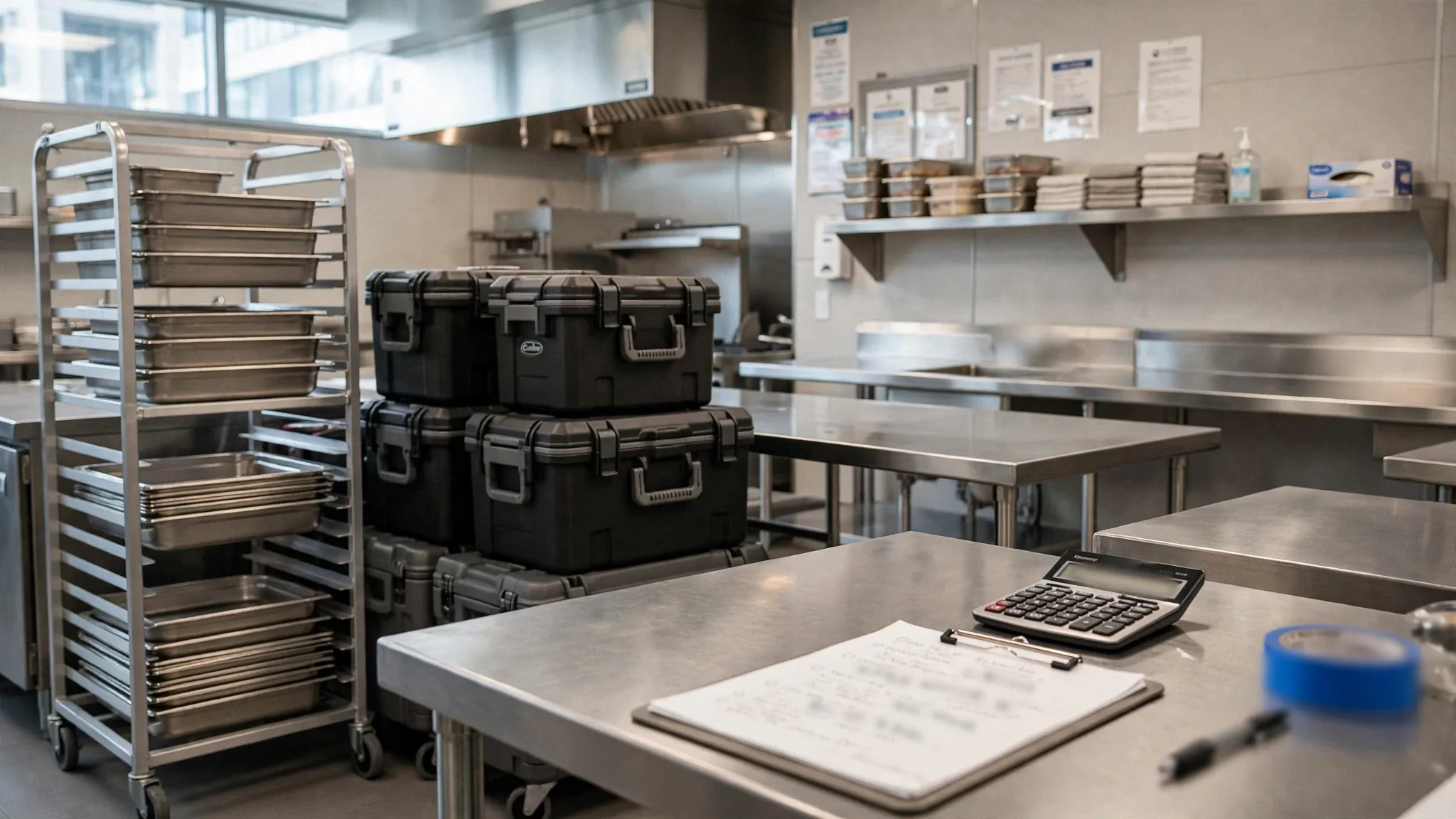
Starting a catering business can look deceptively cheap. You may already know how to cook and have a promising first client. But a quote for preparing 80 meals is not a business plan. A professional caterer must be able to prepare food legally, hold it at safe conditions, move it to a venue, staff service when required, replace failed equipment and manage bookings whose dates and guest counts change.
Quick answer: There is no single U.S. startup cost for a catering company. A lean, legally approved operation using rented commercial kitchen capacity can cost substantially less than a full production kitchen with vans and permanent staff. Toast’s catering startup guide cites a broad $10,000–$50,000 range for some small catering launches, drawing on earlier industry estimates. It is not a verified 2026 national median or a complete price for every staffed event caterer. Your actual cost depends on food production rules, scope, service style, transport and how much cash must remain after opening.
Free opening budget worksheet: Enter your own local startup costs and cash reserve, calculate optional break-even orders, and download your estimate as a CSV. Sample amounts are illustrative.
First define the kind of catering business
| Model | Common advantages | Expenses and risks to price |
|---|---|---|
| Preorder drop-off lunches | Limited service staff and equipment | Kitchen access, packaging, dispatch, delivery time |
| Private event catering | Higher invoice value, specialty menus | Seasonal bookings, labor, rentals, travel and client changes |
| Regular corporate catering | Predictable repeat orders if contracts hold | Production consistency, credit terms and account concentration |
| Full-service wedding/event catering | High potential per event | Staffing, china/rentals, site logistics, service hours, client revisions |
| Catering from an existing restaurant | Shared kitchen and fixed overhead | Capacity conflicts, food-cost allocation, overtime and booking complexity |
Avoid using the same budget for each model. A drop-off lunch business may use an approved shared kitchen and rented transport. A full-service banquet operation may need dedicated refrigeration, larger production capacity, delivery vehicles, serving equipment and management.
Licensing comes before pricing the home kitchen
Some places allow certain home-produced foods under cottage-food rules. That does not mean a home kitchen can produce and serve any cooked meat, dairy-based dish or catered buffet. Requirements differ by state, county, menu, sales channel and event location. Confirm your exact food production license, facility access, transport temperatures, labeling and event rules with local authorities before taking deposits. The FDA Food Code is a regulatory model; each jurisdiction determines what it adopts.
The low-price “start from home” plan is only low-cost if it can legally prepare the actual menu. If approval requires a commissary, dedicated wash area, refrigerator or commercial vehicle arrangement, the model changes. The same question decides a weekly meal prep launch; the meal prep business startup costs guide budgets a licensed shared-kitchen model with refrigerated delivery.
A catering startup budget has ten distinct parts
1. Approved kitchen access
Count security deposits, rent or hourly shared-kitchen charges, cleaning fees, refrigerated and dry storage, utilities and access hours. A kitchen that is cheap to rent but unavailable before Saturday events is operationally expensive. Determine whether ingredients may be stored between bookings and who controls the equipment maintenance schedule.
2. Production equipment and storage
Price the equipment your proposed menus actually require: pots, hotel pans, mixers, food processors, thermometers, racks, refrigeration, hot-holding equipment, washing facilities, carts and smallwares. Compare rental cost with buying, including insurance, pickup and storage. Do not buy equipment to serve 500 guests before you know whether 500-guest bookings exist.
3. Transport and safe holding
A transport plan should cover vehicle access, insulated carriers, securing food safely, cleaning, fuel, loading time, emergency alternatives and transport conditions based on your food-safety plan. A vehicle payment does not represent the entire delivery cost.
4. Licensing and insurance
Quote necessary business registrations, food-service approvals, required inspections, event/vendor permits and general or product liability cover as relevant. Alcohol-related requirements, venues and staffing may create additional conditions. Check real policy coverage, not just a premium estimate.
5. Ordering, documents and admin
An organized caterer needs reliable proposals, contract terms, approved menus, deposit records, revisions, a banquet event order, production plan, invoicing, tax recording and accounts receivable follow-up. This can begin with controlled documents; do not confuse inexpensive software with a complete control process.
6. People and rehearsal
Include actual staff training, test cooking, tasting, safe packing and trial transport. A new team can have a perfect recipe and still fail when food is packed late, the venue has no loading access or part-time servers arrive without a service brief.
7. Marketing and lead generation
Price a clear website, menu photography, sample packs for qualified buyers, local business relationships and communications. Large marketing spending before a menu’s profitability and fulfillment are validated can waste scarce capital.
8. Opening ingredients and packaging
Initial stock is not simply the food cost of your first paid event. Think about testing, spoilage, unexpected guest counts, disposables, cleaning and maintaining enough ingredients for multiple booked events without overbuying.
9. Contingency
Create a separate allowance for broken carriers, substitute rentals, production delays, vehicle repairs and scope changes. Never assume the client will approve every emergency additional charge.
10. Working capital
Clients may pay deposits well before the event, but the business still needs to fund suppliers, payroll and overhead. A customer deposit is connected to a future service obligation; do not automatically treat it as earned profit or freely spendable owner income.
Worked example: a hypothetical $61,000 small caterer
Assume a new independent operator uses a licensed shared kitchen, offers drop-off and modest staffed events, has no dedicated building construction, and hires some event labor as needed. All numbers are illustrative assumptions.
| Startup funding category | Amount |
|---|---|
| Shared kitchen and storage deposits | $5,000 |
| Production, storage and serving equipment | $10,000 |
| Transport setup and carriers | $8,000 |
| Permits, insurance and professional support | $5,000 |
| Initial software, POS/invoicing and equipment setup | $1,500 |
| Menu trials and preopening staff training | $4,000 |
| Basic website, photos and brand materials | $1,500 |
| Opening ingredients and packaging | $5,000 |
| Equipment and opening contingency | $6,000 |
| Working-capital reserve | $15,000 |
| Total required funding | $61,000 |
The sum is not the average cost of a U.S. catering business. A smaller preorder concept may require less; a dedicated commercial kitchen and owned delivery fleet may require much more. If a kitchen rent quote includes utilities or storage, do not list them again as a second charge.
Build a per-event quote before forecasting profit
Catering prices need to cover the complete delivered service, not just edible ingredients. For each event, calculate:
Event contribution = net event revenue – direct food – event labor – rentals – transport – packaging – payment/booking fees – other event-specific costs.
Example: a hypothetical 100-guest drop-off lunch priced at $28 net revenue per guest earns $2,800 net sales. If ingredients cost $840, packaging $180, prep and delivery labor $490, transport $140 and other variable charges $70, event contribution is:
$2,800 – $840 – $180 – $490 – $140 – $70 = $1,080.
That $1,080 must still support the business’s recurring kitchen access, admin, insurance, marketing, fixed wages and owner compensation not already charged. It is not net profit. If the event requires $300 of extra rentals, contribution drops to $780. If the client cuts the count late, make sure the contract governs the effect on cost and payment.
Use our catering pricing calculator and event profitability review to work through the quote and actual outcome.
How many events per month to break even?
Suppose recurring overhead is $9,200/month, excluding costs charged directly to each event. The average event generates $4,000 in net sales with 42% contribution after direct variable costs. That means:
- Contribution per event = $4,000 × 42% = $1,680.
- Break-even events = $9,200 ÷ $1,680 = 5.48, so you need at least 6 similar events monthly to cover that assumed overhead.
This says nothing about the owner’s after-tax income, debt principal or equipment replacement if those were not included. It also assumes enough kitchen and labor capacity to serve six events. Volume growth can force extra fixed costs, so model new expenses before committing to more business. To see how event contribution, overhead and owner pay fit together once the company is running, read how much catering businesses make.
Deposits, cancellations and changes create cash risk
A client might pay 40% before the event; that helps finance purchasing but does not make the event profitable. Create a clear payment schedule, identify refundable and nonrefundable elements under applicable law, and avoid ordering large specialty quantities before the client confirms the count. Define what happens when the client changes venue access, menu, guest numbers or service hours.
A disciplined catering change order and final guest count control protect both the client and the operator. Always issue the latest approved event order to production, dispatch and service—not a collection of email notes.
What to budget monthly
Beyond direct events, include fixed kitchen access or rent, equipment leasing, salaried management, insurance, software, marketing, vehicle availability, accounting, utilities, storage and routine maintenance. Cash forecasts should also account for loan repayments, annual insurance renewals, sales taxes collected and equipment replacement.
Separate the monthly P&L from the cash flow forecast. A business can report a profitable booked month and still face a shortage because several large customers pay 30 days after the event.
Common launch errors
- Quoting only food ingredients instead of the complete labor, transport and rental requirement.
- Using home-kitchen assumptions without regulatory confirmation.
- Accepting a client change verbally without updating the final event order.
- Relying on a single corporate client for the majority of sales.
- Buying banquet equipment that cannot be stored efficiently between events.
- Assuming every booked inquiry becomes an executed paid event.
- Spending event deposits without maintaining the future-event obligation in records.
- Underestimating the time needed to pack, load, travel, unload and clean equipment.
Catering startup checklist
- ☐ Service type and typical guest count defined.
- ☐ Kitchen facility approved for the actual proposed menu.
- ☐ Written transport and safe-holding procedures prepared.
- ☐ Equipment purchase and rental alternatives priced.
- ☐ Event costing includes paid and owner labor appropriately.
- ☐ Contract, deposit and change-order rules reviewed.
- ☐ Booking pipeline and realistic close rates forecast.
- ☐ Monthly overhead and six-event break-even example recalculated for actual quotes.
- ☐ Working capital maintained separately from construction or equipment contingency.
- ☐ First trial event rehearsed and reviewed.
Frequently asked questions
Can I start catering with $10,000?
A very limited, permitted operation with access to an approved kitchen and existing assets may be possible in some markets, but staffed events, extensive equipment and owned transport require more. The cited $10,000–$50,000 industry discussion is not proof that every caterer can launch within that range.
Do I need my own commercial kitchen?
Not necessarily. Some businesses lease approved kitchen space or operate from an existing restaurant. Whether that arrangement is permitted for your foods and service model is a local regulatory question.
What is the biggest financial mistake?
Pricing against food cost while ignoring event-specific labor, logistics, rentals and service time. A large invoice can still lose money.
Bottom line
A useful catering startup budget prices legal kitchen production, complete event delivery, the unpredictable booking calendar and enough cash to fulfill the promises already sold. Do not scale until the economics of a small, well-controlled set of events are proven.
Research sources
- Toast — Starting a Catering Business (historical broad planning range, not a current verified median).
- FDA — Food Code 2026 (a model for local adoption).
- U.S. SBA — Break-even methodology.
Compare other food business models: Explore the startup costs and owner earnings guide library to compare the investment required and potential owner income across coffee shops, food trucks, catering businesses, bakeries, ghost kitchens and pizza shops.
Editorial note: Cost tables and events are hypothetical. Local rules, tax obligations, contract terms and vendor quotes must be checked before reliance.