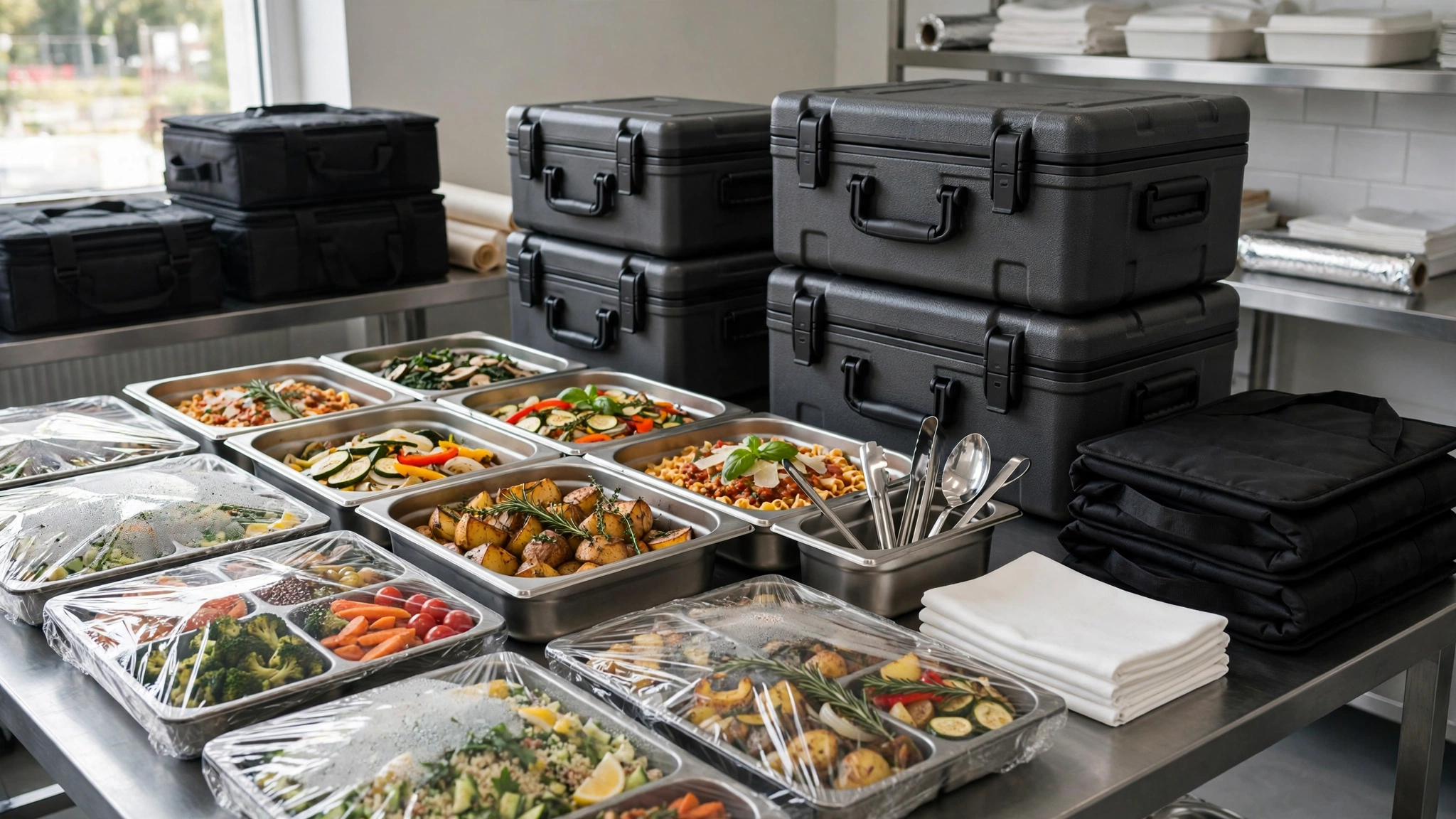
A catering event can look successful because the client was happy, the invoice was large and the team finished on time.
That does not mean the event produced the profit the restaurant expected.
The only reliable way to know is to compare the plan with the actual result after the event.
A catering profitability review should answer:
• Did revenue finish where the quote expected?
• Did food cost stay within the event plan?
• Did labor hours expand?
• Were rentals, transport or outside purchases higher than expected?
• Did client changes get billed?
• Which operating decisions changed the final contribution?
This is not a replacement for formal accounting. It is a management review that connects the quote, production and event execution to actual economics.
Start with the approved event estimate
The review needs a baseline.
Use the final approved version of the event estimate, not the first quote if the order later changed.
The approved baseline should show:
• contracted guest count,
• food and beverage revenue,
• service charges or other revenue items where applicable,
• planned food cost,
• planned labor,
• planned rentals,
• transport/delivery,
• outside services,
• discounts,
• approved client changes.
For the pricing foundation: How to Price Catering Events for Profit
Freeze the final sales number first
Before reviewing costs, confirm event revenue.
Include only the revenue that belongs to the event under the restaurant’s accounting policy.
Check:
• final invoice,
• deposits applied,
• approved additions,
• credits,
• discounts,
• cancellations or quantity reductions,
• taxes and pass-through charges handled consistently.
Do not compare a pre-tax estimate with a tax-inclusive final invoice.
Use the same revenue basis in plan and actual.
Separate planned and actual guest count
Guest count changes affect almost every cost line.
Track:
| Measure | Planned | Actual |
|---|---|---|
| Guest count | 150 | 164 |
| Revenue | $12,000 | $13,120 |
| Food cost | $3,400 | $3,900 |
| Labor | $2,200 | $2,650 |
The figures are illustrative.
If the client added 14 guests, higher food and labor are not automatically management failure. The review should determine whether the added revenue covered the added cost.
Measure food cost from event-specific usage where possible
The ideal event review links the food consumed to the event.
Possible sources include:
• event production sheet,
• issue quantities,
• batch records,
• transfers,
• special purchases,
• returns to stock,
• waste log,
• leftover/carryover records where permitted and appropriate.
Do not simply use total weekly food cost and call it event food cost.
For event production structure: Catering Production Planning: From Guest Count to Prep, Batch and Service Plan
Calculate food-cost variance
A simple variance is:
Food cost variance = Actual food cost – Planned food cost
If planned food cost was $3,400 and actual was $3,900:
$3,900 – $3,400 = $500 unfavorable variance
Then explain the $500.
Possible causes:
• higher guest count,
• menu substitution,
• higher purchase price,
• overproduction,
• larger portions,
• unplanned staff meals,
• waste,
• emergency purchases,
• incorrect recipe estimate.
The variance is the starting point, not the conclusion.
Separate quantity variance from price variance
An event can exceed food budget because it used more product or because the product cost more.
Those are different problems.
Example:
The event planned 40 kg of beef at $12/kg.
Planned cost:
40 x $12 = $480
Actual usage was 44 kg at $12.50/kg.
Actual cost:
44 x $12.50 = $550
The $70 variance contains both extra quantity and a higher unit cost.
The example is illustrative.
This matters because the action differs:
• quantity variance may point to guest count, yield or portion control,
• price variance may point to purchasing or supplier movement.
Review labor by role and phase
Labor is often one of the largest catering variances.
Do not review only total payroll dollars.
Break event labor into phases:
• prep,
• packing/load-out,
• transport,
• setup,
• service,
• breakdown,
• return/unload,
• cleaning.
Then compare planned and actual hours by role.
| Role/phase | Planned hours | Actual hours | Variance |
|---|---|---|---|
| Kitchen prep | 28 | 34 | +6 |
| Service staff | 40 | 42 | +2 |
| Breakdown | 12 | 18 | +6 |
The figures are illustrative.
The pattern tells management where the estimate was weak.
Find why labor ran over
Common causes include:
• setup took longer than estimated,
• venue access was late,
• guest count changed,
• service style changed,
• travel time was underestimated,
• equipment/rental delay,
• menu complexity,
• poor prep completion before load-out,
• breakdown responsibilities were unclear.
The goal is to improve the next estimate, not simply tell the team to “work faster.”
Capture rentals and outside services
Catering profitability can disappear in costs that sit outside normal restaurant operations.
Examples:
• linen,
• tables/chairs,
• china/glassware,
• heaters,
• tents,
• specialty equipment,
• security,
• venue fees,
• subcontracted labor,
• parking,
• permits where applicable.
Match every outside cost to the event.
If a supplier invoice arrives after the event, keep the review open until the material cost is known.
Review transport as a real event cost
Transport can include more than fuel.
Consider:
• vehicle rental,
• driver hours,
• mileage/fuel,
• tolls,
• parking,
• additional trips,
• loading labor,
• failed delivery or return trips.
For transport and holding controls: Catering Transport and Holding: Protect Quality From Kitchen to Event
Track client changes and whether they were billed
One of the most common event-margin leaks is unpriced scope change.
Examples:
• extra guests,
• extra service hour,
• upgraded equipment,
• last-minute menu addition,
• extra delivery,
• venue change,
• additional setup request.
The post-event review should ask:
1. Was the change approved?
2. Was the cost estimated?
3. Was the client charged where appropriate?
4. Did the change increase labor or outside cost?
A profitable event estimate can become weak if several “small” changes are absorbed for free.
Calculate event contribution
A practical event contribution calculation is:
Event contribution = Event revenue – Event-specific variable/direct costs
Which costs belong in the calculation depends on the restaurant’s management model.
Possible direct costs include:
• food and beverage,
• event labor,
• rentals,
• delivery/transport,
• event-specific supplies,
• subcontractors,
• commissions or platform fees.
Do not label contribution as net profit unless all relevant overhead and accounting allocations are included.
Compare contribution dollars and contribution percentage
Suppose final event revenue is $13,120 and direct event costs total $8,050.
Contribution dollars:
$13,120 – $8,050 = $5,070
Contribution percentage:
$5,070 / $13,120 x 100 = 38.6%
The example is illustrative and not a target.
Compare the result with the event’s planned economics and the restaurant’s own objectives.
Review what changed from quote to execution
A useful variance table is:
| Line | Planned | Actual | Variance | Cause | Next action |
|---|---|---|---|---|---|
| Food | $3,400 | $3,900 | +$500 | Guest increase + portion drift | Update guest scaling |
| Labor | $2,200 | $2,650 | +$450 | Setup delay | Add venue access buffer |
| Rentals | $900 | $980 | +$80 | Extra linen | Price change order |
The figures are illustrative.
The “next action” column is what turns the review into a better future estimate.
Look at operational quality beside profit
A high-margin event with poor execution is not automatically a success.
Review:
• on-time dispatch,
• setup completion,
• guest/client complaints,
• missing items,
• equipment damage,
• food-quality issues,
• returns/refunds,
• team overtime,
• venue relationship.
Some events should be improved even if they were financially strong.
Compare planned leftovers with actual leftovers
Overproduction can hide inside “successful abundance.”
For each major category, ask:
• how much was produced,
• how much was served,
• how much returned unused,
• how much became waste,
• whether future production factors should change.
Do not create unsafe reuse practices to save cost. Food handling, holding and disposition must follow the restaurant’s approved procedures and applicable requirements.
Review equipment loss and breakage
Catering events can create hidden asset cost.
Track:
• missing smallwares,
• damaged transport boxes,
• broken serving pieces,
• lost linens,
• rental damage charges,
• equipment left at venue.
The event may still be profitable, but repeated loss needs a separate control.
Separate estimate error from execution error
This distinction improves learning.
Estimate error
The plan itself was unrealistic.
Examples:
• labor hours too low,
• rental price outdated,
• food yield assumption wrong,
• transport time underestimated.
Execution error
The plan was reasonable but performance differed.
Examples:
• excessive waste,
• slow setup,
• missed prep,
• extra trip,
• unrecorded client change.
The corrective action depends on which type occurred.
Build an event scorecard
A compact scorecard can include:
• final revenue,
• contribution dollars,
• food variance,
• labor variance,
• client changes captured,
• on-time dispatch,
• major complaint yes/no,
• equipment loss,
• one lesson for next event.
Do not overload the scorecard with every operational detail.
Review events while the facts are fresh
A useful practice is to complete the operational portion of the review within one or two business days, then finalize financial lines when late supplier invoices or payroll data arrive.
Waiting until month-end increases memory loss.
The kitchen may no longer remember why prep ran long. The event captain may forget the venue delay. A missing rental may no longer be easy to trace.
Use event classes for better estimates
Over time, compare similar events:
• drop-off catering,
• buffet service,
• plated dinner,
• corporate lunch,
• wedding/social event,
• large outdoor event.
Do not assume one labor or food factor works across all event styles.
Historical event classes can improve future estimating without turning one unusual event into a new universal standard.
Example: profitable but below plan
Suppose an event planned:
• revenue: $15,000,
• direct cost: $8,000,
• planned contribution: $7,000.
Actual result:
• revenue: $15,800,
• direct cost: $9,600,
• actual contribution: $6,200.
Sales beat plan by $800, yet contribution missed plan by $800.
Why?
The review finds:
• $400 extra labor,
• $250 unbilled client change,
• $300 extra food cost,
• $650 additional rentals/transport less some offsetting revenue.
The numbers are illustrative.
The lesson is that revenue alone would have made the event look better than it actually was.
Review sales effort and commission where relevant
Some catering business includes sales commission, referral fees or venue-partner fees. If those costs apply to the specific event, include them consistently in the event economics.
Also review whether sales effort was unusually high.
An event that requires repeated site visits, redesigns, tastings and revisions may consume more commercial time than a standard repeat order. You do not need to allocate every office minute to every event, but recurring high-effort account types should be visible when deciding which business is worth pursuing.
Build a repeat-event benchmark
The best use of post-event reviews is not one-event judgment. It is building better estimating data.
For recurring event types, track:
• food cost per guest,
• labor hours per 100 guests,
• setup hours,
• transport hours,
• rental cost per guest,
• contribution per event or per guest.
Do not turn the first few events into fixed benchmarks. Use a growing internal history and explain outliers.
After several similar corporate lunches, for example, management may discover that setup consistently takes longer at one venue because loading access is poor. That becomes a planning input for the next quote rather than another surprise after service.
Close the review with an estimating change log
Every material variance should end in one of three outcomes:
- No change because the event was genuinely unusual.
- Update the estimate assumption.
- Update the operating process.
Keep a small change log so the sales and production teams know what was learned. Otherwise the event review becomes a report that nobody uses.
Common post-event review mistakes
Reviewing only sales
Large invoices can hide weak contribution.
Using the original quote instead of final approved scope
The baseline is wrong.
Ignoring labor phases
Management knows labor was high but not where it failed.
Missing outside invoices
Profitability is overstated.
Treating every variance as employee performance
Some estimates were wrong before the event began.
No action from the review
The same estimating mistake repeats.
Run the post-event review before the details go stale
- Freeze the final approved scope, guest count and billed revenue so the comparison uses the event that was actually sold.
- Collect actual food usage or cost, labor hours, rentals, transport and outside services using the same definitions as the estimate.
- Calculate planned versus actual contribution and rank the largest unfavorable variances by dollars.
- Separate estimating errors from execution errors such as overproduction, overtime, added client scope or venue delays.
- Assign each material variance one outcome: no model change, update the estimating assumption, or change the operating process.
- Record the change in the pricing or production reference used for the next comparable event.
- Recheck the revised assumption on the next event of the same type instead of waiting for a monthly summary.
Catering profitability review checklist
- Final approved scope is identified.
- Final guest count is confirmed.
- Revenue basis matches the estimate.
- Food usage and cost are captured consistently.
- Labor hours are separated by role and phase.
- Rentals and outside services are complete.
- Transport costs are included.
- Client changes are matched to billing.
- Contribution is calculated consistently.
- Major operational outcomes are reviewed.
- Estimate errors are separated from execution errors.
- One or more corrective actions are assigned.
Frequently asked questions
Should every small catering order get a full review?
Not necessarily. Small repeatable orders can use a simplified scorecard. Large, complex or strategically important events deserve a deeper review.
Is contribution the same as net profit?
No. Contribution normally excludes some overhead and fixed costs. Use consistent terminology and accounting support for formal profitability reporting.
What if actual food usage is hard to isolate?
Improve event production, issue and return records. Use the best consistent method available rather than pretending weekly total food cost is event-specific.
Who should attend the review?
For larger events, include the person responsible for sales/estimating, production, event execution and financial follow-up. Smaller events may be reviewed by one manager using the same structure.
Next action
Take the last completed catering event and rebuild it in five lines: final revenue, food cost, event labor, outside/rental/transport cost and contribution. Then list the three largest differences from the approved estimate. Those three differences are the most valuable inputs for pricing and planning the next event.