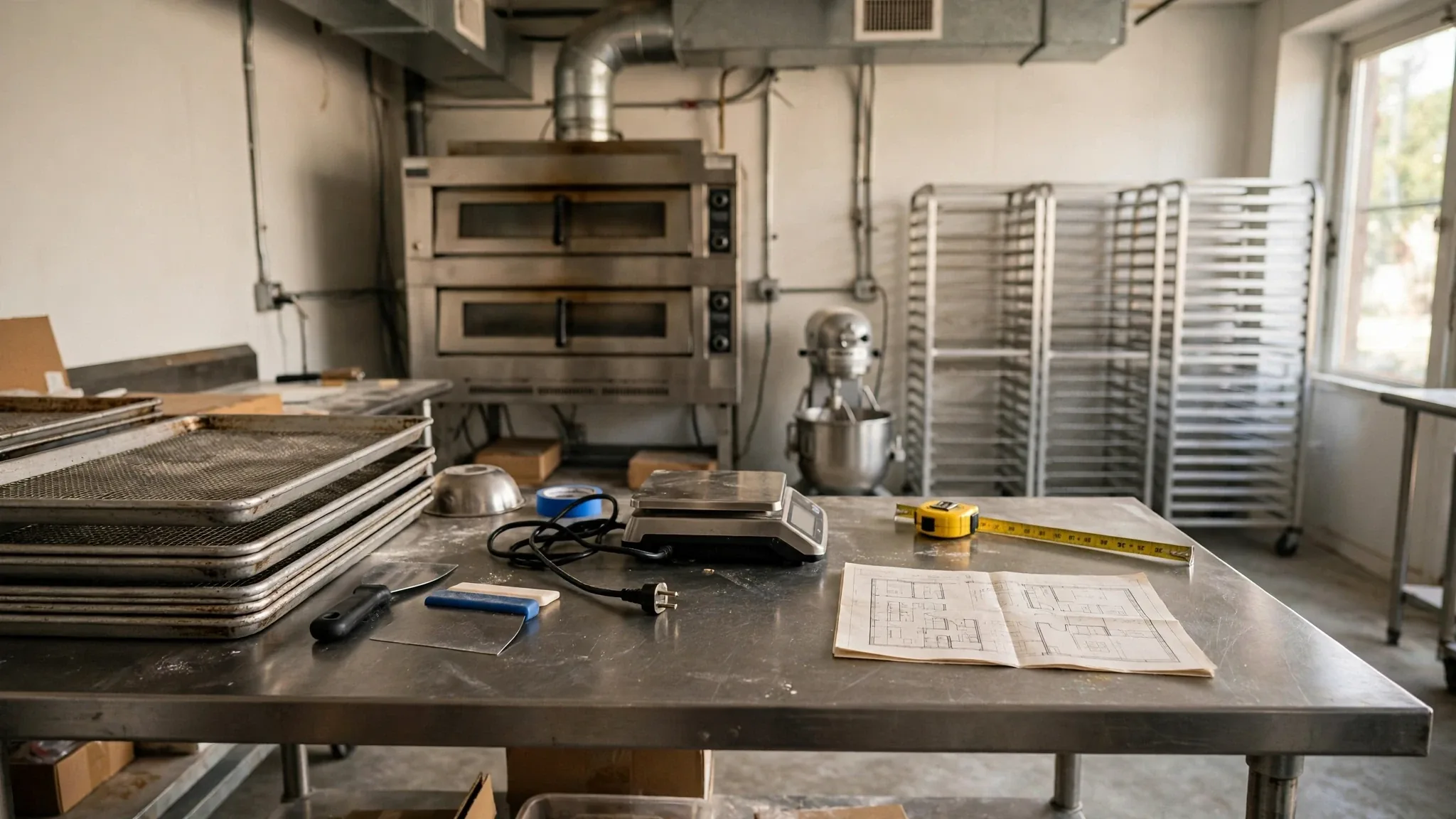
Opening a bakery is not one purchase. You pay to secure a suitable space, make it legal and production-ready, install equipment, hire and train employees, stock ingredients, and survive the weeks when sales are not yet sufficient to cover expenses. The answer to how much does it cost to open a bakery? therefore depends as much on the format you choose as on the price of an oven.
Quick answer: An owner testing a narrow product line in a properly licensed shared kitchen may need dramatically less capital than an owner converting an empty retail unit into a full-production bakery. Published startup-cost guides disagree because they cover different concepts: Toast has described small bakery setups at roughly $10,000–$50,000, while its broader bakery cost discussion includes materially larger equipment and storefront budgets. Rather than treat either range as a national guarantee, build a location-specific estimate and fund working capital separately. Source: Toast bakery startup guide.
Free opening budget worksheet: Enter your own local startup costs and cash reserve, calculate optional break-even orders, and download your estimate as a CSV. Sample amounts are illustrative.
First, choose which bakery you are actually opening
A permitted shared-kitchen microbakery rents approved production space and may sell by preorder, markets, or wholesale. Its economics depend on kitchen-time availability, delivery logistics and whether the venue permits the intended products and sales channels. A small retail bakery adds display cases, customer service, signage, walk-in traffic and often an upgraded storefront. A production/wholesale bakery prioritizes batch capacity, loading, packaging and early-morning labor over the customer-facing room. A bakery-café adds beverages, seating, restrooms, dining service and more complex labor scheduling.
Never estimate all four formats using the same per-square-foot allowance. Compare each proposed site with the approved production flow: receiving → storage → mixing → proofing → baking → cooling → finishing → packing → dispatch. A cheap lease becomes expensive if that flow requires new electrical capacity, ventilation or plumbing.
Bakery startup cost categories to obtain quotes for
| Budget line | What belongs in the line | Questions before signing |
|---|---|---|
| Deposit and occupancy | Deposit, advance rent, legal review, utility setup | Are permitted bakery activities and hours allowed? |
| Build-out | Plumbing, electrical, fire and ventilation work, washable surfaces | Which improvements require landlord approval? |
| Production equipment | Ovens, mixers, proofers, refrigeration, racks, worktables | Can a technician service the selected models locally? |
| Retail equipment | Display, shelving, payment station, furniture | Is it necessary for this concept? |
| Permits and compliance | Plan review, inspections, business registration, training | Which agency approves this exact operation? |
| Systems | POS, inventory, ordering, internet, security | Which monthly fees follow the hardware purchase? |
| Opening supplies | Flour, butter, fillings, boxes, labels, sanitation supplies | What is the minimum safe opening stock? |
| Preopening labor | Trials, training, test batches, cleaning | How many paid hours happen before the first sale? |
| Marketing | Signage, local launch, photography, menus | Can preorders be tested before a large spend? |
| Contingency and runway | Unexpected setup costs plus post-opening losses | Are these two reserves counted separately? |
Do not add an estimated equipment package on top of an included landlord equipment allowance without deducting the overlap. The same applies to first-month rent, utilities and permits included elsewhere in your model.
Worked sample: a modest U.S. neighborhood retail bakery
The following is a hypothetical budget, not a quote, industry median or promise. It assumes leased premises, a compact menu, an existing food-service site requiring some conversion, and an owner who has checked the local code requirements.
| One-time requirement and cash reserve | Example amount |
|---|---|
| Lease deposit and initial occupancy | $9,000 |
| Renovation, utilities and compliance work | $38,000 |
| Ovens, mixing, chilling and major equipment | $48,000 |
| Racks, pans, utensils and other smallwares | $6,000 |
| POS, digital ordering and setup | $3,000 |
| Permits, professional setup and initial insurance | $4,500 |
| First ingredients and packaging | $7,000 |
| Branding, signage and launch activity | $5,000 |
| Hiring, training and production trials | $8,000 |
| Construction and opening contingency | $12,000 |
| Post-opening working-capital reserve | $45,000 |
| Total cash requirement | $185,500 |
The distinction between $140,500 in setup/contingency and $45,000 of working capital matters. The latter is not a second copy of prepaid rent or initial inventory: it is the reserve available to pay legitimate operating shortfalls after opening. Financing may change how much equity you need immediately, but it adds debt service and potentially guarantees. A $185,500 project is not necessarily a $185,500 equity contribution, nor a $185,500 expense on the first month’s profit-and-loss statement.
The oven is not the only capacity bottleneck
Owners often price the oven first because it is the most visible asset. But a bakery can have enough oven capacity and still fail during cooling, icing, packing or counter service. Before buying equipment, make a capacity table by hour. Include realistic changeovers, wash-down, recipe proofing, rack space and packaging labor. If batches cool for longer than the oven cycle, more baking slots may only create a congestion problem.
Compare buying used with buying new on installed cost, warranty, availability of replacement parts, sanitation condition, electrical/gas suitability and lost-revenue risk. A used oven may have a low sticker price and a costly required electrical upgrade. Similarly, a mixer that is too small can force excessive batches and overtime. See the existing bakery production-planning guide for turning demand into workable batches.
Lease and construction costs: five questions that can change the budget
- Is the space already approved for the proposed food production, and does the existing certificate of occupancy cover the intended use?
- Are the hood, fire-suppression system, sinks, drains, grease handling and handwashing provisions appropriate for the product and local rules?
- Can the electrical/gas service support simultaneous oven, refrigeration and ventilation loads?
- Does the lease say who pays for changes demanded at inspection, who owns installed equipment, and when rent begins?
- Are delivery/loading, waste removal and early-morning operations compatible with the property and neighbors?
The FDA Food Code is a model for food safety rules; actual licensing and inspection requirements are set by applicable state/local authorities and can differ by product and process. Do not treat a generic national permit allowance as a verified local fee. FDA Food Code overview.
Budget for ingredients, packaging and waste together
Bakery food cost isn’t just flour divided by selling price. A practical item costing includes every ingredient in the approved recipe, expected edible/saleable yield, decoration, packaging and predictable process loss. Account for product left in the mixer, overbakes, damaged finished pieces, display shrinkage and end-of-day discard. A cheap ingredient can be expensive if the product regularly expires unsold.
Build a simple product sheet with recipe version, batch yield, ingredient cost, packaging unit cost, planned selling price, time needed per batch and expected sell-through. Cross-check it with the bakery ingredient-cost variance guide and shelf-life/date-code controls. Stock that cannot legally or safely be sold tomorrow should not be counted as tomorrow’s opening inventory.
Calculate the monthly sales needed to break even
Use monthly fixed operating costs ÷ contribution margin ratio, where contribution margin ratio is one minus the costs that vary with revenue. Be consistent about whether payment fees, paper packaging and genuinely variable production labor are included. Do not count the same labor line as both fixed and variable.
Hypothetical calculation:
- Fixed operating costs per month: $23,000 (including contracted payroll but excluding owner pay and debt principal).
- Variable costs: 38% of net sales.
- Contribution margin ratio: 62%.
- Break-even sales: $23,000 ÷ 0.62 = $37,096.77 per month.
- If the average transaction is $13, that is about 2,854 checks per month, or 110 checks per day over 26 open days.
This model is sensitive to labor capacity. If 110 orders per day requires another paid baker not included in fixed costs, add that cost and recalculate. A bakery can hit sales break-even while still lacking enough cash for loan principal, capital replacements or the owner’s living expenses. For more scenario testing use the restaurant break-even calculator and 13-week cash-flow forecast.
Working capital: model the cash calendar, not an arbitrary percentage
A bakery may purchase equipment and ingredients well before revenue starts. Payroll and occupancy bills arrive on fixed dates; receipts vary by weather, promotions and neighborhood demand. Weekly cash forecasts should identify opening balance, unavoidable bills, credit-card settlement timing, wholesale customer payment terms, planned purchases and a minimum cash floor.
A wholesale customer paying 30 days after delivery creates a different liquidity requirement than a retail customer paying immediately. If you offer wedding cakes or catering, deposits can help fund materials—but deposits also create an obligation to deliver or potentially refund. Do not spend all deposits as though they are profit.
Test a base case, slow-opening case, and equipment-delay case. For the slow-opening case, reduce expected sales while keeping unavoidable payroll, rent and insurance. For equipment delay, add another month of holding costs and a realistic service contingency. A responsible launch budget includes an explicit stop/replan threshold before all cash is consumed.
How to reduce startup investment without compromising safety
Start with fewer SKUs and equipment that serves several products. Validate demand using approved shared-kitchen production, wholesale trials or preorders before committing to a large retail fit-out. Negotiate which improvements the landlord performs, compare multiple written contractor bids and get a qualified technician to inspect secondhand equipment.
Keep cost cutting away from essential food safety, required ventilation, staff pay, labeling and safe storage. A smaller lawful concept beats a larger underfunded one. If your concept centers on fried dough rather than ovens, the donut shop startup costs guide applies the same budgeting method to fryers, grease handling and early-morning labor. Also resist the temptation to treat a home kitchen as an unrestricted commercial bakery: cottage-food permissions, permitted product categories and sales limits vary by jurisdiction.
Bakery opening budget checklist
- ☐ Choose retail, wholesale, shared-kitchen or bakery-café operating model.
- ☐ Validate permitted use and inspection path before signing the lease.
- ☐ Get written equipment, contractor and installation quotes.
- ☐ Produce a realistic product mix, recipe cost and batch-capacity plan.
- ☐ Include preopening rent, training, marketing and utility expenses.
- ☐ Separate construction contingency from operating runway.
- ☐ Build a 13-week cash forecast with an explicit minimum balance.
- ☐ Recalculate break-even after owner compensation and financing costs.
- ☐ Name the people who will authorize purchasing, production changes and daily close.
Frequently asked questions
Is a shared kitchen always cheaper than a storefront?
Its upfront investment can be lower, but hourly charges, access restrictions, travel, storage, booking conflicts and packaging logistics can raise unit cost. Compare total cost per saleable unit and realistic production capacity rather than the initial deposit alone.
Can I open a bakery for $10,000?
Some narrow-format ventures using compliant shared facilities may approach that scale, but it is not a reliable budget for a fitted commercial storefront with staff, ovens and working capital. Confirm the exact format and all required costs before treating a low published number as actionable.
What is the biggest cost most owners miss?
Often it is the cash needed after opening rather than a single equipment invoice. Underestimated build-out, labor during low-sales weeks and equipment downtime can compound the problem.
How much can the owner take home?
Startup investment alone does not answer that. Calculate operating contribution, wages paid for the owner’s work, debt service, taxes and reinvestment separately. The companion bakery owner earnings guide works through that income side; do not confuse reported business seller earnings with a guaranteed salary.
Bottom line
Ask which bakery, in which approved space, using which production method? Then itemize actual local quotes, calculate monthly break-even, and fund a working-capital reserve that protects the first difficult months. The most useful startup budget is not the lowest number on the internet; it is a number you can explain, audit and update before signing expensive commitments.
Research sources and verification
- Toast: How Much Does It Cost to Open a Bakery? — concept-dependent published ranges, not a quote.
- Toast: Bakery construction and build-out — facility and quotation considerations.
- FDA: Food Code and state/local adoption — model standards, local enforcement.
- SBA: Break-even point — formula and planning framework.
Compare other food business models: Explore the startup costs and owner earnings guide library to compare the investment required and potential owner income across coffee shops, food trucks, catering businesses, bakeries, ghost kitchens and pizza shops.
Editorial note: All budget, check-count and revenue examples are illustrative U.S.-dollar models created for this guide. Actual costs must be verified with local quotes and qualified professionals. Reviewed October 21, 2026.