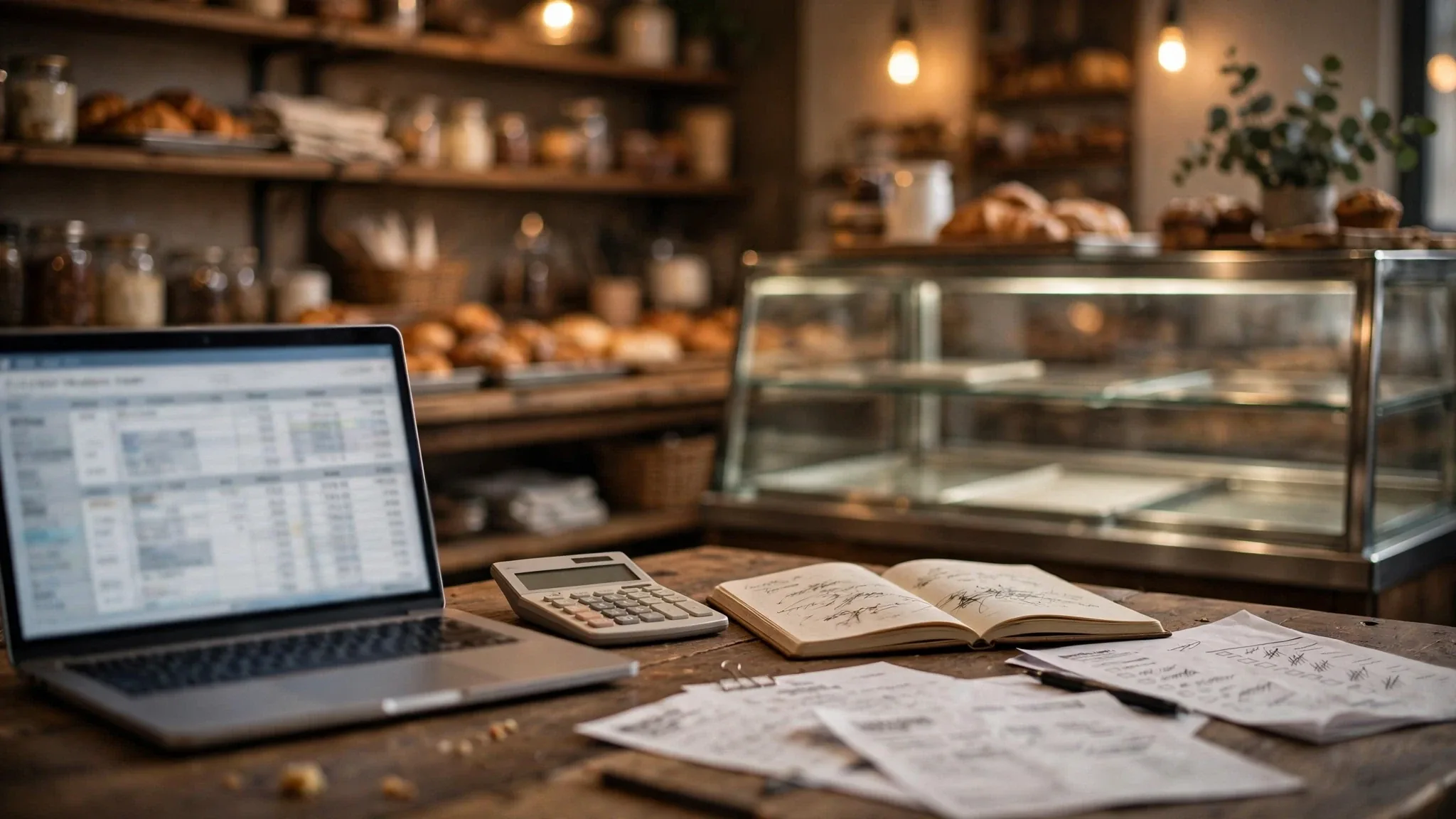
The bakery on the corner may sell hundreds of pastries every morning, but crowded display shelves do not tell you what its owner earns. Revenue pays for ingredients, bakers, counter staff, rent, utilities, packaging, equipment and mistakes before it becomes anything available to the owner. The useful question is not merely how much does a bakery make? but how much remains after the real costs of operating it and paying the people who run it?
Quick answer: Bakery ownership income ranges widely. BizBuySell reports $545,567 median annual revenue and $104,527 median annual seller’s discretionary earnings for U.S. bakery businesses sold on its marketplace during 2021–2025. These figures describe a selected set of sale transactions—not all bakeries, not startups, and not a promised salary for a new owner. BizBuySell bakery benchmarks.
Check the investment alongside owner earnings: Use the free restaurant opening budget planner to estimate startup cash, working capital reserve and optional break-even orders before relying on an income scenario.
What the numbers actually mean
Revenue is the value of net sales from customers and wholesale accounts before normal operating costs. Gross profit is revenue after the direct product costs under your accounting definition; it is not the amount an owner keeps. Operating profit is the amount remaining after ordinary operating expenses, with accounting choices about depreciation, financing and owner wages affecting the reported figure. Cash available to distribute is a cash-flow question; debt principal, equipment replacements, tax reserves and timing of receivables can make it lower than reported profit.
Seller’s discretionary earnings (SDE) is a business-sale valuation convention. It commonly starts with earnings and adds back specified owner compensation and certain discretionary or nonrecurring expenses. The resulting number is intended to help buyers compare owner-operated businesses. It is not the same as accounting net profit, earnings after replacing the owner with a salaried manager, or cash deposited in the owner’s bank account.
That distinction is especially important in bakeries, where an owner may also be the lead baker, purchaser, production planner and retail manager. If a new buyer intends to work fewer hours, the labor needed to replace those tasks must be costed separately.
What does the bakery business-sale evidence say?
BizBuySell reports these five-year benchmarks for bakery transactions, 2021–2025:
| Metric | Bakery businesses sold on BizBuySell |
|---|---|
| Median annual revenue | $545,567 |
| Median annual seller’s discretionary earnings | $104,527 |
| Lower quartile revenue | $314,023 |
| Upper quartile revenue | $951,416 |
| Lower quartile discretionary earnings | $66,692 |
| Upper quartile discretionary earnings | $190,261 |
Source: BizBuySell bakery valuation benchmarks. The report’s separate revenue and earnings medians must not be interpreted as a single actual bakery’s income statement. Dividing one median by the other gives a descriptive ratio, not a verified typical net margin.
Selection bias matters. A business that survives long enough to be sold, has documented accounts and is marketed through a business-for-sale platform is not representative of every newly opened bakery, failed bakery or side business. The report can serve as a reality check for an established operating bakery; it cannot replace your own budget.
The operating model determines where the money goes
A counter-service bakery may generate many small tickets, require early-morning production and pay retail employees even during slow periods. A wholesale bakery might have fewer customers with larger invoices but face payment delays, price pressure, delivery costs and higher concentration risk. A special-order cake business can earn a higher ticket but use substantial skilled decorating labor and suffer from unplanned design revisions. A bakery-café sells drinks but adds seating, service and a different labor pattern.
Compare contribution per order and contribution per production hour, not only total sales. A $75 custom cake that takes six extra decorating hours may earn less than a well-batched range of standard products. A $4 pastry with low material cost can lose money once repeated unsold inventory and staff time are considered. The bakery batch-planning guide and bakery waste-control guide show how to turn a menu into repeatable production numbers.
Three worked revenue-and-profit scenarios
The following are illustrative monthly run-rate scenarios, not industry averages or future earnings forecasts. Assume 26 open days per month, a $13 average transaction, 38% variable costs (including product, packaging, payment fees and selected volume-driven labor), and $24,000 monthly fixed operating costs. In this example fixed costs include regular paid staff, rent and overhead but exclude unpaid owner labor, income taxes, debt principal and major capital purchases.
| Operating assumption | Cautious month | Base month | Busy month |
|---|---|---|---|
| Transactions per open day | 85 | 120 | 165 |
| Monthly revenue | $28,730 | $40,560 | $55,770 |
| Contribution after 38% variable costs | $17,812.60 | $25,147.20 | $34,577.40 |
| Fixed operating cost | $24,000 | $24,000 | $24,000 |
| Operating result before owner pay and exclusions | −$6,187.40 | $1,147.20 | $10,577.40 |
The busy month’s attractive $10,577 result does not guarantee the owner can take $10,577 home. It may require additional staff beyond those modeled, and financing, taxes, maintenance and the owner’s replacement labor still matter. Conversely, the cautious month can be cash-negative even if the products taste excellent and get positive reviews.
How to audit the math: monthly sales = checks/day × 26 × $13; contribution = sales × 0.62; modeled result = contribution − $24,000. Change one assumption at a time to see which variable actually determines sustainability.
How many customers are needed for break-even?
With those assumptions, break-even revenue is $24,000 ÷ 0.62 = $38,709.68 per month. At a $13 average check and 26 open days, the target is roughly 115 checks per operating day. That is checks, not necessarily distinct guests: a customer can place several transactions, and a family may pay on one check. Be careful with any calculator labeling bills as covers.
An owner who wants a hypothetical $4,000 monthly operating compensation in addition to the modeled costs raises the operating target to ($24,000 + $4,000) ÷ 0.62 = $45,161.29 before financing and tax effects. Use the break-even sales calculator with the appropriate check-size input and assumptions.
Bakery labor is more than clocked production time
Direct baking hours are visible. Cleaning mixers, changing recipes, placing orders, receiving frozen butter, reconciling tills, taking custom orders, managing payroll and training new staff may not be. Owners often describe their own income without subtracting the paid role required to replace those responsibilities.
For a meaningful owner-income plan, write two P&Ls: owner-operated, in which you explicitly assign a salary for the owner’s working hours, and manager-run, in which you pay a competent replacement and allocate a reasonable supervision cost. Neither presentation should count owner wages both inside expenses and as an add-back in the same profit figure.
Separately track overtime and production bottlenecks. If sales grow without corresponding planned labor, queues and quality failures can wipe out the supposed margin gain.
Four financial leaks that make busy bakeries poor earners
Unsold display stock. The pastries that make the case look full have a cost even when they do not sell. Track production, sales, waste, discounted units and carryover by SKU and daypart. Treat quality and safety rules as non-negotiable. Shelf-life controls belong in this financial review.
Overly complex assortment. Every additional product may require a unique ingredient, a packaging format, another production step or specialist labor. Calculate actual contribution per constrained hour, not the visual appeal of a large menu.
Underpriced custom orders. Detailed cakes and seasonal products need a written scope, approved revisions, minimum lead time and an allocation for consultation, design and decorating. Pricing only flour, eggs and sugar is a common mistake.
Wholesale terms. A large weekly customer can look valuable while demanding longer payment terms and significant delivery handling. Monitor contribution after delivery and receivables aging. A customer that pays late can create a payroll problem even when the invoice shows profit.
Monthly bakery owner-income dashboard
Review these seven numbers together: net sales by channel; checks and average check; variable contribution dollars; regular operating costs; waste and discount write-offs; owner wage/working hours; and ending unrestricted cash after supplier and financing commitments. Reconcile bookkeeping before taking distributions.
A strong review asks: did revenue rise because of more customers, larger orders or a shift into low-margin wholesale? Did waste change by SKU? Did staff hours per unit improve? Did one catering order create an unusually good month that is not repeatable?
Use the restaurant P&L monthly review to separate accounting results from operating exceptions and the 13-week cash-flow forecast for actual cash availability.
Can an owner build a profitable bakery without doing everything?
Potentially, but it requires written recipes, a production schedule, purchasing controls, quality checks, supervisors and a price structure that pays for their work. The transition from founder-led to manager-led bakery is a genuine cost increase unless productivity or sales also rise. Before promising passive income, prepare the manager-run version of the operating model and compare it with owner-operated results.
Equally, a smaller bakery with reliable preorders and tight production may be financially healthier than an attractive large store with too many labor hours and high rent. Size of the display is not an earnings metric. If your case is mostly fried dough rather than oven-baked goods, the donut shop owner earnings guide applies the same separation of sales, SDE and owner pay to a morning-peak counter.
Frequently asked questions
Does a bakery making $500,000 a year give its owner $100,000?
Not necessarily. Revenue is not profit, and BizBuySell’s discretionary-earnings benchmark comes from different established businesses with different costs and owner roles. Calculate the actual P&L, necessary manager replacement cost, financing, tax obligations and reinvestment first.
Are bakery profit margins really 20%?
A reported SDE-to-sales ratio from sold businesses is not an accounting net-profit margin. The ice cream shop owner earnings guide applies the same caution to a more seasonal dessert business. The two concepts answer different questions. The financial result for a specific bakery can be lower, negative or higher depending on its mix, capacity and operating arrangements.
Do custom cake businesses earn more than bread shops?
There is no reliable universal answer. Compare contribution after ingredients, packaging, specialist decoration labor, corrections, waste and delivery. The higher selling price alone does not establish higher hourly owner earnings.
How much should a bakery owner pay themselves?
Budget fair pay for their actual work and distinguish it from a distribution of business profits. Use a local accountant to choose appropriate payroll, owner draw or distribution treatment for the entity and tax jurisdiction.
Does buying an established bakery guarantee the reported SDE?
No. Validate source records, payroll, vendor terms, lease transferability, actual owner hours, equipment condition and customer concentration. A buyer may need new staff or financing not reflected in the seller’s reported discretionary earnings.
Action plan before you project your income
- Build a realistic unit-volume and average-ticket forecast by product category and daypart.
- Measure saleable yield and waste, not just theoretical recipe cost.
- Separate unavoidable fixed costs from genuine sales-variable costs.
- Add wages for the owner’s working role and run a manager replacement scenario.
- Model cash, debt principal and replacement equipment outside simple operating profit.
- Compare with sale-transaction benchmarks only as context, not as expected year-one performance.
Bottom line: A bakery can produce impressive revenue and little owner income—or modest revenue and a healthy return—depending on labor, product mix, waste and rent. The best income estimate is a transparent monthly P&L plus a cash-flow forecast. For the capital side of this decision, read the companion bakery startup costs guide.
Research sources
- BizBuySell: Bakery Business Valuation Benchmarks, 2021–2025 — sold-business revenue and SDE distribution.
- Toast: How Much Do Bakeries Make? — illustrative industry context, not a verified earnings guarantee.
- SBA: Break-even formula — planning formula.
Compare other food business models: Explore the startup costs and owner earnings guide library to compare the investment required and potential owner income across coffee shops, food trucks, catering businesses, bakeries, ghost kitchens and pizza shops.
Editorial note: Illustrative scenarios are models, not market-representative earnings or recommendations to invest. Reviewed October 21, 2026.