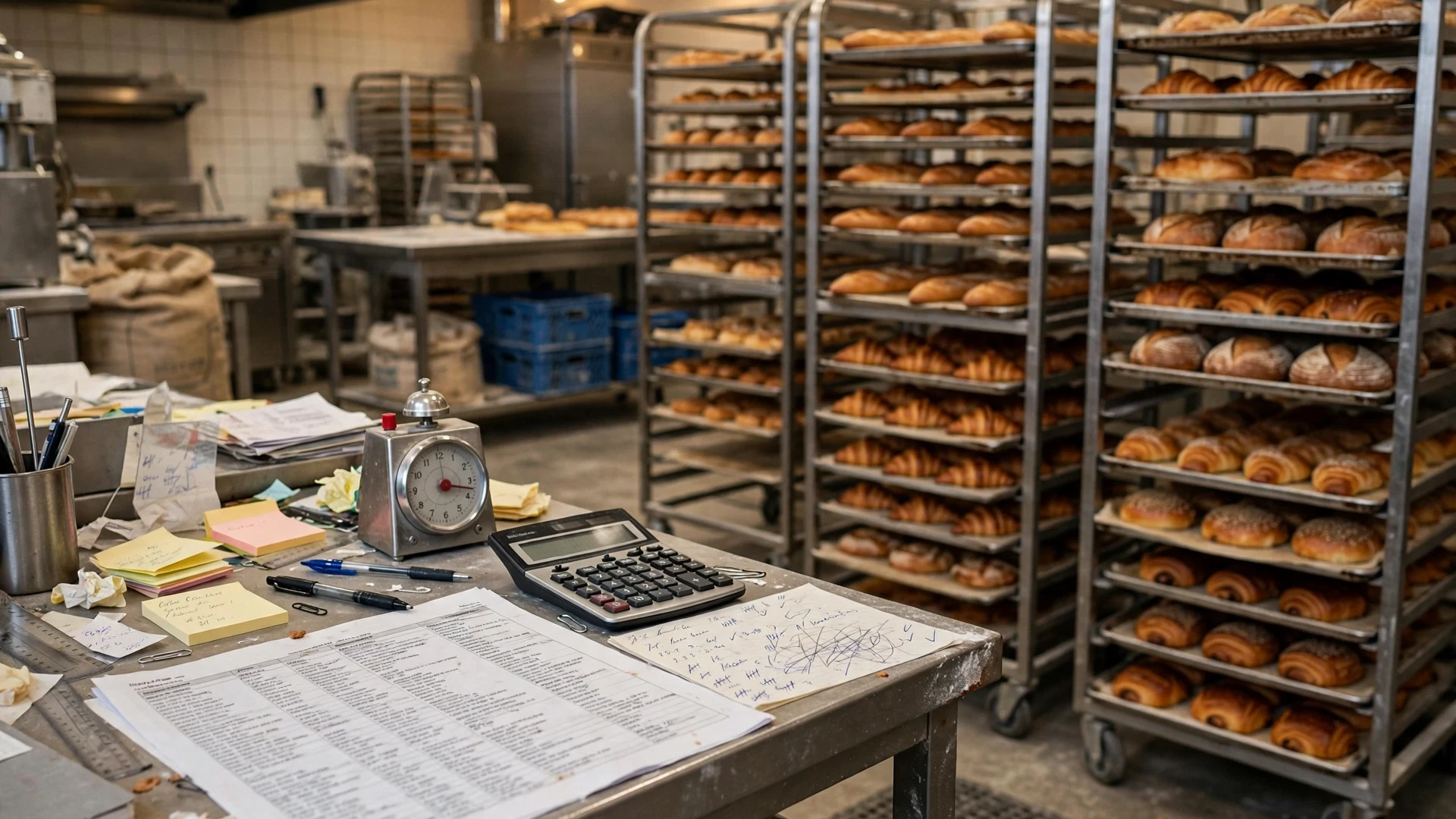
Bakeries lose money at both ends of a product’s life. Sell an item past its quality window and you lose a customer. Throw it away too early and you lose the ingredients, labor and oven time that went into it. Most of that loss comes not from bad baking but from loose dating: unlabeled trays in the cooler, handwritten codes nobody can read, no shared rule for how long a croissant counts as “today’s” and no routine for checking what is about to expire.
Quick answer: set a written shelf-life standard for each product and stage (dough, baked, filled, packaged), label every tray and package with a consistent date code, rotate stock first-in first-out, and run a short daily expiry check that decides what is sold, repurposed, discounted or discarded. Record what is discarded so production quantities and shelf-life rules improve over time.
Shelf life is a production standard, not a guess
Shelf life in a bakery means two different things that are easy to blur together:
- Quality life: how long a product meets your standard for texture, appearance and flavor. A baguette may be best for hours; a dense cake may hold for several days.
- Safety limit: how long a product can be held under specific conditions before it presents a food safety risk. This matters most for items with dairy fillings, custards, cream, cooked meats or other perishable components.
Quality life is your decision. Safety limits are governed by food safety rules, product formulation and storage conditions, and some products require refrigeration or time limits under local regulations. Write down both where they apply, and when in doubt, use the more conservative limit and confirm requirements with your local health authority.
Build a shelf-life standard for every product
Start with a simple table that covers each product at each stage where it is stored. The table becomes the reference for labels, rotation and the daily check.
| Product and stage | Storage | Quality window (house standard) | End-of-window action |
|---|---|---|---|
| Croissant dough, laminated | Refrigerated | Set by your own testing | Bake or discard |
| Croissants, baked plain | Display, ambient | Same day | Repurpose (e.g., almond croissant) or discard |
| Sandwich loaf, packaged | Shelf, ambient | Set by your own testing | Discount or discard |
| Cream-filled pastries | Refrigerated display | Within your safety and quality limits | Discard; do not repurpose |
The examples above show structure, not recommended times. Set your own windows by testing products at intervals under your real storage conditions and recording when they stop meeting your standard. Recheck them when a recipe, supplier or packaging changes.
Choose one date code system and use it everywhere
Inconsistent labels cause most dating errors. One baker writes the bake date, another writes the use-by date, and a third writes the day of the week. Pick one system and train it.
Common approaches include:
- Produced date plus use-by date on every label. Clear, but takes more writing.
- Day color system, where each production day has a label color. Fast to read at a glance, but only works if the color chart is posted and the stock of labels is controlled.
- Printed labels from a scale or label printer that add product name, produced date and use-by date automatically.
Whichever you use, each label should identify the product, the date it was produced or opened, the use-by or sell-by date under your standard, and the initials of the person who made it. Retail packaging may need additional information such as ingredients and allergen declarations, depending on how and where the product is sold.
Rotate stock first-in, first-out
Dating only works if older product is used first. Make rotation physical, not a matter of memory:
- Load new trays behind or below older trays in coolers and racks.
- Keep one designated shelf for “use first” items that are close to their limit.
- Set up display refills so the oldest items are at the front.
- Do not top up a tray of yesterday’s product with today’s product; it hides the older items.
Rotation also applies to ingredients. Flour, butter, dairy, fillings and opened packages need dates and rotation the same way finished goods do. The bakery cooling and packaging workflow is a good place to add labeling, because product is handled there anyway.
Run a daily expiry check
A short daily check, at a fixed time, catches products before they become waste or a complaint. Assign it to a named person on each shift.
- Walk coolers, freezers, racks and display.
- Pull anything past its use-by date and record it.
- Move items on their last day to the “use first” shelf or the display front.
- Decide what happens to items at the end of their window: sell, repurpose, discount or discard.
- Note unlabeled items and resolve them; if their age is unknown, treat them as expired.
The last rule is uncomfortable but important. An unlabeled tray is not “probably fine.” Discarding it teaches the team that labels matter.
Decide end-of-life actions in advance
Write down which products can be repurposed and which cannot. Day-old bread may become croutons or bread pudding; plain croissants may become almond croissants. Products with cream, custard or other perishable fillings usually should not be repurposed. Making these decisions in advance prevents improvised choices at closing time.
Discounting late-day product can recover some value, but it can also teach customers to wait for markdowns. Use it deliberately and track how much is sold at full price versus discount. If discounting becomes routine, the real fix is usually production quantity, which is covered in bakery batch planning and bakery display planning.
Wholesale, pre-order and retail need different rules
The same product can carry different dating rules depending on where it goes. Retail display items are usually sold the same day and handled by your own staff. Wholesale customers may hold your product on their own shelves for a day or more, so they need to know the produced date and the window you guarantee. Pre-orders are produced for a specific pickup time and should be dated for that customer, not mixed with display stock.
- Retail: label trays and display cards internally; rotate front to back.
- Wholesale: agree in writing how products are dated and how long your quality window lasts once delivered; see bakery wholesale order planning.
- Pre-orders: label each order with customer, pickup time and produced date, and keep it separate from display stock; see bakery pre-order planning.
Write these differences into the shelf-life table as separate rows so staff do not apply a retail rule to wholesale product, or the reverse.
Who owns the standard
Name one person, usually the head baker or production manager, as the owner of the shelf-life table and label system. They approve new windows, retest products after recipe or packaging changes, keep label stock in supply and review the discard record each week. Without an owner, rules drift as staff change and the table stops matching what happens in the cooler.
Hypothetical example: a neighborhood bakery cooler
This example is hypothetical and uses illustrative numbers.
A bakery discards an average of 14 trays of product per week, mostly from its walk-in cooler. A one-week review of the waste log shows three patterns: six trays had no label and were discarded because nobody knew their age; five trays of cookie dough were found expired behind newer batches; and three trays of filled pastries reached their limit because more were produced than sold.
The bakery makes three changes. It introduces a day-color label system with a posted chart, adds a “use first” shelf at the cooler entrance, and assigns the opening baker a five-minute expiry check before production starts. Production of filled pastries is reduced on its two slowest days.
Over the following four weeks, unlabeled-tray discards fall to zero, expired dough discards fall to one tray per week, and filled-pastry discards fall by half. If each tray represents about $18 of ingredients and labor, the reduction from 14 to roughly 4 trays per week saves around $180 per week, or about $9,360 a year. Your own figures will differ; the point is that each category of waste had a specific, fixable cause.
Track discards as data
Every product pulled during the daily check should be recorded with the product, quantity, reason (expired, unlabeled, quality failure, damaged) and the action taken. The bakery yield and waste control guide explains how to turn this record into production decisions.
After a few weeks, look for patterns:
- Products that regularly reach their limit are overproduced or have a window that is too short.
- Unlabeled items point to a training or label-supply problem.
- Expired items found behind newer stock point to a rotation problem.
- Quality failures before the end of the window suggest the standard is too long or storage is wrong.
Common mistakes
- Labeling with day names that become ambiguous after a week.
- Mixing produced dates and use-by dates on different labels.
- Letting unlabeled items stay because they “look fine.”
- Repurposing products with perishable fillings.
- Discounting every afternoon instead of fixing production quantities.
- Setting shelf-life windows once and never retesting after recipe or packaging changes.
Shelf-life and date code checklist
- Written quality window (and safety limit where applicable) for each product and stage
- One date code system, posted and trained
- Every tray, container and package labeled with product, date, use-by and initials
- FIFO loading and a “use first” shelf
- Daily expiry check at a fixed time, by a named person
- Written end-of-life actions: sell, repurpose, discount or discard
- Discards recorded with reason and reviewed weekly
Next step
This week, walk your cooler and display once and count how many items are unlabeled or labeled inconsistently. Then draft the shelf-life table for your ten highest-volume products and post it beside the cooler. Pair it with your daily production schedule so the quantities you bake reflect what actually sells inside the window.
Operational note: The figures in this article are illustrative and are not industry benchmarks. Shelf-life, date-labeling and food safety requirements vary by product and jurisdiction; follow the rules that apply to your business and consult your local health authority where needed.