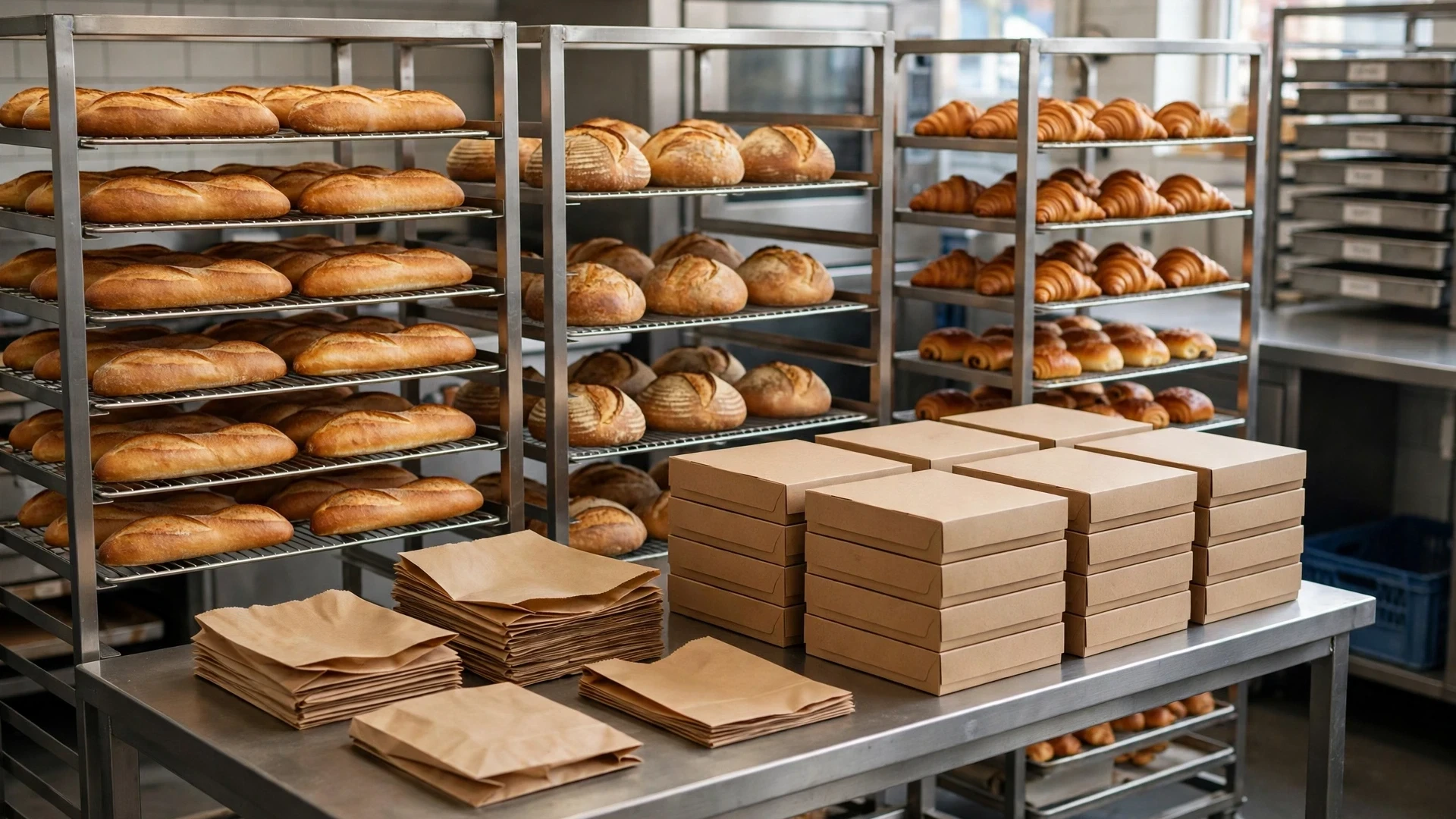
A bakery can schedule mixing, proofing and oven loading perfectly and still miss its dispatch time because the product has nowhere to go after it leaves the oven.
Cooling racks fill. Warm product reaches the packaging table too early. Labels are not printed. Boxes are still being assembled. A wholesale order waits for one loaf that has not cooled enough for the approved packing process. The oven appears to be the bottleneck, but the real queue is downstream.
Cooling and packaging should be planned as production stages with their own capacity, time and release conditions.
Map the post-oven flow
For each major product family, define the sequence after baking. The flow may include unload, depanning, rack transfer, cooling, finishing, slicing, wrapping, boxing, labeling, staging and dispatch.
Not every product needs every step. The point is to make the path visible before high-volume production begins.
Define a release condition for packaging
Avoid instructions such as “pack when cool.” Use the bakery’s approved product standard or process to define when the item can move to packaging without condensation, texture loss, deformation or other quality problems.
Where a product has food-safety controls, follow the approved food-safety procedure and applicable requirements; do not replace them with a generic cooling time from an article.
Calculate rack capacity
Cooling space can be expressed in trays, racks, loaves, pans or square feet depending on the bakery.
| Product | Output per oven load | Cooling space used | Typical post-oven path |
| Pan bread | 24 loaves | 4 rack shelves | depanning → rack cool → slice/pack |
| Pastry | 10 trays | 10 tray positions | rack cool → finish → box |
| Cookies | 12 trays | 12 tray positions | tray cool → transfer → pack |
| Cake layers | 8 pans | 8 rack positions | cool → dep pan → finish |
The values are illustrative. Build the table from actual equipment and product standards.
Treat rack turnover as capacity
A rack position used for 50 minutes is not available for the next oven load during those 50 minutes. If three oven loads finish inside a short window, the bakery must have enough rack positions for all of them or deliberately stagger the loads.
A simple check is required cooling positions versus available positions during the peak window.
Connect oven loading to cooling availability
The oven plan should not release product faster than downstream stages can absorb it.
See Bakery Oven Loading Plan: Sequence Capacity and Bake Time.
If the oven can complete four large loads between 6:00 and 8:00 but cooling space can hold only two loads at a time, the theoretical oven capacity is not the practical system capacity.
Protect airflow and product spacing
Do not overload racks or crowd product simply to create more capacity. Follow the product standard and approved equipment/process requirements for spacing, airflow and handling.
Capacity planning must respect quality and food-safety controls rather than encouraging unsafe or damaging shortcuts.
Plan the packaging station separately
- Packaging material available at the station.
- Correct box, bag, wrap or container by SKU.
- Labels and date/lot information where required by the operation.
- Scale or portion tools if final pack weight is controlled.
- Space for finished product waiting to be packed.
- Space for packed product waiting to be staged.
- Clear distinction between retail, wholesale, catering and pre-order destinations.
Use packaging takt instead of guesswork
Measure how long a typical pack cycle takes for high-volume SKUs. If one employee can pack 60 units per hour under normal conditions and a batch releases 180 units at once, the queue is roughly three labor-hours unless more trained packing capacity is assigned.
Do not publish that rate as a benchmark. Measure the bakery’s own work.
Separate cooling time from packaging labor
A product can be cooling while another batch is being packed. The production schedule should take advantage of that overlap.
Build the flow so packaging labor arrives when enough product is ready, not hours earlier and not after a queue has already formed.
Use a ready-to-pack queue
A simple board can show product, batch, quantity, oven-out time, packaging release status, destination and deadline.
| Status | Meaning |
| COOLING | product not yet released to pack |
| READY | approved for packaging |
| PACKING | work in progress |
| STAGED | packed and assigned to destination |
| HOLD/REVIEW | quality, label or quantity issue requires decision |
This prevents packers from choosing only the easiest product while a deadline-critical order waits.
Prioritize by dispatch deadline
Retail replenishment, wholesale delivery and pre-orders can compete for the same packaging table. Create a priority rule based on committed dispatch/pickup time, product sensitivity and whether another packaging window exists.
The loudest request should not determine queue position.
Check packaging-material inventory before production
A bakery can have finished product and no correct boxes. For high-volume or custom orders, packaging inventory is part of production readiness.
Verify critical materials before the batch starts, especially branded or size-specific packaging with longer supplier lead times.
Coordinate labels before the product is ready
If the operation uses product labels, wholesale labels or order labels, prepare them in advance where appropriate. Waiting for label printing after the product is cooled can turn an administrative step into the bottleneck.
Protect product identification
When several similar products cool at once, use the bakery’s approved identification method so batches do not become mixed. The label/lot process should be strong enough that staff can identify product, destination and version without relying on memory.
Plan finishing capacity
Some bakery products need glazing, icing, slicing, filling or garnish between cooling and packaging. That finishing step can be slower than packaging itself.
List finishing as its own station with labor and capacity. Do not hide it inside “cooling.”
Example: oven capacity is not the real constraint
Assume a bakery produces three pastry loads of 10 trays each. The oven can release a load every 25 minutes. The cooling rack has only 18 suitable tray positions.
After the first load, 10 positions are occupied. When the second load arrives, 20 positions are required but only 18 exist. Unless trays can be moved to another approved cooling area, the second load already creates a capacity conflict.
The fix may be a different bake sequence, more approved rack capacity, a changed batch size or a product mix that uses cooling space differently.
Plan pack-out backward from dispatch
- Set the dispatch or pickup deadline.
- Subtract staging/loading time.
- Subtract packaging time based on quantity and staffing.
- Subtract finishing time if required.
- Subtract the approved cooling/release stage.
- Set the latest oven-out time.
- Work backward into proof, makeup and mixing as needed.
Use actual queue data
For one week, record the time product leaves the oven, becomes ready to pack, starts packaging and finishes packaging. That creates three useful intervals: cooling/release time, waiting time after ready, and active packaging time.
Long waiting after the product is ready indicates a packaging-capacity problem. Long cooling/release time may be normal for the product or may show that the bake sequence creates too many overlapping loads.
Create a cooling-zone map
A rack count alone can hide location constraints. Map which racks or shelves are suitable for which product families, where they can stand without blocking aisles, and how product moves from oven to rack to finishing and packaging.
The best location is not always the closest empty space. Movement should avoid cross-traffic, unstable stacking and interference with raw-production areas or other controlled zones. Follow the bakery’s approved food-safety and facility procedures.
Standardize rack labels and batch identity
When several batches of similar bread or pastry are cooling, the rack should tell the next employee what the product is, when it left the oven, its destination and whether it is still cooling or ready for the next step.
A simple removable rack card can reduce mix-ups between retail, wholesale and special-order production, especially when products look similar before labeling or final finish.
Build a packaging-material bill of use
For the main SKUs, document which box, bag, liner, label, seal or insert is required. This creates a packaging bill of use that purchasing can connect to sales and production forecasts.
If 400 wholesale loaves require one bag and one label each, packaging stock should be planned from that production requirement rather than from a vague weekly par. Custom boxes or branded labels with long supplier lead times deserve special attention.
Use a packaging readiness check before peak production
- Correct packaging SKUs are physically available.
- Printers, label rolls and date/lot materials are ready where used.
- Boxes or cartons that require assembly are prepared in the needed quantity.
- Wholesale or catering order labels match the production schedule.
- Finished-goods staging areas are clear.
- Any scales or sealing equipment required for packaging are operating normally.
Track rework caused by the downstream process
Packaging defects can create hidden production cost. Examples include crushed pastry, condensation, torn wrappers, wrong labels, incorrect pack count, open seals or product mixed between orders.
Record rework and write-off by cause. If repeated defects come from packaging too soon, the fix belongs in release timing. If the issue is wrong packaging selection, it belongs in the SKU/control sheet. If labels are wrong, the administrative handoff needs correction.
Protect wholesale count accuracy
Wholesale production often requires exact pack counts by account. Use a count-and-stage step before loading: expected units, packed units, damaged/rejected units, replacement units and final dispatched quantity.
This prevents the cooling/packaging area from sending partial orders simply because the product looked complete on the rack.
Balance packaging labor across the shift
Packaging demand is usually lumpy. Instead of scheduling a fixed packer all day, a small operation may cross-train an employee who moves into packaging during known release windows. Larger bakeries may need a dedicated team.
The staffing decision should follow measured ready-to-pack volume, not the assumption that packaging is “light work” that someone can fit in between other tasks.
Build an exception path for held product
If a batch has a quality, label, count or food-safety concern, move it to a clearly controlled HOLD/REVIEW status rather than leaving it in the normal ready queue. Identify who can release, rework or dispose of the product under company procedures.
A hold area and decision owner prevent a questionable batch from being packed accidentally during a busy dispatch window.
Manager daily recheck
- Peak cooling-rack utilization.
- Products waiting after they are ready to pack.
- Packaging material shortages.
- Labeling delays or errors.
- Wholesale/pre-order deadlines missed.
- Rework caused by packing too early or using the wrong packaging.
- Packed product that waited too long before dispatch.
Common cooling and packaging mistakes
Scheduling only to oven-out time
The order looks complete while it is still too early to package or dispatch.
Using cooling racks as permanent storage
Tomorrow’s production has no free capacity.
Packing warm product to clear the rack
The bakery sacrifices quality or approved process control to solve a scheduling problem.
One packaging table for every channel with no priority rule
Retail, wholesale and pre-orders block each other.
No packaging-material readiness check
Finished product waits for boxes, bags or labels.
Frequently asked questions
How much cooling rack capacity does a bakery need?
Calculate it from actual product mix, oven release pattern, approved cooling/release requirements and peak overlap. There is no universal rack-per-oven ratio.
Should packaging staff start with production staff?
Not automatically. Schedule them around the actual ready-to-pack workload and any packaging preparation required before product release.
Can a bakery speed up cooling just to improve throughput?
Only within approved product, equipment and food-safety procedures. Do not improvise cooling methods to solve a capacity problem.
What is the best metric for this workflow?
Track ready-to-pack waiting time and missed dispatch deadlines alongside rack utilization. One metric alone can hide the real constraint.
Next action
Tomorrow, mark four times on the five highest-volume bakery batches: oven out, ready to pack, packaging start and packaging finish. Any long gap between ready and start is visible packaging queue. Any rack shortage before the next load arrives is visible cooling-capacity pressure.
Related guides: