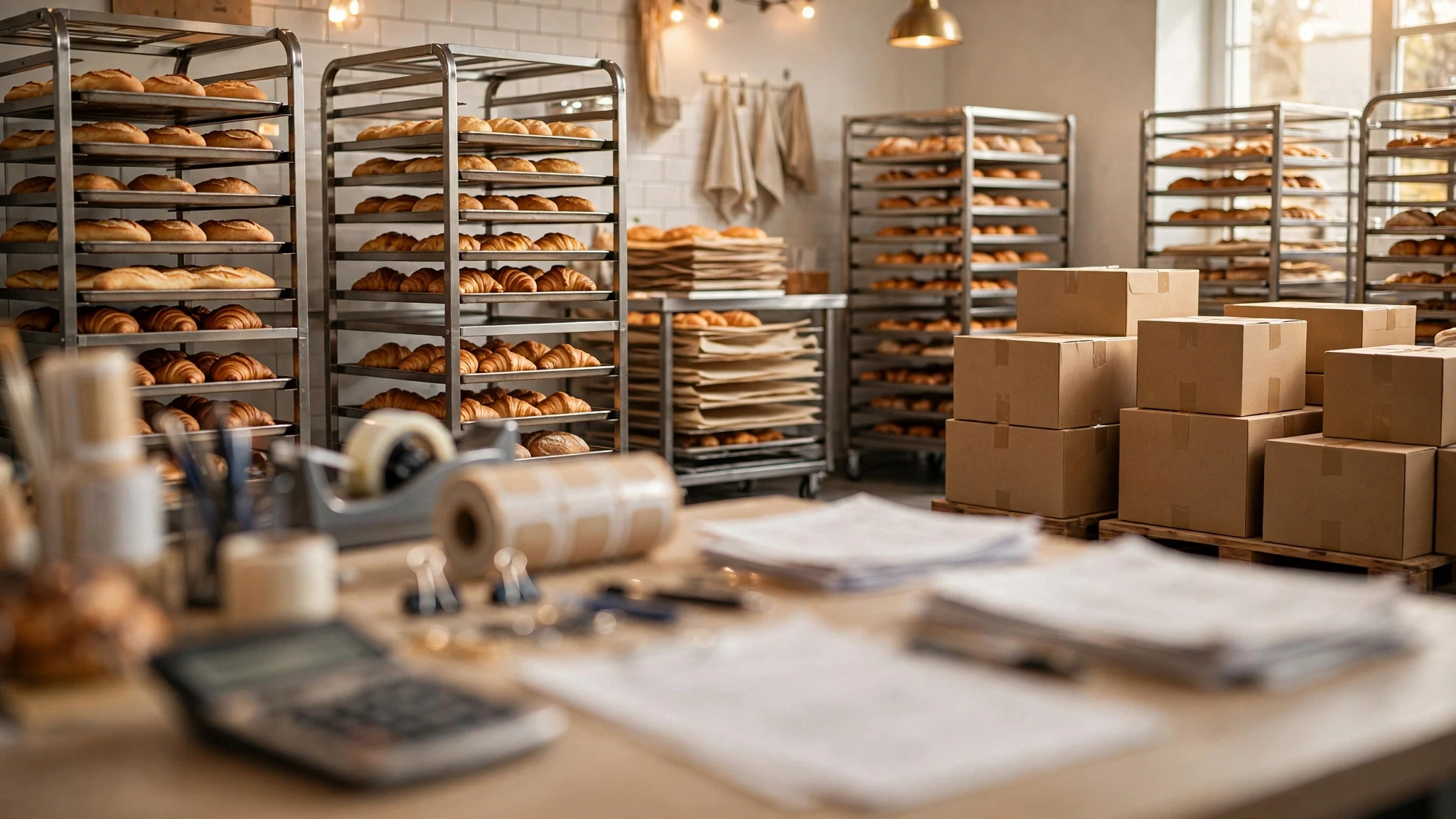
Wholesale bakery sales look predictable because customers often order on a recurring schedule. That predictability can become a trap when standing orders are treated as background volume instead of firm production commitments.
A hotel adds ten loaves for Friday, a cafe changes pastry mix, one account pauses for a holiday, and a new customer asks for a trial order. Meanwhile the retail forecast is still built from historical production that already included wholesale output.
Wholesale order planning separates committed account demand from retail forecast demand and converts both into a production plan the bakery can actually execute.
Create one wholesale order master
For each account, record delivery days, standard products, standing quantities, order/change cutoff, pricing reference, packaging, label requirements, route/delivery window and contact/approval process.
The order master should show the normal commitment; daily/weekly changes should update a controlled order record rather than rewriting memory.
Distinguish standing order from confirmed order
A standing order is the default expectation. A confirmed order is what the bakery will actually produce for the specific date after approved changes, pauses or holiday adjustments.
For stable accounts, confirmation can be automated or exception-based. The operating system still needs a clear final quantity.
Separate wholesale demand from retail forecast
Historical bakery production may contain both retail and wholesale units. If tomorrow’s wholesale orders are added on top of a forecast that already assumes the same wholesale volume, the bakery double counts demand.
Build separate demand streams: confirmed wholesale, confirmed preorder/catering, and forecast retail. Then combine them into production requirements.
Aggregate by SKU before scheduling batches
| Demand source | Croissants | Sourdough | Muffins |
| Wholesale accounts | 180 | 90 | 120 |
| Retail forecast | 140 | 70 | 90 |
| Pre-orders | 20 | 12 | 24 |
| Total planned units | 340 | 172 | 234 |
The numbers are illustrative. Aggregation prevents the bakery from producing the same recipe separately for every account when one controlled batch sequence can serve several channels.
Convert units into tested batches
Use the product’s standard batch yield and approved production constraints.
If one croissant dough batch reliably produces 120 saleable units, 340 planned units require a deliberate batch decision—such as three full batches with a planned remainder use—rather than ‘about three batches.’
Reserve capacity by deadline
Wholesale orders often have earlier dispatch times than retail peaks. Backward-plan from route departure: packaging, cooling, finishing, baking, proofing and mixing.
Bakery Cooling and Packaging Workflow: Prevent Bottlenecks After the Oven.
Protect retail capacity
A large wholesale order can consume the morning’s oven or finishing capacity and leave the retail case empty.
Before accepting a new account or major increase, model the shared bottleneck: oven loads, proofer, cooling racks, decorating/finishing, packaging or delivery route.
Define account change cutoffs
A cafe changing 30 pastries to 90 after dough preparation can create waste or overtime. Set order/change cutoffs from actual production lead time and supplier/packaging constraints.
Commercial consequences should follow the wholesale agreement. Do not improvise late-change fees that were never agreed.
Control account-specific packaging and labels
Wholesale orders may need branded labels, ingredient/allergen information under applicable requirements, case packs, delivery notes or account-specific cartons.
Plan these materials from the confirmed order, not as an afterthought at dispatch.
Use a pick/pack sheet by account
| Account | Product | Required | Packed | Exception |
| Cafe A | croissant | 60 | ||
| Hotel B | sourdough | 24 | ||
| Market C | muffin assorted | 48 |
The production plan groups by SKU; the pack sheet splits finished production back into account quantities.
Control substitutions
Do not substitute wholesale products or pack configurations casually. An account may have menu, label, allergen, brand or resale commitments based on the agreed product.
If a substitute is necessary, use the approved communication and product-specification process.
Build the route from ready-time and delivery window
Production completion and route planning are connected. A route cannot leave at 6:00 AM if a key account’s product is not expected to be pack-ready until 6:20.
Sequence production and loading around committed delivery windows and vehicle capacity.
Handle returns and credits separately
If wholesale agreements allow returns, damages or credits, record them by account/product/reason. Do not subtract returned units from tomorrow’s production forecast without understanding whether the cause was demand, quality, transport or ordering error.
Use account profitability, not revenue alone
A large wholesale account can produce high sales and weak contribution after discounted price, packaging, route cost, special labor and returns.
Track contribution at a level the bakery can support with real data. Avoid invented allocations that make the account look more precise than the records allow.
Set a minimum viable order deliberately
Small orders can consume the same invoice, packaging and delivery stop as larger orders. If the bakery uses minimums, base them on actual account economics and route/service strategy.
The rule belongs in the wholesale agreement, not a hidden production assumption.
Manage holiday exceptions
Wholesale demand can change sharply around public holidays, school calendars or client closures. Confirm exception weeks early and temporarily adjust production instead of applying the normal standing order.
Measure forecast and order accuracy
- Standing quantity versus confirmed quantity.
- Confirmed quantity versus shipped quantity.
- Returns/credits by account.
- Late account changes.
- Production overtime caused by wholesale changes.
- Wholesale demand that displaced retail capacity.
- Unused packaging/account-specific stock.
- Route delays linked to production.
Example: a new account looks easy
A cafe asks for 100 pastries every weekday. The bakery has enough total daily volume on paper, but the order must leave before 6:30 AM. That requirement overlaps the oven and packaging window for two existing hotel accounts.
The true constraint is early-morning capacity, not total daily capacity. Management can adjust sequence, staffing, equipment use or delivery terms before accepting the account.
Common wholesale-planning mistakes
Adding wholesale on top of a blended historical forecast
Demand is double counted.
Scheduling by account instead of SKU
The bakery misses efficient combined batches.
Accepting quantity without checking dispatch deadline
Total capacity exists, but not at the required time.
Ignoring account-specific packaging
Production finishes while orders cannot ship.
Judging accounts by sales only
Route, packaging and discounted price can erase expected margin.
Frequently asked questions
Should wholesale orders be produced before retail product?
Schedule by committed ready/delivery time and shared production constraints. Wholesale does not automatically outrank retail; its deadline is simply more explicit.
How should standing orders be confirmed?
Use a process proportionate to account stability—explicit confirmation or exception-based confirmation—but maintain one final production quantity.
How many wholesale accounts can a bakery support?
Measure constrained capacity and route/service workload, not account count alone.
Should wholesale customers be allowed to change orders late?
Set rules from real production lead time and state them in the account agreement. Operationally, recheck capacity before approving the change.
Next action
Take next week’s wholesale orders and separate them from retail forecast units. Aggregate all accounts by SKU, convert those units into tested batches, then map the earliest delivery deadline against oven, cooling and packaging capacity. Any collision is visible before production starts.
Related guides: