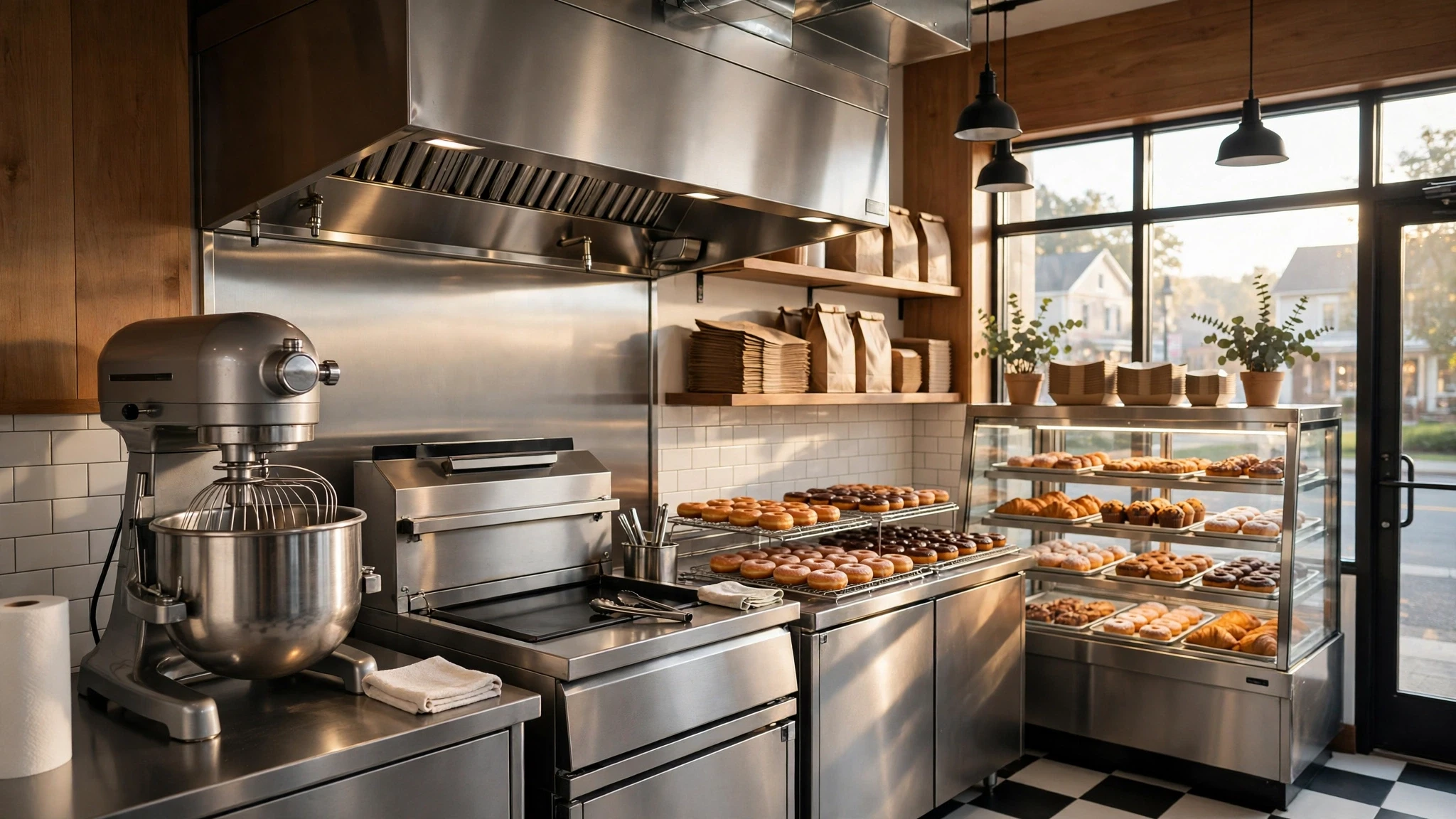
A donut shop can look inexpensive from the customer side: a counter, a pastry case, and a queue in the morning. Behind that counter are costs that many first-time operators underestimate—ventilation, grease handling, production equipment, overnight staffing, refrigeration, a lease, and cash reserves for the weeks when sales are slower than forecast.
Quick answer: There is no credible single U.S. price for opening every donut shop. A compact retail shop buying finished donuts wholesale needs a different budget from a shop frying and glazing its own products. This guide models $203,000 of required startup cash for one hypothetical independent shop making donuts on site, including a $35,000 post-opening reserve. This is an exercise, not a national average, equipment quotation, or expected outcome. Your address, permitted use, production method, and contractor bids determine the real number.
First choose what the shop actually produces
Before considering real estate, decide whether the concept is a wholesale-resale counter, a finishing bakery that receives frozen or par-baked product, or a full on-site donut operation. A finishing shop may require less mixing and frying equipment, but it becomes dependent on supplier quality, delivery timing, and wholesale costs. On-site production provides recipe control yet adds equipment, early production shifts, oil management, sanitation, allergen handling, and possibly more extensive ventilation.
Clarify the sales mix as well. A neighborhood breakfast shop might depend on singles, half-dozens, coffee, and pre-orders. A wholesale-heavy concept serving offices and convenience outlets needs packaging, dispatch space, billing discipline, and capacity for batch production. A kiosk may have low square footage and limited storage, while a full bakery has higher upfront commitments. Franchise models add separate brand fees, mandatory equipment, design, royalty, and advertising obligations; none is included in the example below.
Write a one-page operating specification before requesting bids: daily donuts by type, peak dozens per hour, equipment capacity, beverage service, pickup window, staffing by shift, opening hours, and expected order channels. That document will give contractors and vendors something concrete to quote.
Itemized example: a $203,000 donut shop startup budget
The following sample assumes a leased small storefront, an on-site production process, basic coffee service, and no full-service dining room. All numbers are invented for planning purposes. They are not market prices.
| Startup cash requirement | Illustrative amount |
|---|---|
| Lease deposit, prepaid rent, and occupancy setup | $12,000 |
| Construction, plumbing, electrical, and ventilation work | $52,000 |
| Donut fryer, mixer, proofer, and production equipment | $42,000 |
| Refrigeration, display cases, and storage | $16,000 |
| Counter, furniture, signs, POS, and smallwares | $8,000 |
| Permits, professional advice, insurance setup | $6,000 |
| Opening ingredients, packaging, and oil inventory | $5,000 |
| Recruiting, training, and pre-opening payroll | $8,000 |
| Launch photography and initial marketing | $4,000 |
| Construction and commissioning contingency | $15,000 |
| Pre-opening cash uses | $168,000 |
| Post-opening operating cash reserve | $35,000 |
| Total opening cash requirement | $203,000 |
The $35,000 reserve is cash held for use after opening, not an additional piece of equipment. If an owner takes a loan for the fryer, distinguish gross loan principal, cash actually deposited, vendor payments made directly by the lender, and future debt service. Never subtract a lender-paid asset from startup uses and also count that same direct vendor payment as cash available in the bank.
A storefront that was previously an approved bakery may cost less to adapt, but do not assume its utilities, ventilation, grease controls, or accessibility meet your proposed operation. Conversely, converting a plain retail shell can make the build-out one of the largest risks. Get written quotations and explicit landlord/health-authority guidance before signing an unconditional lease.
Construction and equipment: what actually changes the cost?
A production shop may need a dough mixer, dough-handling worktables, proofing capacity for yeast-raised items, commercial fryers, oil-filtering or disposal arrangements, cooling and glazing stations, refrigeration, appropriate sinks and warewashing, racks, display cabinets, and coffee equipment. The right equipment list depends on the menu and process, not the number of customers on opening day.
Ask equipment suppliers for installed cost, shipping, electrical/gas requirements, access clearance, maintenance schedules, warranty, technician coverage, and replacement-part availability. A cheap used fryer that creates downtime on a Saturday can be more expensive than the apparent purchase saving. Investigate safe oil handling, approved hood and fire-suppression design where required, and wastewater arrangements with qualified local professionals. Do not improvise these systems to fit a spreadsheet budget.
Test capacity backwards. If your busiest morning needs 500 saleable donuts before 8 a.m., how many production cycles, staff hours, rack spaces, glaze steps, and cooling minutes does that require? How many rejects or overproduced units will you tolerate? The menu can overtax a kitchen long before the register looks busy.
A donut’s food cost is not the same as its selling price
Batch costing should capture flour, sugar, yeast, shortening or oil consumption, fillings, icings, toppings, boxes, napkins, cups, shrinkage, and the cost of donuts that never sell. Separate food and packaging cost from labor and occupancy, even when you later examine them together in prime cost.
For example, suppose a blended customer transaction is $9.50 across single donuts, boxes, and beverages. If the fully modeled order-variable cost—including ingredients, typical packaging, processing and variable selling expense—is $3.10, the contribution toward fixed costs is $6.40 per transaction. That does not mean $6.40 is net profit. Remaining payroll, lease, insurance, depreciation, owner pay, repairs, taxes, and financing may consume the contribution.
The most dangerous error is costing only the donut that sells. Suppose 1,000 donuts are made, 850 sell, and 150 are unsold. Ingredient and production-loss analysis must consider the 1,000 produced, not pretend the 150 disappear from the inventory ledger. Rather than automatically declaring all unsold donuts waste, track donations, permitted recovery, staff meals, and safe disposal appropriately. Donated items still have economic cost.
For practical procedures, see our guides on recipe costing, portion control, and bakery shelf-life controls. The published shelf-life control guide is particularly relevant to filled pastries and display rotation.
Calculate the orders required to break even
The U.S. Small Business Administration explains the fundamental formula as monthly fixed costs divided by contribution per unit. SBA break-even calculator.
Assume $22,000 monthly fixed and semi-fixed costs, after classifying the order-variable amounts separately. Under the illustrative average ticket and variable costs above:
- Contribution per transaction: $9.50 − $3.10 = $6.40.
- Break-even transactions per month: $22,000 ÷ $6.40 = 3,437.5, rounded up to 3,438.
- At 26 trading days, the shop needs 133 transactions per open day, rounded up.
- Break-even sales at that mix are approximately $32,661 per month (3,438 × $9.50).
This result is only a threshold under the modeled cost structure—not a safe sales target, lender forecast, or owner’s income. If the owner needs a wage that is missing from fixed costs, add it. If a delivery channel costs more per order, use channel-weighted contribution rather than a single optimistic cost percentage. If you sell far more boxes than individual donuts, test the actual average order composition.
Try your own assumptions with the break-even sales calculator and our free startup budget planner.
Three operating cases: do not forecast one perfect morning forever
| Modeled monthly transactions | Estimated sales at $9.50 | Contribution at $6.40 | Remainder after $22,000 fixed costs |
|---|---|---|---|
| 2,600 | $24,700 | $16,640 | −$5,360 |
| 3,600 | $34,200 | $23,040 | $1,040 |
| 4,800 | $45,600 | $30,720 | $8,720 |
The remainder is before any unmodeled owner pay, financing, income tax, capital replacement or exceptional repair. These cases intentionally hold cost per transaction and fixed costs constant to demonstrate sensitivity. Actual production labor and supply purchases may change in steps as volume changes.
Donut demand may concentrate in the early morning and weekends. A flat annual average can conceal weekdays that barely cover payroll and weekends that require overtime. Model individual dayparts, holiday effects, nearby school calendars, office occupancy, weather, and catering or corporate orders rather than claiming a uniform daily order count.
Build an opening cash runway, not just an equipment budget
The opening reserve should answer: how many weeks can the business pay rent, minimum staffing, utilities, essential inventory, insurance, and necessary debt service if sales start slowly? Build a cash calendar showing when lease deposits, equipment installments, contractor draws, inspections, training payroll, and supplier deposits actually leave the bank.
For a practical first forecast, separate (1) cash spent before opening, (2) cash remaining on opening day, (3) weekly receipts, and (4) weekly cash payments. A line of credit should not be confused with cash already available. Funds promised by an investor should not enter the bank forecast until the commitment and timing are credible.
Use our working-capital guide to structure the review. The companion article, How Much Do Donut Shop Owners Make?, uses a separate annual earnings model; it is not a prediction based on this startup budget.
Regulatory and food-safety checks before signing
Retail bakeries are generally subject to the state and local authorities governing their particular facilities. The FDA Food Code is a model for jurisdictions, not a substitute for the rules adopted in your city or county. Start with the FDA’s food-business overview and then confirm your exact approvals with the local authority having jurisdiction.
Address handwashing facilities, cleaning and sanitizing, allergen communication, employee training, storage conditions, safe oil practices, grease/waste handling and the appropriate response to temperature-control failures. Donuts containing dairy fillings and other time/temperature-controlled ingredients can introduce handling requirements beyond plain shelf-stable baked goods. Ask regulators rather than assuming one rule applies to every filling.
Donut shop launch checklist
- Define production model, menu, expected batches, service hours, and sales channels.
- Obtain a lease term sheet with all occupancy charges and improvement obligations.
- Confirm zoning, permitted food use, required health approvals, ventilation and fire protection before commitment.
- Obtain at least two meaningful equipment or build-out quotations where feasible.
- Model labor by actual production shift, not only counter opening hours.
- Build recipe and packaging costs using saleable output and expected unsold units.
- Calculate break-even checks with variable costs and fixed costs separated.
- Prepare a conservative 13-week cash forecast and explicit liquidity minimum.
- Test refrigeration/fryer failure and delayed opening contingencies.
- Document final owner approval before signing the lease or buying major equipment.
Frequently asked questions
Can I open a donut shop for less than $203,000?
Possibly. A reseller counter or appropriately equipped second-generation food premises may require much less upfront capital. An extensive on-site production fit-out could require considerably more. The $203,000 is hypothetical, not a minimum, median, or national average.
Do I need to buy a new donut fryer?
Not necessarily. Used equipment may be suitable after professional inspection, but verify capacity, safety approval, installation requirements, parts, and operating history. A used machine is not a saving if it fails during the busiest production window.
How many transactions per day does the example need?
The worked model requires 133 transactions per day over 26 trading days, using a $9.50 realized ticket, $3.10 order-variable cost, and $22,000 monthly fixed costs. Your business needs its own assumptions and may have different peak-hour constraints.
Is the owner paid once the shop reaches break-even?
Only if owner compensation was already included in fixed costs. Otherwise, accounting or operating break-even is not the same as owner take-home pay. Financing, income taxes, working-capital needs, and reinvestment can reduce cash available for the owner.
Should I forecast wholesale accounts as retail transactions?
No. Wholesale accounts may pay lower unit prices, order in larger volumes, require delivery, and pay after invoice terms. Model their contribution and cash collection separately from retail checks.
Sources and methodology
- U.S. Small Business Administration — Break-even point calculator: formula and cost classification.
- FDA — How to Start a Food Business: regulatory overview and local jurisdiction guidance.
- FDA — Food Code 2022: nonbinding model food-safety provisions, subject to jurisdiction adoption.
- National Restaurant Association — 2025 Operations Data Abstract: context that restaurant costs vary by type; not a donut-shop cost quote.
Editorial method: Every $203,000 budget item, the $9.50 ticket, $3.10 variable cost, monthly costs, sales case, and break-even estimate are editorial assumptions created to illustrate the calculation. No empirical national startup cost range is asserted. Financial, tax, and legal decisions require location-specific professional review.