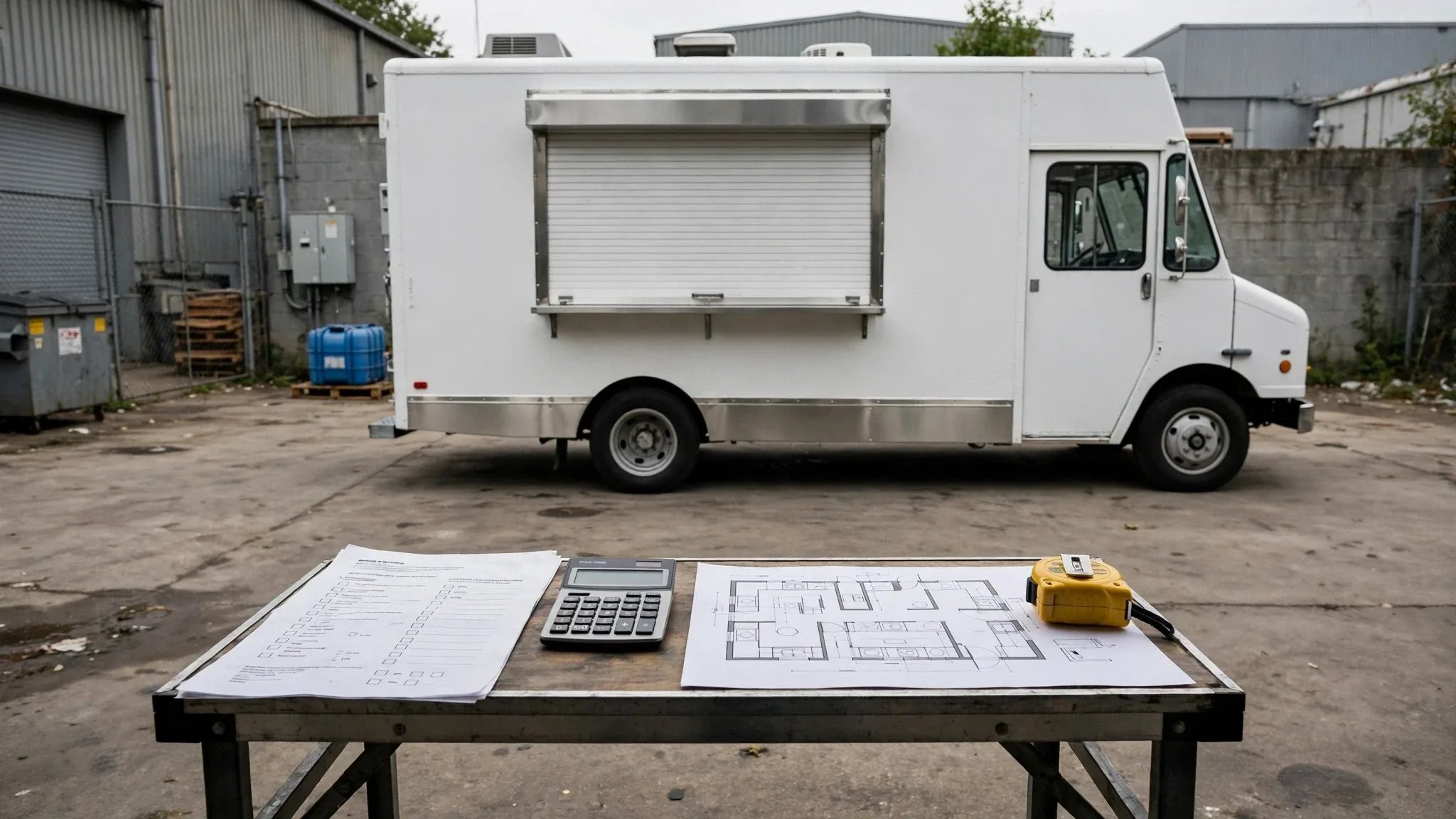
A food truck looks inexpensive compared with a dining-room restaurant because it does not need a conventional dining area. Yet a licensed commercial kitchen on wheels is not just a vehicle. It is a menu-specific production space with power, water, refrigeration, exhaust and fire controls, a route to a permitted service location, and enough liquidity to survive vehicle breakdowns and irregular event sales.
Quick answer: Toast’s August 2026 food truck cost guide gives roughly $75,000 to $250,000+ as a practical broad startup budget, with lean used operations sometimes costing less. The range is not a quote for your county. What matters is whether it includes the vehicle, licensed kitchen configuration, equipment, inspection work, commissary, inventory, insurance and cash needed after launch.
Free opening budget worksheet: Enter your own local startup costs and cash reserve, calculate optional break-even orders, and download your estimate as a CSV. Sample amounts are illustrative.
Decide whether you really need a truck
Four business formats may serve a similar customer:
| Format | Potential cost advantage | Operating limitation |
|---|---|---|
| Pop-up or tent with licensed preparation elsewhere | Minimal vehicle investment | Event dependence and limited production/storage capacity |
| Food trailer | May use a lower-cost towable kitchen | Requires tow vehicle, approved parking, utility access |
| Used food truck | Equipment may already be installed | Unknown mechanical condition, certification and expensive retrofits |
| Newly fitted truck | Production flow built around your menu | Capital cost and long fabrication/inspection lead time |
Do not buy the first affordable truck before finding out where you can legally prepare food, park, vend, dump wastewater and store ingredients. Some jurisdictions require or restrict commissary use; others impose event, route or site-specific conditions. Your municipal and state authorities—not a generic online checklist—determine the rules.
Start with the menu and production capacity
Write the proposed menu as actual dishes, components, production temperatures and peak orders per hour. Then answer:
- What must be cooked on the vehicle, and what can be prepared in an approved commissary?
- How much refrigeration and frozen storage does each service require?
- How much water, power, ventilation and fire suppression is needed?
- What is the realistic workflow for receiving, cooking, plating, payment and handoff?
- Can two staff pass each other safely during the rush?
- How will the truck operate if a fryer, generator or payment terminal fails?
These answers determine equipment, electrical load, plumbing, fire review and staffing. Buying an under-equipped vehicle and retrofitting later may cost more than choosing the right configuration from the beginning.
Itemize the opening investment
Vehicle purchase and mechanical inspection
Request a detailed independent mechanical inspection. Check engine hours or mileage, brakes, tires, generator, electrical systems, corrosion, equipment age, service history and any local vehicle-compliance requirements. The seller’s claim that a truck is “ready to work” is not an approval from your local health or fire authority.
Kitchen installation and compliance
Compare what is already installed against the actual menu. Include cooking line, hot holding, refrigerators, prep counters, sinks, potable and wastewater tanks, ventilation, fire suppression, electrical work and licensed contractors. An installed appliance’s sticker price does not tell you what it costs to make the complete kitchen operational. If you are comparing a taco truck with a fixed storefront, the taco shop startup costs guide models the brick-and-mortar version line by line.
Licenses, operating access and insurance
Budget for business registration, required food-safety inspections and permits, local vending rights, commissary agreements where relevant, auto and liability cover, equipment and product protection, site or event fees and contract reviews. Confirm permit sequencing before fabrication or making nonrefundable payments. The FDA Food Code is a model; the adopted local version controls your operating obligations.
Launch inventory, technology and working capital
The truck needs ingredients, disposables, menu boards, payment equipment, mobile data access, cleaning supplies, uniforms, initial marketing and a cash reserve for vehicle repair, adverse weather, permit delays and low-demand weeks. Separate the first inventory fill from ongoing food purchases; do not count the same supplies twice.
Worked example: a hypothetical $155,000 used-truck launch
Assume a used truck with a functioning base kitchen, a focused hot-food menu and a U.S. market where a separate commissary agreement is available. Every figure is illustrative, not a vendor quote or typical national average.
| Item | Illustrative cost |
|---|---|
| Used truck and base installed kitchen | $65,000 |
| Menu-specific alterations, servicing and kitchen updates | $18,000 |
| Licensing, inspections and professional support | $5,000 |
| Initial insurance premiums and related deposits | $4,000 |
| POS, networking and power-related setup | $6,000 |
| Exterior wrap, signs and menu boards | $5,000 |
| Opening food, packaging and disposables | $5,000 |
| Commissary and approved parking deposits | $3,000 |
| Launch marketing and trial events | $3,000 |
| Repair and purchasing contingency | $11,000 |
| Working-capital reserve | $30,000 |
| Total launch funding | $155,000 |
The base vehicle cost above includes the base kitchen, so the $18,000 is only additional work. If a vendor sells the truck without equipment, you must price that separately. A trailer that needs a towing vehicle, a new custom fabrication or a high-cost event location may create a different total.
How much does a food truck cost monthly?
A truck replaces certain building costs with costs that many first-time operators underestimate. The operating budget can include:
- Ingredients, cooking oil, sauces, packaging and waste.
- Paid kitchen/serving labor, payroll taxes and workers’ compensation where applicable.
- Commissary or approved kitchen fees, storage, parking and waste disposal.
- Fuel, maintenance, generator fuel, inspections and a realistic repair reserve.
- Site rental, event admission, organizer fees and any revenue-share commissions.
- POS fees, insurance, mobile data, marketing, banking and administration.
- Scheduled loan payments and any required asset replacement in the cash forecast.
Event fees may be fixed, variable or a mix. Treat them according to the contract, not automatically as rent. An apparently profitable market-day event can become unprofitable once a high organizer fee and extra labor are included.
Break-even sales: calculate service days and checks
Suppose you forecast $12,000 of monthly fixed operating expense and a 55% contribution margin after genuinely variable costs. Break-even sales before owner salary not already expensed, financing and cash taxes would be:
$12,000 ÷ 0.55 = $21,818.18 per month.
If the average paid check is $15, the truck needs approximately 1,455 checks per month, or 73 checks across 20 trading days, rounded up. That is a transaction target, not necessarily the number of unique customers.
Now test the calendar. What happens if weather cuts the month to 14 days? The same $21,818.18 in required monthly sales becomes approximately 104 checks per operating day. Suddenly the calendar and site quality matter at least as much as the menu price.
Use the Restaurant Break-Even Sales Calculator and model event fees and labor honestly. Do not hide weather or seasonal downtime inside optimistic annual averages.
Compare realistic locations, not only foot traffic
A busy street is not automatically a permitted or profitable vending location. Confirm who controls the site, how many trucks compete for the same demand, what the organizer charges, power availability, trash and water access, weather exposure, order queue space, traffic restrictions and the actual demographic demand for your menu.
A calendar built entirely around uncertain events carries different risk from a recurring weekday corporate-lunch location. You need a backup sales plan for cancellations, construction and seasonal gaps.
Financing and the used-truck trap
A lower purchase price does not automatically mean a lower total cost of ownership. A poorly maintained generator or refrigeration system can destroy inventory and lose high-value bookings. Conversely, expensive new equipment financed on rigid terms may force the business to hit aggressive sales targets before a reliable customer base exists.
Compare total cost, not just the monthly loan installment: down payment, interest, fees, maintenance, licensing, expected resale value, downtime and the amount of cash remaining after purchase. Keep loan principal separate from operating profit calculations. Model cash debt service as part of the monthly runway.
Food truck launch readiness checklist
- ☐ Menu and target service volume established.
- ☐ Health, fire, vending and commissary requirements confirmed locally.
- ☐ Vehicle inspected mechanically and against menu equipment needs.
- ☐ Equipment quote distinguishes included base kitchen from add-on work.
- ☐ Parking, operating locations and event contract costs documented.
- ☐ Ingredients and packaging priced by saleable portion.
- ☐ Owner and paid labor included in the correct financial categories.
- ☐ Downside scenario assumes fewer trade days and unplanned repairs.
- ☐ Working capital remains after all opening invoices are paid.
- ☐ Service-day break-even checks calculated and tested against throughput.
Mistakes that quietly undermine returns
A food truck can be fully booked yet generate poor cash flow. Common explanations include underpriced event catering, too much menu complexity, a long drive between selling opportunities, inaccurate ingredient yield, unpaid owner labor, card fees, high organizer commissions and a generator that fails at the worst time. Measure event contribution and use supplier price comparison before assuming sales growth will cure cost leakage.
Your first months should produce a weekly report with checks, sales, food cost, day-by-day location performance, paid and owner hours, waste, repair expense, and remaining cash. Our weekly cash-flow forecast and daily manager sales review provide the underlying framework.
Frequently asked questions
Can I start a food truck for $30,000?
A simple cart, small trailer, pop-up or unusually favorable used-equipment situation might require less capital than a full food truck, but a fully licensed, fitted vehicle with sustainable reserve cash may cost far more. Get specific local quotes and permits before treating $30,000 as a complete truck budget.
Is a food truck cheaper than a restaurant?
Often the upfront investment is lower than a full-service restaurant, but the truck has distinct mechanical, mobility, site-access and weather risk. Lower opening cost does not guarantee higher profits.
How quickly will a food truck pay back its startup investment?
Payback depends on cash available after operations, tax, debt service and the owner labor requirement, not on sales alone. A hypothetical $155,000 investment does not “pay back in one year” because revenue is $155,000. Model cumulative free cash after true operating costs and reinvestment. The food truck earnings guide shows how to build that monthly operating result before owner pay.
Bottom line
A food truck launch budget must cover the truck and a legal operating model, a reliable menu-specific kitchen, a defensible selling calendar and cash for inevitable disruption. Start with unit economics and permitted locations, then decide how much vehicle you can afford—not the reverse.
Research sources
- Toast: How Much Does a Food Truck Cost to Start in 2026?.
- FDA: 2026 Food Code.
- U.S. SBA break-even analysis.
Compare other food business models: Explore the startup costs and owner earnings guide library to compare the investment required and potential owner income across coffee shops, food trucks, catering businesses, bakeries, ghost kitchens and pizza shops.
Editorial note: All worked budgets and transaction forecasts are clearly hypothetical. Check local permits, insurance and vehicle rules before committing money.