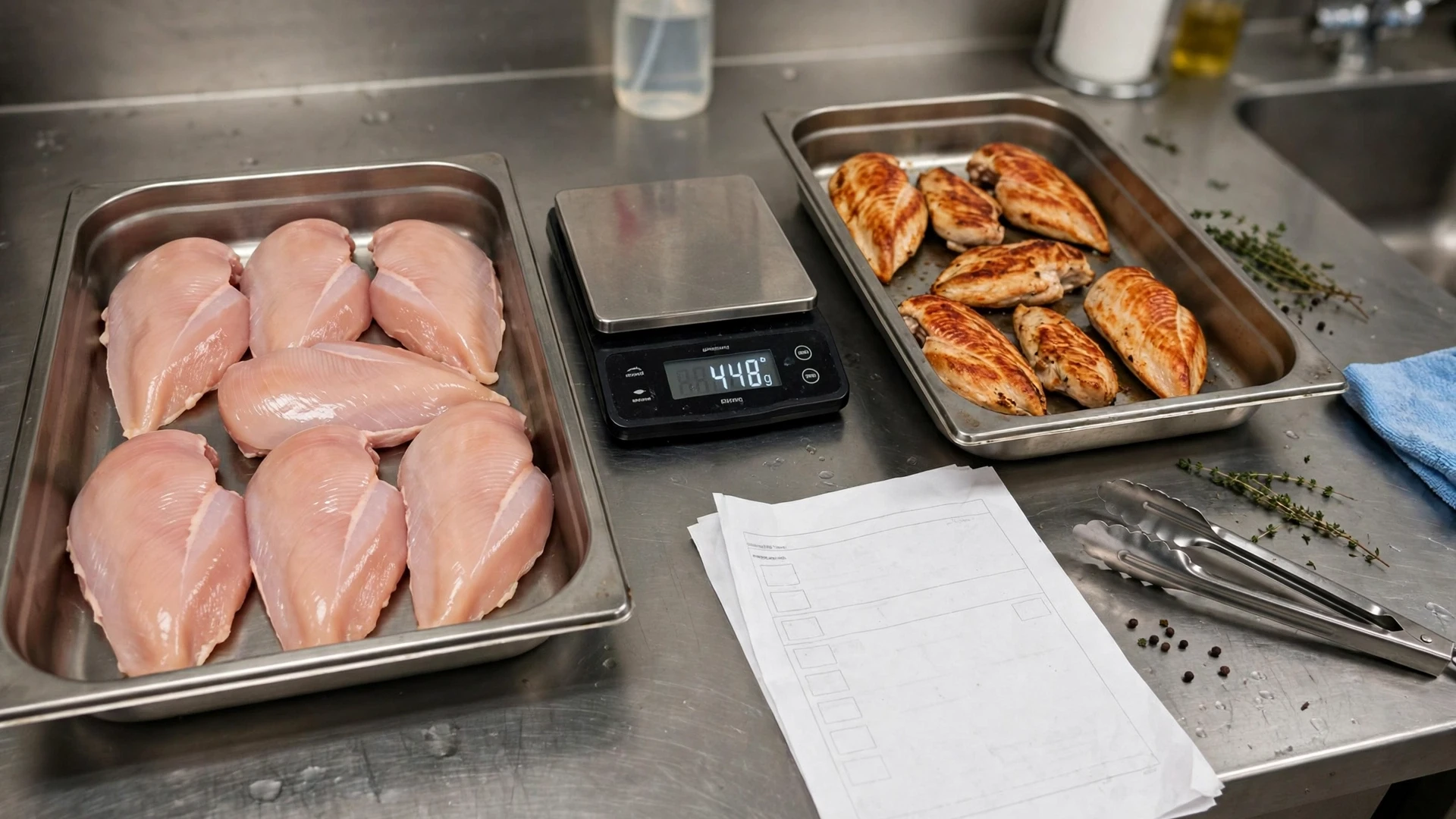
Why raw price is not the real comparison
Two ingredients can have similar purchase prices and very different usable economics after trimming and cooking. Water loss, fat rendering, bone, skin, shrinkage and cooking method all change the quantity that can actually be portioned. Cooking yield comparison converts purchase weight into usable cooked weight so recipe costing and portion decisions are based on what reaches the plate.
The useful unit is cost per usable cooked unit, not cost per purchased unit. That distinction is especially important for proteins, roasted vegetables, cooked grains and any product with meaningful trim or moisture loss.
Define AP, pre-cook usable weight and cooked yield
AP means as-purchased weight. Depending on the product, you may also record trimmed or edible pre-cook weight before cooking. Cooked usable weight is what remains after the defined cooking method and any post-cook trim. Keep the stages explicit so a yield loss can be attributed to trim versus cooking rather than combined into one unexplained percentage.
For repeatability, define whether bones, skins, juices, sauce, ice glaze or packaging are included at each stage. Different definitions can make two yield tests look inconsistent even when the product behaved the same.
Core formulas
- Pre-cook edible yield % = usable raw weight / as-purchased weight × 100.
- Cooking yield % = cooked usable weight / usable raw weight × 100.
- Overall yield % = cooked usable weight / as-purchased weight × 100.
- Cost per cooked unit = purchase cost / cooked usable weight.
- Expected portions = cooked usable weight / standard cooked portion weight.
Run a yield test that can be repeated
Use a representative lot, calibrated scale and normal production method. Record supplier/product specification, raw weight, trim weight, cooking method, equipment, target doneness or endpoint, cooked weight and resting/draining method. Small details matter: weighing immediately after cooking versus after a standard rest can change the result.
Repeat the test enough times to understand normal variation. One unusually wet or dry case should not become the permanent costing standard without verification.
Compare suppliers on cooked economics
A cheaper case can become more expensive after yield loss. Compare supplier A and supplier B using the same cooking method and portion standard. Calculate cost per cooked kilogram or pound, then consider consistency, labor required for trimming, defect rate and service reliability. Supplier decisions should use total usable value, not invoice price alone.
If products have different specifications, document that difference. A higher-priced pre-trimmed product may save labor and produce a more predictable yield; prime-cost analysis can show whether the total operating effect is favorable.
Cooking method can change both yield and guest value
Roasting, grilling, braising, frying and sous-vide-style processes can produce different moisture loss, texture and service characteristics. A method with higher yield is not automatically better if it fails the restaurant’s quality standard. Test yield inside the approved culinary method, not as a separate optimization that changes the product guests expect.
When a new method improves yield, verify ticket time, holding, food safety, equipment capacity and sensory quality before updating the cost standard.
Turn yield into portion control
Once cooked usable yield is known, divide by the standard cooked portion. If a 10 kg raw case yields 7.4 kg cooked usable product and the plate portion is 185 g, the theoretical output is 40 portions. Compare that with actual plated portions. A gap may come from trim, overcooking, carving loss or portioning rather than from the recipe cost itself.
Use the same cooked-weight basis in the recipe, portion guide and calculator. When scaling that recipe for production, use the same yield basis as in batch recipe production. Mixing raw and cooked portion standards is a common source of understated food cost.
Illustrative comparison from raw case to plated portion
Assume Supplier A costs $7.80 per raw kilogram and yields 72%, while Supplier B costs $8.20 and yields 78% under the same tested method. Compare them through the full chain rather than stopping at invoice price.
| Step | Supplier A | Supplier B |
|---|---|---|
| Raw purchase cost per kg | $7.80 | $8.20 |
| Tested cooked yield | 72% | 78% |
| Cooked usable kg from 10 kg raw | 7.2 kg | 7.8 kg |
| Cost of 10 kg raw | $78.00 | $82.00 |
| Cost per cooked usable kg | $78 ÷ 7.2 = $10.83 | $82 ÷ 7.8 = $10.51 |
| Cooked portions at 185 g | about 38.9 | about 42.2 |
| Ingredient cost per theoretical portion | about $2.01 | about $1.94 |
The figures are illustrative, not a purchasing recommendation or benchmark. The decision sequence is the useful part: verify comparable specifications → test both under the same method → calculate usable cooked cost → convert to the restaurant’s portion basis → then consider trimming labor, quality, consistency and service reliability. If the higher-yield product fails the culinary specification, the lower calculated cost does not make it the better purchase.
Build a yield comparison table
- Product/supplier specification.
- AP weight and AP cost.
- Trimmed raw usable weight.
- Cook method and endpoint.
- Cooked usable weight.
- Pre-cook, cooking and overall yield %.
- Cost per cooked unit.
- Standard portion and expected portions.
- Labor/quality note.
- Decision and next test date.
When to retest
Retest after a supplier specification change, major price change, new cooking equipment, new portion standard, recurring yield complaints or a recipe-method change. High-volume expensive items justify more frequent verification than low-cost ingredients with stable behavior.
Use a change threshold appropriate to the restaurant rather than retesting everything constantly. The point is to protect the costing assumptions that materially influence margin.
Common errors
- Comparing raw invoice price instead of cooked usable cost.
- Weighing products at inconsistent points in the cooking/resting process.
- Using one yield test forever despite supplier or method changes.
- Combining trim and cooking loss so the cause is invisible.
- Updating recipe cost without updating portion standards.
- Choosing the highest yield method even when quality or safety is worse.
FAQ
Q: Is edible yield the same as cooking yield? A: No. Edible/prep yield usually removes trim; cooking yield measures change during cooking. For the edible-yield method, see Restaurant Recipe Yield Test.
Q: Can I use vendor-published yield? A: It can be a starting point, but your method, equipment and specification should be tested.
Q: Should yield be measured by weight or volume? A: Use the unit that best fits the product and recipe; weight is usually more repeatable for cost control.
Q: What if yield varies a lot? A: Investigate specification, thawing, trim, cook endpoint, equipment load and weighing method before setting a standard.
Next action
Pick one high-cost, high-volume ingredient and run three controlled yield tests using the normal production method. Update the recipe cost only after the results are consistent enough to represent normal production. Then compare expected portions with actual usage to determine whether the remaining variance is in cooking or portioning.
Use yield comparison in menu pricing and purchasing
Yield changes should flow into recipe cost. If cooked usable cost rises, the menu decision may be purchasing, portion, price, recipe design or product specification. Avoid reacting to invoice price alone when the cooked economics tell a different story.
For high-volume proteins, a small yield improvement can affect more dollars than a small negotiated invoice discount. Compare both on the same cooked-unit basis before deciding where purchasing effort belongs.
Separate natural variation from process drift
Yield will not be identical every batch. Build a normal range from repeated tests, then investigate results outside that range. Wide variation can point to inconsistent trimming, cook endpoint, equipment loading, thawing or supplier specification.
A control chart is optional; even a simple history table of AP weight, cooked weight and yield can reveal when a previously stable process begins to drift.
Additional operating detail
Yield standards should be stored with recipe costing assumptions, not in a separate notebook that pricing staff never see. When a yield test changes the usable cost materially, update the recipe and note the effective date. This creates a clean link from receiving specification to production result to menu economics.
Use yield comparison to evaluate preparation choices too. A more expensive pre-trimmed ingredient may reduce trimming labor and improve consistency; a cheaper whole product may produce better economics when the kitchen has the skill and capacity to process it. Compare total prime-cost implications when the labor difference is material instead of forcing every purchasing decision into food cost alone.
Manager implementation notes
When yield is used for purchasing decisions, separate specification change from kitchen execution. If a supplier changes trim level, moisture content, size range or pack format, the old yield history may no longer be comparable. Save the product specification or invoice description with the test record so a later manager can see whether the ingredient itself changed. This also helps during vendor negotiations: the restaurant can discuss usable cooked cost with evidence rather than arguing only about the case price.
A useful management routine is to review the three ingredients with the highest annual or monthly spend and the widest yield variability. Stable low-cost ingredients rarely justify the same testing effort as expensive proteins or products that lose a large share of weight in cooking. Concentrating yield work on material items keeps the system practical and creates a clearer connection between testing time and financial value.
Compare suppliers on usable cooked economics
The invoice price is only one part of ingredient economics. When two suppliers offer comparable products, test each under the same receiving, trim, cooking, resting and weighing method, then convert the result to cost per usable cooked kilogram or standard portion. A higher raw price can be the better purchase if the item produces materially better yield, more consistent portions or less trim. Keep quality requirements fixed during the comparison; yield is not a reason to accept a product that fails the restaurant’s specification or guest expectation. The meaningful decision is the best usable product among acceptable alternatives, not the cheapest case.
Average yield should be read beside variation. Record several tests and look at the spread by supplier, size grade, trim level, thawing condition, cooking load and operator method. A product that averages well but swings widely can create unstable recipe cost and portion planning. When a supplier changes pack format or specification, treat it as a new comparison instead of blending unlike tests into the same history. Save the supplier item code or specification with the record so a later manager can explain why the yield trend changed. Focus repeated testing on high-spend or high-variance ingredients where better evidence can materially affect purchasing and menu cost.
Turn yield evidence into purchasing and recipe action
A yield test should end with a clear decision. If a supplier delivers better usable cost and acceptable quality, update purchasing preference and recipe costing together. If a cooking method improves yield but harms texture or service speed, reject the method even if the percentage looks attractive. If actual plated portions remain below theoretical yield after cooking is stable, investigate carving and portion control instead of repeating the cook test. Keep the approved yield standard in the same place managers use for costing so an old percentage does not survive after the ingredient or method changes. For high-value items, set a retest trigger such as a supplier switch, specification change, equipment change or repeated unexplained usage variance. This makes yield comparison an operating control tied to decisions rather than a one-time exercise that produces a number no one revisits.
Keep the tested endpoint reproducible
Yield comparisons only mean something when the cooking endpoint is defined well enough to repeat. Record the method, equipment, batch load, resting point and endpoint used by the restaurant rather than relying on “cooked as usual.” If another manager cannot reproduce the test, the number is not yet a reliable costing standard. A short method note beside the yield result protects the comparison when staff, equipment or suppliers change.
Additional topic-specific operating notes
- cooked usable weight measured after a defined process
- tests repeated enough to avoid basing standards on one unusual batch
- Cooking yield % = cooked usable weight / raw prepared weight × 100
- True cooked cost per kg = raw batch cost / cooked usable weight
- Portions per batch = cooked usable weight / portion weight
- Cost per portion = raw batch cost / portions produced
- select the item and cooking method to test
- calculate yield, cost per usable unit and portions
- compare methods or suppliers and retest before changing standards
Supplier A sells a protein for less per kilogram, but it loses more weight during cooking. Supplier B costs more on the invoice yet produces more usable portions. A yield comparison can show that B is actually cheaper per plated portion.
Useful next resource
Yield comparison worksheet for purchasing decisions
A cooking-yield test becomes more useful when it compares usable cost rather than only raw purchase price. Record the same fields for each supplier, cut, cooking method or specification so the restaurant can see which option produces the lowest cost per usable unit.
| Field | What to capture | Why it matters |
|---|---|---|
| Raw weight | Verified receiving or test weight | Creates the denominator for yield. |
| Trim and cook loss | Waste, bones, fat, moisture or other loss | Shows where usable product disappears. |
| Cooked usable weight | Product actually available for portioning | Converts purchase cost into usable cost. |
| Yield % | Usable cooked weight ÷ raw weight × 100 | Lets different specifications be compared on the same basis. |
| Usable cost | Total raw cost ÷ usable cooked quantity | Shows the real cost of each cooked pound, kilogram or portion. |
Decision rule for two competing products
Do not choose the lower invoice price automatically. If Product A costs less per raw kilogram but loses substantially more weight during trimming and cooking, Product B can be cheaper at the portion level. Compare usable cost, labor required for trimming, portion consistency and whether the test reflects the restaurant’s real equipment and cooking method.
- Run at least one controlled test on each specification.
- Use the same cooking endpoint and measurement method.
- Calculate usable cost per portion.
- Repeat the test if the first result is unusually different from normal production.
- Update the recipe cost only after the new yield is verified.
This process turns yield data into a purchasing and pricing decision instead of leaving it as a kitchen statistic.
Use the Recipe Yield & Portion Cost Calculator when you need to convert raw weight, yield and portion size into a cooked-unit cost for the decisions above.