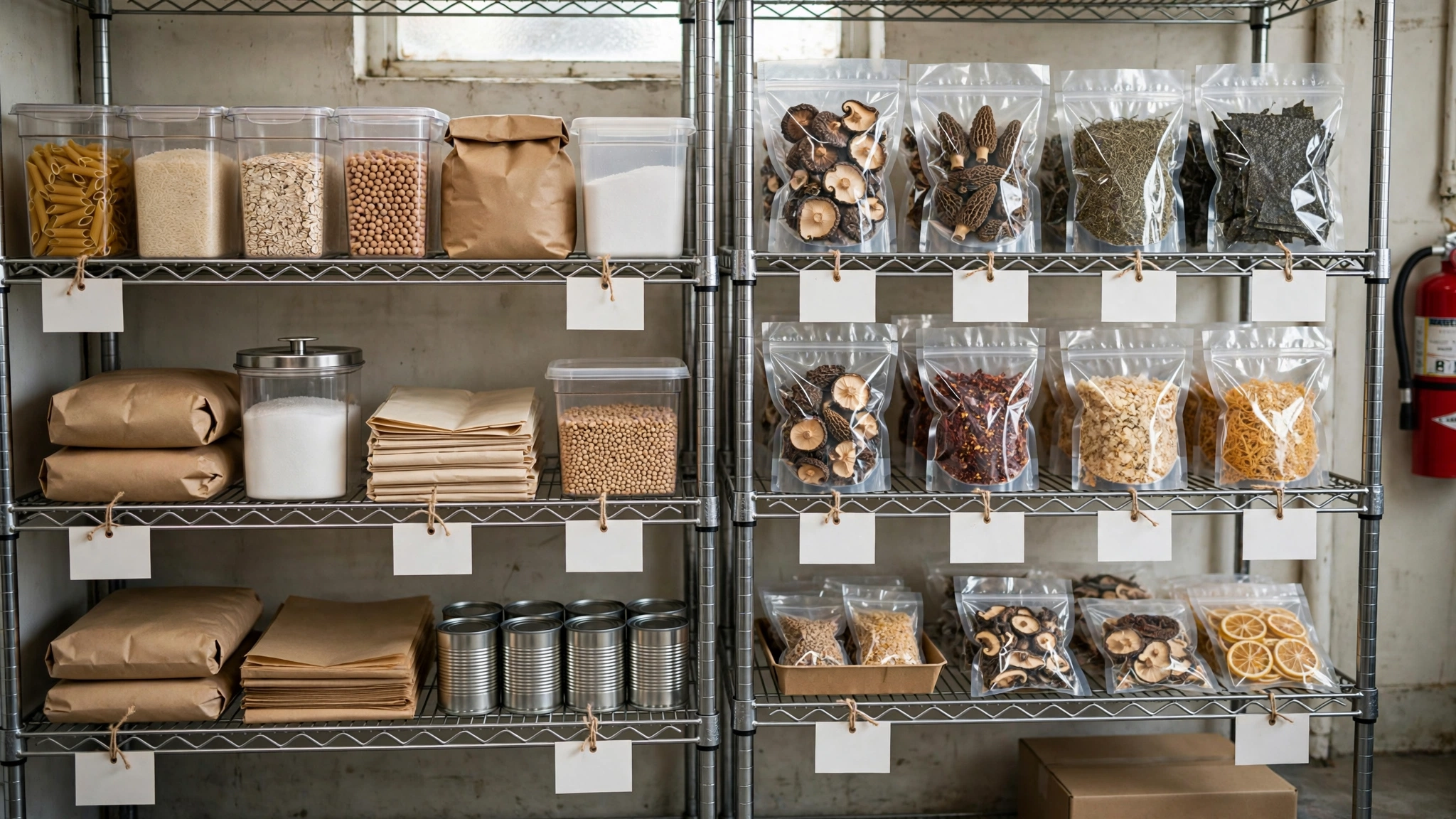
Not every inventory problem looks like a shortage.
Sometimes the restaurant has too much.
A case of sauce sits unopened for months. A specialty ingredient was bought for one menu item that barely sells. Packaging from an old promotion still occupies half a shelf. A freezer is full, yet the buyer keeps ordering because nobody can see which items are actually moving.
This is dead stock: inventory that is no longer moving at a healthy rate and is tying up cash, storage space and management attention.
For restaurants, slow-moving stock is especially dangerous because many products have limited shelf life. What begins as excess inventory can become spoilage, write-offs and food waste surprisingly quickly.
What counts as dead stock in a restaurant?
Dead stock is inventory that has little or no realistic demand under the restaurant’s current operating conditions.
Slow-moving inventory is not completely dead, but it is being used much more slowly than expected.
Examples include:
- a premium ingredient used by a low-selling menu item,
- special packaging left after a promotion ends,
- duplicate products bought under different item names,
- an ingredient that remains after a recipe is removed,
- bulk stock purchased to obtain a discount but consumed too slowly,
- backup stock that keeps growing because reorder levels are too high.
Why excess inventory is expensive even before it expires
The cost of dead stock is not only the purchase price.
It also creates:
- cash tied up on the shelf,
- less space for products that actually move,
- higher counting time,
- more risk of expiration or damage,
- more difficult stock rotation,
- more opportunity for duplicate purchasing.
A crowded storeroom can make the restaurant feel well stocked while actually hiding a weak purchasing system.
Start with inventory age
One of the simplest ways to identify slow-moving stock is to ask how long an item has been sitting in inventory.
For important products, track:
- last purchase date,
- last usage or issue date,
- current quantity on hand,
- current inventory value,
- shelf-life or expiry risk where relevant.
The exact age threshold depends on the product.
A dry good that turns every 45 days may be normal. Fresh produce sitting for a week may already be a serious concern.
Do not use one universal rule for every category.
Measure stock in days of usage
A more useful measure than age alone is how many days of expected usage the restaurant currently holds.
A simple formula is:
Days of inventory = Quantity on hand ÷ Average daily usage
Illustrative example:
- Cooking oil on hand: 24 bottles
- Average usage: 2 bottles per day
Days of inventory:
24 ÷ 2 = 12 days
If the restaurant normally wants seven days of supply, the extra five days should be understood.
Maybe there is a legitimate reason. Maybe the buyer over-ordered.
Calculate the value of excess stock
Quantity alone does not show financial importance.
Translate excess units into money.
Illustrative example:
- Target stock: 10 units
- Actual stock: 18 units
- Excess: 8 units
- Unit cost: $14
Excess inventory value:
8 × $14 = $112
Do this across the major slow-moving items and management can see how much cash is sitting above the desired operating level.
Use movement categories
A simple classification makes the inventory easier to manage.
| Category | Meaning | Typical action |
|---|---|---|
| Fast-moving | Regular usage and healthy turnover | Maintain normal replenishment |
| Slow-moving | Usage below expected rate | Review par and purchasing |
| At risk | High stock with low usage or expiry risk | Take corrective action quickly |
| Dead stock | No realistic current demand | Stop buying and decide disposition |
The categories above are an operational framework, not an accounting standard.
Check whether the item still belongs on the menu
Slow inventory often points to a menu problem.
If a menu item sells only a few times per month but requires a unique ingredient, the restaurant may be carrying stock that exists only to support a weak seller.
Ask:
- How many menu items use this ingredient?
- How often do those items sell?
- Does another ingredient perform the same role?
- Is the product necessary for the menu concept?
- Does the margin justify the inventory burden?
This is where inventory analysis connects directly to menu engineering.
Look for ingredients used by only one menu item
Single-use ingredients deserve special attention.
An ingredient used across ten dishes usually turns faster and is easier to manage than one used in only one low-volume dish.
That does not mean every unique ingredient should be removed.
It means management should understand the trade-off between menu differentiation and inventory complexity.
Par levels are often the real cause
If the reorder target is too high, excess stock becomes automatic.
Suppose average weekly usage is 12 units but the par level is 30.
Every time the buyer tries to restore inventory to 30, the restaurant rebuilds more stock than it needs.
Use actual usage history to set realistic targets.
Our guide on restaurant par levels explains how to connect reorder targets to demand and delivery frequency.
Bulk discounts can create false savings
A supplier may offer a lower unit price for a larger order.
That looks attractive until the restaurant considers the full cost.
If the extra stock:
- expires,
- becomes obsolete,
- occupies valuable freezer space,
- ties up working capital,
- encourages overproduction,
then the lower purchase price may not produce a lower total cost.
A discount is only useful when the restaurant can realistically use the product before its economic or physical value declines.
Review minimum order quantities
Some dead stock is created by supplier minimums.
A restaurant may need only six units per month but be required to buy a case of 24.
In that situation, management can consider:
- another supplier,
- a smaller pack size,
- a menu redesign that uses the ingredient elsewhere,
- less frequent ordering,
- whether the item is worth keeping at all.
Watch seasonal and promotional inventory
Special menus and promotions frequently create leftover stock.
Before launching a limited-time item, decide:
- how much inventory will be purchased,
- what happens if sales are lower than forecast,
- whether the ingredients can be reused elsewhere,
- whether packaging is unique,
- how remaining stock will be handled when the promotion ends.
A promotion is not finished when the marketing ends. It is finished when the related inventory has been dealt with.
Duplicate item names can hide excess stock
A restaurant may unknowingly carry the same product under different names.
For example:
- Tomato Sauce 3kg,
- Pizza Sauce,
- Tomato Base,
- Red Sauce Case.
If these records refer to the same operational product, purchasing history and stock levels become fragmented.
Standardized item names make slow-moving inventory easier to see.
Look at usage, not purchases alone
An item can have frequent purchases and still be overstocked if the restaurant is buying faster than it uses the product.
Compare:
- beginning inventory,
- purchases,
- ending inventory,
- actual usage.
A rising ending inventory balance across several periods is a warning sign even if each individual order looked reasonable.
Use the weekly inventory count to find buildup
The weekly count is not only for calculating food cost.
It can also show whether certain items are accumulating.
If an item’s count looks like this:
- Week 1: 12 units
- Week 2: 15 units
- Week 3: 18 units
- Week 4: 21 units
while sales remain stable, the restaurant should investigate purchasing before the item reaches expiry risk.
See the Restaurant Inventory Count Sheet guide for a repeatable counting process.
Check whether the problem is forecasting
Over-ordering can happen when purchasing is based on last month’s sales rather than current demand.
Demand can change because of:
- seasonality,
- weather,
- school or holiday periods,
- menu changes,
- price changes,
- delivery-channel changes,
- local events.
Par levels and order quantities should be reviewed when demand materially changes.
Separate slow-moving from critical safety stock
Not every low-usage item is a problem.
Some products may be intentionally held as backup stock because they are difficult to obtain quickly or are critical to the menu.
The question is whether the stock level is deliberate and justified.
A slow-moving item with a documented reason is different from stock nobody knew was sitting there.
Use a dead-stock report
A simple report can include:
| Item | On hand | Unit cost | Stock value | Last usage | Status |
|---|---|---|---|---|---|
| Specialty sauce | 14 bottles | $9 | $126 | 28 days ago | At risk |
| Seasonal packaging | 220 units | $0.35 | $77 | 45 days ago | Dead stock |
| Imported cheese | 8 kg | $18 | $144 | 9 days ago | Slow-moving |
Figures are illustrative.
Sort the report by value so management sees the most financially important items first.
Stop buying before trying to solve anything else
If an item is already overstocked, the first corrective action is usually simple:
stop replenishing it.
It is surprisingly common for restaurants to identify excess stock while automatic or habitual ordering continues.
Mark the item clearly in the purchasing system or order sheet.
Use stock before buying more
Where food safety, quality and menu standards allow, existing inventory should be used before additional stock is purchased.
That may involve:
- adjusting the next order,
- moving suitable stock between locations,
- using an ingredient across more compatible recipes,
- running an appropriate menu special,
- reducing duplicate products.
The objective is not to force unnecessary sales. It is to prevent good inventory from becoming waste.
Do not hide dead stock by discounting recklessly
Managers sometimes react to excess stock by immediately discounting the associated menu item.
That can work in some situations, but it should be calculated.
If a heavy discount destroys contribution margin or trains customers to wait for promotions, the restaurant may exchange one problem for another.
Before discounting, know:
- remaining inventory value,
- remaining shelf life,
- normal selling price,
- recipe cost,
- minimum acceptable contribution.
Connect dead stock to purchasing analysis
Excess inventory is usually not an isolated inventory problem.
It often reflects a purchasing decision made earlier.
Use Restaurant Purchasing Analysis to investigate:
- over-ordering,
- minimum order quantities,
- supplier pack sizes,
- emergency purchases,
- price-driven bulk buying,
- weak purchase approvals.
Connect dead stock to waste reporting
If an item ultimately expires or must be discarded, record the disposal properly.
Do not simply remove the item from the shelf.
That value should become visible in the restaurant waste log so management can see the cost consequence of the original purchasing decision.
Assign a reason code
When dead stock is identified, record why it happened.
Useful cause codes might include:
- OVERBUY — quantity ordered above need,
- MENU — menu item removed or low sales,
- PROMO — leftover promotional inventory,
- MOQ — supplier minimum order quantity,
- DUPLICATE — duplicate stock item,
- FORECAST — demand forecast too high,
- SUB — supplier substitution,
- PAR — reorder target too high.
Over time, these codes show whether excess inventory is mainly a purchasing, menu or forecasting problem.
Review the top ten slow-moving items every week
You do not need to inspect hundreds of products in detail.
A short weekly review can focus on the items with the highest combination of:
- stock value,
- days on hand,
- expiry risk,
- low usage.
Ten meaningful exceptions are more useful than a 300-line report nobody reads.
A practical weekly dead-stock routine
- Complete the inventory count.
- Calculate stock value.
- Identify items above normal days of supply.
- Sort excess stock by value.
- Check last usage and menu relevance.
- Stop unnecessary replenishment.
- Assign a cause code.
- Choose a safe operational action.
- Update par levels where needed.
- Review whether the same issue repeats next week.
An illustrative example
A restaurant has 18 bottles of a specialty dressing in storage.
Average usage is only one bottle every four days.
At that rate, the restaurant has roughly 72 days of supply.
The product costs $8 per bottle, so current inventory value is:
18 × $8 = $144
The manager checks the menu and discovers that the dressing is used by one salad that sells only a few times per week.
The par level is still set at 20 bottles because it was created when the salad was heavily promoted.
The corrective action is not a bigger promotion.
The first action is to reduce the par level and stop buying until inventory returns to a reasonable level.
Then management can decide whether the salad still belongs on the menu.
Dead stock is a signal, not just a write-off
When inventory stops moving, it is telling management something.
Maybe the menu changed.
Maybe demand fell.
Maybe the par level is wrong.
Maybe a supplier minimum does not fit the business.
Maybe someone bought for a discount rather than actual need.
The value of a dead-stock report is not only identifying what may need to be written off. It is identifying the decision that created the excess in the first place.
The goal is healthy inventory flow
A strong inventory system does not aim to keep shelves full.
It aims to keep the right products available in the right quantities while minimizing avoidable cash tied up in stock.
Fast enough movement protects freshness. Reasonable par levels protect availability. Good purchasing protects cash. Regular review protects the restaurant from discovering too late that a shelf full of inventory has become a shelf full of waste.
Use inventory turnover as a second signal
Days of inventory is intuitive for operators. Inventory turnover gives another view of how quickly stock is moving over a period.
Inventory turnover = Cost of goods used ÷ Average inventory value
A falling turnover rate can indicate that stock is building faster than it is being consumed. Compare similar periods and product categories rather than applying one universal target across the restaurant.
Create an aging report for nonperishable and specialty stock
| Age band | Management action |
|---|---|
| Current | Normal replenishment |
| Slow-moving | Review par, usage and menu relevance |
| At risk | Stop buying and assign action |
| Dead / obsolete | Follow approved disposition and accounting process |
The actual age bands should be set by item category, shelf life and normal usage. The point is to make old stock visible before it becomes an emergency.
Calculate cash tied up above target
Excess inventory is also a working-capital issue.
Cash tied up above target = (Actual quantity − Target quantity) × Unit cost
Summing that value across the top slow-moving items shows how much cash could potentially be released as inventory returns to healthier levels.
Frequently asked questions
Is dead stock the same as expired stock?
No. Dead stock may still be physically usable but have little realistic demand. Expired or unsafe stock is a separate food-safety and disposition issue.
How often should slow-moving inventory be reviewed?
A weekly exception review works well for many operators, with more frequent attention for perishable or high-value products.
Should restaurants discount menu items to use dead stock?
Only when the promotion still makes commercial and operational sense. First stop unnecessary buying, understand remaining shelf life and calculate the contribution effect of any discount.
Operational note: Inventory thresholds, shelf-life limits and disposition decisions should follow product specifications, food-safety requirements and the restaurant’s own accounting and operating policies. The examples in this guide are illustrative.